• العربية
  • فارسی
Brand
  • Iran Insight
  • Politics
  • Economy
  • Analysis
  • Special Report
  • Opinion
  • Podcast
  • Iran Insight
  • Politics
  • Economy
  • Analysis
  • Special Report
  • Opinion
  • Podcast
  • Theme
  • Language
    • العربية
    • فارسی
  • Iran Insight
  • Politics
  • Economy
  • Analysis
  • Special Report
  • Opinion
  • Podcast
All rights reserved for Volant Media UK Limited
volant media logo

Death Of Hijab Victim Deepens Rejection Of Islamic Republic
Iran International Newsroom
Sep 19, 2022, 08:45 GMT+1Updated: 17:37 GMT+1
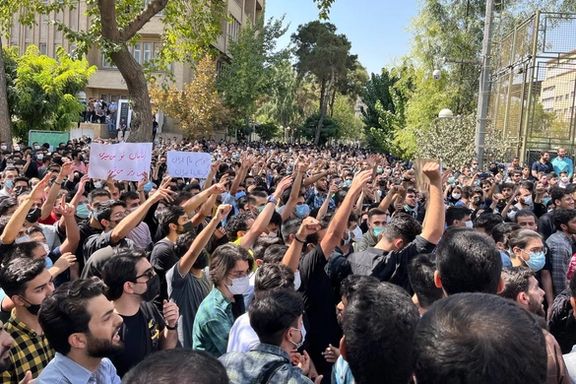
Student protest to the death of a young woman at Amir Kabir University in Tehran, Sept. 19, 2022

A new wave of disillusionment over the legitimacy of the Iranian regime has been emerging since the death in custody of a young woman, Mahsa Amini, on Friday.

The 22-year-old from Western Iran was visiting Tehran with her brother when she was stopped by a religious police patrol controlling hijab on September 13. She was taken into a van and then to a police station. Two hours later police delivered her to a hospital in coma with fatal head injuries. Her brain tissue was damaged beyond any hope, and she died three days later.

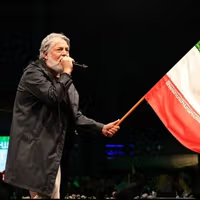
In an interview with BBC Persian on Saturday, Hatam Ghaderi an academic who was once trusted by the founder of the Islamic Republic Ruhollah Khomeini to vet the candidates for the first presidential election in Iran in 1979, has delivered a damning verdict: "By its nature, the Islamic Republic is destructive. It destroys the religion, the country and its women and youths."

Ghaderi warned in the interview that if the Islamic Republic survives, it will leave no Iran and no religion. Ghaderi emphasized that "the Islamic Republic views women's body as a battleground."

Referring to the regime’s religious propaganda, the former revolutionary compared government injustice in Iran to what Shiites believe happened to their venerable saint, Imam Hussain, who was killed by the reigning Muslim caliph in 680. That amounts perhaps to the harshest criticism anyone can throw at the clerical regime which desperately tries to cling to religious legitimacy.

Hatam Ghaderi, former revolutionary and university professor
100%
Hatam Ghaderi, former revolutionary and university professor

Many observers have pointed out that this extent of openness in Ghaderi's anti-regime rhetoric is unprecedented. Nonetheless, Ghaderi, as an original believer in the Islamic Republic, has been highlighting the system's shortcomings for many years. He characteristically explains complicated concepts in plain Persian equally understandable by the man in the street. He says: "We should not look at Khamenei's powers. Instead, we should see how happy Iranians are and how well-fed they are."

Ghaderi at the end of his interview warned Iranians that that after 115 years since the Constitutional Revolution, Iranians have still not managed to harness their leaders' political power. He attributed part of that failure to the "religious ignorance among part of the population." However, he said that the Islamic Republic is moving toward a collapse.

Editor of Jomhuriyeh Eslami conservative newspaper Masih Mohajeri. FILE PHOTO
100%
Editor of Jomhuriyeh Eslami conservative newspaper Masih Mohajeri

Masih Mohajeri, another orthodox believer in Iran's Islamic Revolution, wrote in an editorial in the Jomhouri Eslami newspaper on Sunday that Mahsa Amini's death and the deliberate ambiguity surrounding it "have harmed the people's trust" in the government. He pointed out that Iranians "no longer believe what the officials of the Islamic government say. This is a big loss."

Like many supporters of the regime, Mohajeri also tried to portray the incident as wrongdoing by some policemen, rather than a systemic problem. Comments like this prompt many activists to say that the people no longer wish to reform the Islamic Republic. They want an end to it as it is hopelessly unreformable.

Mohajeri believes that the Islamic principle of "prohibiting vice and upholding virtues" is necessary, but it needs to be done differently. This is in sharp contradiction to the belief of many Iranian women who reject compulsory hijab and demand freedom of choice in lifestyle.

In another development, the daughter of late Ayatollah Mahmoud Taleghani a respected cleric who died under suspicious circumstances in the early years of the Islamic Republic, and an advocate of freedom of choice for women, has said in a tweet that if her father was alive today, he would have thrown his turban on the ground in protest to the Islamic Republic's oppression against women.

Several Twitter users reminded Taleghani that she could still object to the Islamic Republic's heavy-handed treatment of women by throwing her black head-to-toe veil on the ground.


Most Viewed

Ghalibaf defends Iran-US talks amid hardline backlash
1
INSIGHT

Ghalibaf defends Iran-US talks amid hardline backlash

2
ANALYSIS

From instability to influence: Pakistan’s pivotal role in US-Iran diplomacy

3
ANALYSIS

100 days on: why Iran’s January protests spread across social classes

4

War-hit homeowners feel abandoned as Iran’s reconstruction aid fades

5

Iran says no decision yet on talks as Pakistan prepares to host US team

Banner
Banner

Spotlight

  • The politics of pink: how Iran uses cuteness to rebrand violence
    ANALYSIS

    The politics of pink: how Iran uses cuteness to rebrand violence

  • Bread shortages, soaring prices strain households in Iran, residents say
    VOICES FROM IRAN

    Bread shortages, soaring prices strain households in Iran, residents say

  • War-hit homeowners feel abandoned as Iran’s reconstruction aid fades

    War-hit homeowners feel abandoned as Iran’s reconstruction aid fades

  • 100 days on: the anatomy of Iran’s January crackdown
    INSIGHT

    100 days on: the anatomy of Iran’s January crackdown

  • Ghalibaf defends Iran-US talks amid hardline backlash
    INSIGHT

    Ghalibaf defends Iran-US talks amid hardline backlash

  • From instability to influence: Pakistan’s pivotal role in US-Iran diplomacy
    ANALYSIS

    From instability to influence: Pakistan’s pivotal role in US-Iran diplomacy

•
•
•

More Stories

Protests Spread From Hijab Victim’s Hometown To Other Cities In Iran

Sep 18, 2022, 20:52 GMT+1
•
Maryam Sinaiee

Thousands took to the streets in several Iranian cities Sunday to protest the death of a young woman in religious police custody that has shaken the country.

In Sanandaj, capital of Iran's Kordestan (Kurdistan) Province, and Saqqez, a city of around 170,000 in the same province, thousands took to the streets for a second night. Protesters in Sanandaj chanted “Kordestan, Graveyard of Fascists” and “Down with the Dictator”, in Kurdish and Persian.

The 22-year-old Mahsa Amini, known as Zhina to family, originally from Saqqez, collapsed at a detention center two hours after her arrest by a hijab police patrol in Tehran. She passed away Friday afternoon at Kasra Hospital in northern Tehran. Hospital staff told Iran International that she was brought in near death in a coma with what appeared to have been multiple blows to her head.

According to some reports nearly 40 protesters in Saqqez Saturday evening were wounded by security forces who used shotguns and tear gas against protesters with at least two young men in critical condition.

On Sunday, Police used tear gas and water canons to disperse protesters in Sanandaj and fired with shotguns at protesters again, reportedly wounding at least ten people, and arrested over a dozen.

People also took to the streets in Gohardasht district of Karaj, capital of Alvand Province only half an hour from the capital Tehran and in Mahabad, a city of around 170,000 in West Azarbaijan Province, with a majority Kurdish population.

According to Hengaw Human Rights Organization, a Kurdish rights group, security forces shot at protesters in Sanandaj, wounding at least nine people including two women.

In the capital Tehran, dozens of students marched inside the campus of Tehran University Sunday and chanted “Iran Is Bleeding, from Kordestan to Tehran”. Some students carried placards with “Women, Life, Freedom” and. “I Don’t Want to Die” written on them.

Many female protesters have been removing their headscarves in defiance of compulsory hijab and some women have posted photos and videos on social media showing them cutting their own hairor burning their headscarves.

President Ebrahim Raisi on Sunday made a phone call to the family of Mahsa Amini and told them he considered their daughter and “all Iranian girls” as his own children and had ordered a thorough investigation of the incident.

Authorities have so far denied any wrongdoing and not taken any responsibility for the young woman’s death. Police say she died in custody from a “heart attack” but have had very little success in convincing millions of Iranians who know violence against women arrested for hijab is quite common.

Mahsa’s father has told the media that other women arrested at the same time as his daughter say she was beaten but do not dare to come forward.

Kurdish activists and political groups have urged people in Kurdish regions of western Iran to shut their shops on Monday in protest to the violence against women. According to Hengaw, security forces have threatened most businesses in the large western city of Kermanshah, not to join the strike called in the neighboring Kordestan Province.

Various rights and political groups have issued statements over the incident which many consider “state violence”.

“The murder of our daughter, Mahsa, is a manifestation of the gradual killing levied on all of us on a daily basis and at a societal level,” a group of workers of Haft Tappeh Sugarcane Complex in southwestern Iran which has one of the most organized and active labor rights groups in the country, said in a statement on their Telegram channel. “The state’s murder of Mahsa won’t remain without res

Iran’s President Holds Phone Call With Family Of Hijab Victim

Sep 18, 2022, 15:39 GMT+1

Iran's President Ebrahim Raisi on Sunday had a phone conversation with the family of Mahsa Amini who died in the custody of the Islamic Republic's "morality" police.

"Your daughter and all Iranian girls are my own children, and my feeling about this incident is like losing one of my own dear ones," Raisi’s office quoted him as telling the Aminis, promising them to carefully deal with the "incident".

“I was informed of this incident when I was on a trip to Uzbekistan [to attend the latest Shanghai Cooperation Organization summit]. I immediately ordered my [administration] to investigate this as a special case,” he said, adding that “Rest assured will demand the relevant state bodies to follow up on this case until all its aspects come into light.”

The 22-year-old Mahsa Amini who was arrested on Tuesday by the morality police and was taken to hospital two hours later after losing consciousness. She passed away Friday afternoon at Kasra Hospital in Tehran from severe damage to her brain.

Hospital staff told Iran International that Amini received repeated blows to her head and was near death when she was brought in.

Numerous condemnations and protests are still following Amini’s death, with many state officials calling for the elimination of the hijab enforcement patrols. 

Masoumeh Ebtekar, former President Hassan Rouhani's vice president for women and family affairs, said on Sunday that the previous administration tried to cancel the patrols, but hardliners in the country did not allow it. 

Iranians Continue To Fume Over Death of Young Hijab Victim

Sep 18, 2022, 15:20 GMT+1
•
Maryam Sinaiee

A hashtag created in the name of a young woman who went into a coma and died following her arrest by Iran's police this week has passed the 1.6 million mark.

Originally from Saqqez in Kurdistan Province, the 22-year-old woman, Mahsa Amini, known as Zhina to family, collapsed at a detention center two hours after her arrest by a hijab enforcement patrol in Tehran. She passed away Friday afternoon at Kasra Hospital in northern Tehran due to severe brain injury.

A hospital source told Iran International Saturday evening that her brain tissue had been seriously damaged because of multiple blows to the head and there was no chance of surgery.

The hashtag’s popularity is only second to ‘Do Not Execute’ against the death penalty in 2020 which reached an staggering 10 million mark. the hashtag was first used to stop the execution of three young protesters in Iran.

Amini’s father speaking to Ham-Mihan newspaper denied various claims by Islamic Republic officials that his daughter’s death was caused by previous health conditions including epilepsy, hydrocephalus, and cardiovascular diseases.

Some women began cutting their hair as protest against forced hijab and posting the videos on social media.

According to Hengaw Human Rights Organization, a Kurdish rights group, the number of protesters wounded by security forces in Saqqez Saturday after the young woman’s burial has increased to thirty-three including a young man blinded by birdshots.

Iran’s exiled Prince Reza Pahlavi announced two days of public mourning in a statement, telling Iranians that they need to use their grief and anger to boost national solidarity against the Islamic Republic regime.

The former Crown Prince had issued a statement earlier calling the Islamic Republic “misogynistic” and asking Iranians to “stand up against this monstrosity.”

In July he had said that as long as Iranian women are not free, Iran will not be free, calling on men to be in the front lines in this struggle to support women in their struggle to reclaim their obvious and basic rights,” especially the freedom to choose what to wear.

Some Iranians consider Mr Pahlavi’s reaction inadequate in the circumstances and expect him to use his position which comes with some good degree of popularity to encourage action stronger than mere mourning.

“What is an announcement of two days of public mourning going to do for people mourning 24 hours a day, 365 days a year? It will be like pouring two cups of water in the sea. What are they supposed to do during the two days of mourning? Cry? Wail?” Arash Joudaki, essayist and philosophy professor in Belgium, tweeted Saturday, arguing that mourning decreases stamina for action against the regime. “Angry mourners must turn their grief and anger into a springboard for effective action!”

Joudaki replied to a comment from one of the supporters of the former Crown Prince who alleged he was “settling political scores” that he had no accounts to settle with the prince. Another Twitterati directly addressed Reza Pahlavi asking him why he has not been using public arenas to further the cause of the Iranian people. “Go lobby and make speeches at the UN. Aren’t allowed in the UN? Go make a speech in a university, or even in a cafe,” he wrote.

In a tweet Saturday, London-based journalist Pouria Zeraatisuggested that, if possible, businesses should go on strike, women should post their photos without hijab on social media, and people should put graffiti including Mahsa’s image and slogans against compulsory hijab on walls, and chant slogans on rooftops.

But as on previous occasions, the regime appears to be ready to crush protests using tens of thousands of anti-riot forces and armed civilian paramilitaries called the Basij. In nationwide protests in November 2019, these forces killed at least 1,500 unarmed protesters.

Half Of Iran’s Passenger Planes Not Operational Due To Sanctions

Sep 18, 2022, 14:36 GMT+1

An official of Iran’s air travel services said on Sunday that the reason behind a lack of plane tickets is that more than half of the country’s aircraft are grounded.

Omid Khansari, a member of the board of directors of the southwestern province of Khuzestan’s Air Travel and Tourism Services, told ISNA that "Most of the planes owned by the airlines are grounded because they need parts and it is impossible to provide them due to the sanctions."

He added that only about 120 to 130 airplanes out of about 340 airplanes owned by the airlines are operational. 

Confirming the same data, Alireza Pakfetrat, the representative of Shiraz in parliament, said in August that due to sanctions the quantity and quality of Iran's aviation industry are decreasing day by day, noting that the number of passenger planes that remain operational have decreased as well as the number of flights in the country.

Alireza Barkhor, the deputy chairman of the Association of Iranian Airlines, also said last year that more than 50 percent of passenger planes are not working due to lack of spare parts, particularly engines.

Iran has suffered from shortages of civilian airliners since the 1990s and used a variety of ways to lease older planes or buy spare parts through intermediaries, but the technical state of its fleet has been deteriorating.

The 2015 nuclear agreement (JCPOA) suspended sanctions on purchases of Western aircraft and Iran began talks to buy new planes from Boeing and Airbus. A few Airbus planes were delivered but the Trump administration never approved the sale of US planes until Washington withdrew from the JCPOA in May 2018.

Over 33 Protesters Injured In Iran Following Death Of Hijab Victim

Sep 18, 2022, 12:36 GMT+1

At least 33 people, including several teenage girls, have been injured as security forces attacked people protesting the death of a young woman in the custody of hijab police.

According to the Hengaw Human Rights Organization, a Kurdish rights group, on Sunday an 18-year-old man lost one of his eyes after being hit with shot gun bird shots and four others have been transferred to a hospital in Tabriz because their conditions were so critical they could not be treated in Saqqez in Kurdistan province, the hometown of the victim. 

The 22-year-old Mahsa Amini who was arrested on Tuesday by the morality police, was taken to hospital two hours later after losing consciousness. She passed away Friday afternoon at Kasra Hospital in Tehran for severe damage to her brain.

Hospital staff told Iran International that Amini received repeated blows to her head and was near death when she was brought in.

Protests are taking place in the provincial capital Sanandaj as well in several locations in Tehran since her death, with people chanting slogans against the authorities, including the Supreme Leader. 

Iranian students at University of Tehran held a protest rally on Sunday, chanting “From Kurdistan to Tehran: The Entire Iran Covered in Blood.”

Fifteen Iranian activists who were going to hold a gathering outside the Parliament’s building in Tehran in protest at the death of Amini have also been arrested, while sporadic clashes are being reported from several cities across the country.