• العربية
  • فارسی
Brand
  • Iran Insight
  • Politics
  • Economy
  • Analysis
  • Special Report
  • Opinion
  • Podcast
  • Iran Insight
  • Politics
  • Economy
  • Analysis
  • Special Report
  • Opinion
  • Podcast
  • Theme
  • Language
    • العربية
    • فارسی
  • Iran Insight
  • Politics
  • Economy
  • Analysis
  • Special Report
  • Opinion
  • Podcast
All rights reserved for Volant Media UK Limited
volant media logo

Iranian Politicians Try To Show Sympathy After Death Of Hijab Victim
Iran International Newsroom
Sep 17, 2022, 17:20 GMT+1Updated: 17:26 GMT+1
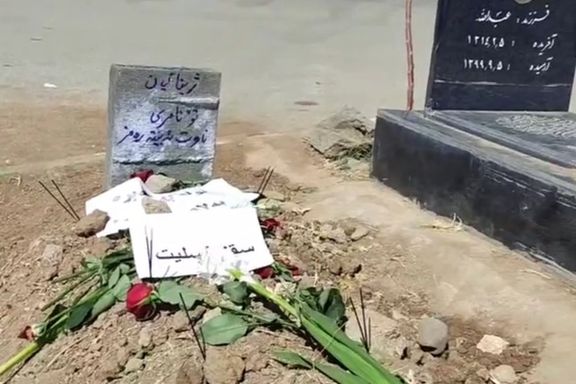
Mahsa Amini's resting place in her hometown of Saqqez in Western Iran. September 16, 2022

The shocking death of a young woman detained by Iran’s religious police has compelled officials to show some reaction, amid intense public indignation and anger.

Mahsa Amini, a 22-year-old woman visiting Tehran from her native Kurdistan province was arrested by a hijab police patrol for not covering her hair properly. Immediately after her detention she received a severe head trauma and when two hours later she was transferred to hospital she was already in coma and brain dead.

Part of the political elite has shown rare sympathy for a citizen that many people see as the victim of the regime’s policies and the brutality of its agents. But judging by reactions on social media, not many people believe in these expressions of sympathy, some saying that politicians are after gaining credit from the incident.

Some politicians have criticized the hijab patrols, stopping women on the streets for their loose headscarves, but many on social media say the problem has gone beyond that and it is the clerical regime that is the root of this and similar draconian measures.

Nevertheless, many hardliners are defiant and defend the regime in the tragic incident.

Vice President Ensieh Khazali who has been under attack in recent days for her son having emigrated to Canada, denied the existence of hijab squads which are more than visible in the Iranian streets.

Mahsa Amini, who received a fatal brain injury in police custody. Undated
100%
Mahsa Amini, who received a fatal brain injury in police custody. Undated

Although Iran's reformists have at times reacted to social events, this is the first time hardliners such as Khazali feel the responsibility to be accountable, but they still evade genuine regrets and express support for the wrong side of the argument.

Interior Minister Ahmad Vahidi wrote in a tweet that he has appointed one of his deputies to investigate the case. Many to his tweet, often harshly criticizing the way the government is handling the case and the issue of hijab and civil liberties in general.

IRGC-linked Fars news agency tried in an utterly fabricated report to whitewash the event by quoting unnamed "reliable sources" as saying that the young woman was ill before being arrested and taken to the notorious Vozara police station in Tehran.

Some Iranian hardliner lawmakers have expressed often vague opinions about the alleged murder. Lawmaker Hassan Lotfi told reporters that he is too busy and that he has not heard about the death of the young woman. He further advised Iranian women to observe the compulsory hijab rules.

Several other conservative lawmakers such as hardliner Jalal Rashidi Kouchi have also promised to follow up the case and end such "bitter events that are against religious teachings". Social media users have reminded other netizens that the MPs made many promises on other matters but failed to stand by their word.

On the reform front former IRGC Navy Commander Hossein Alaei called for a thorough investigation of the hijab squads. He has cautiously suggested that the not only the squads have failed to change Iranian women's lifestyle, but their behavior has led some of women to oppose the compulsory hijab. He further suggested that the hijab squad personnel should be assigned to necessary jobs such as tackling theft and muggings in the streets.

Other pro-reform figures such as former President Mohammad Khatami and politician Gholamhossein Karbaschi seemed to be concerned more about what the tragic event can do to the prestige of the regime. Former lawmaker Ali Motahari also wrote that he feared that the death in custody of Mahsa Amini could portray the Iranian government internationally as an entity like the Taliban in Afghanistan.

Pro-reform commentator Majld Tafreshi also called for an investigation into the case and expressed concern that anti-Iran elements might take advantage of the event.

One of the reformist Green Movement leaders Mehdi Karroubi said in his condolence message that the Islamic Republic’s Supreme Leader Ali Khamenei has obstructed all avenues for reforms in Iran.

Some former officials and presidential candidates such as Mohsen Mehralizadeh and Abdolnasser Hemmati also mildly expressed regret for what had happened but did not point fingers at anyone. Former Vice Pesident Es'haq Jahangiri simply said that "You cannot ignore such bitter events. Stop this kind of behavior," without making clear who he was addressing.


Most Viewed

Ghalibaf defends Iran-US talks amid hardline backlash
1
INSIGHT

Ghalibaf defends Iran-US talks amid hardline backlash

2
ANALYSIS

From instability to influence: Pakistan’s pivotal role in US-Iran diplomacy

3
ANALYSIS

100 days on: why Iran’s January protests spread across social classes

4

War-hit homeowners feel abandoned as Iran’s reconstruction aid fades

5
INSIGHT

100 days on: the anatomy of Iran’s January crackdown

Banner
Banner

Spotlight

  • The politics of pink: how Iran uses cuteness to rebrand violence
    ANALYSIS

    The politics of pink: how Iran uses cuteness to rebrand violence

  • Bread shortages, soaring prices strain households in Iran, residents say
    VOICES FROM IRAN

    Bread shortages, soaring prices strain households in Iran, residents say

  • War-hit homeowners feel abandoned as Iran’s reconstruction aid fades

    War-hit homeowners feel abandoned as Iran’s reconstruction aid fades

  • 100 days on: the anatomy of Iran’s January crackdown
    INSIGHT

    100 days on: the anatomy of Iran’s January crackdown

  • Ghalibaf defends Iran-US talks amid hardline backlash
    INSIGHT

    Ghalibaf defends Iran-US talks amid hardline backlash

  • From instability to influence: Pakistan’s pivotal role in US-Iran diplomacy
    ANALYSIS

    From instability to influence: Pakistan’s pivotal role in US-Iran diplomacy

•
•
•

More Stories

Security Forces Attack People Protesting Death Of Hijab Victim

Sep 17, 2022, 12:47 GMT+1

Iran’s security forces in the western city of Saqqez have used pellet guns and tear gas against protesters following the burial of Mahsa Amini, a young woman who died in the hands of hijab police. 

According to videos obtained by Iran International on Saturday, several protesters were injured when security forces fired at rally outside the building of the governor's office. 

People were chanting slogans against the authorities and sought justice for the perpetrators of the crime at the protest rally as well as during her funeral service at a graveyard in her hometown.

The 22-year-old Mahsa Amini who was arrested on Tuesday by the morality police, was taken to hospital two hours later after losing consciousness. She passed away Friday afternoon at Kasra Hospital in northern Tehran. Originally from Saqqez in Kurdistan province, Amini was arrested in her brother’s car on a visit to the capital to see their relatives.

Condemning her death, Amnesty International called on Friday for an investigation of the circumstances leading to her suspicious death. 

On Friday night, protests were held in several locations in Tehran -- including outside Tehran's Kasra hospital where she died -- in which people chanted slogans such as “Death to Khamenei,” “Death to Oppressors,” and "We Will Kill Those Who Killed Our Sister".

In recent months government and security agencies have intensified their efforts to pressure women into abiding by the hijab laws and several rounds of anti-hijab civil disobedience campaigns have followed.

Patrols by ‘morality police’ have increased on the streets and videos of violent arrests of women and girls as well as confrontations between people and hijab enforcers.

Iran’s Khamenei Appears In Public Despite Reports Of ‘Grave Illness’

Sep 17, 2022, 11:59 GMT+1
•
Maryam Sinaiee

Iran's Supreme Leader Ali Khamenei attended a scheduled religious ceremony on Saturday where he spoke, despite recent rumors and reports of “grave illness”.

There was no mention that he would be speaking at the gathering when the news of his presence at the ceremony emerged. In fact, he was not sitting at his usual spot, facing the crowd. But according to media in Tehran, he gave a short address at the end, after the scheduled mourning ceremony.

The ceremony was held to mark Arbaeen with members of Basij militia from Iranian universities. Arbaeen is the 40th day after the death of the third Shiite Imam, Hussain Ibn Ali, who was killed in a power rivalry by the reigning caliph in a clash in Karbala in 680 AD.

According to the official news agency IRNA, in his short address Khamenei preached about Arbaeen and its significance and urged the Basij students to keep the Shia tradition alive.

The Iranian leader’s official website, Khamenei.ir, had announced Friday that he would be hosting a group of students at Imam Khomeini Hoseinieh, a gathering hall adjacent to his residence and office in central Tehran.

Iran's 83-year-old leader had not appeared in public for over two weeks after a visit to the religious city of Mashhad, his birth city, to attend a ritual at the Shrine of Imam Reza.

Khamenei sitting to the far right of the hall as a preacher speaks at the traditional manbar
100%
Khamenei sitting to the far right of the hall as a preacher speaks at the traditional manbar

Khamenei’s office even cancelled his annual meeting in early September with members of the Assembly of Experts (AoE) whose only responsibilities is selecting a successor for the Supreme Leader and disqualifying an existing one. One of the members of the assembly explained the cancellation as their wish not to put “a heavy burden” on Khamenei.The cancellation of the meeting with the Assembly, as well as at least one other scheduled meeting fueled rumors and suspicions that he was very sick or even dead.

The New York Times on Friday quoted four people familiar with Khamenei’s health condition as saying that he is gravely ill and is currently on bed rest under observation by a team of doctors, adding his appointments have been cancelled. But Khamenei public appearance Saturday put the NYT report in doubt.

Assembly of Experts spokesman, Ahmad Khatami, said September 7 that the members of the assembly had discussed the criteria for choosing the next leader during the previous week and said recent public discussions about Supreme Leader’s succession were simply rumors. Khatami did not elaborate, but it was obvious that he was speaking about widespread discussions on social media about Ali Khamenei's son, Mojtaba, being groomed to be the country's next leader.

On August 9 Mir-Hossein Mousavi, a prime minister in the 1980s who has been under house arrest since February 2011, had published a scathing attack hinting at plans for Khamenei’s son to succeed him and warned the nation over an alleged ‘hereditary leadership’ scheme.Hardliners focused on other topics in Mousavi’s note and fiercely attacked him but made no mention of the succession issue.

In recent weeks there has also been claims that Khamenei has delegated the responsibility for the nuclear talks to restore the 2015 nuclear deal, Joint Comprehensive Plan of Action. (JCPOA) to President Ebrahim Raisi.

If true, the handover of the responsibility gives rise to speculations whether the leader delegated part of his authority because of a medical emergency, or to shift the responsibility to Raisi to remain in a position to criticize any possible deal, if things did not work well.

Death Of Detained Iranian Woman Affront To Human Rights – US

Sep 17, 2022, 09:51 GMT+1

The US State Department told Iran International that the death of a young Iranian woman in custody of the Islamic Republic’s religious police is “an appalling and egregious affront to human rights.”

Twenty-two-year-old Mahsa Amini died Friday from a head trauma after her arrest by a hijab enforcement patrol on Tuesday, sparking anger and some protests in the capital Tehran.

“Our thoughts are with Mahsa’s family and loved ones,” a State Department spokesperson said in response to our correspondent. 

“Women in Iran should have the right to wear what they want, free from violence or harassment,” he added, noting that “Iran must end its use of violence against women for exercising their fundamental freedoms.”

“We call on Iran’s leaders to hold accountable those responsible for Mahsa’s death,” he concluded. 

Earlier in the day, US National Security Advisor Jake Sullivan said, “We’re deeply concerned by death of Mahsa Amini who was reportedly beaten in custody by Iran’s morality police. Her death is unforgivable. We’ll continue to hold Iran officials accountable for such human right abuses.”

Her body was transferred to her hometown Saqqez in the Kurdistan province to be buried. A huge crowd gathered at the cemetery, chanting "Death to Dictator" as well as a Kurdish slogan which roughly translates, "Murder Because of Headscarf; How Long Are We Going to Tolerate Such Disaster?"

According to the latest videos published on social media, security forces fired at protesters who gathered in front of the Saqqez governor's office building after her funeral service.

Iranian Media Talk About Canada Ventures Of Political Elite

Sep 17, 2022, 09:20 GMT+1
•
Iran International Newsroom

A recent scandal at the higher echelons of Iran’s ruling elite has revealed the degree of hypocrisy and self-interest dominating the authoritarian clerical system.

Iran International reported about the full-blown scandal involving the female vice president of Ebrahim Raisi (Raeesi), Ensieh Khazali, who comes from a tough religious hardliner family. As hardliners condemn the “moral decay” and “indecency” engulfing Western countries, it was revealed that Khazali’s son has emigrated to Canada and has established a lucrative internet company.

That by itself would not have been so embarrassing if critics had not accused Khazali’s son, Hamid Rezazadeh, of being in the business of selling VPNs, software to circumvent Iran’s draconian Internet censorship wall. Critics alleged that he was the owner and software manager at a company called Betternet in Canada.

Khazali, the hardliner politician and her sister, who is another government official, have been on the forefront of advocating strict Islamic norms and defending Iran’s internet censorship that blocks thousands of websites and social media platforms such as Facebook, Twitter and You Tube.

Iranian social media exploded over these revelations, which many users labeled hypocrisy within the clerical regime. Some traditional media in Tehran followed up with their own reporting. Matters got worse when Khazali began defending her son. First, she said that he is in Canada for a “knowledge-based” project – a favorite term for the regime that tries to find any jargon possible to promise economic miracles amid its dismal record.

Second, after the controversy about Rezazadeh selling VPNs, Khazali and her supporters claimed that he was not marketing the software to Iranians. Then hardliners started to defend Khazali and her son with more outrageous claims.

Screenshote by Rouydad 24 website showing how Rezazadeh deleted his public profile
100%
Screenshote by Rouydad 24 website showing how Rezazadeh deleted his public profile

Hamshahri newspaper, a former reformist publication hijacked by hardliners,claimed that it investigated the matter and Khazali’s son was never involved in selling VPNs, while his own profile said, “Software Manager @Betternet”. Firthermore, there is clear evidence that Betternet’s VPNs are being sold in Iran through intermediaries.

Once the controversy intensified and others insisted that Betternet was in the business of selling VPNs, Rezazadeh deleted his profile on Rocketreach website.

Some hardliners even began arguing that there is nothing wrong with children of officials emigrating to Western countries and ultimately their success would benefit Iran. Some even suggested that family members of top officials residing abroad can help Iran circumvent sanctions.

Rouydad 24, a website relatively independent of Iran’s hardliners wrote that Rezazadeh started a “computer company” several years ago and immediately through family connection he was promoted as technology and IT pioneer on national TV and began receiving lucrative government contracts.

Rezazadeh’s father, Mohammadreza Rezazadeh, is also a well-known hardliner, which has strengthened the family’s connections. Khazali’s father Ayatollah Abolghasem Khazali was an ultra-fundamentalist cleric who held influential positions in the Islamic Republic.

According to Canada’s National Post, Rezazadeh used a federal program called Start-Up Visa (SUV) to receive permanent residency in the country, but for that one needs to secure at least $200,000 from an approved venture capital fund. But that was also arranged. Betternet received funding from Gate Ventures, which was established by an Iranian investor with ties to Iran’s government.

An ordinary Iranian technology entrepreneur could never receive such backing or have $200,000 to start a business in Canada. As a matter of fact many would never even get a visa to go to Canada.

Iran’s Supreme Leader Khamenei Gravely Ill – The NYT

Sep 16, 2022, 21:15 GMT+1

People familiar with Iran’s Supreme Leader health situation say Ali Khamenei is gravely ill and is currently on bed rest under observation by a team of doctors, the New York Times reported. 

The newspaper on Friday quoted four people familiar with Khamenei’s health condition as saying that all his meetings are cancelled while there have been numerous rumors about his death on social media in recent days. 

Iran International had earlier reported about Khamenei absence from the public scene since the beginning of this month, while some pundits said separately that Khamenei has given Raisi authority to make decision over Iran’s nuclear talks with the West.

The octogenarian leader had surgery at a clinic set up at his home and office complex some time last week for bowel obstruction after suffering extreme stomach pains and high fever, one of the people said. 

One of the sources said he is currently being monitored around the clock by a team of doctors, claiming that his condition was critical last week, but has improved, and he is currently resting. 

The Iranian government has not denied social media reports circulating for more than a week about Khamenei's illness. Meanwhile, his office cancelled two scheduled meetings with the Assembly of Experts members and Basij militia during the past days.

In another development, a picture released by the official news agency IRNA last week about Khamenei's meeting with athletes, turned out to be at last three years old and the agency pulled the story.