• العربية
  • فارسی
Brand
  • Iran Insight
  • Politics
  • Economy
  • Analysis
  • Special Report
  • Opinion
  • Podcast
  • Iran Insight
  • Politics
  • Economy
  • Analysis
  • Special Report
  • Opinion
  • Podcast
  • Theme
  • Language
    • العربية
    • فارسی
  • Iran Insight
  • Politics
  • Economy
  • Analysis
  • Special Report
  • Opinion
  • Podcast
All rights reserved for Volant Media UK Limited
volant media logo

Iranian Insiders Say IAEA Probe Must End Before Any Nuclear Deal
Iran International Newsroom
Sep 15, 2022, 19:22 GMT+1Updated: 17:53 GMT+1
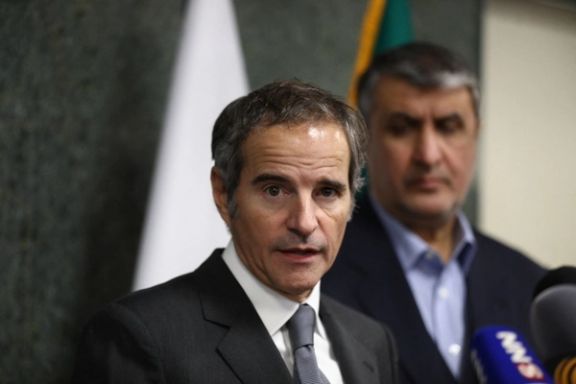
IAEA head Rafael Grossi with Iran's nuclear chief Mohammad Eslami in Tehran on March 5, 2022

A former Iranian lawmaker says the reason why the United States has not yet returned to the 2015 nuclear deal is that Israel keeps exerting pressure on Washington.

Sabah Zanganeh, a relative of Iran's Supreme Leader Ali Khamenei, told conservative news website Nameh News that despite all the shuttle diplomacy between Washington and Tel Aviv, the United States has still not managed to deflect the pressures exerted by Israel.

Although the latest IAEA meeting has not issued a resolution against Tehran, Nameh News says that this does not mean an agreement is any closer.

Zanganeh added in his interview that threats made by some US senators has disheartened Biden officials and delayed decision making in Washington. He said under the circumstances, there is no point in signing an agreement as long as all the hindrances are not addressed.

Asked how these delays can affect Iran, Zanganeh said: "We have to see how controversial or even dangerous these delays can get." Nonetheless, he warned Tehran against "exerting excessive pressures on some issues.” He might have been referring to Iran's demand to shelve a demand by the UN nuclear watchdog, the IAEA’s for Iran to explain traces of uranium found in three undeclared sites.

Meanwhile, hardliner commentator Mohammad Sadegh Koushki also tried to explain the reason for the delay in reaching an agreement in an interview with Nameh News. Koushki said: "The Westerners insist on rigorous inspection of Iranian nuclear sites, but at the same time they are not prepared to offer any guarantees, and this is what has left the Vienna negotiations inconclusive."

Sabah Zanganeh, a relative of Supreme Leader Ali Khamenei
100%
Sabah Zanganeh, politician and a relative of Supreme Leader Ali Khamenei

Koushki reiterated, "It is simple: The Westerners wish to get concessions from Iran, but they refuse to reciprocate." He also criticized the West for once again raising the issue of PMD (possible military dimensions) in Iran's nuclear activities. "The matter was addressed in 2015 and the case was terminated then, but the West raised the issue once again during President Hassan Rouhani's Presidency," Koushki said.

Koushki claimed that "Rouhani accepted serious inspections on the condition that the PMD case would be terminated. If it weren't for that condition, there was no point in allowing the inspections. The West is still not prepared to guarantee that the case about PMD would be terminated," he said.

He reiterated, "The West wants us to sign an agreement in which we will definitely be the losing side." He added: "What the West wants is to allow Iran to export some oil to stabilize the international energy markets and solve the West's problems, but they are not offering anything more to Iran."

Koushki continued that under the circumstances, insisting on Iran's rights is the least the Raisi Administration can do. He added that Iran has already made a lot of compromises but allowing the nuclear dossier to remain open would be a gross loss for Tehran.

But others, such as international relations expert Ghasem Mohebali maintain that reviving the JCPOA depends on a major political decision Iran must make. Meanwhile, he added that continuing the nuclear program without any economic justification is not in Iran's interest, and if there is no profit for Iran in an agreement, the revival of the JCPOA would be impossible.

Mohebali said reaching an agreement would be possible if Iran concludes that the country’s development plans are more important than a nuclear program that not only does not have any benefits but can have destructive consequences for the economy.


Most Viewed

Ideology may be fading in Iran, but not in Kashmir's ‘Mini Iran'
1
INSIGHT

Ideology may be fading in Iran, but not in Kashmir's ‘Mini Iran'

2
INSIGHT

Hardliners push Hormuz ‘red line’ as US blockade tests Iran’s leverage

3
VOICES FROM IRAN

Hope and anger in Iran as fragile ceasefire persists

4

Iran International says it won’t be silenced after London arson attack

5

US sanctions oil network tied to Iranian tycoon Shamkhani

Banner
Banner

Spotlight

  • Hardliners push Hormuz ‘red line’ as US blockade tests Iran’s leverage
    INSIGHT

    Hardliners push Hormuz ‘red line’ as US blockade tests Iran’s leverage

  • Ideology may be fading in Iran, but not in Kashmir's ‘Mini Iran'
    INSIGHT

    Ideology may be fading in Iran, but not in Kashmir's ‘Mini Iran'

  • War damage amounts to $3,000 per Iranian, with blockade set to add to losses
    INSIGHT

    War damage amounts to $3,000 per Iranian, with blockade set to add to losses

  • Why the $100 billion Hormuz toll revenue is a myth
    ANALYSIS

    Why the $100 billion Hormuz toll revenue is a myth

  • US blockade targets Iran oil boom amid regional disruption
    ANALYSIS

    US blockade targets Iran oil boom amid regional disruption

  • Iran's digital economy battered by prolonged blackout
    INSIGHT

    Iran's digital economy battered by prolonged blackout

•
•
•

More Stories

With Iran Talks On Ice, Might UN Assembly Bring Discrete Contacts?

Sep 15, 2022, 11:44 GMT+1
•
Iran International Newsroom

Contacts over reviving the 2015 Iran nuclear deal seem set to focus on next week’s United Nations General Assembly, when lead negotiators will be in New York.

As Joseph Borrell Wednesday said negotiations were in a “stalemate,” two thirds of the International Atomic Energy Agency’s 35-nation member board signed a statement by the United States and three European states (France, Germany and the United Kingdom; the ‘E3’) pressing Tehran to satisfy the agency over unexplained uranium traces.

The statement, presented by Germany, called on Iran to “act immediately to fulfil its legal obligations.” Iran’s foreign affairs spokesman Nasser Kanaani said Thursday the move was “not constructive.”

The decision by the US and E3 not to raise a further resolution, following one passed in June, reflects their sense that success remains possible in talks to revive the 2015 agreement, the JCPOA (Joint Comprehensive Plan of Action). They may also judge that referring Iran from the IAEA board to the United Nations Security Council would achieve little and merely rile Tehran.

Wang Chang, deputy head of China’s IAEA mission, told the IAEA board Tuesday that with JCPOA talks resting on finding a solution to the ‘safeguards’ issue of the uranium traces, it was important to maintain perspective.

“Iran’s outstanding safeguards issues point to possible nuclear activities that took place decades ago, if at all,” Wang said. “There is neither urgency nor proliferation risk involved. Besides, the issue of the possible military dimensions of Iran’s nuclear program was already concluded in 2015.”

Outlining the US approach, State Department spokesman Ned Price said Tuesday Washington had sent feedback on the latest Iranian input after a European Union text, designed to conclude 18-month talks, was circulated August 8. While Price described the Iranian input as “a step backwards in many ways,” he said it was “not too late to conclude a deal.”

EU foreign policy chief Josep Borrell and Enrique Mora in Tehran on June 25, 2022
100%
EU foreign policy chief Josep Borrell and Enrique Mora in Tehran on June 25, 2022

In his remarks Wednesday, Borrell explained the current stalemate in terms of “the political situation in the US” and “so many [other] directions.” Some analysts argue President Joe Biden is wary of restoring the JCPOA before November 8 US Congressional elections, where the Democrats aim to retain control of the Senate and fear Iran emerging as a contentious issue in tightly-fought states.

Negotiators in New York

While no meetings on the JCPOA have been announced for the September 20-24 UN General Assembly, it is likely that Ali Bagheri Kani, Iran’s lead nuclear negotiator, Rob Malley, the White House special Iran envoy for Iran, and Enrique Mora, the senior EU official co-ordinating JCPOA talks, will all be in New York. President Ebrahim Raisi is also due to attend.

The UN’s general debate will offer not just opportunities for speeches aimed at world opinion but opportunities, some analysts suggest, for discrete discussions. United Nations Secretary-General Antonio Guterres Tuesday called for Iran to accept “serious dialogue” over JCPOA restoration.

An official with Prime Minister Yair Lapid in Germany said Monday that the JCPOA was dead, whereas Defense Minister Benny Gantz said Wednesday it was in “the ER room.”

JCPOA critic: ‘Iran is winning’

Gantz, like Borrell, referenced US domestic politics: “There’s a period maybe after the elections, we’ll see how it goes.” US officials talking to journalist Laura Rozen have played down what they see as Israeli attempt to scuttle JCPOA talks with Israeli elections due November 1.

US opponents of the JCPOA have also continued efforts. Congresspeople raised a motion in the House Wednesday that Biden disclose any documents on the nuclear talks. Senator Ted Cruz has proposed legislation banning Raisi from the US.

Richard Goldberg, senior adviser at the Federation for Defense of Democracies, tweeted Thursday a call for “snapback UN sanctions now” as Iran was “winning” – although the US, outside the JCPOA since 2018, cannot trigger ‘snapback’ sanctions against Iran over exceeding the deal’s nuclear limits.

Michael Rubin, Senior Fellow at the American Enterprise Institute, wrote Monday that talks should be paused and US sanctions maintained due to “rumors that Iran’s Supreme Leader Ali Khamenei is on his deathbed.” Rubin has long argued against any talks with Tehran.

UN Calls For ‘Serious’ IAEA-Iran Talks As EU Lost Hope On Nuclear Deal

Sep 14, 2022, 22:37 GMT+1

The UN Secretary-General called on Iran Wednesday to hold a “serious dialogue” with its nuclear watchdog, the IAEA, during the ongoing nuclear deal negotiations.

Ahead of the start of the UN General Assembly, Antonio Guterres said the International Atomic Energy Agency’s “independence exists, must be preserved and is essential. The IAEA cannot be an instrument of parties against other parties.” 

Tehran’s demands that the IAEA shut its probe into suspected Iranian nuclear activity have become a key sticking point as the talks to revive the 2015 deal drag on.

Also on Wednesday, EU foreign policy chief Josep Borrell described the talks to bring Iran and the US back into the deal as an “stalemate,” saying that “I am afraid that with the political situation in the US, and so many directions without being conclusive, now we are going to stay in a kind of stalemate.”

He added that over the past couple of months, “the proposals were converging but unhappily, after the summer, the last proposals are not converging -- they are diverging,” highlighting that “The last proposals from the Iranians were not helping because we were almost there, then new proposals came and the political environment is not the most propitious. I am sorry to say, but I don't expect any breakthrough in the next days.” “From my side, I don't have anything more to propose.” 

Later in the day, two-thirds of the IAEA's 35-nation Board of Governors endorsed a non-binding statement by the United States, Britain, France and Germany pressing Iran to explain about uranium traces found at three undeclared sites.


Raisi Has ‘Final Say’ On Nuclear Deal, As Khamenei Out Of Public View

Sep 14, 2022, 17:52 GMT+1
•
Iran International Newsroom

Iran’s ruler Ali Khamenei has been absent from public view for two weeks, while some say that he has delegated the nuclear issue to President Ebrahim Raisi.

Khabar Online website has quoted reformist commentator Abbas Abdi on Wednesday as saying, "I have been informed by reliable sources that the leader has vested Rasi with the responsibility of deciding on the nuclear issue."

In the absence of Khamenei from the public scene for about two weeks, the handover gives rise to speculations whether the leader delegated part of his authority because of a medical emergency, or he simply wanted to shift the responsibility for a key decision to Raisi so that he could remain in a position to criticize any possible deal, if things do not work well.

Abdi noted that although it has been said over and over in Iran that accepting or rejecting a nuclear deal can be done only by the Supreme Leader, it is now evident that Raisi is in charge of the nuclear deal and whether he signs an agreement or rejects it, he will be responsible for it.

The Iranian government has not denied social media reports about Khamenei's illness. Meanwhile, the leader's office has cancelled two scheduled meetings with the Assembly of Experts members and Bassij militia during the past days.

In another development, a picture released by the official news agency IRNA last week about Khamenei's meeting with athletes, turned out to be at last three years old and the agency pulled the story. All this may indicate that Khamenei is not physically in a good position for public appearances.

Iranian politician and commentator, Abbas Abdi. FILE PHOTO
100%
Iranian politician and commentator, Abbas Abdi

Khamenei's previous absences ended with his powerful re-emergence to deny the report and discredit foreign media who went out of their way to say he was dead. That kind of a publicity stunt cannot be ruled out before more solid evidence emerges about his condition.

In still another development, former lawmaker Ahmad Mazani, a reformist figure, said in an interview with conservative Nameh News that Raisi and Majles Speaker Mohammad Bagher Ghalibaf should be held accountable for the consequences of any delay in reviving the 2015 nuclear agreement, the JCPOA. Like Abdi, Mazani also said, "The news that has reached us says that the Supreme Leader has delegated the responsibility for the revival of the JCPOA to President Raisi as the chairman of the Supreme Council of National Security."

Nonetheless, Abdi noted that still anyone who thinks Khamenei does not have the final say on the nuclear case, has no proper understanding of the status of the Supreme Leader and the significance of a nuclear deal for the Islamic Republic.

Abdi said, this explains why and how the Iranian parliament approved the JCPOA in 2015 within 20 minutes and the Guardian Council uncharacteristically did not find any fault in the decision made by the Majles.

In another development, the Jomhouri Eslami [Islamic Republic] newspaper, a daily founded by Khamenei, wrote in its editorial on Wednesday that "The key to lift the sanctions on Iran is in the hands of the Raisi Administration." The daily further called on the government to "end this story."

The editorial went on, "Now the people expect the Iranian government to solve this problem in this suitable situation and conclude several years of negotiations from a position of power."

Busy Day In Washington As Iran Nuclear Talks Take Center Stage

Sep 14, 2022, 14:30 GMT+1
•
Iran International Newsroom

Focus in the Iran nuclear talks is in Washington today as special envoy Rob Malley briefs Congresspeople, and critics request disclosure of all talks details.

Eighteen months after efforts began between Iran and six world powers to revive the 2015 Iran nuclear deal, negotiations are on hold after Iran and the United States exchanged messages following a European Union text circulated August 8 suggesting ways forward.

In a statement to the governing board of the International Atomic Energy Agency Tuesday, the US said that while it was ready “to quickly implement…mutual return to full implementation” of the 2015 agreement, the JCPOA (Joint Comprehensive Plan of Action), “what we lack is a willing partner in Iran.”

Tehran, which began exceeding the deal’s nuclear limits the year after the US left it in 2018, has attributed the pause in talks to the US being unwilling to accept Iranian ‘red lines’ – including ‘guarantees’ designed to cushion Iran against another US withdrawal – as well as to domestic political US politics.

Some analysts have argued that President Joe Biden does not want Iran to become an issue in November 8 Congressional elections, where the Democrats hope to retain control of the Senate. Critics of the JCPOA, who are disproportionately though not exclusively Republicans, tend to see any airing of Biden’s approach to Iran as a possible vote-winner.

Ned Price, the State Department spokesman, said in his press briefing Tuesday the administration was “not going to detail…publicly” its recent feedback on the August 8 EU text. Price did say Iran had in its latest input taken a “step backwards in many ways.” But he added: “This is a negotiation. There are going to be back-and-forths. Some gaps have closed in recent weeks, but others clearly remain.”

Motion for Congress to see deal proposals

Iran envoy Rob Malley briefing the Senate on May 25, 2022
100%
Iran envoy Rob Malley briefing the Senate on May 25, 2022

With US officials, including Malley, due to brief members of the House of Representatives today, the House Foreign Affairs Committee at 1pm is due to discuss a motion from Virginia Foxx, a Republican. Raised in July, the motion requests the president “transmit certain documents to the House of Representatives relating to any initiative or negotiations regarding Iran’s nuclear program.” Under current legislation, it is believed the administration would submit to Congress any text over reviving the JCPOA only once agreement was reached.

In his press briefing Tuesday Price denied reports, arising from briefings given by an Israeli official accompanying Prime Minister Yair Lapid in Germany, that Malley had been sidelined. “There is nothing to those reports,” Price said. “I can tell you Rob is deeply engaged day-to-day on the substance of this. He is leading a team here at the department.”

Opponents of the JCPOA, although they mostly backed President Trump leaving the agreement and imposing ‘maximum pressure’ sanctions through presidential actions, have accused the Biden administration of trying to sideline Congress. Defending the administration’s record, Price spoke Tuesday of State Department officials, “including Rob,” being “up on the Hill [Capitol Hill, Congress] a number of times briefing relevant committees on our efforts to achieve a mutual return to compliance with the JCPOA.”

Ulyanov: No new resolution at IAEA board

One aspect of the nuclear talks concerning JCPOA critics have been reports, denied by US officials, that the administration has been ready to soften its demand that Iran fully satisfy the IAEA over uranium traces found in sites not declared as nuclear-related. While the US, alongside three European states, moved a motion censuring Tehran at the IAEA board in June, no further action was expected at this week’s quarterly board meeting.

Mikhail Ulyanov, Russia’s ambassador to the IAEA, tweeted Wednesday that discussion of Iran at the board had passed with “no resolution or decision…Just exchange of views.”

US To Keep Pressure On Iran, Not To Get Back To Any Deal – Senator

Sep 14, 2022, 12:09 GMT+1

A US Republican lawmaker told Iran International that Washington is not going to get back to any kind of a deal with Iran and should not let Tehran grow its nuclear capabilities.

Senator Josh Hawley (R-MO) told our correspondent Arash Aalaei on Tuesday that “the Biden administration's approach to Iran is totally misguided. We should not consent to giving Iran any more capability to produce anything on the nuclear front.”

Underlining that the United States is not going to get back to any kind of a deal with Iran, he said, “We're going to keep the strings tight; we're going to keep the pressure on. We don't want to see that region become further destabilized."

“Iran getting a track toward a working nuclear program would be deeply destabilizing,” he added. 

Casting aspersions on the Biden administration’s foreign policies, particularly about Iran and Russia, he added that Biden’s policies do not “make any strategic sense,” as they are not good for the US’ “energy security or independence” nor they help “in terms of our military posture in that region.”

He stated that the US should help its allies and partners in the Middle East to do more to stabilize the region so that it can “focus on East Asia and problems with China.”

Emphasizing Iran's terrible record on religious liberty and rights for women, he questioned the administration’s logic of helping “the tyrannical regime” in Tehran and further emboldening them. “They are walking towards a path that would be deeply harmful to the region, to religious minorities and to the cause of freedom of worship and faith. It is dangerous.”