• العربية
  • فارسی
Brand
  • Iran Insight
  • Politics
  • Economy
  • Analysis
  • Special Report
  • Opinion
  • Podcast
  • Iran Insight
  • Politics
  • Economy
  • Analysis
  • Special Report
  • Opinion
  • Podcast
  • Theme
  • Language
    • العربية
    • فارسی
  • Iran Insight
  • Politics
  • Economy
  • Analysis
  • Special Report
  • Opinion
  • Podcast
All rights reserved for Volant Media UK Limited
volant media logo

Hardliner Says Nuclear Talks Futile, Iran Should Exit NPT
Iran International Newsroom
Sep 4, 2022, 12:10 GMT+1Updated: 17:27 GMT+1
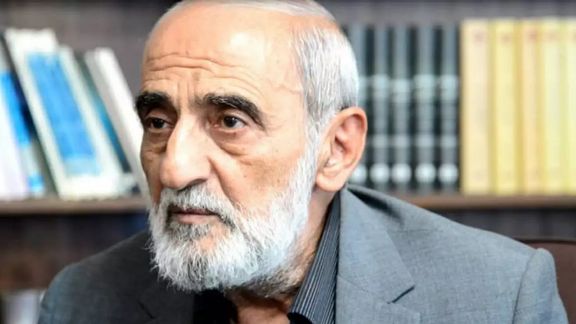
Ultra-conservative editor of Kayhan newspaper Hossein Shariatmadari

A top Iranian ultra-conservative close to the Supreme Leader says nuclear talks with the West are futile and Iran should exit the Nuclear Non-Proliferation Treaty.

Fars news website affiliated with the Revolutionary Guard Sunday published an interview with Hossein Shariatmadari, chief editor of the hardliner Kayhan Daily, blasting the nuclear negotiations as a Western ploy and recommending to quit the NPT.

Kayhan is published under the supervision of Supreme Leader Ali Khamenei’s office and Shariatmadari is his representative at the flagship paper.

The ultra-conservative ideologue said that 20 years of talks prove that “the other side is not worried about Iran producing nuclear weapons, rather it uses the issue as an excuse to keep sanctions” as the only remaining lever for the United States “to confront Islamic Iran,” and it will never give then up.

He went on to argue that consequently, it is meaningless to negotiate, and diplomacy “will lead nowhere”. As an example, Shariatmadari said that the United States openly and clearly says it cannot provide guarantees about its commitments to an agreement. “What kind of an agreement is it when the other side is not willing to provide guarantees about acting according to its commitments?”

At the same time, Ali Khezrian, a member of parliament from the hardliner Paydari Front, in a note published by media, quoted specific clauses of what he claimed to be the new draft nuclear deal, arguing that it is a weak agreement for Iran.

Hardliner member of Iran's parliament, Ali Khezrian
100%
Hardliner member of Iran's parliament, Ali Khezrian

He argued that nuclear activities should not be reduced before US sanctions are lifted and Iran is able to verify that it can conduct business without being impeded by US economic restrictions.

He cited the draft agreement to say that the new deal does not meet this Iranian demand, inscribed in a parliament law passed in December 2020. Khezrian specifically referred to the third appendix of the draft agreement arguing that the US will remove oil sanctions after Iran begins reducing its key nuclear activities, without a chance to verify the US step.

The lawmaker also complained that Washington has not provided any guarantees in the new agreement to remain in the deal and not to use the UN Security Council ‘trigger mechanism’, or to impose new sanctions. On the contrary, Khezrian claimed that in section 5 of the draft, it is Iran that first has to execute its commitments before the US carries out its own obligations.

In addition, international banks must verify who they would be dealing with in Iran to avoid interacting with sanctioned entities, which Khezrian said would lead to heavy fines for any bank violating this part of the agreement.

He also criticized the fact that US ‘foreign terrorist’ designation will remain in place against the Revolutionary Guard, IRGC, and this would impact other areas of business and trade.

Iran had been insisting on removing the IRGC from the US list of Foreign Terrorist Organization (FTO), but US President Joe Biden opposed such a move.

Iran’s argument was that since the IRGC runs large business conglomerates in the country, its continued FTO designation would have ripple effects in Iran’s economy and its ability to have trade and other economic ties with foreign entities.

Kayhan’s editor Shariatmadari in his interview summed up the position of many hardliners. “The ups and downs of negotiations in the past 20 years leave no doubt that if we do not pay ransom – which the current government would not – the talks will go nowhere…and we reach the conclusion that we have to withdraw from the NPT.”


Most Viewed

Ghalibaf defends Iran-US talks amid hardline backlash
1
INSIGHT

Ghalibaf defends Iran-US talks amid hardline backlash

2
INSIGHT

100 days after carnage: Iran economy reels from war, inflation, unemployment

3
INSIGHT

A nation in limbo: 100 days after the massacre, has the world moved on?

4
ANALYSIS

From instability to influence: Pakistan’s pivotal role in US-Iran diplomacy

5
ANALYSIS

100 days on: why Iran’s January protests spread across social classes

Banner
Banner

Spotlight

  • War-hit homeowners feel abandoned as Iran’s reconstruction aid fades

    War-hit homeowners feel abandoned as Iran’s reconstruction aid fades

  • 100 days on: the anatomy of Iran’s January crackdown
    INSIGHT

    100 days on: the anatomy of Iran’s January crackdown

  • Ghalibaf defends Iran-US talks amid hardline backlash
    INSIGHT

    Ghalibaf defends Iran-US talks amid hardline backlash

  • 100 days on: why Iran’s January protests spread across social classes
    ANALYSIS

    100 days on: why Iran’s January protests spread across social classes

  • From instability to influence: Pakistan’s pivotal role in US-Iran diplomacy
    ANALYSIS

    From instability to influence: Pakistan’s pivotal role in US-Iran diplomacy

  • A nation in limbo: 100 days after the massacre, has the world moved on?
    INSIGHT

    A nation in limbo: 100 days after the massacre, has the world moved on?

•
•
•

More Stories

The West Must Be Afraid Of Plutonium In Iran - Ex-Nuclear Chief

Sep 3, 2022, 17:30 GMT+1
•
Iran International Newsroom

Iran's former nuclear chief who is a member of parliament says the Islamic Republic should produce plutonium in addition to enriching uranium to 90 percent.

Fereydoun Abbasi, a member of parliament’s energy committee, said Saturday that Iran should enrich uranium not just to 60 percent – the highest level reached at present – but to 90 percent and more. Uranium enriched to 90 percent is only used for producing nuclear bombs.

But what appeared to be a direct threat amid nuclear talks with the West was Abbasi’s statement that Iran should also produce plutonium.

“Western countries must be afraid of plutonium in Iran. We want plutonium for energy production, not weapons, and it must be available in the country,” he said, adding that “we must keep the enriched materials.” Abbasi went on to say that Iran must do these things publicly and under the supervision of the agency.

Indirect talks between the United States and Iran since April 2021 to revive the Obama-era Joint Comprehensive Plan of Action (JCPOA) has reached a critical stage, as Iran has hardened its position in recent days and insists on its remaining demands.

Tehran is asking for US guarantees both for the durability of a new agreement and on issues related to sanctions. In addition, Tehran also is demanding an International Atomic Energy Agency (IAEA) probe into its past undeclared activities to be closed.

Production of plutonium by Iran was banned outright under the JCPOA in 2015. According to the accord, a plutonium heavy water reactor that Tehran was building in Arak was dismantled and its core filled with concrete. Plutonium produced from uranium reactor spent fuel is the easiest path to making nuclear bombs.

Abbasi had earlier said that the highly enriched uranium fissile material should be used “both for scientific research and for making nuclear fuel for submarines.”

On September 1, another lawmaker and a commander in Iran’s Revolutionary Guard, Mohammad Esmail Kowsari said, "We can turn the 60% enrichment rate into 93%, which means an atomic bomb, and although we are not looking for this, we have the ability to do it if the other side is slow to move" to revive the landmark nuclear accord.

On July 17, Kamal Kharrazi, a senior adviser to Supreme Leader Ali Khamenei said Iran has the technical capability to build a nuclear bomb.

Iran began in 2019 enriching uranium beyond the 3.67 percent cap set by the JCPOA (Joint Comprehensive Plan of Action), the year after the US left the 2015 deal and imposed ‘maximum pressure’ sanctions. There are no civilian uses for 90-percent-enriched uranium including research and medical isotopes which would need up to 20-percent enriched uranium. Iran also has no nuclear submarines and 90 percent is widely considered weapons grade fissile material.

In its nuclear brinksmanship since early 2021, Iran has also severely restricted monitoring by the IAEA by first denying real-time access and then disconnecting cameras and special equipment. In this period, it is believed Tehran has accumulated enough enriched uranium to easily take a leap to 90-percent enriched fissile material enough for one or two nuclear bombs.

Signs Grow Of Iran Hardening Stance In Nuclear Talks

Sep 3, 2022, 12:29 GMT+1
•
Iran International Newsroom

Iran’s atomic energy chief said Friday evening that Tehran’s expansion of the nuclear program had made “the enemies decide to go back to their commitments.”

Speaking in Kashan in honor of “nuclear martyrs” – presumably assassinated Iranian scientists – Mohammad Eslami extolled the benefits of nuclear technology in power generation, agriculture and medical treatment. “The enemy has tried to prevent the Islamic Republic from obtaining advanced technology,” he said.

Eslami has been among leading officials, including President Ebrahim Raisi, insisting the International Atomic Energy Agency must end its enquiries into uranium traces found in Iran as a condition for Tehran returning its nuclear program to the limits of the 2015 nuclear deal, the JCPOA (Joint Comprehensive Plan of Action). Tehran began exceeding JCPOA limits 2019, after the United States left the JCPOA in 2018.

Eslami’s latest remarks come as analysts detect signs of Tehran hardening its stance in on-going nuclear talks, despite both and the US reacting positively to an August 15 Iranian response to a European Union draft text circulated August 8 aiming to bridge US-Iran difference.

An official from one of the European JCPOA signatories – France, Germany, and the United Kingdom; the ‘E3’ – told journalist Laura Rozen Friday that Iran’s latest input on the EU draft text, which Tehran sent Thursday, had “moved us very far back – at a time when, thanks to the EU co-ordinator’s perseverance, and everyone’s flexibility, we were almost there.”

The official’s outlook was bleak. “It’s very difficult to know whether this is fixable,” he said. “In any case, Iran has given a clear signal it is not interested in a deal now.”

US spokesman Vendant Patel said late Thursday that Iran’s input was “not constructive,” a statement Iran deemed ‘hasty.’ Adriene Watson, spokesperson for the National Security Council, moderated the US response later, describing negotiations as a “regular back and forth” in which “some gaps have closed in recent weeks but others remain.”

EU ‘at outer limits of flexibility’

The European official speaking to Rosen highlighted Iran’s approach to the IAEA probe where he said the August 8 EU text was “at the outer limits of our flexibility already – and which they implicitly accepted in their August 15 response.” The Wall Street Journal’s Laurence Norman also reported Thursday he had been told by several sources Iran had added the closure of the IAEA probe “back into its formal concerns.”

In an interview with al-Jazeera television late Friday, relayed Saturday by the official news agency IRNA, Mohammad Marandi, who acts as a spokesman for the Iranian negotiating team, stressed the importance of tightening the language in any accord reviving the JCPOA.

Marandi said that “ambiguities or gaps” could be misused by the US to follow the example of President Donald Trump in withdrawing from the JCPOA. He also stressed the importance of resolving, before the 2015 deal was revived, “fake and politicized accusations made by the IAEA against Iran in the Board of Governors.”

‘Necessary political will’

The US and E3 have insisted Iran must satisfy the agency over the uranium traces, regardless of the JCPOA under its commitment as a signatory of the Nuclear Non-Proliferation Treaty. This 35-member IAEA board passed a resolution raised by the US and E3 censuring Iran.

Iran, by contrast, has argued there is a 2015 precedent in the IAEA closing its enquiries into Tehran’s pre-2003 work, only to revive them after allegations made by Israel in 2018. In his Jazeera interview, Marandi highlighted June’s visit of IAEA chief Rafael Mariano Grossi to Israel shortly before the board voted as evidence that “their [the IAEA’s] stance towards Iran has been politicized.”

Despite remaining challenges in the talks, some see agreement looming. Citing Israel’s Channel 12, Iran International Saturday reported an Israeli foreign ministry report expecting this “within weeks.” Mikhail Ulyanov, Russia’s ambassador to the IAEA, tweeted Friday that the “Iranian suggestions aren’t over-ambitious and can be accommodated provided there is the necessary political will.”

US Rejects Linking Iran Nuclear Deal, IAEA Probes

Sep 2, 2022, 21:59 GMT+1

The US has rejected linking a revival of the Iran nuclear deal with the closure of probes by the UN nuclear watchdog a day after Iran reopened the issue, a Western diplomat said.

Iran on Thursday sent its latest response to a European Union proposed text to revive the agreement known as the JCPOA.

Former US President Donald Trump abandoned the deal in 2018 and re-imposed US sanctions, prompting Iran to start breaching the deal's nuclear curbs and reviving US, Arab and Israeli fears it may be seeking an atomic bomb.

"There should not be any conditionality between re-implementation of the JCPOA and investigations related to Iran's legal obligations under the Non-proliferation Treaty," White House press secretary Karine Jean-Pierre said.

Jean-Pierre was alluding to investigations by the Vienna-based International Atomic Energy Agency (IAEA) into uranium traces found at three undeclared Iranian sites.

Resolution of the so-called safeguards investigations is critical to the UN agency, which seeks to ensure parties to the Nuclear Non-Proliferation Treaty are not secretly diverting nuclear material which they could use to make a weapon.

A senior US official on Aug. 23 said Iran had "basically dropped" some of the main obstacles to reviving the 2015 deal, including on the IAEA, but the issue seems to have been deferred.

A Western diplomat who spoke on condition of anonymity said on Friday Iran had reopened the issue in its latest response, which Washington characterized as “Not constructive”.

Iran's foreign minister this week said the IAEA should drop its "politically motivated probes" of Tehran's nuclear work.

Reporting by Reuters

Iran, US Play ‘Ping Pong Diplomacy’ Over Nuclear Agreement

Sep 2, 2022, 19:12 GMT+1
•
Iran International Newsroom

Three weeks after the European Union August 8 circulated a ‘final text’ for reviving the 2015 Iran nuclear deal, analysts are left interpreting hints and leaks.

A European diplomat told Iran International Friday there was nothing to add to Josep Borrell’s hope expressed Wednesday of reviving Iran nuclear deal in “coming days.” Borrell, the EU foreign policy chief, had said after a meeting of EU foreign ministers in Prague that near-17 months of talks had led to “common ground” and the basis for “an agreement that takes into account…everyone’s concerns.”

Since then, however, US State Department spokesperson Vedant Patel said late Thursday that Iran’s latest input, made Thursday, was “not constructive.” Politico cited a “senior Biden administration official” saying: “Based on their answer, we appear to be moving backwards.”

The latest stage in the 17-month effort to revive the 2015 Iran nuclear deal, the JCPOA (Joint Comprehensive Plan of Action), has essentially become a US-Iran, EU-mediate, indirect dialogue based on the EU text circulated August 8. Iran responded August 15, and then the US August 24. Iran’s latest input, sent as usual through EU mediators, was Friday described as “constructive” and “aimed at finalizing the negotiations” by Foreign Ministry spokesman Nasser Kanaani.

The Iranian website KhabarOnline has a piece based on a recent Clubhouse discussion in which Hasan Behestipour, political analyst at the Institute for Iran-Eurasia Studies (IRAS), called the current process “ping pong diplomacy.” While Behestipour acknowledged that in an ongoing diplomacy, “it is not possible to discuss the details,” he suggested that “media management” could be better.

Hasan Behestipour, political analyst at the Institute for Iran-Eurasia Studies (IRAS), September 2, 2022
100%
Hasan Behestipour, political analyst at the Institute for Iran-Eurasia Studies (IRAS), September 2, 2022

‘People are waiting to know how long this takes’

“Whether we like it or not, these talks and negotiations have affected people’s lives [in Iran],” Behestipour said. “If America has given an answer, people are interested to know what the answer of America is generally about…People are waiting to know how long this process will take…I think that the evidence shows that both Iran and America need an agreement and both are trying to reach an agreement with maximum points.”

The weeks of ‘ping pong’ has given space for a wide airing of views, including from those wary of compromise. Mehdi Sa’adati, a hardliner parliamentary deputy who was a high-ranking IRGC commander for many years, quoted in the official news agency IRNA, argued Iranian negotiators needed to stand firm on verifying the lifting of US sanctions, ‘guarantees’ over Washington’s commitment to a renewed agreement, and clarity that any US sanctions against Iran’s Revolutionary Guards would not affect “other economic areas.”

Mehdi Sa'adati, IRGC general and parliament deputy
100%
Mehdi Sa'adati, IRGC general and parliament deputy

Sa’adati also demanded the removal of the “safeguards issue,” an apparent reference to the International Atomic Energy Agency (IAEA) probe into mysterious uranium traces found in Iran and linked to pre-2003 work. This is line with public statements by Iranian officials, including President Ebrahim Raisi, that the IAEA enquiry should end before the JCPOA is revived.

But Sa’adati rejected the idea these issues might be dealt with “later,” insisting they had to be “clarified in these talks.” This put him at odds with a raft of recent reports suggesting the Iran-US talks were looking at a stage-by-stage return to the JCPOA, with the IAEA probe dealt with perhaps 120 days after the initial agreement to restore the JCPOA.

‘A much longer stick’

Sa’adati also criticized the IAEA director-general Rafael Mariano Grossi for his June visit to Israel, which holds nuclear weapons clandestinely and has refused to sign the Nuclear Non-Proliferation treaty. Iran has charged that the IAEA probe into Iran’s pre-2003 activities was closed in 2015 and then revived only after Israeli allegations.

In Israel, Ram Ben-Barak, head of the parliament’s foreign affairs and defense committee, told the 102 FM radio station that “a much better deal” was needed with “a much longer stick.” Ben-Barak, former deputy director of the Mossad extraterritorial force, emphasized the importance of the IAEA probe to get “honest and real answers about what they did there,” but also referred to an option of military force to end Iran’s nuclear program.

“What Israel wants is something better in place of this deal,” he said. “Something better means telling the Iranians ‘Listen, you will not have a nuclear program’.”

Western Powers Can Get Better Iran Deal, Israeli Lawmaker Says

Sep 2, 2022, 18:19 GMT+1

Israel believes Western powers can reach a better nuclear deal with Iran, a senior lawmaker said on Friday, as attempts to revive a 2015 pact continue with no final deal yet.

"We must draft a much better deal with a much longer stick. And this is what we're not seeing," Ram Ben-Barak, head of parliament's foreign affairs and defense committee, said in a radio interview in Israel.

Tehran's insistence that the International Atomic Energy Agency (IAEA) close its probes into uranium traces found at three undeclared sites before the nuclear pact is revived is one key hurdle.

After 16 months of indirect talks between Tehran and Washington, the European made a proposal in August but key differences remain between Iran and the US.
The open probes and future inspection were Israel's main concerns with the current deal, Ben-Barak said.

"We must get honest and real answers about what they did there," he said.
Ben-Barak, who once served as deputy director of Israel's Mossad spy agency, said Iran is not as strong as some people may think and has been struggling under sanctions. This could lead Tehran to give up on its nuclear ambitions entirely, whether by diplomacy or military power, he added.

Israel has pledged never to allow Iran to obtain atomic weapons, saying Tehran advocates its destruction. Iran denies ever seeking nuclear arms.

"What Israel wants is something better in place of this deal. Something better means telling the Iranians 'listen, you will not have a nuclear program'," he said.


Reporting by Reuters