• العربية
  • فارسی
Brand
  • Iran Insight
  • Politics
  • Economy
  • Analysis
  • Special Report
  • Opinion
  • Podcast
  • Iran Insight
  • Politics
  • Economy
  • Analysis
  • Special Report
  • Opinion
  • Podcast
  • Theme
  • Language
    • العربية
    • فارسی
  • Iran Insight
  • Politics
  • Economy
  • Analysis
  • Special Report
  • Opinion
  • Podcast
All rights reserved for Volant Media UK Limited
volant media logo

IRGC-Affiliated Website Welcomes Article Praising Iran’s F-14s
Iran International Newsroom
Aug 27, 2022, 21:28 GMT+1Updated: 17:20 GMT+1
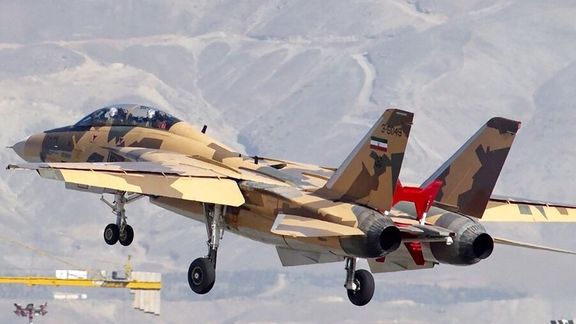
An Iranian F-14 Tomcat fighter still flying after 50 years

Fars news agency affiliated with Iran’s Revolutionary Guard has showcased an American article about how well Iranian pilots used the F-14 Tomcat fighters.

The article published by a US-based website 19FortyFive re-told the story that the first air-to-air kill by an F-14 was not accomplished by American pilots, but by an Iranian on September 7, 1980, one day after the long Iran-Iraq war began that lasted eight years.

Fars tells its readers that an American website has given credit to pilots of the Islamic Republic for the first air-to-air F-14 victory, one year before US pilots shot down Libyan planes in a punitive engagement. Fars said that the American publication recognized the unique abilities of Iranian pilots with the heavy American fighter designed to face Soviet bombers at long distances.

What Fars does not say is that these fighter pilots who engaged the Iraqi air force one year after the 1979 revolution and the establishment of the Islamic Republic were in fact officers recruited by the Imperial air force during the monarchy and trained by the US Air Force.

It also does not mention how Iran’s last king, Mohammad Reza Shah had been able to get 70 Grumman F-14 Tomcats, a fourth-generation sophisticated fighter, in the 1970s from the United States. In fact, it was President Richard Nixon who approved the sale to one of the most trusted US allies outside NATO at a time when the United States was losing the war in Vietnam and the power and influence of the Soviet Union was on ascendancy.

Iranian F-14 Tomcat’s M61A1 Vulcan gun. Undated
100%
Iranian F-14 Tomcat’s M61A1 Vulcan gun

The Shah’s son, Reza Pahlavi was also sent to the United States to be trained on the F-14 right before revolution broke out. He currently lives near Washington DC and is an influential political figure for many Iranians opposed to the Islamic Republic.

“On September 7, 1980, five Mil Mi-25 (export model of the Soviet Mi-24) attack helicopters in Iraq’s Army Air Corps penetrated Iranian airspace and attacked a few border posts. In response, two F-14 Tomcat pilots intervened in an attempt to take out the aircraft,” the article in 19FortyFive says.

Citing another source, The Aviation Geek, the article explains that the Tomcat pilot failed to hit the MI-25 helicopters with his AIM9P Sidewinder missiles, but “Selecting ‘GUN’ on his control column, he put the gunsight pipper over the rearmost Mi-25 and opened fire. The aircraft’s M61A1 Vulcan gun gull spewed out 400 rounds. Many found their mark and the Iraqi attack helicopter exploded in a brilliant ball of fire.”

There are still around 40 F-14s in the Islamic Republic’s air force that have been somehow maintained, although periodically some have crashed. One Tomcat crashed in June and another in 2019. Some have been used for parts to maintain the others, since the United States severed relations with Iran in 1980 and imposed sanctions on export of US technology to the country.

Iran has also tried to build parts for the Tomcats and adapt homegrown Russian-model air-to-air missiles, but it there is no independent confirmation of their effectiveness.

Still, after nearly 50 years, the F-14 Tomcats are an important part of Iran’s air force, which has a hodgepodge of old Russian, Chinese and even French warplanes that Iraq sent to Iran faced with an imminent US attack.


Most Viewed

100 days after carnage: Iran economy reels from war, inflation, unemployment
1
INSIGHT

100 days after carnage: Iran economy reels from war, inflation, unemployment

2
INSIGHT

Ghalibaf defends Iran-US talks amid hardline backlash

3
EXCLUSIVE

Iranian assaulted in London amid concern over threats to regime critics

4

IRGC fires at Indian vessel in Hormuz

5
INSIGHT

A nation in limbo: 100 days after the massacre, has the world moved on?

Banner
Banner

Spotlight

  • War-hit homeowners feel abandoned as Iran’s reconstruction aid fades

    War-hit homeowners feel abandoned as Iran’s reconstruction aid fades

  • 100 days on: the anatomy of Iran’s January crackdown
    INSIGHT

    100 days on: the anatomy of Iran’s January crackdown

  • Ghalibaf defends Iran-US talks amid hardline backlash
    INSIGHT

    Ghalibaf defends Iran-US talks amid hardline backlash

  • 100 days on: why Iran’s January protests spread across social classes
    ANALYSIS

    100 days on: why Iran’s January protests spread across social classes

  • From instability to influence: Pakistan’s pivotal role in US-Iran diplomacy
    ANALYSIS

    From instability to influence: Pakistan’s pivotal role in US-Iran diplomacy

  • A nation in limbo: 100 days after the massacre, has the world moved on?
    INSIGHT

    A nation in limbo: 100 days after the massacre, has the world moved on?

•
•
•

More Stories

US Told Iran It Won’t Seek To Escalate Hostilities In Syria

Aug 27, 2022, 17:31 GMT+1

Following a series of US strikes on Iranian militia in Syria, reports say Washington has told Tehran through various channels that it does not seek to heighten tensions in Syria. 

An article by the New York Times quoted a US official as saying that the Americans made clear to Iran, through private channels as well as publicly, that they were not trying to escalate hostilities but only sought to protect US interests.

US President Joe Biden told Congress on Thursday, August 25, that he ordered the strikes on the Iran-backed militia “to degrade and disrupt” attacks on US forces. 

On Friday, Iran’s foreign ministry spokesman Nasser Kanaani rejected Biden’s argument that the US is responding to threats against American forces. Knaani on Wednesday had denied any links between Iran and the militia forces in Syria.

Militias backed by Iran’s Revolutionary Guards attacked a US military base in southern Syria with drones on August 15 and on the same day, a different base used by the US-led coalition near Syria’s eastern border with Iraq came under rocket fire, triggering a string of tit-for-tat attacks this week, including airstrikes on three consecutive nights against Iran-linked targets. 

Senior US officials said the August 15 attacks on the two US bases in Syria could have been an Iranian attempt to avenge a previous Israeli attack, as the attack on US base at al-Tanf -- near the border in southern Syria -- came a day after Israel struck bases in the Syrian provinces of Damascus and Tartus, where Iran-backed fighters are often stationed. 

Prof’s Remarks On Rushdie Attack Prompt Probe On Pro-Iran Propaganda

Aug 27, 2022, 14:57 GMT+1

Controversial remarks by a University of Denver professor who blamed Israel's Mossad for the attack on author Salman Rushdie has prompted Republicans to probe pro-Iran propaganda in US colleges.

Lawmakers associated with the Republican Study Committee (RSC), the largest Republican caucus in Congress, are set to launch oversight investigations into schools like the University of Denver to root out "anti-Semitic and anti-American conspiracy theories."

Indiana representative Jim Banks, the RSC's chairman and a member of the House Armed Services Committee, told the Free Beacon that "Anti-Semitic and anti-American conspiracy theories are now widespread in universities and poisoning students' minds," stressing the need for oversight on professors promoting the Iranian regime's anti-Semitic propaganda and reforming the higher education.

His remarks came after Nader Hashemi, the director of the Denver University’s Center for Middle East Studies, said this week during a podcast that Rushdie’s alleged attacker, Hadi Matar, could have been persuaded to carry out the attack by Mossad agents posing as members of Iran’s Revolutionary Guards, which reportedly were in contact with Matar prior to the near-fatal stabbing.

He said a "much more likely" scenario for the attack revolves around Matar’s supposed communications "with someone online who claimed to be an Islamic Revolutionary Guard Corps (IRGC) supporter and lured him into attacking Salman Rushdie. And that so-called person online…could have been a Mossad operative."

Representative Greg Steube from Florida, a member of the RSC and the House Foreign Affairs Committee, described Hashemi’s remarks as untrue and especially dangerous to pro-Israel students on campus, saying, "Propaganda from the Iranian regime has no place on American college campuses."

Football Fans Boo Islamic Republic’s Propaganda Song In Stadium

Aug 27, 2022, 12:59 GMT+1

Spectators of a football match in Tehran’s Azadi stadium booed while a choir was performing ‘Hello Commander’, a pop genre religious and ideological propaganda song. 

Videos circulating on social media showed people booing a performance of the heavily-promoted song at the stadium before a match of Iran’s premier league on Friday.

The football fans also chanted the name of Voria Ghafouri, a popular former captain of Esteghlal football club who was fired from his team for criticizing the government. Ghafouri’s criticism of government’s regional policies and downplaying the impact of US sanctions on ordinary Iranians, had met with an angry response from Supreme Leader Ali Khamenei.

State organizations and the ministry of education have been promoting ‘Hello Commander’ in schools and during numerous cultural and sport events since it was broadcast from state television for the first time this year after Khamenei’s speech for the Iranian New Year on March 20.

‘Hello Commander’ is a song dedicated to Mahdi, the 12th Imam, who Shiite believers say has been in occultation since the 9th century. The song and its promotion are unusual as the its pop genre has no place on Iran’s state media.

Many social media users have seen the song as propaganda for Khamenei as the “hidden Imam’s representative on earth”, and commander-in-chief of Iran’s Armed Forces. Some draw a parallel between him and Hitler by sharing a video of Nazi Youth gatherings with the original audio replaced with ‘Hello Commander’.

Israel, US Discuss Security Concerns, Military Option Against Iran

Aug 27, 2022, 12:05 GMT+1

Israeli Defense Minister Benjamin Gantz met Friday with US National Security Advisor Jake Sullivan in Washington to consult on security issues of mutual concern.

Discussing the draft of the agreement to revive Iran’s 2015 nuclear deal, Gantz reiterated Israel’s opposition to the deal, and pointed out specific components that the US must insist on in order for Iran not to build a nuclear weapon. 

Stressing the need to strengthen military capabilities to undermine the Islamic Republic's nuclear progress and its regional aggression aside from the deal, Gantz told Sullivan the United States needs to ensure that it retains a viable military option against Iran’s nuclear facilities even if a new deal is reached with the Islamic Republic. 

Axios quoted an unnamed senior Israeli defense official as saying that “A nuclear deal is not a peace treaty. A military threat has a lot of weight that can help create a deterrence even in a reality in which there is a deal.” Gantz received "positive hints" about a possible military option when he pressed Sullivan on the issue. 

"We feel there is a trajectory for deepening and strengthening the capabilities against Iran and the Americans understand deeply that it will give the Iranians an incentive to be more pragmatic about the nuclear deal and will strengthen their position," the official added.

Sullivan emphasized President Joe Biden’s unwavering commitment to Israel’s security, and the two exchanged views on ways to deepen the US-Israel security partnership, including via regional cooperation and coordination.

Iran Making Plans For Latin America As Nuclear Deal Nears

Aug 26, 2022, 20:42 GMT+1
•
Mardo Soghom

“Iran’s play in America’s backyard” is the headline by the official government news website IRNA heralding new hopes of expanding influence in Latin America.

The article tried to give credit to hardliner President Ebrahim Raisi for making more inroads in Central and South America, particularly drawing attention to the election of a leftist president in Columbia.

IRNA publishes several articles daily to praise the accomplishments of the president who is under fire even by some hardliners for having failed to deliver any of his promises when he got elected last year.

The article about Latin America published on August 25 is no exception, presenting as a victory a trip by one of Raisi’s aides to Columbia in early August to take part in the inauguration of Gustavo Petro, a former anti-American leftist guerrilla fighter. IRNA said that Petro had condemned the targeted killing of Qasem Soleimani in January 2020 on the orders of former US President Donald Trump, saying, “America always empowers the worst in the Middle East.”

The article mainly speaks about Latin America’s economic and diplomatic potential and makes no mention of Iran’s long-running overt and covert operations to build influence and networks in the region, together with its proxy, the Lebanese Hezbollah.

“Experts believe areas of cooperation with Latin American countries can include energy, particularly oil, food production industries, chemical industries, infrastructure, dam construction, electricity generation and hydroelectric power…,” IRNA said, adding a few other options.

Venezuelan President Nicolas Maduro with Iran's Ebrahim Riasi in Tehran, June 10,  2022
100%
Venezuelan President Nicolas Maduro with Iran's Ebrahim Riasi in Tehran, June 10, 2022

Iran already closely cooperates with Venezuela in fossil fuels and security matters.

However, since 2005 when Iran’s attempts to expand its foothold in Latin America gained more momentum, Tehran has made plenty of economic promises to the region’s countries, but few have materialized because the period since has been marked by crippling international and US sanctions on Tehran.

With a possible nuclear deal on the horizon, these sanctions will be lifted, and Iran will get hold of tens of billions of dollars it can spend in Latin America. The IRNA article seems to be oriented toward making investments in countries friendly with the Islamic Republic.

But some countries are a bit careful about Iranian activities. In early June, Argentina grounded a Boeing 747 that Iran provided to Venezuela to launch an air cargo company. The plane was carrying at least five Iranians all with IRGC (Revolutionary Guard) ties.

Gerardo Milman, an Argentine lawmaker, told Iran International on June 23 that Iranians aboard the Venezuelan plane planned “attacks on human targets.” The aircraft itself had belonged to an Iranian airline with ties to the IRGC and had been sanctioned by the United States.

Secret Iranian and Hezbollah networks are involved in illicit activities, allegedly including the drug trade for generating funds.

Iran also converts locals to Shiite Islam and sends some to its seminaries in the religious city of Qom to be trained and indoctrinated.

US Senators Bob Menendez and Marco Rubio were concerned over Iranian activities as far back as in 2012 and held hearings to assess the threat of Tehran launching anti-US operations from its backyard.

Two experts in 2020 offered a grim prospect on Iran’s influence in the region. “Iran has penetrated the governmental structure of many Latin American nations, especially the nations of the already left-leaning Bolivarian Alliance (Cuba, Venezuela, Bolivia, Antigua and Barbuda, Dominica, Nicaragua, Saint Lucia, Saint Vincent and Grenadines, Saint Kitts, and Nevis), and this is not only unconventional but also very dangerous.”





