• العربية
  • فارسی
Brand
  • Iran Insight
  • Politics
  • Economy
  • Analysis
  • Special Report
  • Opinion
  • Podcast
  • Iran Insight
  • Politics
  • Economy
  • Analysis
  • Special Report
  • Opinion
  • Podcast
  • Theme
  • Language
    • العربية
    • فارسی
  • Iran Insight
  • Politics
  • Economy
  • Analysis
  • Special Report
  • Opinion
  • Podcast
All rights reserved for Volant Media UK Limited
volant media logo

Iran Speaks Of ‘Final Stages’ As It Sifts US Nuclear Response
Iran International Newsroom
Aug 26, 2022, 15:26 GMT+1Updated: 17:36 GMT+1
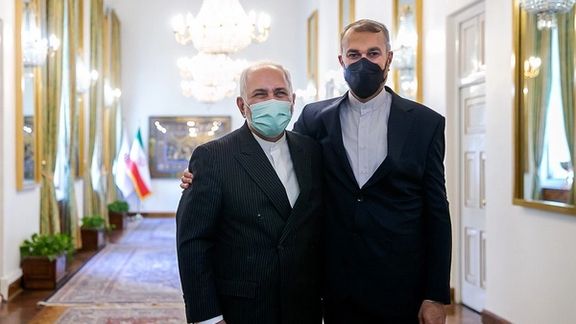
Former foreign minister Javad Zarif who negotiated the JCPOA in 2015 and current minister Amir-Abdollahian in August 2021

Iran is “going through the final stages” of work to revive the 2015 nuclear deal, Foreign Minister Hossein Amir-Abdollahian said in Zanzibar Friday.

There had been “a lot of progress in discussions and text editing” over some months, noted Amir-Abdollahian in remarks reported from his meeting with President Hossein Movini.

Tehran is currently reviewing a United States response submitted August 24, following Iran’s August 15 input, to a text circulated by the European Union August 8 in efforts to renew the 2015 agreement, the Joint Comprehensive Plan of Action (JCPOA).

Amir-Abdollahian reiterated Thursday in Tanzania that Iran was “very serious about the remaining issues of safeguards” as with a revived JCPOA “political and baseless accusations” could later be “stuck like a bone in a wound.”

The foreign minister was apparently referring to Iran’s hope that the International Atomic Energy Agency (IAEA) would drop an enquiry into Iran’s nuclear work before 2003. Tehran argues the IAEA completed these investigations in 2018, and revived them only after allegations made by Israel in 2018 to undermine the JCPOA.

The US, France, Germany, and the United Kingdom in June successfully moved a resolution at the IAEA Governing Board backing the agency in seeking further explanations from Iran over uranium traces found by inspectors apparently working on information provided by the Israelis. The US and three European states argue Iran, regardless of the JCPOA talks, should satisfy the agency as part of its ‘safeguards’ commitment under the Nuclear Non-Proliferation treaty.

Iranian lawmaker Jalal Rahimi Jahanabadi
100%
Jalal Rahimi Jahanabadi, a lawmaker who says the revival of the JCPOA is a done deal

Some JCPOA opponents in the US argue that the Biden administration, despite public assurances, has accepted Iran’s demand that the IAEA probe be shelved. Omri Ceren, an advisor to Republican senator Ted Cruz, tweeted Thursday that the US side had “collapsed” on the issue.

Another JCPOA critic, former ambassador to Israel David Freidman, tweeted that the US was “insane” and heading down a “rabbit hole” in not insisting on inspection of Iran’s military sites – which is not an IAEA responsibility.

But French President Emmanuel Macron, who in a meeting with IAEA chief Rafael Mariano Grossi Thursday stressed France’s commitment to the agency’s work, said Friday in Algeria that the “ball in is Iran’s court” over JCPOA revival.

In a further indication of Iran and the US inching closer after 16 months of talks to revive the JCPOA, which President Donald Trump abandoned 2018 in imposing ‘maximum pressure’ sanctions, Jalil Rahimi Jahanabadi, a member of the Iranian parliament, said Friday there was a high probability of agreement within ten days.

Assurances, bad faith and patience

Jahanabadi, who sits on the parliament’s national security committee, said Iran had been largely successful in obtaining guarantees – both over its nuclear program and sanctions – should the US again leave the JCPOA. Earlier in August, Jahanabadi had stressed the importance of such assurances.

Reporting of the negotiations has suggested Iran has looked to mothball, rather than destroy, more advanced centrifuges it could then quickly deploy after any US withdrawal. Tehran would also like assurances over a pause in the reimposition of US sanctions after any future withdrawal.

In several cases,” said Jahanabadi, “the parties still have minor differences of opinion, but for Iran, as a country that has witnessed the bad faith of the United States and its withdrawal from the JCPOA, it is very difficult to renew an agreement without any guarantees and a guarantee of firm implementation.”

Mikhail Ulyanov, Russia’s ambassador to the IAEA, tweeted Thursday an appeal for patience all round. “It may be regrettable but participants have the right to ask for changes to the text in accordance with normal practice of multilateral diplomacy,” he wrote.


Most Viewed

Ghalibaf defends Iran-US talks amid hardline backlash
1
INSIGHT

Ghalibaf defends Iran-US talks amid hardline backlash

2
VOICES FROM IRAN

Bread shortages, soaring prices strain households in Iran, residents say

3
ANALYSIS

From instability to influence: Pakistan’s pivotal role in US-Iran diplomacy

4
ANALYSIS

100 days on: why Iran’s January protests spread across social classes

5

War-hit homeowners feel abandoned as Iran’s reconstruction aid fades

Banner
Banner

Spotlight

  • Iran crackdown reaches cemeteries as graves of slain protesters defaced
    EXCLUSIVE

    Iran crackdown reaches cemeteries as graves of slain protesters defaced

  • Iran diplomacy wobbles as factions compete to avoid looking soft on US
    INSIGHT

    Iran diplomacy wobbles as factions compete to avoid looking soft on US

  • The politics of pink: how Iran uses cuteness to rebrand violence
    ANALYSIS

    The politics of pink: how Iran uses cuteness to rebrand violence

  • Bread shortages, soaring prices strain households in Iran, residents say
    VOICES FROM IRAN

    Bread shortages, soaring prices strain households in Iran, residents say

  • 100 days on: the anatomy of Iran’s January crackdown
    INSIGHT

    100 days on: the anatomy of Iran’s January crackdown

  • Ghalibaf defends Iran-US talks amid hardline backlash
    INSIGHT

    Ghalibaf defends Iran-US talks amid hardline backlash

•
•
•

More Stories

Ambiguity Prevails As Iran Studies US Response To EU Proposal

Aug 25, 2022, 20:10 GMT+1
•
Iran International Newsroom

Media in Tehran Thursday focused on news that the US has rejected Iran's three demands as spelled out in its response to an EU proposal in the nuclear talks.

The media quoted France 24 Tehran reporter Ali Montazeri, as saying that while Iran wanted to preserve the current status of its nuclear enrichment so that it would be able to return to the existing status in case Washington violates its obligations under the JCPOA, Washington has rejected it and has said that Iran should reverse its nuclear program and return to the status it had in March 2015.

Also, while Iran wanted to dismantle its new generation centrifuges but keep them in storage for a possible return to the current situation, the United States wants all those centrifuges destroyed.

Iran has also called for an end to the IAEA'a enquiry about the origin of uranium traces in three sites, but the United States has rejected that demand too and wants Tehran to give a convincing explanation to the IAEA.

These differences are fundamental and will inevitably lead to continuation of indirect talks between Tehran and Washington with Europe acting as mediator.

In recent days Iranian officials seemed upbeat about the prospects for a deal, but on Thursday a website close to the supreme national security council said that Iran is studying the US response according to its “red lines” and will respond in due course without any time deadlines.

But, Mohammad Marandi who often speaks for the negotiating team, spoke optimistically about the United States' response. He said Thursday morning, "It is a mistake to say that the United States has given its final reply to Iran about the agreement." Marandi said he cannot elaborate on this, but everyone will find out that he was right when the deal is done.

However, the editor of Hardline daily Kayhan, which operates under the aegis of the office of Supreme Leader Ali Khamenei, wrote in a commentary on Thursday, which even Tehrsn media assessed it as being utterly rude to the United States, that the JCPOA was a golden document for the US and a catastrophic agreement for Iran.

Kayhan's editor, the firebrand Hossein Shariatmadari, criticized the Iranian negotiators, telling them, "You are making an agreement while the sanctions have not been lifted, the IRGC is still under sanctions and uranium enrichment has been suspended. He simply ignored the fact that the sanctions on the IRGC are not part of the contents of the deal and the other matters are supposed to be done after an agreement is signed.

He also charged that an agreement with the United States will put Iran's nuclear sites under the scrutiny of the CIA and Mossad. Meanwhile, Shariatmadari suggested that a mysterious group has infiltrated the Iranian nuclear negotiation team and said that the infiltrators are taking advantage of Iran's emergency economic situation to undermine its national interests and security.

While Khamenei has been conspicuously silent about the negotiations and a possible agreement, it is not quite clear why his representative at the Kayhan is taking such a hard line about an agreement most Iranian politicians seem to support. It is likely that either he is too sure that Khamenei will shout at the negotiators sooner or later, as he has usually done, or simply tries to appease Khamenei by portraying himself as an ardent hardliner.

Iran Says Examining US Response On Nuclear Issue Without A Deadline

Aug 25, 2022, 18:07 GMT+1

Iran will continue its deliberations over the latest US response on the nuclear issue, without any deadlines, Nour News, affiliated with the national security council said Thursday.

The website known for reflecting the views of the Supreme National Security Council secretary Ali Shamkhani, also asked why the European Union foreign policy chief Josep Borrell has stayed silent about the nature of the US response.

When Iran responded in writing to an EU draft text on August 15, Borell characterized it as “reasonable” earlier this week. Nour News says that the EU diplomat should also say what he thinks of the US response, and whether Washington’s answers are reasonable or not.

US officials have been quoted as saying that the Biden Administration has rejected three Iranian demands.

The website says that Iranian experts are reviewing Washington’s response and Tehran will take the necessary time to carefully weigh everything according to its “red lines.” It added that in this process Iran will not consider any time limitations, in the same way that in the past it ignored deadlines set by the West.

In the end Nour News reiterates Iran’s position that it will accept an agreement that in addition to guaranteeing its legal rights, also ensures Iran’s “peaceful nuclear activities and ends unfounded safeguards issues. The agreement should also secure Iran’s economic interests, in a “trustworthy and guaranteed” manner.

Hardliner Daily In Tehran Says JCPOA Was Bad And Remains Bad

Aug 24, 2022, 22:29 GMT+1
•
Iran International Newsroom

The hardliner Kayhan daily in Iran, close to the Supreme Leader, has again attacked the impending nuclear agreement with the United States calling it worthless.

The hardliner paper wrote in an August 23 commentary that "all the claims about the nuclear agreement are lies and no sanctions are going to be lifted as a result of a deal" with Washington.

The Kayhan repeated its own rude rhetoric about the West in this commentary, calling Europe "a dog trained by the United States" and claimed that Europeans have turned to burning logs [as a result of fuel shortage caused by the war in Ukraine] and consuming rotten food [as a result of food shortage for the same reason]."

While parties are still negotiating to revive the 2015 agreement, JCPOA, Kayhan lashed out at its domestic supporters, mainly Iranian reformists, and wrote: "Weren't they saying every day that Iran was suffering a $100 million loss per day as the revival of the JCPOA was delayed? What has the Iranian economy gained after all that hurry to strike a deal?"

The hardliner daily accused the supporters of a deal with the United States of “throwing the country into a bottomless well."

Meanwhile the daily attributed the closure of several Iranian industrial plants to the nuclear deal while Iranian experts have said repeatedly that those firms were shut down after they were confiscated by the government and because inefficient government management pushed them into bankruptcy and closure.

Many politicians and pundits in recent days have argued that a nuclear deal is not a magic wand that will quickly fix Iran’s economic crisis. They pointed out that financial corruption and the government's inefficiency are responsible for up to 80 percent of the economic crisis in Iran and no breakthrough will happen unless those two problems are effectively tackled.

Incidentally, a report published on the same day in Didban Iran website in Tehran noted that more than half of government employees in Iran have been hired based on their connections, adding that more than 45 percent of government employees in Iran are inefficient as they lack the right skills.

Meanwhile, reformist politician Mehdi Ayati told Nameh News website in Tehran on Tuesday that the revival of the JCPOA will definitely have a positive impact on Iran's economy, but added that the agreement should facilitate Iran's ability to economically benefit from it.

In another development, Iran's nuclear Chief Mohammad Eslami said that "Iran will not accept Israel's positions as the agenda of the International Atomic Energy Agency (IAEA)." Reacting to safeguard questions raised by the IAEA and European and US negotiators' insistence on the need for Iran to respond to questions about enriched Uranium traces in several locations, Eslami said: "These accusations are not new, and Tehran has been responding to them for 20 years now." But did not say why Iran has failed to convince the IAEA.

In one of the latest developments regarding a possible agreement, Iran's Security Chief Ali Shamkhani told the press in Tehran that the Supreme Council of National Security which he heads, has had no resolution yet about the negotiations. He added that a possible agreement will be first approved by the SCNS before being put to vote at the parliament (Majles).

Iran Reviews Latest US Offer As Israel Leader Pledges Action

Aug 24, 2022, 17:54 GMT+1
•
Iran International Newsroom

Iran has received and is assessing the latest United States input over restoring the 2015 nuclear agreement, the foreign ministry spokesman said Wednesday.

“A precise review of the views of the American side has begun,” Nasser Kanaani told the official news agency IRNA. “The Islamic Republic will after the competition of this examination pass on its opinions to the coordinator.”

The European Union, which has coordinated 16-month talks between Iran and world powers over reviving the 2015 agreement, circulated August 8 what its officials called a “final text” designed to overcome remaining differences between Tehran and Washington. Iran responded August 15.

Various reports and anonymous briefings have suggested that remaining challenges concern Tehran’s request for guarantees, over both sanctions and its nuclear program, should the US leave a revived deal, just as it in 2018 abandoned the original agreement, the JCPOA (Joint Comprehensive Plan of Action).

Iran has also stressed an expectation that the International Atomic Energy Agency drop enquiries into nuclear work carried out before 2003, which it says were revived at the behest of Israel, whose leaders have consistently opposed the JCPOA.

‘$100 prize for breaking commitments’

Following recent reports of Israel ramping up behind-the-scenes efforts against further diplomacy, Prime Minister Yair Lapid Wednesday made a strident attack on the JCPOA. He told a press briefing that reviving the agreement, which President Donald Trump left in 2018, would “give Iran a hundred billion dollars a year…[to] spread terror around the globe.” This money, a “prize for [the Iranians] breaking all of their commitments,” would lead to increased support, he said, for Palestinian groups and Hezbollah in Lebanon.

European Union officials in Tehran to discuss a resumption of nucler talks, on June 254, 2022
100%
European Union officials in Tehran to discuss a resumption of nucler talks, on June 254, 2022

Israel supported Trump’s imposition in 2018 of ‘maximum pressure’ sanctions, which threatened punitive action against third parties buying Iranian oil or dealing with its financial sector – measures that would be lifted with a revived JCPOA in return for intrusive international inspections and resumed restrictions on Iran’s nuclear program.

Lapid mocked the EU for making “what they called their ‘final offer’ for a return to the nuclear deal.”

“The Iranians, as always, did not say no,” Lapid said. “They said ‘Yes, but…;’ And then they sent a draft of their own, with more changes and demands…This is not the first time this has happened. The countries of the West draw a red line, the Iranians ignore it, and the red line moves.”

Lapid claimed a revived JCPOA would not “meet the standards set by President Biden himself: preventing Iran from becoming a nuclear state.” He alleged it would endanger the independence of the International Atomic Energy Agency but putting it under “political pressure” to “close open cases,” an apparent reference into the IAEA probe into Iran’s pre-2003 nuclear work.

No agreement obligates Israel

The Israeli prime minister called President Joe Biden, who came to office in 2021 pledging to revive the JCPOA, “one of the best friends Israel has ever known” with whom Israel had “an open dialogue...on all matters of disagreement.” Lapid said he had urged the leaders of France, Germany and the United Kingdom to break off talks with Iran.

The Israeli premier added that no agreement reached by world powers would “obligate Israel,” which would “act to prevent Iran from becoming a nuclear state.” Israel is widely thought responsible for attacks on Iranian nuclear sites and for killing nuclear scientists.

In an interview with an Israeli radio station on Wednesday, former Israeli military intelligence chief, Tamir Hayman, joined other former officials in arguing JCPOA restoration was “the lesser of two evils.” Hayman said it would hold back Iran from being a nuclear threshold state until at least 2030, when some JCPOA restrictions would expire.

Some Politicians Delayed Revival Of Nuclear Deal – Iranian Lawmaker

Aug 24, 2022, 14:40 GMT+1

An Iranian lawmaker says some politicians unnecessarily delayed an agreement to revive the 2015 nuclear deal (JCPOA), hurting ordinary people’s livelihoods.

Jalil Rahimi Jahanabadi, member of the Iranian parliament’s foreign policy and national security committee, told local media that the same people who were tearing up the JCPOA in recent past now completely agree with its revival.

Rahimi was implicitly referring to hardliners who during the presidency of Hassan Rouhani opposed the agreement his government had concluded with world powers in 2015.

The lawmaker said that opposition to the deal was driven by political motives. He retorted that some politicians “did not want the previous government to restore the agreement. They wanted to be the ones to do it.”

Rahimi, a Sunni Muslim and a two-term parliament member, told the former opponents of JCPOA that they have to answer to the people as “why they did that to their livelihood.”

The US left the JCPOA in 2015 and imposed crippling sanctions on Iran.

Tehran began talks in April 2021, and could have reportedly concluded an agreement to revive the deal, but it was delayed until presidential elections in June 2021 when it was all but certain that hardliner Ebrahim Raisi would be elected.

Five months after the election, the new government dominated by the hardliner camp returned to negotiations in Vienna.