• العربية
  • فارسی
Brand
  • Iran Insight
  • Politics
  • Economy
  • Analysis
  • Special Report
  • Opinion
  • Podcast
  • Iran Insight
  • Politics
  • Economy
  • Analysis
  • Special Report
  • Opinion
  • Podcast
  • Theme
  • Language
    • العربية
    • فارسی
  • Iran Insight
  • Politics
  • Economy
  • Analysis
  • Special Report
  • Opinion
  • Podcast
All rights reserved for Volant Media UK Limited
volant media logo

Senators Concerned About Move To Let In Terror-Linked People
Aug 24, 2022, 23:21 GMT+1
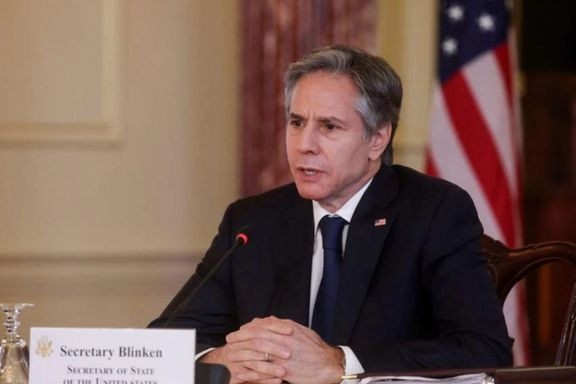
Secretary of State Antony Blinken

A group of American senators have expressed serious concerns over a decision which makes individuals who supported terrorist organizations eligible for immigration to the United States. 

In a letter to Secretary of Homeland Security Alejandro Mayorkas and Secretary of State Antony Blinken released on Tuesday, Senator Bill Hagerty (R-TN) led his colleagues, including Ted Cruz (R-TX), Marco Rubio (R-FL), Joni Ernst (R-IA), to ask for explanation over a determination that allows individuals who provide “insignificant material support” or “limited material support” to terrorist organizations from admission into the United States. 

On June 8, 2022, the Department of Homeland Security and Department of State determined that they will no longer bar such individuals, that critics say can alter immigration policy and affect the security of the United States.

“Under federal law, persons who have engaged or assisted in terrorist activities are generally ineligible to immigrate to the United States,” the senators highlighted, saying that the June 8 Determination broadly permits the admission of foreign individuals who provided material support to terrorist organizations that the Biden Administration deems insignificant or limited.

“The timing of the June 8 Determination -- nearly a year after the Administration’s botched withdrawal from Afghanistan -- also raises questions. If its intent is to ensure that Afghan refugees are able to gain asylum in the United States, there is no explanation regarding why this decision was not made months ago with prudent restrictions limiting its application to Afghan refugees,” they said, asking the administration to provide a detailed description of the Afghan nationals to whom the decision is applied and provide examples of their support for the designated terrorist organizations.

Most Viewed

Ghalibaf defends Iran-US talks amid hardline backlash
1
INSIGHT

Ghalibaf defends Iran-US talks amid hardline backlash

2
ANALYSIS

From instability to influence: Pakistan’s pivotal role in US-Iran diplomacy

3
ANALYSIS

100 days on: why Iran’s January protests spread across social classes

4

War-hit homeowners feel abandoned as Iran’s reconstruction aid fades

5

Iran says no decision yet on talks as Pakistan prepares to host US team

Banner
Banner

Spotlight

  • The politics of pink: how Iran uses cuteness to rebrand violence
    ANALYSIS

    The politics of pink: how Iran uses cuteness to rebrand violence

  • Bread shortages, soaring prices strain households in Iran, residents say
    VOICES FROM IRAN

    Bread shortages, soaring prices strain households in Iran, residents say

  • War-hit homeowners feel abandoned as Iran’s reconstruction aid fades

    War-hit homeowners feel abandoned as Iran’s reconstruction aid fades

  • 100 days on: the anatomy of Iran’s January crackdown
    INSIGHT

    100 days on: the anatomy of Iran’s January crackdown

  • Ghalibaf defends Iran-US talks amid hardline backlash
    INSIGHT

    Ghalibaf defends Iran-US talks amid hardline backlash

  • From instability to influence: Pakistan’s pivotal role in US-Iran diplomacy
    ANALYSIS

    From instability to influence: Pakistan’s pivotal role in US-Iran diplomacy

•
•
•

More Stories

Republican Lawmakers Voice Opposition To New Deal With Iran

Aug 24, 2022, 12:53 GMT+1

Several US Republicans have expressed their concerns about the apparently imminent agreement with Iran to revive the 2015 nuclear accord. 

Texas Senator Ted Cruz said on Tuesday that "This deal will quickly flood the regime with hundreds of billions of dollars and soon afterwards the deal will be worth trillions. It will dismantle sanctions on Iran economy, which is controlled by IRGC, and provides IRGC with resources it needs to export its terror globally."

He said that “the Iranian regime violated the last nuclear deal, violated their most fundamental nuclear obligations beyond the deal, and violated international norms against nuclear proliferation. This deal will excuse Iran from that previous cheating, while enabling it to continue into the future.”

Reiterating his intention “to systemically fight the implementation of this catastrophic deal” Cruz added that he “will work with my colleagues to ensure that is blocked and eventually reversed in January 2025," referring to the date the next US administration assumes office. "A year ago, Biden gave Afghanistan to the Taliban. Now he intends to give a nuclear arsenal to Iran. The details of this deal are only now emerging, but we already know they'll be catastrophic to the national security of the US and allies and to the safety of Americans."

Expressing concern over a lack of recent engagement with Congress on reviving the JCPOA, Texas Representative Michael McCaul wrote to President Joe Biden to demand that Congress be given a chance to review any agreement to revive JCPOA.

Indiana's representative Jim Banks said, “Biden can't stop Congress nor a future GOP admin from reimposing Iran sanctions.” “If Iran is looking for 'guarantees,' I guarantee conservatives will work to reverse any of Biden's sanctions relief.”

Iran Says Europe Needs A Nuclear Deal 'Not To Freeze' This Winter

Aug 23, 2022, 20:15 GMT+1
•
Mardo Soghom

Fars news agency in Tehran has again brought up the issue of an energy crunch, arguing that Europe needs a nuclear deal with Iran not to "freeze this winter."

Fars, linked to the Revolutionary Guard, is not the only government-controlled media outlet periodically bringing up this issue, as Iran negotiates with the United States through the Europeans to restore the 2015 nuclear deal (JCPOA).

Once the deal is restored the United States will lift oil export sanctions imposed by former President Donald Trump when he withdrew from the JCPOA in 2018. It will also remove international banking restrictions also imposed as part of Trump’s ‘maximum pressure’ on Tehran.

But what Iranian media presents as ‘Europe’s freezing winter” has almost nothing to do with Tehran’s crude oil exports, except generally helping to bring down oil prices. Europe’s need to replace Russian gas is a specific issue on its own that Iran cannot help with at all.

There are two major reasons why a nuclear agreement now cannot impact Iran’s ability to export natural gas for the foreseeable future.

First is Iran’s huge domestic need that exceeds its current production capacity, and second is the absence of the infrastructure to export the gas as LNG.

Iran produces around 750 million cubic meters of gas per day, which is a considerable amount, but it has suffered from domestic shortages for the past three years as demand has risen and gas production has plateaued or decreased.

A gas production platform in South Pars field in the Persian Gulf in 2018
100%
A gas production platform in South Pars field in the Persian Gulf in 2018

The huge domestic demand primarily comes from extraordinary low prices – a de facto fuel subsidy offered to the population more as a loft-over of the revolutionary days than any good reason. Some estimates say that Iran has sustained a loss of close to $300 billion in the past decade simply by selling gas cheap to domestic consumers. In the same manner, gasoline and electricity are extremely cheap in Iran. A gallon of gasoline is sold at the pump for around 22 US cents.

Natural gas production could have increased with exports in mind, since Iran has the second largest reserves in the world, but for close to 20 years successive government were unable to invest in boosting extraction. The reason for this was both international sanctions (2010-2015) and current US sanctions imposed since 2018. There are also US sanctions prohibiting American participation in Iran’s energy sector going back to 1996.

All these sanctions were imposed because of Iran’s nuclear program and they banned investments and critical technology that only Western energy giants could have provided for expanding production.

Even Chinese energy companies left Iran’s South Pars gas field in the Persian Gulf that can easily produce more than 10 percent of global needs.

Having fallen behind in gas production, Iran also never built LNG terminals to serve global markets, like its tiny neighbor Qatar has done. Building such terminals can take 3-5 years, even if a nuclear agreement is signed today and US sanctions are lifted. Considering the need to build larger gas platforms to boost production, the time needed for Iran to ship LNG to Europe is at least 7-8 years.

There are also political hurdles Tehran must overcome. Its most important strategic ally is Russia, which would not like Iran taking a big share of its European market. The Iranian government is talking about a “gas swap” with Moscow, which means Russia wants Iran to sell its natural gas.

If current European strategy of replacing Russian gas stays in place in the absence of a resolution to the Ukraine crisis, any gas deal with Iran would mean buying energy from Moscow.

Swedish Police Defuse Bomb Near Iranian Concert Venue

Aug 22, 2022, 17:10 GMT+1

A bag with an explosive charge was found in a Stockholm park on Sunday night during an annual cultural festival in which Iranian popstar Ebi was performing. 

Police in Sweden said Monday that the content of the bag was immediately “assessed as dangerous” and that the National Bomb Squad has opened an investigation into the attempted public destruction. The finding prompted police to cordon off the area while traffic was briefly re-directed.

The Swedish newspaper Aftonbladet said it contained a bomb and was found near the Cafe Opera, a famous nightclub. 

“It is only after the investigation at the national forensic center that we can say whether the dangerous object was functional," said Erik Åkerlund, local police manager. At the moment no one is in custody.

The five-day Stockholm Culture Festival wrapped up on Sunday with a concert by legendary pop singer Ebi, whose real name is Ebrahim Hamedi and is a known Iranian dissident. 

Tensions are relatively high between Iran and Sweden over a Swedish court’s sentencing of former Iranian jailor Hamid Nouri to life imprisonment over executions of political prisoners in 1988.

While human rights advocates such as UN High Commissioner for Human Rights Michelle Bachelet and Amnesty International have lauded the decision as a historic conviction and "an unequivocal, and long overdue, message to the Iranian authorities” for crimes against humanity, the Islamic Republic “strongly condemned” the court’s “politically-motivated and unacceptable” verdict. 

In June, the Swedish Ministry of Foreign Affairs advised its citizens against traveling to the Islamic Republic due to the security risks to foreigners.

US, France, UK, Germany Discuss Iran’s Nuclear Deal, Destabilizing Acts

Aug 21, 2022, 22:11 GMT+1

The leaders of Western powers engaged in Iran's nuclear talks discussed efforts to revive the 2015 JCPOA accord, the White House said on Sunday in a statement. 

In addition to the Russian invasion of Ukraine, “they discussed ongoing negotiations over Iran’s nuclear program, the need to strengthen support for partners in the Middle East region, and joint efforts to deter and constrain Iran’s destabilizing regional activities," the White House said in its description of the call among the four allies. It did not provide any further details about the issues concerning the Middle East.

US President Joe Biden, British Prime Minister Boris Johnson, French President Emmanuel Macron and German Chancellor Olaf Scholz participated in the call.

Last week, the European Union and United States said they were studying Iran's response to what the EU described as a "final" proposal to restore the deal. 

Earlier in the day, Mohammad Marandi, the de facto spokesman for Iran's nuclear negotiating team, said that Tehran has received considerable concessions from Washington in the nuclear talks.

A leaked report from Tehran on Friday, August 19, said that Iran’s chief nuclear negotiator Ali Bagheri-Kani had given local reporters in a closed-door briefing a list of “concessions” obtained from the United States.

These included exempting a range of Iranian government-linked entities from sanctions imposed for their role in Iran’s terror-related activities, and a pledge not to sanction any entity for links with the Revolutionary Guard.

Iran Targets Members Of Advocacy Group On US Soil

Aug 20, 2022, 16:49 GMT+1

Iranian operatives have targeted several senior members of US-based advocacy group United Against Nuclear Iran (UANI) through surveillance and cyber operations. 

According to a report by The Dispatch, members of the New York-based think tank have been the subject of suspected Iranian surveillance operations carried out on US soil as well as various phasing operations believed to be carried out by a cyber warfare group linked to the Islamic Republic.

The report said in addition to threats against former National Security Advisor John Bolton and former secretary of state Mike Pompeo, those being targeted include UANI CEO and former US Ambassador to the United Nations under the George W. Bush administration Mark Wallace, the group’s original funder Thomas Kaplan, and former Democratic Senator Joe Lieberman from Connecticut who currently serves as the chairman for UANI. 

In cyberspace, suspected Iranian hackers have attempted to carry out various phishing operations on UANI members. According to UANI these hacking campaigns are the work of Charming Kitten, an Iranian government-linked cyberwarfare group.

Kaplan told The Dispatch, “The threat existed from the very beginning. It’s just gotten more and more pervasive. I’d been sort of given signals that the Iranians were watching, and that didn’t inhibit me. And it still doesn’t inhibit me despite the fact that the threat level is now at an official level.”

“The threats to Americans are multiple, pervasive, and systematic. This is a strategic effort by the Iranians to intimidate, exert their strength—a show of force—because they feel like they can either manage, or deal with, or temper any response,” Wallace said.






