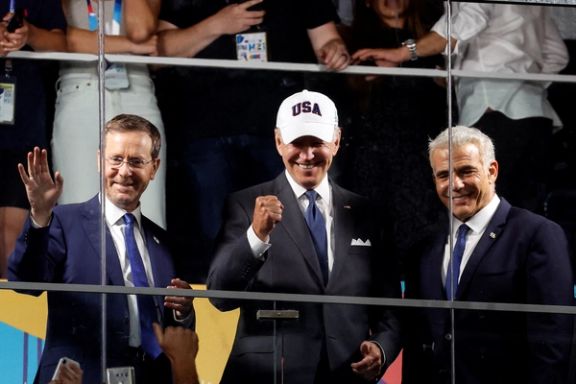
President Joe Biden with Israeli leaders during his regional tour, on July 14, 2022
As optimism about a nuclear deal with the West takes hold in Iran, its battered currency has risen by around 15 percent in August, which can help with inflation.
The US dollar has dropped from a high of 330,000 rials in June to around 280,000 in Tehran’s exchange market as of Sunday morning local time. That could help prevent a faster rise in the annual inflation rate, which stands at 54 percent, with food prices having risen by more than 100 percent in the past year.
The small but important reprieve from economic pressure, however, can reverse itself if negative signs emerge that the nuclear talks have hit a snag.
Statements and leaks by Iranian officials of having gained big concessions from the United States have fueled a sense of certainty that most important issues have been resolved in the talks.
At the same, time the Israeli Walla News reported on Saturday that Biden Administration officials have told Israel’s leaders a new deal “is not imminent” and Washington has not made any new concessions to Tehran.
However, the report said that Israeli officials, who in recent days had called for an end to talks, have not been convinced by US assurances.
“We may be closer to a deal than we were two weeks ago, but there are still uncertainties about a resolution and differences remain with the Iranians,” an unnamed US official told the site. “At any rate, the signing of a nuclear deal is not expected in the immediate timeframe.”
In fact, Iran is waiting for the US to send a response to the European Union regarding Iran’s position passed on to the EU on August 15. Observers were expecting the US response on Friday, but so far it is not clear when Washington will formally send an answer.
In the meantime, a leak from Tehran attributed details of “US concessions” to Iran’s top negotiator Ali Bagheri-Kani from a closed-door briefing with local reporters. It is not clear if the leak was meant to influence US politics regarding the nuclear deal or was to assure domestic audiences that Iran won in the negotiations.
The ultra-conservative Kayhan newspaper in Tehran, affiliated with Supreme Leader Ali Khamenei published a lead article on Sunday urging Iran’s negotiators not to give in the “America’s bluffs”. The paper claimed that the economic situation is so bad in Europe and the United States that they are the ones who need the nuclear deal.
At the same time, the government official news website IRNA on Sunday citedan International Monetary Fund report, saying that Iran’s available foreign currency reserves have risen from $21 billion in 2021 to $41 billion so far.
In fact, Iran’s economic crisis is far from being resolved, despite more clandestine oil exports starting from late 2020 and higher oil prices since the invasion of Ukraine.
A government official speaking on financial hardship to meet salary and pension increases promised to the population said that Iran’s estimated budget deficit would be 3,250 trillion rials until March 2023. Depending on the exchange rates, this could range from $13 billion to as much as $18 billion, but the important fact is that it constitutes around 30 percent of the budget.
The parliament’s research center estimated in December that the budget deficit for 2022 would be “between 3,000 and 6,000 trillion rials.”
Mohammad Marandi, spokesman for Iran's nuclear negotiating team
Mohammad Marandi, who acts as de facto spokesman for Iran's nuclear negotiating team, claims that removing Revolutionary Guard form the US terrorism designation was never a key demand for Tehran.
Marandi said in a tweet on Saturday that “I've often said over the past few months that removing the Guards from the US Foreign Terrorist Organization list was never a precondition or key demand.”
“Iran will simply keep CENTCOM on its terror list. But if the US needs to say this to sell the deal, that's their business,” he added.
Marandi’s comment came while talks to revive the JCPOA in Vienna came to an abrupt stop in March, reportedly for Iran’s insistence that the IRGC be removed for the US list of Foreign Terrorist Organizations (FTO).
Marandi, who has been advisor-cum-spokesman for Tehran’s negotiators, made the remarks after a leak quoted Iran's chief nuclear negotiator Ali Bagheri-Kani presenting a detailed list of "concessions" Iran claims to have received from the US, but removing the IRGC terrorist designation was not included in the list. Bagheri-Kani was quoted as saying that the IRGC Issue will be discussed at a later stage with the US.
However, according to the same leak, the US is willing to guarantee that its sanctions against IRGC would not affect other sectors and firms, including companies dealing or affiliated with the military force.
An undated photo showing former IRGC commander Qassem Soleimani (L) killed by a US drone strike, with other top generals
An unnamed US official has told CNN that Iran has dropped one of its key demands in the nuclear talks, while leaks from Tehran portray extensive US concessions.
CNN quoted the US official late Friday that Iran’s thorny demand to remove its Revolutionary Guard (IRGC) from the US list of Foreign Terrorist Organizations is no longer mentioned by Tehran in its latest response to a European Union draft proposal.
Leaked information from Iran obtained Friday by Iran Internationalcorroborates this development, as Iran’s chief negotiator Ali Bagheri-Kani allegedly told reporters in a closed-door briefing this week that the IRGC issue will be taken up in separate future talks.
What remains unclear are dozens of companies and banks sanctioned by the United States that are affiliated with the IRGC. It is not clear if the US will remove sanctions on most or some of these entities.
The leaked information from Iran, although not specific, points to 17 banks and numerous companies and quasi-state institutions being relieved of sanctions, while the official speaking to CNN said Iran “also dropped demands related to delisting” several companies linked to IRGC.
Iran's chief negotiator Ali Bagheri-Kani meeting with Russia's Mikhail Ulyanov in the latest round of talks in Vienna, August 4, 2022
The apparent contradiction might be entirely an issue of numbers. While dozens of entities were sanctions by the Trump administration, a few might be kept on US sanctions, while many more might be removed. In a sense, at this point when there is no official details about the talks, both the leaked information from Tehran and the unnamed official in Washington might be semantically telling part of the truth.
Iran International reported on Thursdaythat information circulating among pro-government hardliners in Tehran said sanctions will be removed from 150 institutions or entities, all affiliated with the state or with centers of power such as “charitable” organizations linked to the office of the Supreme Leader and possibly the IRGC.
One name mentioned is a huge business conglomerate, presented as a charity, directly run by Supreme Leader Ali Khamenei’s office. The entity is called The Execution of Imam Khomeini's Order (EIKO), which is known in Persian simply as Setad, which was not sanctioned specifically for Iran’s nuclear program.
In this sense, the problem of whether to delist IRGC or not is clouding the main issue in the US negotiations policy. The Biden Administration has been claiming that it will not lift non-nuclear sanctions, such as those imposed for links to terrorism, Iran’s missile program or human rights violations. EIKO was sanctioned on January 13, 2021, days before President Trump left office, under the Executive Order (E.O.) 13876, which was imposed for Iran’s regional destabilizing activities and its missile program.
Therefore, the more important issue with US concessions to Iran is not merely keeping the IRGC and a few of its companies sanctioned, but more broadly what other regime-affiliated entities will be taken out of sanctions.
In the leak about Bagheri-Kani’s briefing, it is mentioned that the IRGC sanctions will remain in place, but they will have a more “symbolic” significance, since the US has agreed not to penalize other entities having interactions with the military-intelligence force dominating Iran’s political and economic landscape.
A leaked report on alleged remarks by Iran's chief nuclear negotiator obtained by Iran International, provides details on "concessions" Iran claims to have received from the US.
The leaked report is from a closed-door briefing Ali Bagheri-Kani provided to journalists in Tehran in recent days.
The length and breadth of points mentioned by Iran’s chief negotiator show a multitude of concessions by the United States, but it does not include references to what Iran has agreed to do, to return to compliance with 2015 nuclear deal, the JCPOA.
According to detailed leaked information, Bagheri Kani mentioned the following “concessions” Iran was able to extract from the US.
1- The amount of natural uranium Iran receives from Russia must be double the amount of yellowcake it is obligated to hand over to Russia according to the JCPOA.
2- Issue of removing IRGC from the US list of Foreign Terrorist Organization (FTO) will be discussed in negotiations that will follow the revival of JCPOA.
3- However, the US guarantees that its sanctions against IRGC would not affect other sectors and firms: e.g. a petrochemical company shouldn't be sanctioned by US because of doing business with IRGC. In other words, the FTO designation will have mostly a “symbolic” value.
Bagheri-Kani in Vienna as he starts his first roud of talks on November 29, 2021
4- The US guarantees that its domestic laws like The Countering America's Adversaries Through Sanctions Act (CAATSA) and Patriot Actwould not impact implementation of its obligations under JCPOA. This claim by Bagheri-Kani can have serious legal implications, since both deal with financial and other illegal activities in arms proliferation and terrorism.
5- In addition to the United States abrogating three Executive Orders issued by former President Donald Trump, Iran has received concessions from US on two other Trump EOs which deal with sanctions on Iranian entities tightly linked to the state and its military and clandestine projects. Bagheri-Kani said during the briefing that Iran has not given any concessions in return for annulment of these Eos.
6- Upon Russia's proposal, the deal says, "the participants note the firm commitment of the US President (not mentioning Joe Biden by name) for returning to JCPOA compliance as long as Iran remains committed to the deal." Bagheri says this means the US president guarantees implementation of JCPOA (even though it's not binding for any of the two sides).
Bagheri-Kani meeting with the Russian negotiator Mikhail Ulyanov, January 23, 2022
7- The UN Security Council’s snapback mechanism to be used in case of Iranian JCPOA violations can only be triggered based on an IAEA report. If one country triggers the mechanism unilaterally, other parties commit not to cooperate with it, and compensate the Iranian side.
8- The US guarantees that all foreign companies that would start working with Iran until the end of Joe Biden’s presidency, will remain exempted from possible reinstated US sanctions for 2.5 years after a US withdrawal. Bagheri- Kani explained that Iran demanded this clause in case if Republicans win the Whit House in 2024 and move to withdraw from the JCPOA. Although not binding once the US withdraws, but it would add more international political pressure on the United States.
9- US Secretary of State will publish a letter announcing the US participation in JCPOA.
* Bagheri-Kani also claimed that he heard from Mora that Ulyanov had, in his talks with EU, expressed objection to closure of IAEA's Iran probe. But Bagheri says Mora must have been “lying” because Ulyanov always supported Iran's demand in his talks with the Iranian team.
Baqer and Siamak Namzi, father and son, held hostage in Iran since before the US exited the JCPOA
11- Iran will release all US prisoners once the $7 billion worth of its assets frozen in South Korea are released. Bagheri said Iran and the US had earlier agreed on this, but US reneged on its promise, assuming that the money will give Iran financial breathing room to raise new demands.
According to Bagheri, Iran refused to accept the following US demands:
1- Discuss Iran’s missile program in parallel with the JCPOA talks. In fact, this was dropped during the first weeks of the Vienna talks in 2021 when the previous Iranian administration was conducting the negotiations.
2- Discuss Iran’s regional policies and actions, which the US still insists on and might be tied to future talks on lifting the IRGC sanctions – if any such talks take place.
3- Discuss limiting Iran’s nuclear breakout time.
4- Destruction of Iran's uranium enrichment centrifuges. Bagheri-Kani said that the other side wanted Iran to destroy its IR-6 advanced centrifuges (around 100 machines), but they finally agreed that Iran keeps the machines in a warehouse under IAEA's watch.
5- Destruction of concrete platforms of for these and possibly other centrifuges.
6- A promise by the two countries' foreign ministry spokespersons that Iran and the US will not anymore seek to kill citizens of the other side. Iran refused to accept this, even though US law enforcement agencies say the Islamic Republic launched plots to kill former Trump administration officials on US soil.
Bagheri-Kani at one point also said that Iran used smart tactics to win points. One example was disregarding around 11 deadlines set by the West, and on one occasion dismissiing US Special Envoy Rob Malley's threat to leave Vienna, saying that in the end Malley stayed.
It is not clear if leaking the information from Bagheri-Kani’s alleged media briefing was an intentional act by Tehran.
What he claimed in the briefing could still damage the outcome of the talks, and it is possible the victorious claims were intended for domestic consumption, once media in Iran is allowed to publish them.
An Iranian lawmaker says due to sanctions on the country the quantity and quality of Iran's aviation industry is decreasing day by day.
According to Alireza Pakfetrat, the representative of Shiraz in the parliament, the number of passenger planes that remain operational have decreased as well as the number of flights in the country.
He added that the quality and technical upkeep of the aircraft have also suffered significantly, causing flight delays.
Criticizing Roads and Urban Development Ministry, he said it is spending most of its time and budget on housing projects and forgets that the aviation industry is also part of their responsibilities.
He also proposed splitting the ministry in two: one for urban development and one for road and transportation, which was the case in the past.
Iran has suffered from shortages of civilian airliners since the 1990s and used a variety of ways to lease older planes or buy spare parts through intermediaries, but the technical state of its fleet has been deteriorating.
The 2015 nuclear agreement (JCPOA) suspended sanctions on purchases of Western aircraft and Iran began talks to buy new planes from Boeing and Airbus. A few airbus planes were delivered but the Trump administration never approved sale of US planes until Washington withdrew from the JCPOA in May 2018 and reimposed sanctions.
The flags of South Korea and the Islamic Republic of Iran
South Korea is discussing with top officials from the United States and the European Union the possible restoration of the 2015 Iran nuclear deal, which may lead to unfreezing of Tehran’s assets in Seoul.
According to Yonhap, South Korea's vice foreign minister Cho Hyun-dong held back-to-back separate phone calls Friday with US special envoy for Iran Robert Malley and EU coordinator Enrique Mora to share the latest progress in negotiations to revive the JCPOA nuclear accord.
During the phone talks, Cho reaffirmed Seoul's support for restoring the agreement and expressed hope that a deal could help resolve South Korea's pending issues related to Iran.
Bilateral relations between Seoul and Teheran remain frayed after two South Korean banks locked $7-9 billion of Iranian funds owed for oil imports because of US banking sanctions, which were reimposed after former President Donald Trump in 2018 withdrew from the deal.
Iran, which sits on the world's fourth-largest oil reserves, was a key oil supplier to South Korea, and a main importer of goods such as industrial equipment, household appliances and vehicle parts.
Seoul stopped purchasing Iranian oil in May 2019 due to sanctions that banned the Islamic republic's oil exports.