• العربية
  • فارسی
Brand
  • Iran Insight
  • Politics
  • Economy
  • Analysis
  • Special Report
  • Opinion
  • Podcast
  • Iran Insight
  • Politics
  • Economy
  • Analysis
  • Special Report
  • Opinion
  • Podcast
  • Theme
  • Language
    • العربية
    • فارسی
  • Iran Insight
  • Politics
  • Economy
  • Analysis
  • Special Report
  • Opinion
  • Podcast
All rights reserved for Volant Media UK Limited
volant media logo

Internet Services Disrupted In Iran Amid Authorities’ Buck Passing
Aug 1, 2022, 17:51 GMT+1
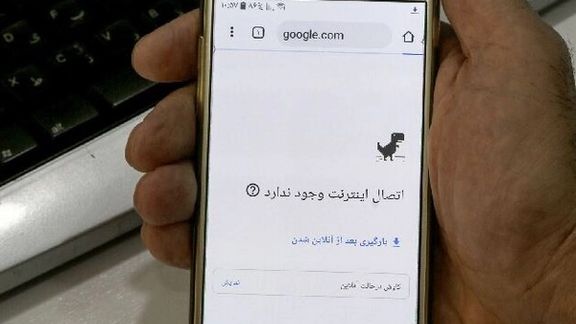
Internet services have been disrupted in Iran in the past few days.

Following days of disruption in internet services in Iran and conflicting explanations by authorities, cyberspace watchdog NetBlocks has confirmed a loss in national connectivity.

NetBlocks, which monitors cybersecurity and the governance of the internet, said on Monday, “A significant internet outage has been registered in Iran affecting cellular and fixed-line services including Irancell and the TIC gateway; real-time network data show national connectivity at 79% of ordinary levels; incident ongoing.”

Iran’s Telecommunication Company announced that the widespread disruption was caused by a fire in one of the infrastructure facilities. A few days ago, the ministry of information and communications technology had blamed power fluctuations and out-of-date infrastructure at the country’s Electricity Distribution Company for the issue, a claim that the power company denied. 

It is not clear what happened in Iran's internet distribution center that the authorities are perhaps trying to hide, but one of the Islamic Republic’s policies to cover up sabotages is obfuscation through conflicting statements that cannot be confirmed or denied. 

Iran has been heavily censoring access to the Internet for the past 20 years to restrict citizens’ access to information. Many foreign and Iranian websites, including news media websites, are already blocked in Iran although controls are readily sidestepped by VPNs (virtual private networks) and anti-filtering software.

Since a few months ago, hardliners in the parliament are pushing to ratify a bill to further restrict internet and social media access, and reportedly launch a domestic intranet, whose content can be supervised. 

Late in July, Iranians were outraged by a government move to forcibly activate Safe Search on Google for all citizens.


Most Viewed

Ghalibaf defends Iran-US talks amid hardline backlash
1
INSIGHT

Ghalibaf defends Iran-US talks amid hardline backlash

2
VOICES FROM IRAN

Bread shortages, soaring prices strain households in Iran, residents say

3
INSIGHT

Iran diplomacy wobbles as factions compete to avoid looking soft on US

4
ANALYSIS

The politics of pink: how Iran uses cuteness to rebrand violence

5
ANALYSIS

From instability to influence: Pakistan’s pivotal role in US-Iran diplomacy

Banner
Banner

Spotlight

  • Is Iran entering its Gorbachev moment?
    INSIGHT

    Is Iran entering its Gorbachev moment?

  • Iran crackdown reaches cemeteries as graves of slain protesters defaced
    EXCLUSIVE

    Iran crackdown reaches cemeteries as graves of slain protesters defaced

  • Iran diplomacy wobbles as factions compete to avoid looking soft on US
    INSIGHT

    Iran diplomacy wobbles as factions compete to avoid looking soft on US

  • The politics of pink: how Iran uses cuteness to rebrand violence
    ANALYSIS

    The politics of pink: how Iran uses cuteness to rebrand violence

  • Bread shortages, soaring prices strain households in Iran, residents say
    VOICES FROM IRAN

    Bread shortages, soaring prices strain households in Iran, residents say

  • Ghalibaf defends Iran-US talks amid hardline backlash
    INSIGHT

    Ghalibaf defends Iran-US talks amid hardline backlash

•
•
•

More Stories

Food Inflation In Iran Nears 100% As Nuclear Talks Drag On

Aug 1, 2022, 16:17 GMT+1
•
Mardo Soghom

Annual food inflation has reached 100 percent in parts of Iran, according to the latest figures published by the Statistical Center of Iran (SCI) in late July.

The overall nationwide point-to-point annual food inflation rate in June 2022 compared with the same period in 2021 was 87 percent, SCI reported last week, but in four provinces the rate reached almost 100 percent.

Most of the price increases happened since early May when the government scrapped a food import subsidy to save around $15 billion annually. The move immediately triggered a massive rise in prices for basic food staples, such as bread, dairy products, cooking oil and meet.

Although the government has repeatedly said its oil exports are steadily increasing despite sanctions by the United States, economic conditions keep deteriorating, with overall annual inflation reaching 54 percent in June.

However, Iran has not made a decisive move to reach a nuclear agreement with the US, which could lift oil export sanctions and boost government revenues.

When the government stopped the import subsidies it promised to issue coupons to people with lower incomes to buy essential food items at lower prices, but so far, no system has been set up to issue coupons.

Aftab News in Tehran said Monday that the government is planning not to issue coupons offering lower prices but aims to limit how much food people can buy. This would create new political tensions even among the hardline supporters of the government. The website adds that food prices will never go down, and on the contrary inflation can only get worse.

Another major problem during US sanctions is the fast growth in Iran’s money supply, which has climbed to upwards of 50 quadrillion rials. That is 50 with fifteen zeros. In free market exchange rate this amount would be around $200 billion, simply because the Iranian currency has lost so much of its value. If we take the exchange rate before the United States imposed sanctions in 2018, the liquidity in Iran would be equivalent to 1.5 trillion dollars.

Mahmoud Jamsaz, an economist in Tehran told Khabar Online news website on July 31 that in the past Iranian year, from March 2021-to March 2022, the government has been printing the equivalent of $15 million a day to finance its budgetary shortfall. That is 3.8 trillion rials every day.

Despite assurances by President Ebrahim Raisi’s (Raeesi) government that it has stopped printing money, Jamsaz insisted that simply the format of government borrowing has changed, not the fact that it is adding to the money supply. This in turn fuels more inflation, impoverishing tens of millions of people who were modest wage earners or members of the middle class, able to live relatively comfortable lives before.

The economist explained that government finances this year are in a worse situation compared to last year, because the budget has been built on two unrealistic revenue projections.

The biggest expectation is close to five quadrillion rials of oil income, twice as high as what materialized last year, while US sanctions are still in place and the war in Ukraine has made Russia a competitive to Iran in the oil market.

The second optimistic figure is tax revenues estimated to be 62 percent higher than last year. This is unrealistic because the economy is not growing to allow so much more tax collection.

This was confirmed by the Supreme Accounting Office of the state in July that said just 15 percent of expected oil revenue came into the treasury from March to May.

Jamsaz, like other economists says that the Raisi government holds “the record in both high inflation and money supply” in nearly three decades.

Iran Says Stability Of Mideast Hinges On Iraq’s Stability

Aug 1, 2022, 14:29 GMT+1

Following days of protests at Iraq’s parliament against Iran’s interference in the country’s politics, Tehran says it respects the choice of the Iraqi people. 

Speaking in his weekly press conference on Monday, Iran’s foreign ministry spokesman Nasser Kanaani said that stability in the region depends on the stability in Iraq. 

Emphasizing that dialogue is the best way to solve Iraq’s domestic problems, he said, “we are confident that with the maturity of the Iraqi people, and the tact by the Iraqi leaders, the country will pass this phase well and we will witness increasing stability and peace in Iraq.”

Describing Iraq as Iran’s “big and important neighboring country,” Kanaani said Tehran follows the developments there carefully and attaches significant importance to the security of this “important friendly and brotherly neighbor.”

“We believe that Iraqi political movements and parties and organizations can overcome the current situation in a peaceful way... within the framework of the constitution and legal mechanisms of the country and help the country’s development and progress through forming a popular government,” he added. 

On Sunday, July 31, influential Iraqi Shiite cleric Muqtada al-Sadr -- who seeks to curb the influence of the Islamic Republic of Iran in Iraqi politics -- called on his supporters to join thousands of others who have camped at the parliament to prevent the formation of a new government, saying that now is the best time to change the political system and constitution. “This is a great chance for radical change to the political system. Don’t miss your chance."


Two More Workers In Iran Set Themselves On Fire Due To Economic Hardship

Aug 1, 2022, 12:26 GMT+1

While people in Iran face severe economic hardship induced by corruption, mismanagement and sanctions, two more cases of self-immolations were reported in the country. 

The recent cases happened in the northern city of Lahijan and western city of Ilam due to financial hardships the victims faced. The prosecutor of Lahijan, Ebrahim Ansari, said on Sunday that one of the workers of the city’s water and wastewater management company set himself on fire in protest to his suspension by the contracting company. 

Hengaw Organization for Human Rights also reported that a 30-year-old man, identified as Jamil Valibaygi, set himself on fire because of financial pressures. 

In June, two workers in Bandar-e Mahshahr in the southwestern province of Khuzestan also set themselves on fire in protest to their dismissal. They survived thanks to prompt intervention by their coworkers. Earlier, a worker in the city of Yasuj, the capital of Kohgiluyeh and Boyer-Ahmad province, set himself on fire over his inability to pay a debt of about 10 million tomans, or $300. 

Earlier in the year, a biology teacher killed himself in the city of Minab in the southern province of Hormozgan over economic problems. In recent months, there have been other reports about teachers committing suicide due to financial problems, including Gholamabbas Yahyapour, a mathematics teacher from the city of Gerash in the Fars province who killed himself late in 2021.

Food prices have risen by more than 80 to 100 percent in recent months, on top of high inflation in the previous three years, while most wage earners get less than $200 a month.

Iran Intensifying Harassment Of Baha’i Religious Minority

Aug 1, 2022, 10:57 GMT+1

Iran’s security forces have arrested several members of the Baha’i religious community regarded by the clerical government as heretics, and raided more than 20 households. 

Fariba Kamalabadi, Mahvash Sabet (Shahriari) and Afif Naimi, three former directors of the Iranian Baha'i community known as "Yaran", were among those who were arrested on Sunday, July 31, in Tehran and Karaj. The three had been detained before in 2018 and spent 10 years behind bars. 

Several arrests were also reported in the cities of Sari in the northern Mazandaran province and Qazvin, near the capital. 

Iran’s intelligence ministry claimed on Monday that the arrested Baha’is were linked to the Baha’i center in Israel, where the religious group’s international headquarters are located, and had collected and transferred information there.

The Worldwide Baha’i Community said in a July 20 statement that Tehran had intensified its systematic campaign to suppress the religious minority in recent weeks, either arresting, summoning to court, putting on trial or closing the businesses of at least 20 Baha'i citizens just in July.

According to the community, in June at least 44 Baha'is were detained, summoned to court, put on trial or given prison sentences, or had their homes searched.

The 1979 constitution of the Islamic Republic recognizes only Islam, Christianity, Judaism and Zoroastrianism. Supreme Leader Ali Khamenei has on several occasions called the Baha'i faith a cult and in a religious fatwa in 2018 forbade contact, including business dealings, with followers of the faith.

Baha'is, who number around 300,000 in Iran, say their rights are systematically violated and they are often harassed, forced to leave their homes and businesses, and are deprived of government jobs and university education.

Iran To Draw 50-Year Roadmap For Nuclear Program

Jul 31, 2022, 20:15 GMT+1

Iran’s atomic chief says members of parliament are seeking to legislate a 50-year nuclear roadmap so change of administrations cannot influence the program. 

Following a meeting with the members of parliament's energy committee on Sunday, Mohammad Eslami, vice president and the head of the Atomic Energy Organization of Iran (AEOI), said that the parliamentarians are pushing to turn the so-called comprehensive roadmap for nuclear industry into law in such a way that the nuclear development process is not damaged by the change of administrations.

The document, which was unveiled on April 9 this year by the AEOI, includes the country’s plans for nuclear activities such as power generation, increasing nuclear radiation applications, radiopharmaceuticals, protection against radiation, and developing nuclear infrastructures. 

He added that the AEOI wants people to feel the tangible effects of nuclear technology in their lives. 

During the past weeks, many Iranian observers including commentators and lawmakers criticized President Ebrahim Raisi for claiming that the people wish to resist rather than reach an agreement that would lift US sanctions and bring about a breakthrough in Iran's economy.

Some former Iranian diplomats suggested that Raisi and other ultraconservatives take advantage of the current foreign policy impasse over the revival of the JCPOA for their own personal or factional political gains to strengthen their foothold in Iran's domestic politics.

Diplomats negotiating to revive the 2015 nuclear deal, JCPOA, have repeatedly said that an agreement has almost been completed in 11 months of talks in Vienna, but Tehran demands more sanctions be lifted than Washington is willing to waive.