• العربية
  • فارسی
Brand
  • Iran Insight
  • Politics
  • Economy
  • Analysis
  • Special Report
  • Opinion
  • Podcast
  • Iran Insight
  • Politics
  • Economy
  • Analysis
  • Special Report
  • Opinion
  • Podcast
  • Theme
  • Language
    • العربية
    • فارسی
  • Iran Insight
  • Politics
  • Economy
  • Analysis
  • Special Report
  • Opinion
  • Podcast
All rights reserved for Volant Media UK Limited
volant media logo

Second Politician In Tehran Says Iran Can Produce Nuclear Weapons
Iran International Newsroom
Jul 18, 2022, 09:41 GMT+1Updated: 17:37 GMT+1
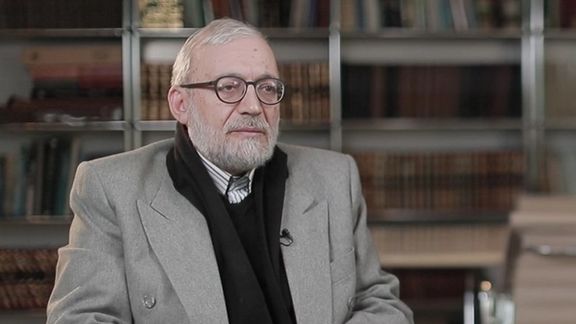
Mohammad Javad Larijani, a long-time political figure in Tehran's power pyramid

A senior political figure in Tehran has spoken of Iran’s ability to produce nuclear weapons, hours after a top adviser insisted the country has the capability.

Mohammad Javad Larijani, a former high-ranking official and one of the Larijani brothers who have long been influential regime insiders, told a TV program in Tehran on Sunday that if Iran wants to build a nuclear bomb “no one can stop it.”

Referring to what Iran says is a Fatwa by Supreme Leader Ali Khamenei against producing weapons of mass destruction, Larijani said, “We do not have permission to pursue weapons of mass destruction, including nuclear weapons, but if at some point we decide to do it naturally no one can prevent us.” Without naming the United States or Israel, he added, “They also know this.”

Hours before Larijani’s remarks on television, Kamal Kharrazi, Khamenei’s top foreign policy adviser told Al Jazeera Arabic, ““It is no secret that we have the technical capabilities to manufacture a nuclear bomb, but we have no decision to do so.”

The subtle threats from two senior Iranian figures come in the wake of President Joe Biden’s trip to Israel and Saudi Arabia last week, during which the president sounded a bit more forceful regarding Iran and its nuclear threat. Long before the trip, there were media reports of the United States forging some sort of a military network between Israel and Sunni Arab states opposed to Tehran’s rulers.

The trip, according to most assessments, had relatively modest results that can be summed up in reassuring Israel about US commitment to its defense and a start to re-building confidence with Saudi Arabia after a rough start by Biden. The US also signed a joint declaration with Israel, which said Washington is committed to preventing Iran from becoming a nuclear weapons state.

Larijani in his remarks also tried to appear optimistic about the stalled nuclear negotiations with the US. “I believe that the slowing down in the JCPOA process will be quickly fixed,” but he quickly added that Iran’s ability to make a nuclear bomb “is not something that can be eradicated with bombings.” Larijani was most likely referring to repeated Israeli threats to use a military strike if it feels Tehran is on the verge of building a bomb.

Larijani also took a jab at Biden, saying, “They swore not to let Iran obtain nuclear weapons, but American policies, are ancient like Biden. They are powerless in front of us.”

The chief of Israel's armed forces Lieutenant-General Aviv Kochavi said Sunday that preparing a military option against Iran is amoral duty and an urgent national security matter.

In fact, Iran’s ruler Khamenei is four years older than the US president.

Iran currently has sufficient uranium enriched to 60-percent purity to produce weapons-grade fissile material at 90-percent enrichment. The remaining stage would be the knowhow to make a nuclear bomb, and what Kharrazi and Larijani have hinted at is that Iran has that capability.


Most Viewed

Ghalibaf defends Iran-US talks amid hardline backlash
1
INSIGHT

Ghalibaf defends Iran-US talks amid hardline backlash

2
INSIGHT

A nation in limbo: 100 days after the massacre, has the world moved on?

3
ANALYSIS

From instability to influence: Pakistan’s pivotal role in US-Iran diplomacy

4
ANALYSIS

100 days on: why Iran’s January protests spread across social classes

5

War-hit homeowners feel abandoned as Iran’s reconstruction aid fades

Banner
Banner

Spotlight

  • Bread shortages, soaring prices strain households in Iran, residents say
    VOICES FROM IRAN

    Bread shortages, soaring prices strain households in Iran, residents say

  • War-hit homeowners feel abandoned as Iran’s reconstruction aid fades

    War-hit homeowners feel abandoned as Iran’s reconstruction aid fades

  • 100 days on: the anatomy of Iran’s January crackdown
    INSIGHT

    100 days on: the anatomy of Iran’s January crackdown

  • Ghalibaf defends Iran-US talks amid hardline backlash
    INSIGHT

    Ghalibaf defends Iran-US talks amid hardline backlash

  • 100 days on: why Iran’s January protests spread across social classes
    ANALYSIS

    100 days on: why Iran’s January protests spread across social classes

  • From instability to influence: Pakistan’s pivotal role in US-Iran diplomacy
    ANALYSIS

    From instability to influence: Pakistan’s pivotal role in US-Iran diplomacy

•
•
•

More Stories

Khamenei Adviser Says Iran Has Not Opted For Nukes But Has Capability

Jul 17, 2022, 18:30 GMT+1
•
Maryam Sinaiee

A senior adviser to Supreme Leader Ali Khamenei said Sunday that Iran has the technical capability to build a nuclear bomb but has not decided to do so.

“It is no secret that we have the technical capabilities to manufacture a nuclear bomb, but we have no decision to do so," Kamal Kharrazi, the head of Iran's Strategic Council on Foreign Relations and senior adviser to Khamenei told Al Jazeera's Arabic service.

"In a few days we were able to enrich uranium up to 60% and we can easily produce 90% enriched uranium,” Kharrazi said while stressing that Iran has the technical means to produce a nuclear bomb but has not decided to build one.

This is not the first time that Iranian officials say Iran is a nuclear threshold country butdoes not want or need a nuclear weapon and is only enriching uranium for energy and other civilian uses. They often add that Iran's supreme leader has declared that the production, stockpiling and use of nuclear weapons are all forbidden under Islam (haram).

Khamenei’s fatwa, or religious edict, against the acquisition or manufacture of nuclear weapons was first revealed in a statement from Iran to the International Atomic Agency (IAEA) in Vienna in August 2005.

But former Intelligence Minister Mahmoud Alavi in February 2021 hinted that the fatwa could change. Former Iranian diplomat and IRGC brigadier-general Amir Mousavi also in an interview with Lebanon’s al-Mayadeen television in January 2021 had said fatwas are not permanent and are issued in accordance with developing circumstances. “Therefore, I believe that if the Americans and Zionists act in a dangerous manner, the [Khamenei] fatwa might change.”

Indirect talks between Iran and President Joe Biden

Iran launching a ballistic missile on December 24, 2021
100%
Iran launching a ballistic missile on December 24, 2021

's administration, which aims to bring both Washington and Tehran back into compliance with the 2015 nuclear pact, officially known as the JCPOA, have been in limbo since March. Tehran and Washington both put the onus of breaking the deadlock on each other.

"There are no American guarantees relating to preserving the nuclear deal, and this will freeze any possible agreement," Kharrazi told Al Jazeera. He was referring to Iran’s demands to receive guarantees that the US would not leave the JCPOA and also lift all sanctions impacting its economy.

The advisor to Iran's Leader further said that direct talks with Washington were difficult “due to the thick wall of mistrust and American policies” while insisting that Tehran would never negotiate over its missile program and regional policy, as demanded by the US and its allies in the Middle East. “Accepting this would mean capitulating [to their demands].”

He also said that speaking of “Middle Eastern NATO” -- a military alliance in the Middle East that similar to NATO -- was “a superficial notion” and that “Saudi Arabia has stressed that such a plan is not on the agenda.”

Kharrazi stressed that the Islamic Republic would directly respond against Israel should its security be targeted. "Targeting our security from neighboring countries will be dealt with a response from us to these countries and a direct response to Israel. We have held extensive drills targeting Israel's depth in case our sensitive facilities are targeted."

But since mid-2020, Israel has reportedly targeted Iran’s sensitive facilities and top personnel several times and Iran has not responded directly.

The US and Israel recently agreed to take a joint stance against Iran's nuclear program and involvement in regional conflicts and said they would work together to prevent Tehran from obtaining a nuclear weapon. The US and Saudi Arabia also agreed on July 15 on preventing Iran from acquiring a nuclear weapon during US President Joe Biden’s visit to Riyadh.

US, Saudi Arabia Agree On Stopping Iran From Getting Nukes

Jul 16, 2022, 08:33 GMT+1
•
Iran International Newsroom

Washington and Riyadh agreed on the importance of stopping Iran from "acquiring a nuclear weapon", during a visit by US President Joe Biden, a joint statement said.

The statement covering the results of bilateral talks included a section on “Security and Defense” which said Biden affirmed the United States’ continued commitment to supporting "Saudi Arabia’s security and territorial defense, and facilitating the Kingdom’s ability to obtain necessary capabilities to defend its people and territory against external threats."

Saudi Arabia and the United States also underscored the need to further deter Iran’s interference in "the internal affairs of other countries, its support for terrorism through its armed proxies, and its efforts to destabilize the security and stability of the region," the statement said.

President Biden began his Middle east Tour by first visiting Israel, where in an interview he said he is willing to consider the use of force against Iran “as a last resort”, which was his first clear statement since assuming office that a military option remains on the table to stop Tehran from building nuclear weapons. He also emphasized that diplomacy to reach a deal with Iran is his priority. But his remark about willing to use force was probably meant to reassure Israel and Saudi Arabia, both opposed to a weak nuclear deal with Iran and vulnerable to a nuclear armed Iran.

Washington and Riyadh also stressed the importance of preserving the free flow of commerce through strategic international waterways such as the Bab al-Mandab and the Strait of Hormuz in the joint statement.

Bilateral meeting between US and Saudi delegations on Jul 15, 2022
100%
Bilateral meeting between US and Saudi delegations on Jul 15, 2022

“The United States also emphasized the growing cooperation between the Royal Saudi Naval Forces and U.S. Fifth Fleet’s Task Force 59, which leads an expanding fleet of cutting edge, integrated unmanned surface vessels using artificial intelligence to improve maritime security and domain awareness in support of regional security,” the statement said.

The joint statement appeared to signal a new era of closer partnership between the Biden Administration and Riyadh. Relations were marred by the Biden’s critical stance toward the powerful crown prince Mohammed bin Salman for the killing of journalist Jamal Khashoggi in Turkey in 2018.

Biden said on Friday he told the Crown Prince he held him responsible for Khashoggi’s murder, shortly after exchanging a fist bump with the kingdom's de facto ruler.

"I was straight forward and direct in discussing it. I made my view crystal clear. I said very straightforwardly, for an American president to be silent on an issue of human rights is inconsistent with who we are and who I am," Biden said.

This seems to have put the matter to rest as far as bilateral relations are concerned, in which Biden is eager to get Riyadh’s attentive ear to boosting oil production and lowering gasoline prices that fuel inflation in the United States.

Both Iran and oil production are on the agenda of an Arab summit with the United States on Saturday, where other large Persian Gulf producers will be present. Saudi Arabia and the United Arab Emirates both are the only countries at this point that hold spare oil capacity and can compensate for any shortage triggered by Russia’s invasion of Ukraine.

No Clear Path Ahead As Biden Lands In Jeddah With Iran On The Agenda

Jul 15, 2022, 13:45 GMT+1
•
Iran International Newsroom

President Joe Biden touches down in Saudi Arabia today aiming to balance various United States policies and interests.

The United States commentariat have focused both on a possible plea to the Saudis to pump more oil to ease American gasoline prices now near $5 a gallon and on the president’s shift from shunning Saudi crown prince Mohammad bin Salman as a pariah after the 2018 murder of Washington Post journalist Jamal Khashoggi.

A summit on Saturday of the Gulf-Cooperation Council (GCC) – the six Gulf nations broadly led by Saudi Arabia – alongside Egypt, Iraq and Jorden is widely expected to recognize, and perhaps enhance, existing air-defense cooperation with Israel, under US supervision, against Iranian and Iranian-supplied missiles and drones.

Israel’s 2020 ‘normalization’ agreement with Bahrain, Morocco and the United Arab Emirates have encouraged talk of ‘friendship’ and warm relations. In Israel, Biden made great play of his regard for Zionism, making scant reference to Israeli occupation of the West Bank and none to May’s killing of Palestinian-American journalist Shireen Aby Akleh.

He also said clearly for the first time that use of force against Iran remains on the table “as a last resort” to prevent Tehran to produce nuclear weapons.

‘Gigantic mistake’

But Biden also stressed in an interview with Channel 12 television his support for the 2015 Iran nuclear deal, the Joint Comprehensive Plan of Action (JCPOA). Diplomacy remained the best way to preclude Tehran from developing a weapon, Biden argued, and called predecessor Donald Trump’s taking the US out of the deal, a move backed by Israel, as a “gigantic mistake” that meant Iran was “closer to a nuclear weapon now than they were before.”

Biden meeting Palestinian leader Mahmoud Abbas on July 15, 2022
100%
Biden meeting Palestinian leader Mahmoud Abbas on July 15, 2022

While Saudi Arabia remains open, like Israel, to further US arms supplies, there is clear skepticism in Riyadh over US intentions and a continuing reluctance to pivot too far in Washington’s direction. Analysts differ over Saudi’s practical ability to boost oil production, but even so Riyadh appears committed to the approach of the Opec+ grouping led by the Saudis alongside Russia, which agreed a modest increase in August after cutbacks at the height of the Covid-19 pandemic.

Saudis wary, UAE rules out ‘Middle East Nato’

Saudi Arabia is wary over Biden’s commitment, following Trump, to downscale US involvement in the Middle East. Riyadh last year opened an Iraqi-mediated dialogue with Iran, from whom it broke diplomatic relations in 2016. Iraq will be the only majority-Shia and broadly Shia-led state at Friday’s GCC-plus-three summit.

The UAE is also hedging. The president’s diplomatic adviser Anwar Gagash said Friday that the Emirates did not support a confrontational approach to Iran and was working to send an ambassador to Tehran, filling the currently vacant post.

Gagash downplayed talk of a ‘Middle East Nato’ – built up from air-defense cooperation – as a “theoretical” concept. “We are open to cooperation, but not cooperation targeting any other country in the region and I specifically mention Iran,” he said. “The UAE is not going to be a party to any group of countries that sees confrontation as a direction, but we do have serious issues with Iran with its regional politics.”

In Tehran, following President Ebrahim Raisi’s warning of a “harsh” Iranian response to any “mistake” by the US and its allies, Brigadier General Abolfazl Shekarchi mocked Biden Friday for his “sleepiness” when threatening force to halt the Iranian nuclear program. Iranian TV Friday announced Tehran’s first drone division in the Indian Ocean.

Some analysts have suggested in recent weeks that Iran stiffened its approach in JCPOA-revival talks with the US in Doha last month in part because of wariness that US mid-term elections could result in Republican Congressional majorities that would immediately undermine any agreement.

General In Tehran Says Biden Was 'Sleepy' When Making Iran Remarks

Jul 15, 2022, 08:50 GMT+1
•
Mardo Soghom

US President Joe Biden’s threat to resort to use force against Iran is the result of his “sleepiness”, the spokesman of Iran’s armed forces said on Friday.

Local media quoted Brigadier Gen. Abolfazl Shekarchi as saying: “The use the phrase “resorting to force” by the "poor" American president and "the helpless" prime minister of the fake Zionist regime is an attempt at psychological warfare, delusion and sleepiness they are known for.”

The use of “sleepiness” by the Iranian official was a clear case of ‘plagiarism’ by the Iranian military spokesman taken from Tehran’s arch foe, former US President Donald Trump who called President Biden “sleepy Joe” during the last presidential campaign.

“The Americans and Zionists (Israel) know very well the price for using the word 'force against Iran,'" Shekarchi said.

"Biden must have been sleepy when he threatened Iran," he said, adding, "Watch your soldiers’ pants - they might get wet in the Persian Gulf!”

The Islamic Republic has tried to put a brave face during Biden’s regional tour, which started with the US President telling an Israeli television that he would be willing to use force against Iran “as a last resort”, if it tries to build nuclear weapons.

This clear statement showing his intention to strengthen ties with America’s traditional allies in the Middle East was followed by a Joint Declaration with Israel on July 14, giving a shared commitment to Israel’s military supremacy and preventing Iran from building nuclear weapons.

The declaration was followed by Israeli national security advisor Eyal Hulata telling Israel’s Channel 13 that his government will act as it sees fit regarding the Iranian threat. “We are not afraid to tell the Americans that we have differences of opinion with them, or that even inside Iran we carry out operations,” adding that Israel acts according to its own determinations.

Hulata came out openly acknowledging that Israel has carried out attacks inside Iran, especially “in the past one year”, insisting that the US “supports us” and Israel’s operation do not harm its relations with the US President.

Despite these statements, Iran’s foreign ministry showed a low-key reaction on Fridayto developments during Biden’s trip to Israel.

The ministry spokesman Naser Kanani wrote on Twitter that the United States issued a clear and lasting commitment to protect Israel and its military superiority, in the Joint Declaration. But he added, “Make no mistake. The target [of the declaration] is not just Iran, but all Arab and Muslim countries should accept Israel’s superiority.” He concluded, “Therefore, the main source of threat for the region is completely clear.”

The official government new website IRNA also argued that the US military guarantees to Israel are nothing new and come from the past decades.

Iran’s defiant foreign policy seems to be caught between two opposing forces. On the one hand officials, usually military commanders, issue strong statements and even threats, while sometimes others sound low-key or try to dispel the specter of a military threat and more isolation.

The reason is the country’s domestic economic crisis, that many recognize as the result of decades of anti-West and anti-Israel policies. The social and economic crisis has reached a point that some officials sometimes try not to anger the people by more bellicose postures.

Nevertheless, IRNA called the US-Israeli declaration an “anti-Iranian” statement, denying that Tehran poses any threat to regional countries to warrant a US policy of fostering an alliance among its allies.

But Tehran is continuing uranium enrichment and is said to have enough fissile material at this point to produce a nuclear weapon, while more than a year of nuclear talks with the US have remained stalled.

Only Military Option Will Stop Iran - Bibi To Biden

Jul 14, 2022, 18:58 GMT+1

In a meeting with visiting US President Joe Biden on Thursday, former Israeli Premier Benjamin Netanyahu stressed the necessity of a military option against Iran.

Netanyahu, who is now head of the opposition, told Biden that "if and when" he returns to office, his hard stance on Iran will remain the same, claiming that “Biden said he agrees with my position and I was glad to hear that. This is what I will do if and when I return to the Prime Minister's Office."

Discussing the Iranian nuclear issue, Bibi said, "Without a reliable military option, it will be impossible to stop Iran, and if it is not deterred, the military option must be exercised."

Netanyahu added that to ensure US-Israeli friendship for the next 40 years “we have to address the Iranian threat,” noting that "Economic sanctions and even a defensive pact are not enough, there is a need for a military-offensive option on Iran, without it, nothing will work."

Earlier in the day, Biden and Israeli Prime Minister Yair Lapid signed a declaration on a shared commitment to Israel’s military supremacy and preventing Iran from building nuclear weapons.

Washington pledged further “defense assistance” on top of the $38 billion 10-year Memorandum of Understanding signed in 2016 under President Barack Obama and the $1-billion assistance after the 2021 Israeli-Palestinian violence centered on Gaza.

The document – dubbed the ‘Jerusalem Declaration’ – singled out as integral “to this pledge…the commitment never to allow Iran to acquire a nuclear weapon.” The US was, it said, “prepared to use all elements of its national power to ensure that outcome.”