Israel, US Do Not ‘Necessarily Agree' Over Military Option Against Iran
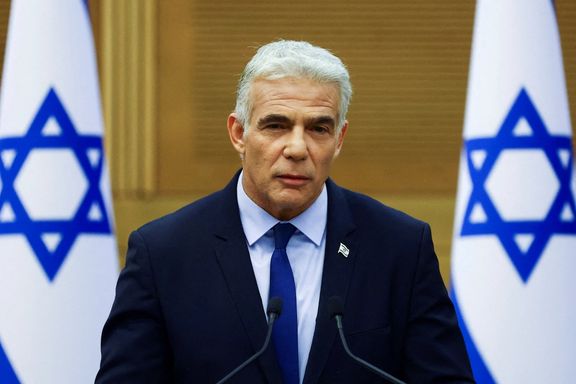
Israeli Prime Minister Yair Lapid
Israeli Prime Minister Yair Lapid says US and Israel do not “necessarily agree” over a credible military option against Iran but Israel maintains complete freedom to act against Tehran.
At the weekly cabinet meeting on Sunday, Lapid said, “We came and asked to introduce a credible military threat during President Biden’s visit. We want the basis [for world power’s negotiations with Iran] to be a credible military threat. We didn’t necessarily agree on this with the Americans at the present time.”
He said he “made it clear to the president and his team that Israel opposes the nuclear deal and maintains complete freedom to act, diplomatically and operationally, in the face of the Iranian nuclear program.”
Lapid also described Biden’s trip to Israel “a historic visit, with achievements in diplomacy, security and the economy.”
Lapid’s office also issued a photo of him hanging up the so-called Jerusalem Declaration -- signed by Lapid and Biden in which Washington committed to “use all elements of its national power” to ensure Iran never acquires a nuclear weapon -- in the cabinet meeting room in Jerusalem. Lapid said he was hanging the statement “in the place intended for historical declarations.”
Amid serious warnings about land subsidence across Iran, a member of Tehran City Council has said the situation is “hazardous” in a few regions of the capital.
The deputy head of the environmental protection committee of the capital’s City Council, Mehdi Babaee, told ILNA on Sunday that ground subsidence in the southwestern districts of Tehran has reached a dangerous level, to about 20 centimeters per year.
"We are developing a plan in Tehran city council, according to which the municipality will be required to use surface water recycling for water consumption in urban areas, including irrigation of green spaces,” he said, noting that the implementation of such a plan can lead to a reduction in the extraction of the capital's underground water resources and reduce the rate of land subsidence in the city.
According to the latest official data by the geological organization of the country, the rate of subsidence in the plains around Tehran was between 17 and 24 centimeters per year.
Tehran is facing a serious problem of rapid ground subsidence due to decreasing ground water levels, imagery consulting firm Intel Lab reported in July 2021. Intel Lab published a series of satellite imagery showing relative levels of sinking ground between January 2020 and April 2021. In some areas the ground had sunk up to 25 centimeters or more than 8 inches.
Depletion of underground water is one of the main causes for ground subsidence that can threaten not only cities but also agricultural lands. Moreover, land subsidence is not limited to cities and their surrounding plains. In many other areas in Iran cracks and huge hollows that resemble meteor craters have appeared in the ground in recent years.
A huge sink hole that suddenly appeared in central Iran. Undated
Ali Saberi, a geologist, said last year that one million hectares of land in the country is affected by subsidence, blaming unlimited extraction of ground water as the main cause of the phenomenon.
Alireza Shahidi, the head of Iran’s Geological Organization said in 2021 that land subsidence is a “disaster” and a “silent earthquake” that can lead to political and security crises.
Iran’s natural disaster taskforce says 20 million urban residents face ground subsidence in 29 of 31 provinces, warning about agricultural overuse of water. Ali Beytollahi, the head of the taskforce said Iran has not come up with policies and rules to deal with the disaster, as drought and wasteful irrigation methods are depleting groundwater reserves, adding that unless serious action is taken, the country can soon reach a point of no return.
According to Gholam-Ali Jafarzadeh, the head of the National Cartography Center, 80 percent of the groundwater is withdrawn annually in Iran, adding that over the past decades, some of the aquifer levels dropped by 100 centimeters.
In addition to Inefficient irrigation methods, digging illegal wells is the other cause of subsidence, as out of 50,000 wells pumping underground water resources in the capital, 30,000 are illegal.
Iran has been suffering from drought for more than a decade and this year lack of precipitation is larming. Over the next 40 years, the country's temperature will rise by 2.6 degrees Celsius, which will make matters worse.
As drought persists, more underground water is exploited for irrigation, depleting natural reservoirs formed during thousands of years. This has aggravated ground subsidence, alarming government officials who have circulated confidential memos on the subject.
Frame grab show the woman enforcing hijab and threatening anti-hijab protesters in a city bus in Tehran on July 16.
After a video of a woman enforcing hijab rules quarreling with a female bus rider became viral, IRGC affiliated Fars news said the hijab violator has been arrested.
The video started circulating on social media on Saturday, a few days after Iranian women launched a campaign against the compulsory Islamic dress code, or hijab.
In the video a woman fully covered by a long, black ‘chador’ – which is typical of the supporters of the Islamic Republic – is seen shouting at a woman who had unveiled in a transit bus. The quarrel became so frantic that other passengers intervened and kicked the hijab enforcer out of the bus. She was also recording the incident and threatening the hijab-protester to send it to the Revolutionary Guards.
Some people on social media express doubt that police has been able to identify the hijab challenger in a matter of hours, and they regard the news by the Fars as only a tactic to frighten people whose support for anti-hijab protests are growing.
In another video released this week, a man started berating a few teenage girls who had removed their hijab at a subway station in Tehran, but other people came to help and sent the angry man away.
However, Iran has started arresting women who participated in the nationwide civil disobedience campaign against the compulsory Islamic dress code this week.
Following President Joe Biden’s Middle East tour, Iran says the United States seeks to foment crisis in the region through its policy of Iranophobia.
Iran's Foreign Ministry spokesman Nasser Kanaani made the remarks on July 16, in reaction to Biden’s address to a summit of regional Arab states in the Saudi city of Jeddah, accusing the Islamic Republic of destabilizing activities in the region.
Rejecting the US president’s remarks as unacceptable and unfounded, Kanaani said, "Such groundless allegations are in line with Washington’s policy to incite sedition and create tension in the region... by resorting to its failed policy of Iranophobia.”
“False accusations that the United States levels against Iran’s peaceful nuclear program while turning a blind eye to several decades of the Zionist regime’s deception as a regime that is not a member of the nuclear Non-Proliferation Treaty (NPT) while possessing the biggest nuclear arsenal in the region, are a major sign of hypocrisy of the US government,” he added.
Biden said during his tour that "Around the world, we’re seeing efforts to undermine the rules-based order: with China’s increasingly coercive actions in the Indo-Pacific and beyond; with Russia’s brutal and unprovoked war against its neighboring Ukraine; and with Iran’s destabilizing activities," emphasizing that “It’s only becoming clear to me how closely interwoven America’s interests are with the successes of the Middle East…We will not walk away and leave a vacuum to be filled by China, Russia or Iran.”
An Iranian oil tanker in the Persian Gulf, in August 2021
Russia is taking market share from Iran’s bitumen (asphalt) exports, Tehran media reported Saturday, as a trade competition has flared between the two allies.
The general secretary of oil by-products exporters union, Hamid Hosseini was quoted by Fararu website as saying that Iran has lost about a quarter of its bitumen exports, mainly to India, because of steep discounts by Russia. In the last three months Iran’s monthly exports of the oil by-product dropped from 430,000 tons to 330,000, Hosseini said.
Reports about Russia taking market share from Iran in oil and steel exports emerged in June. Kpler, an industry intelligence firm reportedthat Iran’s oil sales to China “had halved” in May, as Russia offered larger discounts. Other sources later confirmed the fierce competition for market share, although it is not clear how much sales Iran has lost.
In May, Reza Shahrestani, a member of Iran’s steel producers’ association told local media that exports had stoppedfrom mid-March to early May to China, Afghanistan, Thailand and South Korea, Tehran’s biggest customers, who shifted to buying discounted Russian steel.
The two countries are strategic allies, with Tehran subtly supporting Russia in its Ukraine invasion by blaming NATO expansion for the conflict, but also calling for an end to hostilities.
They are also allies in the Syrian civil war, where Russia intervened in 2015 to save Bashar al Assad’s rule against Sunni rebels. Its air power proved decisive as thousands of Iranian forces were bogged down in fighting. Assad reclaimed most of the territory taken by rebels, but Iran also found a foothold in the country with designs against neighboring Israel.
The loss of market share in bitumen or asphalt exports could cost Iran up to $50,000 million a month, given higher oil prices. At the same time Russia’s ambassador in Tehran Levan Dzhagaryan (Jagarian) on Saturday criticized Iran for owing Moscow hundreds of million of dollars and not making payments.
All types of exports are vital for Iran amid US oil and banking sanctions. The government faces a more than a 50-percent budget deficit, with annual inflation at 55 percent and popular discontent rising.
In recent days, US National Security Adviser Jake Sullivan has accused Russia and Iran of preparing a military drone deal, with Moscow sending a delegation to Iran to review options to buy drones to use in Ukraine. Iran has tried to dispel concerns by saying that it would not side with warring sides, but there is some evidence of Russian interest in acquiring Iranian drones.
Russian President Vladimir Putin is scheduled to visit Tehran on Tuesday, July 19 and will meet Iran’s Supreme Leader Ali Khamenei. The visit follows US President Joe Biden’s tour of the Middle East, and is seen by some as Putin’s answer to American efforts at unifying its regional allies.
Iran’s anti-West and pro-Russia posture increasingly raises questions even among some Islamic Republic politicians. Also, the business community, which can be considered loyal to the regime have begun expressing concern over Russia competition.
The Wall Street Journal wrote on July 16, “Within Iran, the fight has highlighted divisions over the country’s alignment with Russia, which the Tehran government has backed through the Ukraine invasion while the Iranian business community privately simmers over what it sees as unfair competition.”
A poster created by the hacktivist group Labdoukhtegan revealing the identities of IRGC hackers
A hacking group has revealed the identities of several hackers working for the cyber division of Iran’s Revolutionary Guard (IRGC).
According to information obtained by Iran International July 16, these hackers – or the so-called Iranian Cyber Army -- work for Naji Technology and Afkar System companies, which are affiliated with the IRGC.
In their report, the hacktivist group, called ‘Lab-Doukhtegan’ or ‘Sealed Lips’, said these IRGC hackers “repeatedly attacked targets in the US and Europe with the aim of extortion," making use of "the security loopholes discovered in European and American organizations.”
Describing the attempted attack as “deeply disturbing,” Idaho’s Republican Senator Jim Risch said that “it’s typical of a regime that’s synonymous with global terrorism.”