• العربية
  • فارسی
Brand
  • Iran Insight
  • Politics
  • Economy
  • Analysis
  • Special Report
  • Opinion
  • Podcast
  • Iran Insight
  • Politics
  • Economy
  • Analysis
  • Special Report
  • Opinion
  • Podcast
  • Theme
  • Language
    • العربية
    • فارسی
  • Iran Insight
  • Politics
  • Economy
  • Analysis
  • Special Report
  • Opinion
  • Podcast
All rights reserved for Volant Media UK Limited
volant media logo

Will Doha Talks Tackle ‘Unanswered’ Questions On Iran Nuclear File?
Iran International Newsroom
Jun 28, 2022, 12:56 GMT+1Updated: 17:38 GMT+1
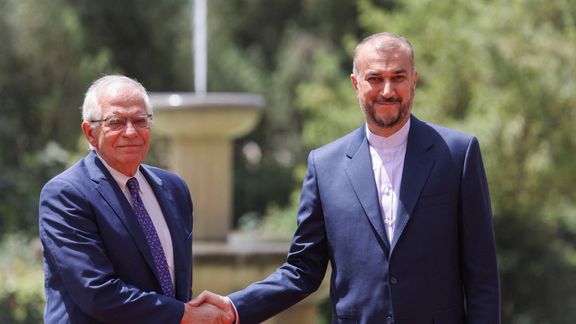
Josep Borrell (L) and Iranian foreign minister Hossein Amir Abdollahian in Tehran on June 25, 2022

Qatar said in a statement Tuesday that if successful, US-Iran nuclear talks could open up “new prospects for wider regional cooperation and dialog with Iran.”

But Qatari optimism, which has seen the Persian Gulf state mediate in recent months, was not shared by United States and European officials, nor by opponents of the 2015 deal in Tehran.

The Virginia-based Politico news-site quoted a US official with “very low expectations” and two “senior Western officials” sharing the American’s pessimism and saying they expected the talks to last only two or three days.

In announcing the new round of talks while in Tehran Saturday, the European Union foreign policy chief Josep Borrell said nuclear talks in Vienna had been suspended in March with both Iran and the US needing to answer “questions.”

Those talks – involving Iran, and six world powers including indirectly the US – reportedly reached a broad understanding of what was needed to revive the JCPOA but did not bring complete agreement over which US sanctions were incompatible with the 2015 deal, which the US left in 2018. Iran was particularly irked over the inclusion since 2019 of its Revolutionary Guards on a US list of sanctioned ‘foreign terrorist organizations.’

While there have been suggestions from analysts as to how such obstacles might be cleared, the US and Iran have continued to place the onus on the other to move.

Go-betweens

Enrique Mora, a senior EU official, chaired the Vienna talks and is expected to lead a team of European officials in Qatar acting as go-betweens for US and Iranian negotiators. Iran has refused to meet the US directly.

Qatar’s role may be less formal. The Persian Gulf state has good relations with both Washington and Tehran, and played a discrete but effective role in negotiations between the US administration of President Donald Trump and the Taliban that led to their 2020 agreement over US military withdrawal from Afghanistan.

But opponents of restoring the JCPOA are vocal in both Tehran and the US. In Israel, Prime Minister Naftali Bennett has slammed military and intelligence leaders – including reportedly the head of military intelligence Major General Aaron Haliva– who favor the JCPOA.

It remains unclear whether the US encouraging Israeli-Saudi military cooperation as a way to reconcile the two states to a revived JCPOA, or as a genuine attempt to bolster a new regional defense architecture against Iran and its regional allies, including Hezbollah, and Ansar Allah in Yemen.

Last chance?

Some analysts see the Qatar talks as the last chance for the US and Iran to agree over bringing back the JCPOA.

Robert Malley, the US special envoy who leads the US negotiators in Qatar, told the Senate in May that the US would continue to work to restore the JCPOA as long as “we assess that the non-proliferation benefits of a return to the deal are worth the sanctions lifting we would need to provide.”

Critics of the JCPOA argue any benefits are running out. Rafael Mariano Grossi, director general of the International Atomic Energy Agency, told a news conference in Vienna June 9 that, given Iran’s restrictions on agency monitoring, four weeks remained to restore enough inspector’s access to avoid a “fatal blow” to the IAEA’s ability to certify the Iranian nuclear program as peaceful. Iran began exceeding JCPOA limits in 2019, the year after the US left the agreement, and is now enriching uranium to 60 percent, far above the 3.67 percent allowed under the JCPOA.


Most Viewed

100 days after carnage: Iran economy reels from war, inflation, unemployment
1
INSIGHT

100 days after carnage: Iran economy reels from war, inflation, unemployment

2
INSIGHT

Ghalibaf defends Iran-US talks amid hardline backlash

3
INSIGHT

A nation in limbo: 100 days after the massacre, has the world moved on?

4
ANALYSIS

From instability to influence: Pakistan’s pivotal role in US-Iran diplomacy

5
ANALYSIS

100 days on: why Iran’s January protests spread across social classes

Banner
Banner

Spotlight

  • War-hit homeowners feel abandoned as Iran’s reconstruction aid fades

    War-hit homeowners feel abandoned as Iran’s reconstruction aid fades

  • 100 days on: the anatomy of Iran’s January crackdown
    INSIGHT

    100 days on: the anatomy of Iran’s January crackdown

  • Ghalibaf defends Iran-US talks amid hardline backlash
    INSIGHT

    Ghalibaf defends Iran-US talks amid hardline backlash

  • 100 days on: why Iran’s January protests spread across social classes
    ANALYSIS

    100 days on: why Iran’s January protests spread across social classes

  • From instability to influence: Pakistan’s pivotal role in US-Iran diplomacy
    ANALYSIS

    From instability to influence: Pakistan’s pivotal role in US-Iran diplomacy

  • A nation in limbo: 100 days after the massacre, has the world moved on?
    INSIGHT

    A nation in limbo: 100 days after the massacre, has the world moved on?

•
•
•

More Stories

US And Iranian Diplomats In Doha For Nuclear Talks

Jun 28, 2022, 11:47 GMT+1

Iranian and United States lead negotiators were in Doha Tuesday as Qatar expressed hope that talks would “culminate in positive results that contribute to revival of JCPOA.” 

In a statement, the Qatari Foreign Ministry said the talks to revive the 2015 nuclear deal – the JCPOA, Joint Comprehensive Plan of Action – would be coordinated by the European Union.

Ali Bagheri-Kani, leading the Iranian delegation, arrived in Doha Tuesday morning. Welcoming him, Tehran’s ambassador Hamidreza Dehghani, tweeted, "Without any prejudice and expression of unrealistic pessimism or optimism, I wish them success in carrying out their important mission.”

United States special envoy Robert Malley met Tuesday with Qatar's Foreign Minister Mohammed bin Abdulrahman Al Thani. The US embassy said they discussed “the strong partnership and our joint diplomatic efforts to address issues with Iran.”

US National Security Advisor Jake Sullivan reiterated Monday that restoring the JCPOA was the best way to preclude any possible Iranian path to a nuclear weapon, and reiterated that Washington put the onus on Tehran to make the necessary moves. “There is a deal available on the table to Iran, and it’s up to Iran to decide whether or not it wants to take it,” Sullivan said.

Some analysts portray the talks – which, although US and Iran still talk indirectly, are separate to stalled Vienna talks between Iran and six world powers – as the last chance for Washington and Tehran to revive the JCPOA. 

Iranian Pundits Cautious Over Chances Of A Deal With US

Jun 28, 2022, 10:09 GMT+1
•
Iran International Newsroom

Iranian media and commentators have shown mixed reactions to the idea of holding the next session of nuclear negotiations in a Persian Gulf country, Qatar.

Hardline newspaper Kayhan on Monday carried a frontpage headline that said: "Negotiations in Qatar is a trap. We should not reward America."

Kayhan and its chief editor Hossein Shariatmadari are affiliated with the office of Supreme Leader Ali Khamenei.

The Kayhan wrote, "The venue of the negotiations is not the main issue. What matters is that we should not reward the United States for sending [EU Foreign Policy chief] Josep Borrell to Tehran and laying a diplomatic trap for Iran. We should not be overwhelmed and should not welcome the continuation of the negotiations, which means stepping back from our positions and our main condition."

After year-long talks in Vienna came to a standstill in March, it became apparent that Tehran was insisting on the removal of its Revolutionary Guard from the US list of Foreign Terrorist Organizations.

Meanwhile, many Iranians on social media noted that Borrel simply used the term Gulf when speaking about the venue of the talks, a sensitive issue for Iranians who reject a habit by international media and politicians to call the Persian Gulf, simply “Gulf”, or “Arabian Gulf” in rare cases.

Kayhan's firebrand editor, Hossein Shariatmadari
100%
Kayhan's firebrand editor, Hossein Shariatmadari

It also listed several headlines from US and regional media that said the US ‘maximum pressure’ policy has failed and Iran's position has been strengthening during the past months. The Kayhan insisted that "Iran is powerful" and then asked: "Why should we need negotiation with the evil and criminal West?"

Kayhan also expressed concern that "negotiating in the region might undermine the interests of Russia and China, the two countries that have voted against the IAEA Board of Governor's resolution against Iran." The daily then called on Iranian diplomats to insist on the lifting of all sanctions against Iran, to verify US measures and demand guarantees from Washington."

Meanwhile in an interview with the reformist Arman Emrooz newspaper, former diplomat Jalal Sadatian warned that Iran should not be optimistic toward the upcoming round of negotiations although it looks like that the meeting in Qatar is going to have a more serious approach to the nuclear issue than the ones in Vienna.

Nonetheless, he was not optimistic about the upcoming talks as he believed that “Russia is still against an agreement” and that is why Moscow sent Foreign Minister Lavrov to Tehran shortly before Borrell's visit

Foreign relations analyst and former lawmaker Ahmad Bakhshayesh told Arman Emrooz that the West has realized pressures on Iran has brought it closer to te East (China) where it is selling its oil. He added that under pressure from the energy implications of the war in Ukraine, the West is trying to embrace Iran once again before the next winter.

Bakhshayesh echoed what Sadatian also said that Iranian and US negotiators will talk face to face without any need for mediators. However, he did not explain why he thinks so. He added that Russia has the upper hand in Ukraine and the West needs to find a replacement for the oil from Russia and Iran seems to be the best possible replacement.

Meanwhile, foreign policy analyst Diako Hosseini said in an interview with ILNA that both Iran and the United States see the JCPOA as serving their interests and if talks resume, this would be the last round and an agreement will be at hand.

Iran-US On Brink Of ‘Indirect’ Nuclear Talks In Qatar

Jun 27, 2022, 19:55 GMT+1
•
Iran International Newsroom

Iran’s Tasnim news reported Monday that lead negotiator Ali Bagheri Kani was heading to Doha Tuesday for indirect talks with the US over the 2015 nuclear deal.

This came with expectations firming of indirect United States-Iran talks over restoring the agreement – the JCPOA, Joint Comprehensive Plan of Action – but with no indication of how gaps would be bridged.

“Resuming negotiations doesn’t mean we’re closer to agreement,” Mohammad Marandi, advisor to Iran’s nuclear negotiators and a de facto spokesman, told media outlets in Tehran. “America hasn’t yet taken the necessary decisions.”

Saeed Khatibzadeh, foreign ministry spokesman, said Monday Iran would “wait and see if the Americans will part with Trump’s legacy and if Borrell’s messages become a reality.”

In visiting Iran, Josep Borrell, the European Union foreign policy chief, announced Saturday that Iran and the US had agreed to renew contacts. Year-long talks in Vienna over reviving the 2015 deal, abandoned by President Donald Trump 2018, paused in March with a draft text largely agreed but with outstanding questions left for the US and Iran to resolve.

The Iranian media has reported that new indirect talks between the US and Iran will take place in Doha, Qatar, with EU representatives acting as go-betweens. In Vienna, formal talks involved all remaining JCPOA participants – China, France, Germany, Iran, Russia, and the United Kingdom – with US negotiators based in a separate hotel.

There have been suggestions in recent months that Qatar has tried to mediate. Talks between the US and Iran leading up to the 2015 deal – the JCPOA (Joint Comprehensive Plan of Action) – took place in Oman.

US officials have confirmed to American media outlets that Washington has agreed to a new round of talks, but have also been suggested their expectations were low.

The greatest obstacles in the Vienna talks centered on reaching agreement over which US sanctions contravened the JCPOA, which ruled out “discriminatory regulatory and procedural requirements in lieu of the sanctions,” and exactly how Iran’s nuclear program, expanded incrementally since 2019, would be brought back within JCPOA limits.

Israeli ‘sabotage’

Tehran has specifically argued that some sanctions introduced by Trump under other rubrics, including ‘terrorism,’ were designed to stymie efforts to restore the JCPOA. Biden administration officials, although committed to restoring the deal, have accused Iran of thereby introducing demands not relevant to the JCPOA.

In recent days, there have been suggestions of some compromise over the US listing of Iran’s Revolutionary Guards, part of its armed forces, as a ‘foreign terrorist organization.’ While Tehran has requested this rescinded – it was done by Trump in 2019 – there has been criticism of such a proposed move by politicians in Washington.

Borrell’s apparent success in reviving the talks provoked a spat in Israel, with Defense Minister Benny Gantz taking to Twitter to dismiss reports that Israeli military intelligence chiefs favored restoring the JCPOA.

Politico reported Sunday that Israeli Foreign Minister Yair Lapid had told Borrell he was “very disappointed” with the EU foreign policy chief’s mission to Tehran, calling it a “strategic mistake that sends the wrong message to Iran.” Politico suggested Brussels in turn saw Lapid as trying to “sabotage the negotiations.”

Iran Has Selected Qatar As Venue For Talks With US, Official Says

Jun 27, 2022, 10:11 GMT+1

Qatar will host indirect nuclear talks between Iran and the United States, a media adviser to the Iranian nuclear team was quoted on Monday as saying.

"Iran chose Qatar to host because it is our friend," Mohammad Marandi told the semi-official ISNA news agency. Marandi who was born in the US has been a key media official for the Islamic Republic.

Since a trip by the European Union’s foreign policy chief Josep Borrell to Iran over the weekend that ended with an agreement to resume talks in a Persian Gulf country, Qatar was mentioned as the likely venue.

Year-long negotiations in Vienna to revive the 2015 nuclear agreement known as JCPOA came to an abrupt halt in March. During Borrell’s trip it was agreed that Iran and the United States will resume indirect talks apparently with a new format without the presence of Russia and China, two of the original signatories of the agreement.

It is not clear when exactly negotiations will resume and if the mediator will be the EU foreign policy team or other European diplomats from the United Kingdom, France and Germany will also be present. The E3 were also signatories of JCPOA.

There has so far been little official reaction from Washington to the EU-Iran announcement, but it appears there was coordination between the US and EU before Borrell visited Tehran.

Iran Sounds Cautiously Optimistic Over New Talks With US

Jun 27, 2022, 08:15 GMT+1

Iran said Monday that Washington has given assurances it will carry out the 2015 nuclear deal and UN resolution 2231 and will “consider” Iran’s economic benefits.

Iran agreed on Saturday [June 25] to resume nuclear talks with the United States after the European Union’s foreign policy chief Josep Borrell visited Tehran and held talks to restart stalled nuclear negotiations.

Foreign ministry spokesman Saeed Khatibzadeh speaking at his weekly media briefing thanked Borrell and said, “We confirm that there have been agreements regarding the format, essence and topics” for the new round of talks. “The most important aspect of the talks was that America has given assurances to act based on the entirety of the JCPOA and issues covered by resolution 2231, taking into account Iran’s [expected] economic benefits” from a renewed nuclear agreement.

Khatibzadeh also seemed to hedge Iran’s bets, saying, “We must wait and see if the Americans will part with Trump’s legacy and Borrell’s messages become a reality. We will continue the talks with seriousness and decisiveness with the caveat of not fully trusting America.”

Year-long talks in Vienna came to a sudden halt in March after diplomats said that a draft agreement was 99 percent ready to restore the Joint Comprehensive Plan of Action (JCPOA). The sticking points apparently revolved around Iran’s demand that the US should lift all sanctions imposed by former President Donald Trump when he withdrew from the deal in 2018.

However, many sanctions, including the designation of Iran’s Revolutionary Guard (IRGC) as a terrorist organization were not directly related to Iran’s nuclear program and the Biden Administration has so far not accepted Tehran’s demands.

Lately, Tehran has reportedly argued that the demand to remove sanctions related to terrorism is because they would prevent full economic benefits for Iran even if the nuclear deal is restored. Khatibzadeh’s statement that the US has accepted to consider Iran’s “economic benefits” points to Tehran accepting a promise from Washington, rather than a formal removal of all sanctions.

Some observers in Iran have suggested that perhaps the issue of remaining sanctions and other differences will be dealt with after the JCPOA is restored through additional talks.

Iran’s regional aggressive behavior and its missile threat are long-standing problems that the United States and its regional allies are keen to address. The lifting of terrorism and other sanctions could evolve into a new round of talks aimed at Iran’s overall foreign and military policies.

The new talks Borrell agreed with the Iranians seem indeed to differ from the Vienna format. The talks, which Khatobzadeh said will start in a few days, are slated to take place not in Vienna but in a Persian Gulf country, most likely Qatar.

Although many details are still unclear, the talks will not take place with the direct participation of Russia and China as was the case in Vienna. It is not clear if the United Kingdom, France and Germany, as European signatories of the JCPOA will be present or only the EU will mediate in what would be indirect talks, as Iran still refuses to negotiate with the US face to face.