• العربية
  • فارسی
Brand
  • Iran Insight
  • Politics
  • Economy
  • Analysis
  • Special Report
  • Opinion
  • Podcast
  • Iran Insight
  • Politics
  • Economy
  • Analysis
  • Special Report
  • Opinion
  • Podcast
  • Theme
  • Language
    • العربية
    • فارسی
  • Iran Insight
  • Politics
  • Economy
  • Analysis
  • Special Report
  • Opinion
  • Podcast
All rights reserved for Volant Media UK Limited
volant media logo

Leaving The NPT Is Not A Sensible Option For Iran, Lawmaker Says
Iran International Newsroom
Jun 19, 2022, 21:13 GMT+1Updated: 17:43 GMT+1
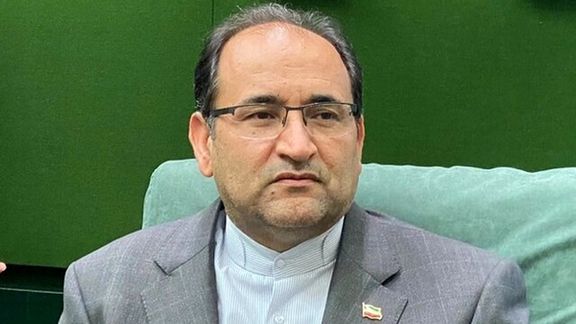
Jalil Rahimi Jahanabadi, a member of Iranian parliament's national security committee

A senior Iranian lawmaker speaking about proposals to leave the Nuclear Non-Proliferation Treaty (NPT) has said such a move would provide “excuses to the West”.

Hardliner Iranian politicians have been suggesting that Tehran should withdraw from the NPT and even the 2015 nuclear deal with world powers known as the JCPOA as retaliation for being snubbed by the United Nations nuclear watchdog, the IAEA on June 8.

Jalil Rahimi Jahanabadi, a member of parliament’s National Security and Foreign Policy Committee told Etemad Online website on Sunday [June 19] that the IAEA resolution does not carry any legal and political risks for Iran.

The 35-nation IAEA Board of Governors passed the critical resolution after it determined that Iran has not cooperated in an investigation of its past nuclear activities.

So far, the government’s response to the IAEA was to disconnect many monitoring devices installed at its nuclear facilities by the UN watchdog, which in of itself was a significant move. But the noise about leaving the NPT has remained at the level of hardliner agitators and lawmakers.

One day before the vote on the resolution, a top hardliner in Iran, Hossein Shariatmadari, running the Kayhan Daily proposed leaving the NPT. He is Supreme Leader Ali Khamenei’s appointee at the flagship ultra-conservative newspaper, and many interpret his remarks as those endorsed by Khamenei’s office.

When the resolution passed on June 8, a large group of lawmakers also proposed to leave the NPT and stop cooperation with IAEA nuclear inspections and monitoring.

Later it was also revealed that former parliament speaker Ali Larijani and Supreme Council of national Security Secretary Ali Shamkhani lashed out at ultraconservative Saeed Jalili after he voiced support at the Expediency Council for the idea of Tehran exiting the Nuclear Non-proliferation Treaty (NPT).

But others among the Islamic Republic political elite warn that a drastic move against the NPT or the IAEA can send Iran’s nuclear file to the UN Security Council, which could lead to the restoration of international economic sanctions against the country. Those sanctions imposed in late 2000s and early 2010s carried the weight of the Security Council and were lifted only after Iran agreed to the 2015 nuclear deal, the JCPOA.

Jahanabadi, who appears to be one of the cautious politicians, tried to explain that the other lawmakers are making suggestions to the presidential administration, and it is not a process of forcing the executive to take steps on the issue of the NPT. He said that lawmakers are thinking to end voluntary cooperation with IAEA in the framework of the Additional Protocol and not within the NPT.

“Exiting the NPT for a country that has no intention to produce nuclear weapons, is not sensible,” he said. “Iran is not after inviting international challenges, and we should be aware that exiting the NPT will not solve any of our problems. Instead, it will provide an excuse for Westerners,” Jahanabadi added.”

He went on to say that Iran has no reason to go “from bad to worse”. If the IAEA shows no flexibility “exiting the NPT becomes an option, but we should not rush into these kinds of options now.”


Most Viewed

Ghalibaf defends Iran-US talks amid hardline backlash
1
INSIGHT

Ghalibaf defends Iran-US talks amid hardline backlash

2
ANALYSIS

From instability to influence: Pakistan’s pivotal role in US-Iran diplomacy

3
ANALYSIS

100 days on: why Iran’s January protests spread across social classes

4

War-hit homeowners feel abandoned as Iran’s reconstruction aid fades

5
INSIGHT

100 days on: the anatomy of Iran’s January crackdown

Banner
Banner

Spotlight

  • Bread shortages, soaring prices strain households in Iran, residents say
    VOICES FROM IRAN

    Bread shortages, soaring prices strain households in Iran, residents say

  • War-hit homeowners feel abandoned as Iran’s reconstruction aid fades

    War-hit homeowners feel abandoned as Iran’s reconstruction aid fades

  • 100 days on: the anatomy of Iran’s January crackdown
    INSIGHT

    100 days on: the anatomy of Iran’s January crackdown

  • Ghalibaf defends Iran-US talks amid hardline backlash
    INSIGHT

    Ghalibaf defends Iran-US talks amid hardline backlash

  • 100 days on: why Iran’s January protests spread across social classes
    ANALYSIS

    100 days on: why Iran’s January protests spread across social classes

  • From instability to influence: Pakistan’s pivotal role in US-Iran diplomacy
    ANALYSIS

    From instability to influence: Pakistan’s pivotal role in US-Iran diplomacy

•
•
•

More Stories

Pundits In Tehran Say Iran May Be Headed For War

Jun 18, 2022, 21:50 GMT+1
•
Iran International Newsroom

A prominent Iranian analyst, often referred to as an expert on US affairs, says political threats against Tehran are changing and taking a military form.

Mehdi Motaharnia, told Didban Iran website on June 18 that threats coming particularly from the US Central Command (CENTCOM) in the region are no longer political in nature and can be characterized as military.

Speaking in the cryptic language of Iranian analysts, Motaharnia added that "these threats are coming through Israel's security tunnel." He added that Tel Aviv's moves are becoming increasingly elaborate and that they can change the situation in the region and push it toward a collision.

Motaharnia said indications show that a military confrontation is not only "possible" but "probable".

He argued that US President Joe Biden's upcoming visit to Saudi Arabia is meant to tackle the Arab-Israeli problem and bring about meaningful strategic changes, including bringing Saudi Arabia closer to Israel. All this, he said will have serious repercussions for Iran.

In fact, Israel this week called for a regional alliance against Iran under the aegis of the United States.

Iranian analyst, Mehdi Motaharnia
100%
Iranian analyst, Mehdi Motaharnia

It could also lead to Iran's further isolation and create an anti-Iranian alliance. Motaharnia said that a Gulf Cooperation Council meeting will be also held during Biden's visit to the region, and this is likely to lead to a regional order against Tehran.

Meanwhile, the former editor of hardline daily Kayhan, Mehdi Nasiri also said on the same day that the Islamic Republic is moving toward a war.

Nasiri wrote in an article: "Evidence including the suspension of nuclear negotiations in Vienna and the escalation of tensions between Tehran and the International Atomic Energy Agency (IAEA) might indicate that the Islamic Republic is interested in war and such a war is likely to start."

Nasiri added: "If such a war starts, it could lead to major humanitarian and economic catastrophe for Iranians who still have not recovered from the scars of the 8-year war with Iraq in the 1980s."

Former editor of conservative Kayhan daily, Mehdi Nasiri
100%
Former editor of conservative Kayhan daily, Mehdi Nasiri

Nasiri warned Islamic Republic officials that this war is in contradiction with Iran's national interests and that they have no right to impose such a conflict on the people even if they believe it would be an anti-imperialist move. "They have no right to start a war based on ideological and religious justifications without first seeking the consent of the Iranian people."

In a blunt statement by someone living in Iran he said: "While clerics and others in the government are living an aristocratic life, they have no right to impose war and aggression on the people and bring about poverty and misery with the pretext of resistance."

Nasiri added that if leaders believe most Iranians support an aggressive and belligerent foreign policy, they should prove this by holding a referendum.

The warnings about the Islamic Republic's interest in a probable war come while according to a report published by reformist daily Sharq, there is no consensus among Iranian and US officials whether "an agreement is within reach," or all the chances for a deal have been lost.

The report said that the realities on the ground point to the fact that currently there is no chance for a deal, adding that during the past 10 days since the IAEA Board of Governors condemned Iran's lack of cooperation with the agency and Iran’s reaction to the IAEA resolution have been discouraging. The report stressed that chances for an agreement have been practically reduced to nil.

Sharq's report said, "The nuclear agreement (JCPOA) is dead, but the Raisi administration lacks the courage to bury it."

In Conversation With EU’s Borrell, Iranian FM Slams US For IAEA Resolution

Jun 18, 2022, 20:05 GMT+1

The Iranian foreign minister criticized the US for "the counterproductive and hasty" move over the resolution passed by the International Atomic Energy Agency's Board of Governors.

In a phone conversation with European Union foreign policy chief Josep Borrell on Saturday, Hossein Amir-Abdollahian said “in order to reach a good and lasting agreement, it is necessary for the other side to give up its double standards and contradictory behavior."

He added that the Islamic Republic still believes that "diplomacy is the best and most appropriate" solution to the outstanding issues on the revival of the deal,” reiterating that "Iran has never distanced itself from the negotiating table.”

“If the United States wants to continue its unconstructive behavior, it will face our proportionate response," Amir-Abdollahian emphasized.

The resolution called on Iran to engage with the IAEA without delay and expressed “profound concern” at Iran’s failure to satisfy the agency over traces of uranium found at three undeclared sites and highlighted earlier in June in a report by IAEA Director General Rafael Grossi.

The resolution came as year-long talks paused since March between Iran and five world powers aimed at reviving the 2015 Iran nuclear deal, the JCPOA (Joint Comprehensive Plan of Action).

Following the resolution, Iran retaliated, telling the IAEA it plans to remove more monitoring equipment, but intends to maintain a basic level of monitoring and inspectors’ access as required under the Nuclear Non-Proliferation Treaty (NPT).

Iran Says Tunnel Network Near Natanz Aimed At Protecting Facility

Jun 18, 2022, 15:37 GMT+1

After a report revealed Iran’s construction of “a vast tunnel network” just south of its Natanz uranium enrichment plant, Iran says the move was to intensify security measures.

In an interview with Nour News, a website affiliated to the secretary of Iran's Supreme National Security Council, the spokesman for the Atomic Energy Organization of Iran Behrouz Kamalvandi made the remarks on Friday in reaction to a report by the New York Times about the work at the underground nuclear facility purportedly able to withstand cyberattacks and bunker-penetrating bombs.

US officials told the Times that the new underground facility was to replace a centrifuge assembly plant that the Times said Israel blew up in 2020 “in a particularly sophisticated attack.”

Kamalvandi claimed that Iran had notified the UN nuclear agency of its plan to relocate the activities of the TESA complex in Karaj to the city of Natanz, saying that the transfer of some of the activities to an area near the Natanz nuclear site aims to prevent the recurrence of attacks, referring to last year’s sabotage at the TESA complex. 

He said that said the International Atomic Energy Agency (IAEA) has been informed about it, even though Iran has no obligation to provide such information to the agency.

The complex in Karaj, on the outskirts of Tehran, saw a sabotage attack in June last year, which authorities blamed on Israel. The attack damaged surveillance cameras at the site.

Tunnel Vision, As Biden Tour Suggests ‘Extreme Measures’ Against Iran

Jun 17, 2022, 16:20 GMT+1
•
Iran International Newsroom

Conflict over Iran’s nuclear program is “about to flare again” with President Joe Biden’s July trip to Saudi Arabia and Israel, the New York Times said Friday.

In a piece by staff in Washington and Mossad expert Ronen Bergman in Israel, the Times highlighted Iran’s construction of “a vast tunnel network” just south of its Natanz uranium enrichment plant.

With year-long talks in Vienna to restore the 2015 Iran nuclear deal on hold since March, the paper suggested that “high on the agenda” for Biden’s trip would be “the question of taking more extreme measures to stop Iran, as the United States and Israel have attempted before.” Diplomatic efforts to “reimpose limits on Iran’s nuclear actions appear all but dead,” the Times argued.

The purpose of the tunnels was, however, unclear. US officials told the Times that the new underground facility was to replace a centrifuge assembly plant that the Times – apparently referring to a fire at Natanz in July 2020 ­– said “Israel blew up in April 2020 [sic], in a particularly sophisticated attack.”

US officials also told the Times Iran was probably engaged in a brinkmanship they believed to influence the nuclear talks. As well as expanding levels of uranium enrichment and restricting the access of International Atomic Energy Agency inspections, Tehran sought “new pressure points, including the excavation of the mountain plant near Natanz.”

The Times reported Kenneth McKenzie, who stepped down in April as commander of US Central Command covering the Middle East, also suggesting Iran sought leverage. “They like the idea of hanging the nuclear program over us because it produces a response,” he said.

A photo released by Iran showing different types of uranium enriching centrifuges. April 10, 2021
100%
A photo released by Iran showing different types of uranium enriching centrifuges. April 10, 2021

McKenzie argued that the nuclear program was not the main issue. The real “crown jewels” for Iran were ballistic missiles, cruise missiles and drones – where he suggested it had “made huge strides in the last five to seven years.”

‘Relentless effort for a bomb’

Israeli officials gave the New York Times a different take. For them, the paper said, the Natanz tunnels were “more evidence of a relentless Iranian effort to pursue a bomb capability” and justified Israel’s “accelerated attacks on the nuclear program and the scientists and engineers behind both Iran’s nuclear and missile programs.”

Among recent attacks on Iranian facilities was one on the Karaj manufacturing workshop in June 2021, which Tehran blamed on Israel. The strike soured Iran’s relations with the International Atomic Energy Agency and led it to switch manufacturing to existing space at Natanz.

While the killing of Iranian scientists attributed to Israel goes back to 2010, there have been suggestions that Israeli intelligence recently poisoned two more.

The freeze in talks to revive the JCPOA – which according to some reports boil down to the US listing Iran’s Revolutionary Guards as a ‘foreign terrorist organization’ – alarm many in Europe also concerned over Biden’s rapprochement with Saudi Arabia after initially in office taking distance from Riyadh over ‘human rights’ and its role in the Yemen war.

‘Time for decision is now’

While EU efforts to revive the Vienna nuclear talks over the 2015 nuclear deal, the JCPOA (Joint Comprehensive Plan of Action), have failed to bridge the US-Iran divide, EU foreign policy chief Josep Borell told the United Nations Security Council Thursday of his “permanent contact with all the parties to try arrange a return to the JCPOA and ensure its full implementation.”

Insisting that the “basic elements and terms to do this are known and on the table,” Borrell said “the time for decision is now.”

In a separate part of his speech referring to countries buying Russian exports, Borrell reiterated the EU’s opposition to ‘secondary’ sanctions – punitive measures against third parties. Ironically, the US Thursday took such measures against Chinese and Emirati firms over Iranian petrochemical exports. Hamad Al Kaabi, the United Arab Emirati envoy to the IAEA, said Friday he hoped Iran would work with the IAEA to reassure “the international community” over its nuclear program.

Former Iranian Lawmaker Calls Hardline Politician 'Warmonger'

Jun 17, 2022, 11:54 GMT+1
•
Iran International Newsroom

A former lawmaker is the first Iranian politician who has spoken about an alleged quarrel between high-ranking state officials over the nuclear issue recently.

According to the highly active political rumor mill in Iran, Former parliament speaker Ali Larijani and Supreme Council of national Security Secretary Ali Shamkhani lashed out at ultraconservative Saeed Jalili after he voiced support at the Expediency Council for the idea of Tehran exiting the Nuclear Non-proliferation Treaty (NPT).

Jalili was Iran’s chief nuclear negotiator during the presidency of Mahmoud Ahmadinejad when Iran was nabbed with international sanctions. He is also the long-time mentor of current negotiator, Ali Bagheri-Kani.

Reformist newspaper Sharq later revealed that the news of the quarrel was first disclosed by "Ammarioun," an ultraconservative group close to the IRGC and the ultraconservative Paydari Party that had nominated Jalili as their candidate for presidency in 2013.

The former lawmaker, Gholamreza Jafarzadeh Imanabadi said in an interview with Didban Iran [Iran Monitor] website that he is not aware of the details of the argument, but he added that "It is obvious the country cannot be run based on the ideas of Mr. Jalili," who is a staunch opponent of an agreement with the United States. Imanabadi further characterized Jalili as a "warmonger."

However, Imanabadi's criticism of the government goes beyond his opposition with Jalili's rejectionism. He said, "all those who engineered the 2021 presidential election and brought Ebrahim Raisi to power should be accountable for what they did."

Saeed Jalali (R) is a hardliner and the mentor of current nuclear negotiator Ali Bagheri Kani (L)
100%
Saeed Jalali (R) is a hardliner and the mentor of current nuclear negotiator Ali Bagheri Kani (L)

"It is not important to know who fought whom at the Expediency Council. The real struggle is about the people's life and livelihood."

Imanabadi charged that "Raisi is to be blamed for all the swear words people use against the regime." The former lawmaker further warned that if Iran ever exits the NPT, the Islamic Republic and the Iranian people will have to face an emergency situation.

He said that individuals such as Jalili are determined to ruin the last remnants of the people's livelihood. Elaborating on the perils of the Raisi administration's economic policy, Imanabadi said that a tripling of tax revenues this year is tantamount to picking the nation's pockets.

He further criticized Interior Minister Ahmad Vahidi for saying that prices of only four food items have increased, adding that Mr. Vahidi has never visited the kitchen in his own home!

On the nuclear deal with world powers and negotiations with the United States, he said: "Whether you like it or not, the people's livelihood is tied to the nuclear deal and relations with other countries. You cannot say that you want a dynamic economy and at the same time be sulking with all countries!" He further charged that "the Raisi administration is the weakest government Iran has ever had and Mr. Raisi does not know anything about how to run a country."

In another development, according to the conservative Nameh News website, political analyst Gholamreza Zarifian suggested that Raisi should benefit from the experience of former ultraconservative President Mahmoud Ahmadinejad.

He added that Iran has so many economic problems that the only solution is trying to have the sanctions lifted. "I hope Raisi would benefit from the experiences of his predecessors Rouhani and Ahmadinejad."

Zarifian was referring to the fact that Ahmadinejad called UN resolutions shreds of paper and ignored warnings about Iran’s nuclear program, which led to international sanctions, while President Hassan Rouhani used diplomacy to negotiate with the United States and have the sanctions lifted for a few years.





