• العربية
  • فارسی
Brand
  • Iran Insight
  • Politics
  • Economy
  • Analysis
  • Special Report
  • Opinion
  • Podcast
  • Iran Insight
  • Politics
  • Economy
  • Analysis
  • Special Report
  • Opinion
  • Podcast
  • Theme
  • Language
    • العربية
    • فارسی
  • Iran Insight
  • Politics
  • Economy
  • Analysis
  • Special Report
  • Opinion
  • Podcast
All rights reserved for Volant Media UK Limited
volant media logo

Conservative Paper Calls For Axing Iran’s Islamic Propaganda Outfit

Iran International Newsroom
Jun 11, 2022, 10:38 GMT+1Updated: 17:34 GMT+1
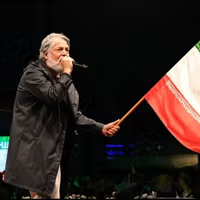
Ahmad Khatami, the firebrand fundamentalist Friday Prayer Imam in Tehran

A conservative newspaper in Iran has called on President Ebrahim Raisi to shut down the Islamic Propagation Organization and spend the budget on pressing needs.

In an editorial authored by the daily's outspoken managing editor Masih Mohajeri on June 9, Jomhouri Eslami [Islamic Republic] writing about the Iranian government's economic problems said, "A government that holds up payments to pensioners as a bid to solve its economic problems should prioritize its expenditures and get rid of unnecessary organizations."

The daily asked: "Some of Iran's cultural organizations do nothing other than duplicating the efforts of other government institutions. For instance, what kind of service is the Islamic Propagation Organization rendering that justifies its survival?" The newspaper maintained: "The high-maintenance organization should have attained its initial goals during the past 40 years [of an Islamic government]. If it hasn't, it means that it has not been successful."

The Islamic Propagation Organization is a body that operates in parallel with Ministry of Culture and Islamic Guidance and one of its objectives is offering guidelines to Friday Prayer Imams in cities and towns nationwide.

Over the past four decades, the organization's main function has been justifying the government's policies and trumpeting the ideas of fundamentalists in Iran such as the Friday Prayer Imams in Isfahan and Mashhad. The two clerics are often criticized by the people for undermining human rights and advocating violence against women and those who follow a lifestyle different from the preferences of the fundamentalists.

Masih Mohajeri, the conservative editor who called for abolishing Islamic proaganda outfits. FILE
100%
Masih Mohajeri, the conservative editor who called for abolishing Islamic proaganda outfits

Last week, a young man in Isfahan attacked Yousef Tabatabainejad, the Imam in Isfahan who had opined that people can attack "bad-hijab" women at their own discretion. In their sermons on Friday June 10, several imams made outlandish statements. Ignoring Iran's economic problems, Rasoul Abdollahi who led the prayers in Tabriz said that Raisi's economic policy is being followed in Russia as an economic model for resistance.

Meanwhile, Mohamad Nabi Mousavi Fard in Ahwaz called for shaming those who undermine “Islamic values in the streets” as a lesson for others, while Ahmad Khatami in Tehran and many others in other cities repeated the official jargon about a resolution passed this week at the UN nuclear watchdog, the IAEA, criticizing Iran's non-cooperative behavior and praised the government for undermining IAEA safeguards.

In another article on Thursday, the Jomhouri Eslami wrote that the government has increased the Islamic Propagation Organization's budget by 156 per cent in for the current year. The article charged that the government of President Ebrahim Raisi has started what he called an "economic surgery" by targeting the poorest Iranians while giving more funds to government bodies such as the Islamic Propagation Organization.

Last year the organization received around $40 million based on the average exchange rate in 2021, there fore this year the appropriation is more than $100 million. Although this might not seem like a large sum by Western standards, in Iran an average person has a salary of $150 per month.

Overall, the government spends close to $800 million on propaganda outfits, not counting the state television with close to 40,000 employees and a $200 million budget plus advertising income.

The article went on to say that such organizations have been a burden on the country's annual budget and national financial resources for years without being able to contribute to productive efforts or the nation's welfare. The daily argued that economic pressures should be distributed fairly among various parts of the government and groups of the population.


Most Viewed

Iran International says it won’t be silenced after London arson attack
1

Iran International says it won’t be silenced after London arson attack

2
VOICES FROM IRAN

Hope and anger in Iran as fragile ceasefire persists

3

US sanctions oil network tied to Iranian tycoon Shamkhani

4

Iran halts petrochemical exports to supply domestic market

5
INSIGHT

How Tehran bends its own red lines to boost state rallies

Banner
Banner

Spotlight

  • Hardliners push Hormuz ‘red line’ as US blockade tests Iran’s leverage
    INSIGHT

    Hardliners push Hormuz ‘red line’ as US blockade tests Iran’s leverage

  • Ideology may be fading in Iran, but not in Kashmir's ‘Mini Iran'
    INSIGHT

    Ideology may be fading in Iran, but not in Kashmir's ‘Mini Iran'

  • War damage amounts to $3,000 per Iranian, with blockade set to add to losses
    INSIGHT

    War damage amounts to $3,000 per Iranian, with blockade set to add to losses

  • Why the $100 billion Hormuz toll revenue is a myth
    ANALYSIS

    Why the $100 billion Hormuz toll revenue is a myth

  • US blockade targets Iran oil boom amid regional disruption
    ANALYSIS

    US blockade targets Iran oil boom amid regional disruption

  • Iran's digital economy battered by prolonged blackout
    INSIGHT

    Iran's digital economy battered by prolonged blackout

•
•
•

More Stories

Friday Prayers Leaders Back Iran’s Removal Of IAEA Cameras

Jun 11, 2022, 00:52 GMT+1

Friday Prayer leaders in Iran have backed the government’s decision to reduce access to the UN nuclear watchdog, IAEA, in the wake of a critical resolution adopted against Tehran.

The Friday Imams described removing the monitoring equipment installed by the International Atomic Energy Agency as the first step in reducing relations with the agency, with Tehran's Friday prayer Imam Ahmad Khatami condemning the IAEA resolution against Iran and saying that “the revolutionaries hit the bully in the mouth."

Referring to the IAEA director general Rafael Mariano Grossi's visit to Israel, the hardliner cleric called on the authorities "not to provide complete information to the IAEA." 

Similar remarks against the resolution and IAEA’s monitoring of Iranian facilities were made during the Friday prayer sermons in several other cities, including Esfahan, Arak, Bushehr, Ilam, and Ahvaz. 

Iran told the IAEA it plans to remove more monitoring equipment after the 35-member IAEA board Wednesday passed the resolution. Tehran says it intends to maintain a basic level of monitoring and inspectors’ access as required under the Nuclear Non-Proliferation Treaty (NPT).

The contents of Friday Prayer sermons delivered by Khamenei's local representatives in various cities are dictated by two state bodies close to Khamenei's office, officially known as "The Policy-making Council for Friday Prayer Imams" and the "Friday Prayer Headquarters," both dominated by hardliner clerics.

Iranian Police Adds $10 Million Worth Of Equipment For Riot Control

Jun 10, 2022, 17:07 GMT+1

Amid a growing wave of protests across Iran, the country’s police have added about $10 million worth of anti-riot equipment to law enforcement forces, including special armored vehicles.

The deputy commander of the Iranian police, Brigadier-General Ghasem Rezaei, made the announcement during a ceremony where some of the equipment was handed over to special units, including 527 vehicles and motorcycles.

Rezaei said that the new equipment and vehicles will help the operational units better execute their missions and is aimed at "strengthening the security of the country." 

In addition to enhancing operational mobility, some of the new equipment provides police forces with “self-protection” during missions, he added. 

Iran has tens of thousands of special police and security units that are often deployed to break up antigovernmental protests that have become more frequent since 2017.

In November 2019, when a sudden government price increase for fuel was announced and nationwide demonstrations began, these security forces were ordered to shoot unarmed protesters, killing at least 1,500 people in a matter of a few days.

Last year, special forces were used in two provinces to quell protests during which more than ten people were killed and hundreds wounded.

Iranian Teachers Plan New Round Of Nationwide Strikes, Protests

Jun 10, 2022, 16:24 GMT+1
•
Iran International Newsroom

While many cities across Iran are scenes of protests by various union activists, Iranian teachers have announced a nationwide protest slated for next week.

The Coordination Council of Iranian Teachers’ Trade Associations issued a statement on Thursday, calling on teachers all over the country to take to streets on June 16 from 10:00 AM to 12:00 PM local time and demand their legal rights.

Teachers have been often holding protests for nearly a year, but the political situation in Iran has worsened in recent months, with rising food prices and a growing perception of government inefficiency and corruption.

The statement said their demands include better salaries, freedom of their colleagues arrested during the previous rounds of demonstrations as well as standard education facilities and free education for students. They also demand the implementation of decade-old legislation that would bring the salaries and pensions of 750,000 teachers in line with other civil servants.

Emphasizing that holding protests for their demands is among their basic rights, the statement added that the authorities are charging union activists with fabricated accusations of endangering the security of the country, as a last resort to repress the protests and ignore teachers’ demands.

“We declare loudly that if our colleagues are not released immediately and unconditionally, and the legitimate demands of Iranian teachers are not fulfilled, the protests will continue,” the statement read.

The teachers’ restlessness coincides with protests by Iranian retirees, which started Monday and continued Thursday in several cities across the country.

The pensioners, who are protesting the meager rise in their pensions while the inflation rate is hovering at over 40 percent, gathered in front of the offices of the Social Security Organization in the cities of Karaj, Zanjan and Arak among others. Just a few days ago the government announced that pensions for most retirees will increase by just 10 percent.

On Monday, enraged protesters chanted slogans such as “Death to Raisi”, directing their anger at President Ebrahim Raisi and denounced “empty promises” by the government. Videos surfaced on social media Thursday showing people cheering for the Pahlavis, who ruled Iran before the 1979 Islamic revolution, praising the Shah’s government for taking care of them.

On Tuesday, videos showed the bazaar in the northwestern city of Tabriz was on strike with merchants shutting down their stores and businesses in protest to a sudden increase in sales tax.

On Wednesday, similar strikes and protest rallies were reported by merchants in the southern city of Bandar Abbas.

Strikes in Bazaar, or traditional retail market, have a deep historical root in Iran and signal a serious political and economic crisis. The bazaar strikes played a major role both in the Constitutional Revolution of the early 20th century and the 1979 revolution against the monarchy.

Four years of deep economic crisis in Iran following the introduction of United States ‘maximum pressure’ sanctions in 2018 has led to sharp increases in living costs and to labor unrest. In January hundreds of firefighters and staff from the judiciary took to the streets in several cities. Prison guards have also picketed to protest their salaries.

People from different walks of life, including teachers, nurses, firefighters, and even judiciary department employees and prison guards, have held protest rallies or strikes to demand higher salaries.

Iran Police Claim Arrest Of 13 People After Large Bank Heist

Jun 10, 2022, 11:45 GMT+1
•
Iran International Newsroom

Iranian police Friday displayed recovered money and gold after they announced the arrest of 13 people allegedly involved in a recent large bank heist in Tehran.

The surprisingly quick reaction by the police still leaves many questions unanswered about the robbery of safety deposit boxes at a central branch of Bank Melli (National Bank) near Tehran University and half a mile distance from Supreme Leader Ali Khamnei’s headquarters and residence in central Tehran.

Officials produced a photo of nine people in prison uniform standing against a prison wall, with their faces hidden, while one police official claimed some had been arrested during a shootout and were wounded, but there was no indication in the photo of wounded detainees.

They also said that three of the 13 people detained were caught after fleeing to Turkey, but so far there are no reports in Turkish media.

Whoever robbed up to 250 safety deposit boxes took advantage of a long weekend in Iran and by some accounts they entered the vault housing the boxes sometime at night and completed the heist on Friday, but it remained unknown until Monday when the bank re-opened.

Tasnim news agency affiliated with the Revolutionary Guard published a video showing a large table covered with hundreds of plastic bags containing foreign currency, gold and documents, saying authorities have laid out the stolen loot for owners of the safety deposit boxes to identify.

It was not clear how officials separated the recovered money and gold in separate bags when they had said earlier that the bank had no idea what customers kept in their boxes, which is always the case in all banks.

Many Iranians remained skeptical of the whole saga, as earlier suspicions fell on political actors rather than ordinary criminals being behind the heist. Two lines of conspiracy theories quickly took root. First, that adversaries of the Islamic Republic who have been conducting sabotage acts in the country were behind what was seen as an extremely difficult operation.

Second, suspicions fell on internal actors who ostensibly broke into the bank not to steal money but to get hold of politically sensitive documents that current or former politicians might have hidden as a bargaining chip.

One theory circulating on social media pointed at documents possibly kept by former president Mahmoud Ahmadinejad, who has repeatedly threatened in the past to reveal secrets about politicians and officials. “Shall I tell?” is a well-known refrain by Ahmadinejad over the past decade.

The police have not said how they were able to catch the burglars in 48 hours, as they claimed on Friday. Their identities have also not been disclosed.

There are also no details yet about how the burglars were able to break through multiple security barriers in the bank, where according to earlier reports they also stole the main security server with all CCTV recordings.

Asked by reporters if bank employees might have been involved, Tehran’s police chief rejected the notion but accused the bank of failing to have adequate security measures in place. He added that one month earlier, police investigators who surveyed security at the branch warned the management of inadequate measures.

Top Iran Official Admits Corruption In Deadly Building Collapse

Jun 9, 2022, 11:59 GMT+1
•
Iran International Newsroom

A high-ranking Iranian official has admitted that "corruption" was the underlying reason for the collapse of a high-rise building that led to days of protests.

Raja News website which speaks for the ultraconservative Paydari party quoted governor general of Khuzestan Province Sadegh Khalilian as saying that the Metropol Towers were built during Iran's previous government, adding that "the building was erected on the foundations of corruption and unhealthy relations."

Officials say they have recovered more than 40 bodies but citizens say many more people were inside when it collapsed.

Earlier, Iranian media and social media activists had pointed out that the owner of Metropol maintained illicit links to individuals, as high-ranking as Ali Shamkhani, the Secretary of Iran's Supreme Council of National Security. They accused the bigwig of helping the owner Hossein Abdolbaghi by using his influence through local officials including his nephew Mo'ud Shamkhani.

Mr. Shamkhani, an IRGC general, categorically denied using his influence, but subsequently, other reports mentioned further details about the link including family bonds between the Shamkhanis and Abdolbaghis, which could not be denied.

The decision to hint at some of the corruption involved in building the towers could have been made at a higher level in the government. The official Instagram account of the Iranian government on June 5 also posted a photo of the ruins of Metropol Tower in Abadan that collapsed on 23 May. The text in the post quoted Khalilian as saying: "The Metropol incident is the consequence of unhealthy relations and lack of supervisory measures."

Thousands of people protesting in Abadan after the Metropol collapse. May 25, 2022
100%
Thousands of people protesting in Abadan after the Metropol collapse. May 25, 2022

Khalilian was the first high-level official to confirm media reports about financial corruption in the tragedy. He acknowledged that there has been corruption in the province dating back to 2015-2020, distancing himself and the Raisi administration that assumed office in 2021.

Unlike most of Iran's local governors who come from the Revolutionary Guard’s top brass, Khalilian was previously an academic at the University of Ahvaz and the Teachers Training University in Tehran although he had started his career as a petty officer in the IRGC.

Khalilian said that the local authorities at the time were aware of the building's instability in with at least two series of reports given to them by the engineering supervisory body in 2017 and 2019, but they simply ignored it because of those "unhealthy relations", which means bribery in the Iranian administrative jargon.

He added that the building was illegally constructed in an alleyway that was only 4 meters wide and this made search and rescue efforts difficult, and that the building permit was for a 6-story building and five floors were added later.

Khalilian had earlier said that 13 local officials including the cities last three mayors are under arrest. Earlier this week, former governor general of Khuzestan Gholamreza Shariati who has been implicated in corruption cases, left Iran for the United Arab Emirates and reports about his "escape" were published on social media. Later, the Iranian Judiciary said that he was not implicated in the case.

On Tuesday, Shariati wrote on social media that he is back in Iran, however, there is no evidence that the statement was really made by him or if he did return. Khalilian said that leaving the country was a mistake by the former governor and called on the judiciary to take this into account.

Talking further about corruption Khalilian said, "Perhaps no money has changed hands, but when high-ranking officials take part in the opening ceremony of the building, this creates an aura of security around the owner, and everyone believes that he is a well-connected person."

Initial reports by local reporters living abroad indicated that Abdolbaghi had given expensive lands or buildings to some local officials as gift.