• العربية
  • فارسی
Brand
  • Iran Insight
  • Politics
  • Economy
  • Analysis
  • Special Report
  • Opinion
  • Podcast
  • Iran Insight
  • Politics
  • Economy
  • Analysis
  • Special Report
  • Opinion
  • Podcast
  • Theme
  • Language
    • العربية
    • فارسی
  • Iran Insight
  • Politics
  • Economy
  • Analysis
  • Special Report
  • Opinion
  • Podcast
All rights reserved for Volant Media UK Limited
volant media logo

US Envoy Malley, South Korean Top Diplomat Discuss Iran
Jun 11, 2022, 11:25 GMT+1
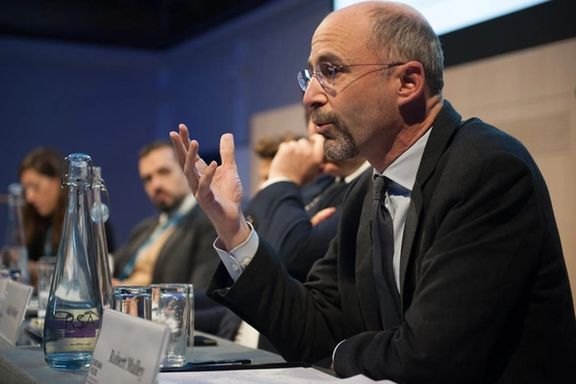
The United States Special Representative for Iran Robert Malley

The United States Special Representative for Iran Robert Malley held an “excellent” phone conversation with South Korean First Vice Foreign Minister Choi Jong-kun about Iran.

Malley said in a tweet on Friday that Washington and Seoul “are committed to coordinating our efforts across a wide range of shared interests on Iran.”

He did not elaborate on what exactly was discussed but the two diplomats probably talked about the Islamic Republic’s frozen assets in Korean banks due to US sanctions. 

Since the beginning of the year, Iran and South Korea announced on several occasions that they would start negotiations to devise a mechanism to release the funds frozen, but nothing materialized.

Two South Korea banks hold $7-9 billion of Iranian money, owed for oil imports, but the funds are locked under US sanctions, which were reimposed after former President Donald Trump in 2018 withdrew from the Iran nuclear deal, Joint Comprehensive Plan of Action (JCPOA).

In April, Iranian media said $7 billion of Iran's frozen funds in South Korea will be freed in exchange for the release of three American dual citizens held as hostages in Tehran.

Iranian hardliner newspaper funded by Iran’s Supreme Leader suggested later in April that Iran must close the Strait of Hormuz to South Korean vessels until Seoul releases $7 billion frozen funds.

US National Security advisor Jake Sullivan said in May that Iran’s money in South Korea and elsewhere will remain frozen as long as a nuclear deal has not been reached.


Most Viewed

100 days after carnage: Iran economy reels from war, inflation, unemployment
1
INSIGHT

100 days after carnage: Iran economy reels from war, inflation, unemployment

2
INSIGHT

Ghalibaf defends Iran-US talks amid hardline backlash

3
EXCLUSIVE

Iranian assaulted in London amid concern over threats to regime critics

4

IRGC fires at Indian vessel in Hormuz

5
INSIGHT

A nation in limbo: 100 days after the massacre, has the world moved on?

Banner
Banner

Spotlight

  • War-hit homeowners feel abandoned as Iran’s reconstruction aid fades

    War-hit homeowners feel abandoned as Iran’s reconstruction aid fades

  • 100 days on: the anatomy of Iran’s January crackdown
    INSIGHT

    100 days on: the anatomy of Iran’s January crackdown

  • Ghalibaf defends Iran-US talks amid hardline backlash
    INSIGHT

    Ghalibaf defends Iran-US talks amid hardline backlash

  • 100 days on: why Iran’s January protests spread across social classes
    ANALYSIS

    100 days on: why Iran’s January protests spread across social classes

  • From instability to influence: Pakistan’s pivotal role in US-Iran diplomacy
    ANALYSIS

    From instability to influence: Pakistan’s pivotal role in US-Iran diplomacy

  • A nation in limbo: 100 days after the massacre, has the world moved on?
    INSIGHT

    A nation in limbo: 100 days after the massacre, has the world moved on?

•
•
•

More Stories

Friday Prayers Leaders Back Iran’s Removal Of IAEA Cameras

Jun 11, 2022, 00:52 GMT+1

Friday Prayer leaders in Iran have backed the government’s decision to reduce access to the UN nuclear watchdog, IAEA, in the wake of a critical resolution adopted against Tehran.

The Friday Imams described removing the monitoring equipment installed by the International Atomic Energy Agency as the first step in reducing relations with the agency, with Tehran's Friday prayer Imam Ahmad Khatami condemning the IAEA resolution against Iran and saying that “the revolutionaries hit the bully in the mouth."

Referring to the IAEA director general Rafael Mariano Grossi's visit to Israel, the hardliner cleric called on the authorities "not to provide complete information to the IAEA." 

Similar remarks against the resolution and IAEA’s monitoring of Iranian facilities were made during the Friday prayer sermons in several other cities, including Esfahan, Arak, Bushehr, Ilam, and Ahvaz. 

Iran told the IAEA it plans to remove more monitoring equipment after the 35-member IAEA board Wednesday passed the resolution. Tehran says it intends to maintain a basic level of monitoring and inspectors’ access as required under the Nuclear Non-Proliferation Treaty (NPT).

The contents of Friday Prayer sermons delivered by Khamenei's local representatives in various cities are dictated by two state bodies close to Khamenei's office, officially known as "The Policy-making Council for Friday Prayer Imams" and the "Friday Prayer Headquarters," both dominated by hardliner clerics.

Venezuela, Iran Pioneers Of New World Order, Maduro Says In Tehran

Jun 10, 2022, 21:07 GMT+1

Venezuelan President Nicolas Maduro says his country and Iran are in the vanguard of the emerging global order, sharing a common goal of fighting colonialism and imperialism.

Maduro, who arrived in Tehran on Friday one day ahead of the announced schedule, made the remarks in an interview with Iran's state-run Spanish-language television channel Hispan TV.

He also announced that a 20-year cooperation plan with Iran will be signed between the two countries.

Describing Venezuela and Iran as the pioneers of shaping a world free of imperialism and dominant powers, Maduro said, “The era of the United States' military dominance of the world is over.”

He also urged sharing know-how with Iran in all fields, and hailed the Islamic Republic's “courageous move” to send fuel tankers to his energy-hungry nation despite US sanctions and threats.

He added that the delegation accompanying him to Tehran is aiming at facilitating further investments from Iran, noting that Iranians’ willingness to work in Venezuela indicates that resisting the US sanctions will eventually bear fruit.

Iran and Venezuela have been slapped with sanctions by the US, which doesn’t currently import oil from either nation, and has in recent years reimposed sanctions on Iranian state entities, including the national oil company NIOC, and in 2019 blacklisted PDVSA.

The two countries strengthened their cooperation in 2020, with Venezuela importing condensate from Iran, key to thinning its extra-thick crude oil. Iran has also stepped in to help its South American ally with engineers, refined products and spare parts for its oil industry.

US Senate Foreign Relations Committee Approves ‘Stop Iranian Drones Act’

Jun 10, 2022, 12:00 GMT+1

The US Senate Foreign Relations Committee has approved the Stop Iranian Drones Act (SIDA), which seeks to prevent Iran and Iran-backed militia groups from acquiring lethal drones.

In line with efforts to stop Tehran’s flourishing drone program, “the bipartisan legislation would amend the Countering America’s Adversaries Through Sanctions Act (CAATSA) to make clear that supporting the supply, sale or transfer to or from Iran of UAVs, or providing other assistance related to UAVs, is sanctionable under US law,” the committee Chairman Senator Bob Menendez (D-N.J.) and Ranking Member Jim Risch (R-Idaho) said in a statement on Thursday.

“As evinced by Iran’s drone attacks on Israeli shipping, Houthi attacks on Saudi Arabia and the UAE, and Iran-backed militia attacks on US facilities across Iraq... Iran’s reckless use and export of lethal drones to proxies and terrorist actors across the Middle East represents a significant threat to US national security and that of our allies and partners,” Menendez said, adding that “I look forward to working with my colleagues to ensure swift passage on the Senate floor and ultimate enactment of this bipartisan legislation into law.”

The House of Representatives passed the legislation late in April but it requires approval from the Senate and a presidential signature to become law.

“Iran’s regional terrorism continues to threaten not only the safety and security of our partners in the Middle East, but also American national security interests. Drones have rapidly become Iran’s weapon of choice,” Risch noted.

Canada Urges Citizens To Avoid All Travel To Iran

Jun 10, 2022, 10:16 GMT+1

Canada has warned its citizens against all travel to Iran “due to the volatile security situation, the regional threat of terrorism and the possibility of arbitrary detention.

The Canadian government updated its travel advisory on Wednesday, pointing out that there is no resident Canadian government office in Iran, therefore the ability of Canadian officials to provide consular assistance is extremely limited.

The advisory said that Canadians in Iran may be closely watched by Iranian authorities, noting that seemingly innocuous behaviors, such as the use of cameras in public places, travel beyond well-established tourist attractions or casual interactions with Iranian friends, may be misinterpreted and may lead to investigation. Canadians in Iran could also face kidnapping and petty crimes, and women visitors may face sexual harassment. 

The advisory update came as Canada announced on Tuesday that it has notified Iran of Ontario's Superior Court of Justice’s ruling that IRGC’s downing of Ukraine Airlines Flight PS752 was intentional. The airliner was shot down by two air-defense missiles fired by the IRGC on January 8, 2020, as it took off from Tehran’s Imam Khomeini International Airport. 

Canada broke off diplomatic relations with Iran in 2012, citing its support to the Syrian government, non-compliance with United Nations resolutions over the nuclear program, and fears for Canadian diplomats after protestors stormed the British embassy. 

Earlier in the week, the US also upgraded its Iran Travel Advisory to Level 4, which asked its citizens not to travel to the country, due to the risk of kidnapping and the arbitrary arrest and detention.

Iraq Approves Massive Emergency Finance Bill to Pay Iran Gas Debt

Jun 9, 2022, 17:30 GMT+1

The Iraqi parliament passed Wednesday an emergency finance bill to pay debts to Iran to ensure gas supplies and stop worsening power cuts.

The parliament, which has still not adopted its budget for 2022, approved the law relating to "food security and development" totaling 25 trillion Iraqi dinars, approximately over $17 billion.

Of that, $2.6 billion will be allocated to settling Iraq's gas and electricity debts, as well as for buying further energy supplies from abroad, and about $3.4 billion will be used to buy cereals, including large volumes of wheat supplies from both the domestic market and abroad.

Despite its immense oil and gas reserves, Iraq remains dependent on imports to meet energy needs, especially from neighboring Iran, which currently provides a third of Iraq's gas and electricity needs. 

Iran had demanded Iraq pay $1.6 billion it owes for gas imports by the start of June to guarantee further supplies, as it is cutting or reducing supplies regularly due to its own shortages. 

The debt to Iran, which has sharply reduced its gas exports in recent days, dates back to 2020, but payment was stalled amid sanctions against Iran by the United States, which means that Baghdad cannot pay directly for energy imports in cash.

On Tuesday, Iraqi Prime Minister Mustafa al-Kadhemi said that Iran has "promised to restore the needed supply of gas in the coming days.”

Electricity demand surges in Iraq as people seek to keep cool as the country enters the intense heat of the summer, when temperatures soar to over 50 degrees Celsius (122 Fahrenheit).