• العربية
  • فارسی
Brand
  • Iran Insight
  • Politics
  • Economy
  • Analysis
  • Special Report
  • Opinion
  • Podcast
  • Iran Insight
  • Politics
  • Economy
  • Analysis
  • Special Report
  • Opinion
  • Podcast
  • Theme
  • Language
    • العربية
    • فارسی
  • Iran Insight
  • Politics
  • Economy
  • Analysis
  • Special Report
  • Opinion
  • Podcast
All rights reserved for Volant Media UK Limited
volant media logo

Russian Envoy Says Iran Not Going Nuclear Now Unless Provoked
Iran International Newsroom
Jun 10, 2022, 20:27 GMT+1Updated: 17:29 GMT+1
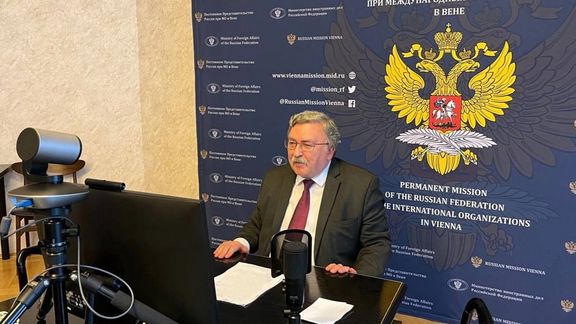
Russian envoy to Iran nuclear talks Mikhail Ulyanov speaking with Iran International from Vienna. June 10, 2022

Russia’s envoy to the International Atomic Energy Agency (IAEA) told Iran International Friday there was “still time” to save the 2015 Iran nuclear deal.

“It’s feasible, it’s doable,” Mikhail Ulyanov said. The ambassador claimed agreement between Iran and world powers was “99.9 percent” achieved when talks broke off March 10.

"We were five minutes from the finishing line,” he told Iran International Fardad Farahzad in a video interview.

After year-long negotiations to revive the 2015 deal, known as JCPOA, stopped in Vienna, it became clear that Iran and the United States had significant differences over what sanctions would be removed once an agreement was inked. Iran insisted that its Revolutionary Guard should be removed from the US list of terrorist organizations, a demand Washington has refused.

Ulyanov condemned the resolution passed Wednesday by the IAEA board criticizing Iran, which he said was "counterproductive" and "illogical at a very delicate moment in the Vienna talks when the final outcome is in question.” On Thursday, Ulyanov had called the Western move “stupid”, but in the he told Iran International that he should not have deviated from diplomatic language.

The resolution tabled by the United States, United Kingdom, France and Germany passed overwhelmingly, leaving only China and Russia as countries voting against.

Resolutions were passed by the 35-member board, Ulyanov argued only “on rare occasions and is perceived as something extraordinary as a rule.”

Ulyanov holding a meeting in Vienna with the Iranian delegation. February 13, 2022
100%
Ulyanov holding a meeting in Vienna with the Iranian delegation. February 13, 2022

The ambassador denied the situation with Iran – including its growing stockpile of uranium enriched to 60 percent and its continuing restrictions of IAEA monitoring - was extraordinary.

“It’s not urgent,” he said. “We are talking about uranium particles which belong to the beginning of this millennium [work carried out by Iran before 2003]…nobody can insist that these particles represent any proliferation risk.” Tehran had provided some information to the IAEA, he added, including over uranium metal, so that “progress is there.”

But the IAEA thought otherwise when on June 6 its director Rafael Grossi submitted his report to the Board of Directors saying, “Iran has not provided explanations that are technically credible in relation to the Agency’s findings at three undeclared locations in Iran.”

Iran and the IAEA had agreed in March that Tehran would fully answer questions about its past nuclear work by mid-June, and the UN nuclear watchdog concluded that there was little progress in that respect.

Ulyanov insisted that the passage of the resolution had led to Iran’s “retaliatory measures” in informing the IAEA it would remove further monitoring equipment. This, he said, had confirmed his assessment expressed before the resolution was raised.

Ulyanov meeting with US envoy Rob Malley in Vienna, Dec. 29, 2022
100%
Ulyanov meeting with US envoy Rob Malley in Vienna, Dec. 29, 2022

“I could not understand the logic behind this initiative of my western counterparts. I must tell you that last year they tried to do something like those three times – in which case the Russian Federation managed to convince them not to take this step.”

Such persuasion was more difficult in the current climate, Ulyanov conceded, obliquely referring to tensions over Ukraine.

Moscow remained committed, he insisted, to the 2015 nuclear deal (the JCPOA, Joint Comprehensive Plan of Action) as a “great achievement in the field of” non-proliferation.” He said that the current state of Iran’s nuclear program did not bring Tehran as near to nuclear weapons as some suggested.

“Russia is the strongest supporter of the nuclear non-proliferation regime…we don’t want the so-called ‘nuclear club’ [those states possessing nuclear weapons] to be extended… Speculations about so-called ‘break out time’ [the time it would take Iran to develop a bomb]…are not helpful…If Tehran obtains a sufficient amount of nuclear material – if they don’t have it at this stage – then they will [still] need to produce a nuclear warhead, which will take a lot of time, even if a political decision is taken in this regard.”

However, not all Iranian research and military sites are under international monitoring, and no one can be sure how quickly it can assemble a weapon once it has sufficient fissile material. By most accounts, Iran either already has or will soon amass enough enriched uranium for one or maybe two bombs.

The ambassador noted that while aspects of the Iranian nuclear program were “rather sensitive” that “at this stage we have no reason to believe Iran is looking for nuclear weapons…at least nobody has proved such an allegation.”

Ulyanov argued that Iran, while enriching uranium to 60 percent was not enriching to ‘weapons grade” [90 percent]: “To the best of my knowledge, at this stage they are not going to do that, unless somebody from outside provokes them to take some risky steps.”

But critics of the talks say that as Iran has dragged out the talks it has engaged in nuclear brinksmanship, advancing its program, while claiming it is not after weapons.


Most Viewed

Ghalibaf defends Iran-US talks amid hardline backlash
1
INSIGHT

Ghalibaf defends Iran-US talks amid hardline backlash

2
ANALYSIS

From instability to influence: Pakistan’s pivotal role in US-Iran diplomacy

3
ANALYSIS

100 days on: why Iran’s January protests spread across social classes

4

War-hit homeowners feel abandoned as Iran’s reconstruction aid fades

5
INSIGHT

100 days on: the anatomy of Iran’s January crackdown

Banner
Banner

Spotlight

  • Bread shortages, soaring prices strain households in Iran, residents say
    VOICES FROM IRAN

    Bread shortages, soaring prices strain households in Iran, residents say

  • War-hit homeowners feel abandoned as Iran’s reconstruction aid fades

    War-hit homeowners feel abandoned as Iran’s reconstruction aid fades

  • 100 days on: the anatomy of Iran’s January crackdown
    INSIGHT

    100 days on: the anatomy of Iran’s January crackdown

  • Ghalibaf defends Iran-US talks amid hardline backlash
    INSIGHT

    Ghalibaf defends Iran-US talks amid hardline backlash

  • 100 days on: why Iran’s January protests spread across social classes
    ANALYSIS

    100 days on: why Iran’s January protests spread across social classes

  • From instability to influence: Pakistan’s pivotal role in US-Iran diplomacy
    ANALYSIS

    From instability to influence: Pakistan’s pivotal role in US-Iran diplomacy

•
•
•

More Stories

Amid Iran's Defiance, Chances Dim For Reviving Nuclear Deal

Jun 10, 2022, 08:59 GMT+1
•
Iran International Newsroom

The Eurpean E3 condemned Iran’s action to reduce monitoring by the UN nuclear watchdog, while Washington said it would not necessarily hamper the Vienna talks.

France, Britain and Germany condemned on Thursday steps taken by Iran to essentially remove all the monitoring equipment installed by the International Atomic Energy Agency (IAEA) under the 2015 nuclear deal, saying the move cast a doubt on Tehran's will to revive the accord.

"These actions only aggravate the situation and complicate our efforts to restore full implementation of the JCPoA (nuclear deal)," the three countries said in a statement. "They also cast further doubt on Iran’s commitment to a successful outcome."

Unlike a joint statement made with the United States on Wednesday, Washington did not sign up to Thursday's statement.

The four Western powers who signed the 2015 nuclear agreement with Iran tabled a resolution critical of Iran this week at a meeting of the IAEA board of governors in Vienna after the UN watchdog’s director Rafael Grossi submitted a report saying Tehran has been stonewalling in an investigation of its past nuclear activities.

However, US officials on Thursday came up with their separate statements critical of Iran but saying that ultimately the safeguards and IAEA monitoring issues are “separate from the JCPOA.”

“The Board spoke to Iran's safeguard obligations, which are separate from the JCPOA. We are ready for a mutual return to full compliance immediately,” Rob Malley, US Special Envoy for Iran tweeted.

His statement that Iran’s safeguard obligations are separate from the JCPOA raised eyebrows, as Iran’s dismantling of monitoring equipment on Thursday was directly related to JCPOA.

US Special Envoy for Iran Rob Malley discussing Iran with Russia's represnetative Amb. Mikhail Ulyanoc in Vienna. Dec. 29, 2021
100%
US Special Envoy for Iran Rob Malley discussing Iran with Russia's represnetative Amb. Mikhail Ulyanoc in Vienna. Dec. 29, 2021

The former Director for Countering Iranian Weapons of Mass Destruction for the White House National Security Council, Richard Goldberg tweeted, “It strikes me as an obvious question to ask any senior official: Can Iran be in full compliance with the JCPOA while remaining in non-compliance with the NPT?”

But Malley’s remark simply followed a statement by National Security Advisor Jake Sullivan on Wednesday that said, “Iran’s issues with the IAEA and efforts to revive the 2015 deal are “on separate tracks, and that’s how we’re going to proceed.”

This in effect means that if Iran continues its non-cooperation with IAEA regarding its past secret nuclear activities, that will not interfere with a new deal.

The question arises if such a US position undercuts the UN nuclear watchdog’s authority not only in relation to Iran but in the bigger picture of global non-proliferation efforts.

Meanwhile, Iranian officials remained defiant as they annouced they are speeding up uranium enrichment, with more advanced machines.

The Wall Street Journal Editorial Board in a column on Thursday said, “There are few good options when dealing with rogue states that have or want the bomb, but rewarding Iran for its malign behavior is easily the worst. It’s all the more remarkable that the Iranians now seem to prefer humiliating the White House over taking the generous concessions apparently on offer.”

US lawmakers, skeptical of the Biden Administration’s Iran policy, will also take a dim view of developments this week, especially Tehran’s decision to turn off IAEA’s monitoring equipment and warnings that Iran now has enough fissile material to race for a bomb almost immediately.

The Democratic chairman of the Senate Foreign Relations Committee, Sen Bob Menendez said Wednesday, “Iran now has enough uranium to produce a nuclear weapon. This latest milestone returns us to a familiar question: At what point will the Administration acknowledge that Iran’s nuclear advances make a return to the 2015 JCPOA not in the United States’ strategic interest?”

Iran Politicians, Media Defy UN Nuclear Watchdog Censure

Jun 9, 2022, 19:30 GMT+1
•
Iran International Newsroom

Top Iranian officials Thursday showed defiance in the face of the IAEA resolution criticizing Tehran for lack of cooperation with the UN nuclear watchdog.

One day after the International Atomic Energy Agency passed the resolution, Iran responded by starting to disconnect some 27 cameras and monitoring devices in and around its nuclear sites, as its officials and media continued making defying remarks.

Iran's President Ebrahim Raisi said on the state television that “in the name of God and the great nation of Iran, we will not back off a single step from our positions.” The comment was followed by Foreign Ministry Spokesman Saeed Khatibzadeh's statement in which he said: "Iran's response to the IAEA resolution will be firm and proportionate."

On Twitter, former reformist lawmaker Mahmoud Sadeghi criticized Raisi for making the comment about the resolution and suggested that he should take measures that would prevent the handing over of Iran's nuclear case to the UN Security Council. Other reformists who have been pushed to the side-lines in the past two years were mostly silent.

Also on Thursday, the IRGC-linked Tasnim News agency carried a video showing an Iranian technician turning off an IAEA inspection camera. Meanwhile, another IRGC-linked news agency, Fars, said in a commentary that the resolution passed by the IAEA Board of Governors "Was a purely political measure to exert pressure on Iran." The agency added that the IAEA's action was "wrong and non-constructive."

IAEA's Grossi meeting Iran's nuclear chief Mohammad Eslami in Tehran to reach an agreement over monitoring. March 5, 2022
100%
IAEA's Grossi meeting Iran's nuclear chief Mohammad Eslami in Tehran to reach an agreement over monitoring. March 5, 2022

Fars quoted an “expert” as saying that the West has been using the IAEA to portray Iran as rogue. He added IAEA Chief that Rafael Grossi's visit to Israel shortly before the Board of Governor's meeting was aimed at portraying Iran as the non-cooperative party in the nuclear negotiations.

Thursday afternoon, Iran's security Chief Ali Shamkhani said in an interview with Fars News Agency that "The only way to defend Iran's rights against international bullies is to resort to reciprocal action." He added that reciprocity is what should be done in JCPOA talks, with the IAEA and at other forums.

Meanwhile, Fada Hossein Maleki, a member of the Iranian Parliament's national security committee told Fars that further measures are on the way to further restrict Iran's cooperation with the IAEA.

In another development, Didban Iran [Iran Monitor] news website reported on Thursday that media outlets close to Parliament Speaker Mohammad Bagher Ghalibaf as saying that by issuing this resolution, the IAEA and the countries that tabled it have closed the path to the revival of JCPOA. The media outlets close to Ghalibaf also said that the resolution might lead to the end of negotiations and that would be costly for the IAEA.

It is worth noting that the year-long JCPOA talks stopped in March due to Iran’s demands to remove its Revolutionary Guard from the US list of Foreign Terrorist Organization (FTO).

International relations expert Mehdi Motaharnia told Khabar Online website that the IAEA resolution will lead to further frictions between Iran and the West, namely the United States and its three European allies, the United Kingdom, France and Germany.

Meanwhile in a brief commentary on Twitter, international relations expert Diako Hosseini attributed Iran's isolation at the IAEA Board of Governors to the poor performance of its foreign ministry which he said could have interacted with the IAEA in a better way during the past year.

In the meantime, US Secretary of State Antony Blinken wrote in a tweet on Thursday: "The overwhelming majority of the IAEA Board of Governors made clear to Iran that it must provide the IAEA credible cooperation and resolve concerns. At the same time, Iran should use this opportunity to return to full implementation of the JCPOA."

Grossi Gives 28-Day Deadline For Restoring Iran Nuclear Deal

Jun 9, 2022, 15:35 GMT+1
•
Iran International Newsroom

Four weeks at most remain to restore enough inspectors’ access to avoid a “fatal blow” to hopes of reviving Iran’s 2015 nuclear deal, the UN atomic chief says.

Rafael Mariano Grossi, director general of the International Atomic Energy Agency (IAEA) told a news conference in Vienna Thursday that without Iran restoring some of the monitoring equipment it is now removing, the agency would be unable to piece together enough of Tehran’s most important nuclear work for the 2015 deal, the JCPOA (Joint Comprehensive Plan of Action), to be worth saving.

Grossi was speaking after Iran overnight told the IAEA it planned to remove further equipment, including cameras, after the 35-member IAEA board Wednesday passed a resolution critical of Iran for not satisfying the agency over the nature and origins of uranium traces found in three sites. Grossi told the press conference this meant that even though more than 40 agency cameras would still operate, “basically all” the extra equipment installed under the 2015 deal would be gone.

Tehran has stressed that it intended to maintain a basic level of monitoring and inspectors’ access as required under the Nuclear Non-Proliferation Treaty (NPT), and has argued that questions regarding the uranium traces, which relate to pre-2003 work, are ‘technical’ and should be kept separate from the ‘political’ challenge of reviving the JCPOA.

In this, Iran has been supported by China and Russia, which opposed the IAEA resolution moved Wednesday by France, Germany, the United Kingdom, and the United States.

But Grossi’s argument is that without the agency being able to understand Iran’s activities during the time it has exceeded JCPOA limits – starting 2019, the year after the United States left the JCPOA – it would be unable to resume its role of certifying that Iran remained within the terms of a revived 2015 agreement.

Contrary to ‘mutual confidence’

­Grossi told the press conference that his greatest potential concern was Iran’s acceleration of earlier announced plans to install more efficient centrifuges, devices that enrich uranium, at its Natanz plant.Such machines, barred under the JCPOA, increase speed and efficiency in raising enrichment levels, when Iran is near to acquiring sufficient highly-enriched uranium for a crude nuclear weapon. “This runs contrary to the idea of providing more mutual confidence,” Grossi said.

Iran decided in November 2020 to begin enriching uranium beyond 5-percent purity, and reduce IAEA access at a time when President-elect Joe Biden had expressed a clear intent to restore the JCPOA.

Grossi agreed with Iran om a temporary arrangement in February 2021 to continue access and monitoring above the level required under the NPT, but these have come under increasing pressure since talks to revive the JCPOA between Iran and six world powers faltered in March.

Strategic interests

It remains unclear what the consequences of the IAEA resolution will be. Some analysts have welcomed the IAEA resolution as a spur to renewed efforts to salvage the JCPOA. There are also voices in Europe, including former European Union foreign policy chief Javier Solana, who have criticized the Biden administration for passivity in the face of domestic politics and warned that failure to restore the deal will promote dangerous instability.

In contrast, Robert Menendez, chairman of the US Senate Foreign Relations Committee and a Democrat, argued Thursday in a tweet welcoming the IAEA resolution that a return to the JCPOA was not in Washington’s strategic interests.

In a speech carried on state television Thursday, Iran’s President Ebrahim Raisi said that, in the face of the IAEA resolution, “in the name of God and the great nation of Iran, we will not back off a single step from our positions.”

Biden Admin Must Accept Return To JCPOA Is Not In US Interest– Senator Menendez

Jun 9, 2022, 12:20 GMT+1

The chairman of the US Senate Foreign Relations Committee has said the Biden administration must accept that a return to the 2015 nuclear deal, the JCPOA, is not in US interest.

Senator Bob Menendez (D-N.J.) said on Wednesday that “Iran now has enough uranium to produce a nuclear weapon. This latest milestone returns us to a familiar question: At what point will the Administration acknowledge that Iran’s nuclear advances make a return to the 2015 JCPOA not in the United States’ strategic interest?” The Politico reporter who quoted Menendez did not say where he made the remarks. 

He also commended the UN’s “International Atomic Energy Agency (IAEA) Board of Governors’ approval – by an overwhelming majority – of a resolution condemning Iran, saying, “It is high time the board of governors publicly hold Iran to account for its failure to provide credible and timely cooperation with the IAEA’s inquiry into undeclared nuclear materials, which are in contravention of Iran’s safeguard agreement.” 

Of 35 member states on the board, 30 voted in favor of the resolution sponsored by the ‘E3’ (France, Germany, the United Kingdom) and the United States. India, Libya and Pakistan abstained, while Russia and China voted against.

Menendez reiterated that it is time for a comprehensive strategy to address Iran and the threat it poses, “Iran as it is, not the Iran we might hope for.”

“I commend the Biden administration, and France, Germany, and the United Kingdom for introducing this resolution as a first step to realizing such a strategy,” he added.

US Senators Say Turning Off IAEA Cameras Shows Iran’s Ill Intentions

Jun 9, 2022, 10:53 GMT+1

A number of US lawmakers told Iran International that the Islamic Republic’s removal of the UN nuclear watchdog's surveillance cameras shows Iran’s intentions are not peaceful. 

Republican Senator Mike Rounds from South Dakota said on Wednesday that “they have intents other than peaceful desires with regards to nuclear weapons. They have clearly been on the road to developing a nuclear weapon from day one.”

Highlighting that Israel is at risk of attacks by Iran, Rounds said the US has done “hopefully” its best to limit the Islamic Republic’s ability to get a nuclear weapon. 

Criticizing the Biden administration's Iran policy, he said that “when you move from one admin to another you have to have a consistent policy.”

He added that he had disagreed in the past and still disagrees with “the proposed settlements between the US and Iran."

Indiana’s Republican Senator Todd Young said the path Iran is pursuing is going to make the country even more isolated, noting, “This is not going to any place good for Iran's leaders. They want to continue to be isolated by the international community.”

Referring to the recent anti-government protests across the country, he said that “If they want to continue to hurt their people who have recently been rising up against their leadership because of their economic circumstances, then they're doing the right thing. If instead, they would like to enjoy prosperity and opportunity for their people and longer-term security, they're going to need to abide by the terms in the spirit of IAEA mandates to go in and look at all the facilities to ensure Iran is not trying to develop nuclear weapons."