• العربية
  • فارسی
Brand
  • Iran Insight
  • Politics
  • Economy
  • Analysis
  • Special Report
  • Opinion
  • Podcast
  • Iran Insight
  • Politics
  • Economy
  • Analysis
  • Special Report
  • Opinion
  • Podcast
  • Theme
  • Language
    • العربية
    • فارسی
  • Iran Insight
  • Politics
  • Economy
  • Analysis
  • Special Report
  • Opinion
  • Podcast
All rights reserved for Volant Media UK Limited
volant media logo

Russia Joins China In Opposing Move Against Iran At UN Nuclear Board
Iran International Newsroom
Jun 4, 2022, 13:58 GMT+1Updated: 17:41 GMT+1
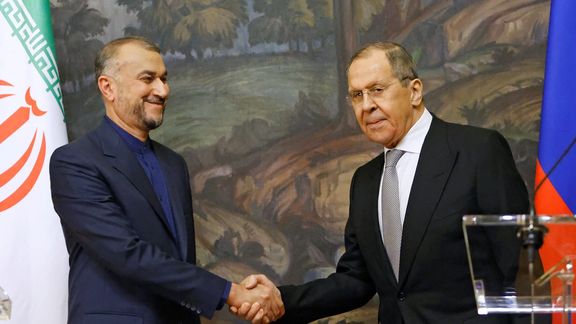
Russian Foreign Minister Sergei Lavrov (left) and Iranian Foreign Minister Hossein Amir-Abdollahian meeting on March 15, 2022

Russia has joined China in opposing a possible resolution from the United States and ‘E3’ condemning Iran at next week’s meeting of the UN nuclear watchdog.

Following a report from the United Nations’ International Atomic Energy Agency this week expressing dissatisfaction at Iran’s answers to queries over its pre-2003 nuclear work, the US and E3 – France, Germany, and the United Kingdom – have been discussing moving a resolution at the 35-member IAEA board meeting June 6-10.

Russian Foreign Minister Sergei Lavrov told Iranian Foreign Minister Hossein Amir-Abdollahian Friday that Moscow was in “definite opposition” to such a move The Iranian foreign minister told Lavrov that such a resolution would contradict the diplomatic process wherebyTehran and Washington exchanged notes over the past two months through Europeans.

Echoing a Chinese view expressed Thursday, Lavrov said that such a resolution would have “no positive impact” and that “issues of cooperation between IAEA and Iran should be resolved within IAEA’s technical path.”

Over the past year, the US and E3 have held back from moves critical of Iran’s co-operation with the IAEA so as not to undermined negotiations in Vienna over reviving the 2015 nuclear deal, the JCPOA (Joint Comprehensive Plan of Action), which the US left in 2018.

But questions over Iran’s pre-2003 nuclear work, and alleged lack of transparency over it, were recently revived by documents from 2004-5 released by Israel purporting to show Iranian efforts to hoodwink IAEA inspectors using information gleaned from purloined agency documents. This has blurred the distinction between the supposed ‘technical’ issues dealt with the agency and the ‘political’ process of JCPOA renewal.

‘Shrinking’

The administration of President Joe Biden, which came to office committed to re-joining the JCPOA as a means to gain cap Iran’s nuclear program, has insisted that not all US sanctions put in place by the previous administration of President Donald Trump contravene the 2015 agreement. Reports have suggested the 2019 listing of Iran’s Revolutionary Guards as a ‘foreign terrorist organization’ is a particular sticking point.

Joseph Borrell, the European Union foreign affairs chief, tweeted Saturday after a phone-call to Amir-Abdollahian that while the chance of reviving the JCPOA was “shrinking,” it could still be done “with an extra effort.” Borrell wrote he would “stand ready any time to facilitate a solution to the latest outstanding issues.”

US State Department Spokesman Ned Price said May 31 that the JCPOA revival was “absolutely within reach” and that the US would continue efforts to revive the deal as long as this held out clear non-proliferation benefits. But Iran’s accumulation of uranium enriched to 60 percent, the most serious violation of its JCPOA limits since 2019, has strengthened domestic criticism of Biden, both from JCPOA critics and from those arguing Biden needs urgently to revive the agreement.

Price Friday cited Secretary of State Antony Blinken speaking with Oman’s Foreign Minister Sayyid Badr al-Busaidi to thank him for efforts to mediate both over the current truce in Yemen and to discuss Iran.


Most Viewed

Ideology may be fading in Iran, but not in Kashmir's ‘Mini Iran'
1
INSIGHT

Ideology may be fading in Iran, but not in Kashmir's ‘Mini Iran'

2
INSIGHT

Hardliners push Hormuz ‘red line’ as US blockade tests Iran’s leverage

3
VOICES FROM IRAN

Hope and anger in Iran as fragile ceasefire persists

4

US sanctions oil network tied to Iranian tycoon Shamkhani

5

Iran International says it won’t be silenced after London arson attack

Banner
Banner

Spotlight

  • Hardliners push Hormuz ‘red line’ as US blockade tests Iran’s leverage
    INSIGHT

    Hardliners push Hormuz ‘red line’ as US blockade tests Iran’s leverage

  • Ideology may be fading in Iran, but not in Kashmir's ‘Mini Iran'
    INSIGHT

    Ideology may be fading in Iran, but not in Kashmir's ‘Mini Iran'

  • War damage amounts to $3,000 per Iranian, with blockade set to add to losses
    INSIGHT

    War damage amounts to $3,000 per Iranian, with blockade set to add to losses

  • Why the $100 billion Hormuz toll revenue is a myth
    ANALYSIS

    Why the $100 billion Hormuz toll revenue is a myth

  • US blockade targets Iran oil boom amid regional disruption
    ANALYSIS

    US blockade targets Iran oil boom amid regional disruption

  • Iran's digital economy battered by prolonged blackout
    INSIGHT

    Iran's digital economy battered by prolonged blackout

•
•
•

More Stories

Iranian Aerospace Engineer Dies In Suspicious Circumstances

Jun 4, 2022, 13:36 GMT+1

An Iranian aerospace engineer said to have worked on developing missiles and drones at a research and development center in the central city of Yazd has died under suspicious circumstances. 

Ayoob Entezari, who held a PhD in Mechanical and Aerospace Engineering from Tehran’s Sharif University, died last week with some reports mentioning food poisoning as the cause of his death, Iranian and Israeli media reported on Saturday. He reportedly took part in several projects at the Yazd Institute of Technology.

The circumstances surrounding his death are shady as some people on social media say the Iranian scientist was killed and Mossad is also mentioned in some reports as being responsible but no official source has yet spoken out about his death.

The reports came a day after Iran confirmed the death of another colonel from the Quds Force, Ali Esmailzadeh of the Islamic Revolutionary Guard Corps, the second in two weeks from the unit which allegedly oversees terror operation abroad.

Iranian government and IRGC media said that Col. Esmailzadeh died “in an incident in recent days” at his home without mentioning any details after Iran International quoted sources in Iran as saying that the IRGC killed him over suspicions of espionage. Officials of the Revolutionary Guard told Esmailzadeh’s family that the reason for his death was suicide.

He was a close colleague of Colonel Hassan Sayyad-Khodaei, the acting commander of the elite Qods Unit 840, who was earlier shot dead behind the wheel of his car outside his home in Tehran on May 22 by two gunmen who fled the scene on a motorbike.

Family Of American-Iranian Dual Citizen Appeals To Biden For His Release

Jun 4, 2022, 10:56 GMT+1

The family of Emad Sharghi (Shargi), an American-Iranian dual citizen jailed in Iran since 2018, made an appeal to the US president to "do anything" in his power to bring him home.

In an exclusive interview with CBS News on Friday, Sharghi’s wife and two daughters said they have requested a meeting with Joe Biden "numerous times," including as recently as ten days ago, but has so far not received a response from the White House.

"Really what we would like is to sit in front of the president and tell our story and beg him — because he is the only one that can make the decision to bring Emad and the other hostages home," said Bahareh, Emad's wife.

"We really hope that the administration puts patriotism over politics and brings these Americans home," said Emad's 25-year-old daughter Ariana. 

In April, which marked four years since Sharghi’s detention, US Secretary of State Antony Blinken and Special Envoy for Iran Robert Malley called on Iran to release Sharghi and stop its policy of holding people as political pawns.

The 56-year-old businessman has been sentenced to ten years in prison on charges of espionage and collecting military intelligence but had attempted to flee while on bail awaiting the result of an appeal.

Foreign governments and human rights organizations have accused Iran of detaining foreigners and dual nationals on trumped up charges to use them for getting concessions from Western countries.

Tehran Commentators Mull Fate Of Iran Nuclear Negotiations

Jun 4, 2022, 06:28 GMT+1
•
Iran International Newsroom

The Rouydad website in Tehran has warned that failure in Iran nuclear talks would increase regional and international tensions and perhaps lead to war.

The website, which takes a centrist political position, argued Iran faced a stark choice between reviving the deal – the JCPOA, Joint Comprehensive Plan of Action – or announcing its death.

The suspension in March of Iran’s year-long negotiations with world powers in Vienna coincided with the Russian invasion of Ukraine, which complicated the situation. There have been no subsequent signs of rapprochement between the United States and Iran.

In the latest round of exchanges, the US State Department Spokesman Ned Price blamed the talks’ suspension on Tehran raising demands beyond the JCPOA. Iran has long argued that sanctions introduced by President Donald Trump – no matter whether under rubrics of ‘human rights’ or ‘terrorism’ – were designed to stymie subsequent efforts to revive the JCPOA, from which Trump withdrew the US in 2018.

Foreign Minister Hossein Amir-Abdollahian has said the Biden Administration's inaction has left diplomacy in suspended animation, and that agreement over reviving the JCPOA was a simple matter of all parties honoring commitments.

With the US and the three European JCPOA signatories considering a resolution at next week’s IAEA board critical of Iran for failing to satisfy the agency over its pre-2003 nuclear work, China Thursday said such a move would undermine JCPOA negotiations. Qatar and Oman have been trying to mediate.

Iran Diplomacy website suggested that with the Vienna talks suspended, the US, France, Germany, and the United States might persuade the 35-member IAEA board “to make a political decision and issue a resolution that would send Iran's case to the UNSC [United Nations Security Council]."

‘Technical,’ and ‘political’

Qasem Mohebali, a former Iranian diplomat, told Nameh News website, that a report from IAEA chief Rafael Mariano Grossi on the pre-2003 work, which leaked May 30, was ‘technical’ whereas any decision by the UNSC would be political. In very different circumstances in 2005-6, Iran’s expansion of its nuclear program led to a referral from the IAEA to the UNSC, which imposed multilateral sanctions with the support of both Russia and China.

Mohebali said that any IAEA board decision would be made purely on votes cast by the 35 member states, and that the outcome “depends on how US and Europe can garner support for their idea.”

Political commentator Javad Arianmanesh told Nameh News that the JCPOA was likely to fall aside. " In that case, things can become more difficult for Iran," he said. Arianmanesh argued “the most important obstacle on the way of any settlement" was the disagreement between Tehran and Washington over the US listing of Iran’s Revolutionary Guards as a ‘foreign terrorist organization.’

Arianmanesh argued that the “fate of the country’s economy” depended on lifting US sanctions, and that “the longer the suspension of the talks continues” the more difficult “everything” would be for Iran.

Fingers Of Iranian Prisoner Cut Off With New Guillotine

Jun 4, 2022, 01:29 GMT+1

Four fingers of an Iranian prisoner who was sentenced to amputation for robbery were cut off in Tehran’s Evin Prison with a guillotine-like device that the prison has recently acquired. 

A former political prisoner and civil rights activist, Arash Sadeghi, said in a tweet on Thursday that the guillotine machine arrived at the prison about a month ago and was installed at the infirmary to carry out such sentences. 

According to Sadeghi, the man whose fingers were cut off on Tuesday had been transferred from the Kermanshah prison to carry out the sentence.

He added that three other prisoners convicted of robbery, namely Hadi Rostami, Mehdi Sharafian, and Mehdi Shahivand, have been transferred from the Orumiyeh prison in the northwestern province of West Azarbaijan to Evin to carry out their amputation sentences. 

According to Islamic Sharia law, punishment for theft can be amputation of fingers or hands.

The three prisoners have spent five years waiting for their sentence to be carried out.

Human rights organization Amnesty International had previously condemned the move to “deliberately mutilate and traumatize prisoners through unspeakably cruel judicial corporal punishments.”

Their trial was grossly unfair and relied on “confessions” which the men have said were obtained under torture and other ill-treatment while they were detained, without access to their lawyers, Amnesty said in December 2020. 

Kylie Moore-Gilbert, an Australian-British academic previously jailed in Iran for over two years, deplored the move, describing the procedure as “barbaric and medieval.”

Young Man Assaults Top Cleric In Esfahan After Friday Prayers

Jun 3, 2022, 20:35 GMT+1

The representative of Iran’s Supreme Leader in the central city of Esfahan, Yousef Tabatabaei-Nejad, was attacked Friday by a young man carrying a knife.

The hardliner cleric, who is the Friday prayer Imam of the city, said on Friday that a troubled young man in his 20s ambushed him from behind after the prayers, adding that he was hit on the neck, but it was nothing serious and he was not hurt.

Tabatabai-Nejad said the assailant, whose identity was not announced, was arrested immediately and his motives are being investigated. Iranian media say that the cleric suffered minor injuries.

People on social media said the man attacked the cleric with a metal object.

In 2020, Tabatabai-Nejad said society must become unsafe for women with loose-fitting hijabs. Similar calls for crackdown on those who fail to comply with compulsory hijab sparked a series of acid attacks on women in Esfahan in 2014.

Earlier in the year, a member of the Assembly of the Qom Seminary Scholars and Researchers, Mohammad Taghi Fazel Meybodi, said that clerics and seminary students are avoiding their usual garb for fear of being insulted in public, adding that the people in Iran have a negative view of the clergy, and blame them for the current hardships they experience, including high prices and corruption.

Another well-known cleric, Mohammad-Reza Zaeri, also talked about the growing hatred and grudge towards the clergy in January, warning of a crisis unfolding in society.



