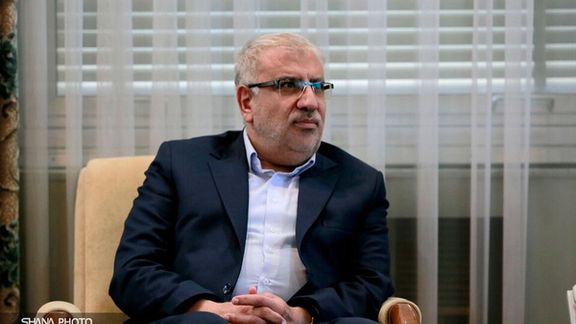
Iranian oil minister Javad Owji in Baku. June 2, 2022
Iran’s oil minister claimed Thursday that both crude and natural gas production capacity has increased, amid anticipated energy price problems for the world.
Minister Javad Owji who was attending the Baku Energy Forum in Azerbaijan said that daily oil production capacity has reached 4 million barrels and gas production capacity stands at one billion cubic meters.
However, the concept of production capacity does not mean the practical ability to actually reach the full limit. For example, Iran formally says its electricity generation capacity is 85,000 megawatt (MW), but its real production is around 55,000, with regular shortages and blackouts during peak winter and summer seasons.
After the Russian invasion of Ukraine, Iranian officials have been periodically hinting at the need for Iran’s oil and gas, considering current high prices and Europe’s quest to reduce imports from Russia.
Iran is currently producing around 2.5 million barrelsof oil per day, exporting just under one million barrels and consuming most of the rest. Without United States sanctions on Iran’s oil exports Iran could perhaps produce another one million barrels per, as was the case in 2017 before the sanctions, when its production was around 3.5 million barrels and exports just above 2 million.
Recently announced figuresby the head of Iran’s natural gas distribution system indicate that a little over 700 million cubic meters of gas daily was used domestically. Considering that the country has no natural gas exports, one can assume that this volume is what it produces.
The oil minister’s claim of a one-billion-cubic-meter production capacity cannot be substantiated as according to the same report, Iran just managed to supply its domestic market and had no additional production.
The oil minister’s claim also comes at the backdrop of his own admission last November that Iran needs upwards of $160 billion in investments just to keep its oil and gas industries from further decay after decades of negligible attention.
No substantial investment has been made in the natural gas sector since the French Total pulled out of a $5 billion deal when the Trump administration appeared ready to impose sanctions on Iran. Even the Chinese are not active despite repeated claims that they would develop the country’s energy sector.
Without a comprehensive deal with the United States to resolve differences, no serious international investor would commit to the Iranian market.
If a nuclear agreement is achieved, which increasingly looks unlikely, what Tehran could benefit from is lifting of oil export sanctions and some ease in banking relations with the world. But doubts will remain on the part of investors as any geopolitical incident or flare up of tensions led by Iran in the region can set back economic cooperation plans.
Small independent Chinese refineries are behind the surge in Iran’s oil revenues, says an advocacy group that works to expose those who help Tehran evade economic sanctions.
The Washington Free Beacon cited information obtained by United Against a Nuclear Iran (UANI) to reveal a network of Chinese petrochemical refiners, or "teapots," behind the upswing in illicit Iranian crude oil trade, saying they provided the Islamic Republic with at least $22 billion in revenue since President Joe Biden took office.
These Chinese private firms, which are not state-controlled, are primarily responsible for "funding this illicit and uniquely lucrative trade" with Iran, the report said, adding records seen by the UANI detailed at least 40 different shipments of Iranian oil to China dating back to 2019.
The information about small refiners buying Iranian oil is not new but the details in UANI’s report shed further light on the illicit trade.
Mohammad Bagher Ghalibaf, Iran's parliament speaker chairing a session. February 21, 2022
While Iran's president is struggling amid deteriorating economic situation and protests, lawmakers are again calling for impeachment of his economic ministers.
The move could be an attempt to divert attention from the sharp devaluation of the Iranian currency in the recent days, which has brought the rate of exchange for the US dollar to an all-time high of 318,000 rials. The devaluation heralds more inflation, already standing above 40 percent with food prices rising sharply in May. It could also be an attempt to show that the parliament or Majles is active as protests to government corruption and ineptitude continue.
However, it could be just as well a genuine attempt by Majles to make things right as the government seems to be incapable of mitigating the country's problems with its current makeup.
During the past months lawmakers trying to impeach several ministers including Labor Minister Hojjat Abdolmaleki and Industry Minister Reza Fatemi Amin, complained that there is more than enough support for the impeachment motion, but the Majles presidium opposes to move, apparently to give more time to Raisi and his ministers to catch up with worsening crises in the country.
This time it is different as according to ILNA website in Tehran, a member of the Majles presidium, Ahmad Amirabadi told the state TV on Monday, "We are waiting for the President to reshuffle his cabinet,” urging parliament members to wait.
Speaking on national television, Amirabadi said at least three or four ministers, one vice president and several provincial governors need to be replaced, without mentioning any names.
Amirabadi accused some of Raisi's ministers of thinking only about the interests of their hometowns, as if they are a member of parliament. He added: "It is good that current [hardliner] lawmakers helped a revolutionary government to take over the affairs of the state, but this should not lead to undermining of the parliament's supervisory role."
Meanwhile, in a May 31 report, moderate news website Rouydad24 said that parliament may not be willing to extend the time it gave Raisi to reshuffle his ministers, and lawmakers have already started to warn Raisi and even threaten him over the imminent impeachment of his ministers.
The website quoted several lawmakers as having said that "The Majles should quickly table impeachment motions if Raisi refuses to make changes in his cabinet." The lawmakers have also said: "Majles is considering to impeach five to six cabinet ministers, but the cases of the labor and industry ministers are being discussed more seriously."
Lawmaker Lotfollah Siahkali told Rouydad24 that "some of these ministers will certainly lose their post if they are ever summoned to the Majles." Apart from the two ministers, according to Amirabadi, there is also strong support for the impeachment of Communication Minister Isa Zarepour.
The move to impeach ministers seems more serious than ever as Majles Speaker Mohammad Bagher Ghalibaf, who a few months ago suggested to delay radical moves, last week changed his tune: "If the government's missions are not accomplished, the Majles might use its supervisory authority including impeachment and legal action."
A man selling US dollars outside a currency exchange office in Tehran. Undated
Iran’s rial hit a low point against major currencies Monday, as nuclear talks with the United States remain in limbo, prices rise and popular protests continue.
The rial has been sliding since mid-March when year-long multi-lateral talks in Vienna to revive the 2015 nuclear agreement known as JCPOA came to an abrupt halt. Washington and Tehran apparently were too far apart on some issues, including Iran’s demand that its Revolutionary Guard should be removed from the US list of terrorist organizations.
The rial slid to 310,000 to the US dollaron Monday, while in 2017, before the Trump administration decided to withdraw from the JCPOA it traded at 34,000 to the US dollar, ninefold decline. This was the currency’s lowest point so far in 2022.
The continuing decline of the currency is bad news for the rulers of the Islamic Republic as they already face runaway inflation at above 40 percent. Every percentage point the rial loses in value it translates into higher food prices, because at least half of Iran’s wheat and a large amount of animal feed is imported.
The government’s decision in early May to stop multi-billion-dollar subsidies for food impots resulted in a price shock for ordinary people, with experts predicting even higher inflation.
A report in the Iranian media on Monday said that even bottled drinking water is too expensive for people living on ordinary salaries.
The Statistical Center of Iran (SCI) just last week released its report on prices for the 30-day period of April 21-May 20.
Prices for pasta, which has become a relatively cheap source of calories for wage earners, jumped by 49 percent in one month, and cooking oil by 22.3 percent.
When it comes to chicken, eggs and other food items, what people and media report is astonishing. Chicken prices have doubled in recent weeks and sales declined by 30 percent. The government was forced to lift export restrictions to help producers stay financially solvent, but most have cut back on production, reportedly killing and dumping newly hatched chicks.
SCI reports that price of lemons has risen 11 percent and watermelon by 12.8 percent in one month.
As the government lifted food import subsidies, protests began in dozens of small towns, as large cities, notably the capital Tehran remained mostly quiet. But on May 22, an unexpected disaster sparked new protests.
A 10-story building in the south-Western city of Abadan in the oil-rich |Khuzestan province collapsed, killing more than 30 people and leaving an equal number under the debris. Quickly it became apparent that the newly built building was mired in corruption, as repeated warnings by inspectors were ignored by its well-connected owner. He even received permission to add a few floors to the building.
Iranians on social media often talk of a crisis of legitimacy for the Islamic Republic. Many people have lost all confidence that the authorities can govern even at a minimally acceptable standard.
This, than any particular incident or inflation is the deep rooted cause of protests. A building collapse, such as the incident in Abadan, simply comes to remind citizens that the authoritarian system is corrupt at all levels, and there is no hope for any tangible improvement.
A former deputy minister and political activist Mostafa Tajzadeh tweeted Monday that the government claims to be able to circumvent US sanctions and export oil, yet there is no positive impact on the economy and people continue to suffer.
Iran’s Foreign Ministry summoned Wednesday the Greek chargé d'affaires to protest the seizure of a vessel carrying Iranian crude oil in Greece's territorial waters.
The ministry said it notified the Greek envoy of his country's "international obligations" regarding the vessel's emergency stop due to a technical difficulty.
The Russia-flagged aframax Lana, formerly named Pegas, was detained on April 15 by Greek authorities and had been waiting at Karistos port pending a court ruling. On Monday afternoon, a tanker owned by Dynacom Tankers Management, called Ice Energy, was chartered by the US Department of Justice and started a ship-to-ship transfer of the US-sanctioned Iranian crude on the basis of Russian sanctions.
The operation, first reported by watchdog group United Against Iran, was verified using Lloyd's List intelligence data.
The head of the Mediterranean and East European affairs at the Iranian ministry condemned Greece’s "unacceptable" surrender to "illegal" US sanctions, saying the "seizure of the cargo of the ship with the flag of the Islamic Republic of Iran was an example of international piracy."
Lana, which arrived off Greece early in April with reports of a possible mechanical failure and anchored south of the Greek island of Evia, was identified as the Russian-flagged Pegas and the assumption at the time was that it was laden with Russian crude.
"The seizure came at the request of the Americans because the cargo came from a sanctioned country and moved on a sanctioned ship," a Greek official told Dow Jones on Wednesday.
Russian Deputy Prime Minister Alexander Novak (left) and Iranian Oil Minister Javad Owji during a ceremony to sign energy agreements in Tehran on May 25, 2022
Tehran and Moscow have signed a number of major memoranda of understanding (MoUs) to expand energy and trade ties, as Russian Deputy Prime Minister Alexander Novak visited Iran.
The agreements were signed in Tehran on Wednesday during a meeting attended by Novak and Iranian Oil Minister Javad Owji.
"Iran and Russia are both under oppressive sanctions, which, God willing, can be neutralized by working together and developing relations in various fields," Owji was quoted as saying by the oil ministry’s news agency, Shana.
"Good agreements were reached in the fields of rail, road transport, shipping and aviation," he said, without expanding further, adding that both sides have "good capacities for cooperation in energy, banking, transportation, agriculture, nuclear energy, industry and trade".
"We plan to increase the level of Iran-Russia trade relations in these fields to $40 billion a year," the oil minister added. Current annual bilateral trade is around $4 billion.
According to Russia's Interfax news agency Novak and Owji discussed the potential for oil and gas swaps, as well as "increasing joint investments in oil and gas projects" with the Russian official emphasizing that "Energy is one of the most important sectors of our trade and economic cooperation."
"We agreed to switch over to the use of national currencies as much as possible," Novak added, noting that "A path is being pursued to increasing trade, economic, logistics, investment, financial and banking cooperation, despite the unprecedented pressure that Russia is currently experiencing from unfriendly countries."
While Tehran has been chafing under sanctions for years, especially after the US pulled out of the nuclear deal in 2018, Western governments have imposed tough sanctions on Russia after it invaded Ukraine in February.