• العربية
  • فارسی
Brand
  • Iran Insight
  • Politics
  • Economy
  • Analysis
  • Special Report
  • Opinion
  • Podcast
  • Iran Insight
  • Politics
  • Economy
  • Analysis
  • Special Report
  • Opinion
  • Podcast
  • Theme
  • Language
    • العربية
    • فارسی
  • Iran Insight
  • Politics
  • Economy
  • Analysis
  • Special Report
  • Opinion
  • Podcast
All rights reserved for Volant Media UK Limited
volant media logo

IRGC-Linked Lawmaker Says Iran Not Insisting On Delisting The Guards

Iran International Newsroom
May 30, 2022, 11:11 GMT+1Updated: 17:39 GMT+1
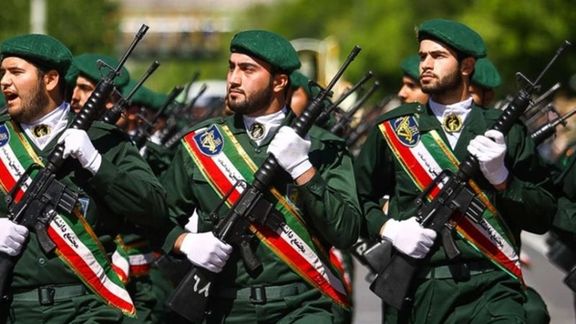
Iran’s Revolutionary Guard’s cadets during a parade

An Iranian lawmaker who was Tehran’s security commander as an IRGC general, says "We do not insist on delisting the IRGC as a terrorist group. But the United States should behave logically."

Asked during an interview with Didban Iran website whether the US decision not to delist the IRGC means the end of the nuclear deal with Iran, the Joint Comprehensive Plan of Action (JCPOA), Esmail Kowsari said: "We have set a framework for the nuclear negotiations. America jumping up and down will not affect our decision."

Talks to revive the JCPOA in Vienna came to an abrupt stop in March, reportedly for Iran’s insistence that the IRGC be removed for the US list of Foreign Terrorist Organizations (FTO).

Kowsari added, "The time is over for America's jingoism and irrelevant responses. It is now the United States' turn to give us a logical response."

He further said that "We know that it was not Biden who added the IRGC to the FTO list, but we also know that it was Trump, the evil one, who imposed the sanctions on Iran and pulled out of the deal with us."

Kowsari also suggested a solution for the diplomatic impasse: "If Mr. Biden wants the nuclear negotiations to revive the JCPOA to be fruitful, he needs to lift those sanctions and delist the IRGC. It is in that case that we can reach an agreement about our relations."

However, the former Revolutionary Guard general who is now a lawmaker from Tehran reiterated that "Nothing will happen to the Islamic Republic, and we will continue what we are doing if Biden refuses to delist the IRGC. In this case the talks over the revival of the JCPOA will remain inconclusive."

He added, "We have shown our honesty and remained loyal to our commitments. If the United States refuses to fulfil its commitments the whole world will realize that the Americans are criminals."

Elsewhere in his remarks, Kowsari said he was not aware of the attack on the Parchin base southeast of Tehran during which an Iranian officer was killed. He said: "I am not a member of the national security committee of the Majles [parliament] and no one briefs me on developments like that."

Brigadier General Esmail Kowsari (file photo)
100%
Brigadier General Esmail Kowsari

Meanwhile, the moderate news website Rouydad24 pointed out in a report on Sunday that the US President's refusal to delist the IRGC is the main obstacle on the way of reviving the nuclear negotiations with Iran and subsequently reaching an agreement between Tehran and Washington.

This comes while in less than ten days, the International Atomic Energy Agency (IAEA) is slated to publish is seasonal report on Iran's nuclear activities. Without further elaborating on the issue Rouydad24 said there are no good news coming from the IAEA about its upcoming report.

In the meantime, according to Wall Street Journal, based on Middle East intelligence officials and documents reviewed by the Journal, "Iran used secret records of the United Nations International Atomic Energy Agency, the IAEA, nearly two decades ago to skirt investigations into its nuclear program and hide suspected work on nuclear weapons."

The resulting pessimism about the future of Iran's nuclear case, has led some media outlets in Iran, including the reformist Mostaghel (Independent) dailyto believe that Iran's nuclear case will be handed over to the UN Security Council.The daily quoted political analyst Jalal Sadatian as saying, "This will be the beginning of a dangerous phase in the course of Iran's nuclear case."

Most Viewed

Ghalibaf defends Iran-US talks amid hardline backlash
1
INSIGHT

Ghalibaf defends Iran-US talks amid hardline backlash

2
INSIGHT

Iran diplomacy wobbles as factions compete to avoid looking soft on US

3
VOICES FROM IRAN

Bread shortages, soaring prices strain households in Iran, residents say

4
ANALYSIS

The politics of pink: how Iran uses cuteness to rebrand violence

5

War-hit homeowners feel abandoned as Iran’s reconstruction aid fades

Banner
Banner

Spotlight

  • Lights out, then gunfire: Witnesses recount Mashhad protest crackdown
    VOICES FROM IRAN

    Lights out, then gunfire: Witnesses recount Mashhad protest crackdown

  • Family told missing teen was alive, then received his body 60 days later
    EXCLUSIVE

    Family told missing teen was alive, then received his body 60 days later

  • Is Iran entering its Gorbachev moment?
    INSIGHT

    Is Iran entering its Gorbachev moment?

  • Iran crackdown reaches cemeteries as graves of slain protesters defaced
    EXCLUSIVE

    Iran crackdown reaches cemeteries as graves of slain protesters defaced

  • Iran diplomacy wobbles as factions compete to avoid looking soft on US
    INSIGHT

    Iran diplomacy wobbles as factions compete to avoid looking soft on US

  • The politics of pink: how Iran uses cuteness to rebrand violence
    ANALYSIS

    The politics of pink: how Iran uses cuteness to rebrand violence

  • Bread shortages, soaring prices strain households in Iran, residents say
    VOICES FROM IRAN

    Bread shortages, soaring prices strain households in Iran, residents say

•
•
•

More Stories

Sanctions Cause Iran's High Rate Of Air Force Accidents - Veteran Pilot

May 29, 2022, 12:42 GMT+1

A veteran Iranian fighter jet pilot says sanctions on the country are the main reason for the high number of military aviation accidents and casualties among air force pilots. 

Brigadier General Kioumars Heidarian, a retired pilot who underwent training in the US state of Texas and flew fighter jets for Iran’s air force both before and after the 1979 revolution, told ISNA on Saturday that if Iran could procure better aircraft equipment, it could reduce the number the accidents.

“Accidents happen everywhere, and no one in the world has managed to decrease the number of accidents to zero, but if the equipment is complete, it is natural that the number of accidents will be fewer,” he said.

The veteran pilot added that the situation would have been much better if new fighters replaced the current dilapidated fleet, noting that “parts are made both domestically and imported from countries such as Russia and China, but the main problem is international sanctions against our country.”

Last week, an F-7 fighter jet of the Iranian Air Force crashed near the central city of Esfahan, killing both of the aircraft’s pilots, and in February, two other pilots were killed when an Iranian F-5 fighter jet crashed into a soccer stadium in the northwest city of Tabriz.

In June 2021, two Air Force pilots were killed at Dezful air base in the southern province of Khuzestan due to the sudden glitch in their ejection seats while preparing the plane before the flight.

Iran Sees No Reason To Negotiate As US Allows Oil Exports

May 28, 2022, 16:14 GMT+1
•
Mardo Soghom

The Biden policy of not enforcing Iran oil sanctions has led to a misperception in Tehran that there is no need for a nuclear agreement, a website in Iran says.

The Iran Diplomacy website (not secure for a link), close to the foreign ministry in an article penned by Mehdi Bazargan, a journalist on Saturday wrote that the Islamic Republic hardliners have concluded that by exporting close to one million barrels of oil per day at prices above $100 a barrel, Iran can generate enough income equal to a full export volume, without a need to agree to the revival of the Joint Comprehensive Plan of Actions, JCPOA.

After former US president Donald Trump pulled out of the Obama-era deal in May 2018 and began imposing oil sanctions on Iran, crude exports dropped from above two million barrels a day to less than 300,000 in 2019. The drop came at a time when oil was much cheaper and left the Islamic Republic with a serious shortage of foreign currency to finance its imports.

This led to an immediate rise in inflation rate and a historic drop in the value of Iran’s currency, with a deep recession gripping the economy for at least two years.

Nevertheless, Tehran refused to negotiate with the Trump administration, which was not bashful to call its sanctions ‘maximum pressure’ and make comprehensive demands for a drastic change in Iran’s behavior.

Things changed in September 2020, when during the US presidential campaign, the Democratic candidate Joe Biden penned an op-ed on CNN’s website announcing that his administration will return to the JCPOA and lift sanctions.

Russian representative in Vienna talks, Mikhail Ulyanov holding a meeting with Iran's chief nuclear negotiator, Ali Bagheri-Kani. January 23, 2022
100%
Russian representative in Vienna talks, Mikhail Ulyanov holding a meeting with Iran's chief nuclear negotiator, Ali Bagheri-Kani. January 23, 2022

Still Tehran refused to directly negotiate with Washington as multilateral talks began in Vienna in April 2021 to restore the nuclear deal.

Already, in the closing months of 2020 reports began to emerge that Iran’s illicit oil exports to China had increased. Beijing might have concluded that Biden was less likely to penalize third parties for quietly breaking US sanctions.

This was followed by more reports of higher Iranian crude exports in 2021. By early 2022, it was safe to say that Tehran was selling just under one million barrels of oil, most to China but probably also to others such as India.

Bazargan argues that the Iranian leadership perhaps sank deeper in miscalculation as the invasion of Ukraine began and they assumed that with a looming energy shortage they can extract more concessions from Washington – and if not, they could sell enough oil at high prices to survive, given Biden’s unwillingness to enforce Trump’s sanctions.

The talks in Vienna were said to be nearing success in early March when the diplomatic process came to an abrupt pause two weeks after the invasion of Ukraine. Statements by various sources, including Iranian officials showed that one major impediment in the talks was Iran’s demand that its Revolutionary Guard (IRGC) be removed from the US list of terrorist organizations. Subsequently, members of the US Congress began expressing serious objections and blaming the administration of willingness to make too many concessions to Iran. The White House has reportedly decided not to accept Iran’s demand and the nuclear talks remain in a stalemate.

However, the administration still insists negotiations are the best way to force Iran to curtail its nuclear program but has made references to a tougher enforcement of sanctions if the current stalemate continues.

The Iran Diplomacy article says more enforcement of sanctions has already begun and cites the seizure of Iranian oil from a stranded tanker near the Greek coast this week.

Diplomatic Briefing, Or Conspiracy? Memo Reveals 2018 US-Zarif Meeting

May 27, 2022, 18:10 GMT+1

An article published Thursday by the Washington Free Beacon continues controversy over meetings in 2018 between former United States officials and Iran.

The Beacon piece is based on a State Department memo apparently unclassified after legal action under the Freedom of Information Act by the American Center for Law and Justice (ACLJ), a conservative Christian group. The memo records views expressed by then Iranian foreign minister Mohammad Javad Zarif in an off-the-record meeting October 2018 at the residence of Iran’s UN ambassador in New York residence with “a group of US former ambassadors and policy analysts.”

Both the Beacon and the ACLJ, which highlighted the memo on its website May 24, see proof of secret dealings between former officials in the Obama administration and Iran to undermine President Donald Trump and Secretary of State Mike Pompeo. Five months earlier, in May 2018, Trump had announced the US would leave the 2015 Iran nuclear deal, the JCPOA (Joint Comprehensive Plan of Action), reached under the Obama administration, and introduce stringent economic sanctions.

“The meeting took place around the same time John Kerry was reported to be working behind-the-scenes with Iranian officials to salvage the 2015 nuclear accord,” the Beacon noted. The memo, the Beacon argued, was “the firmest proof to date that Obama-era officials were engaged in back-channel efforts to keep negotiations with Iran alive.”

Pompeo ‘was not aware’

The controversy over Obama officials’ links with Iran surfaced back in 2018. Kerry, Obama’s secretary of state when the JCPOA was signed, denied accusations from Pompeo and Trump made in September 2018 that he had met Iranian officials subsequent to the May 2018 Trump decision for the US to leave the JCPOA. Kerry said he had met Zarifafter leaving office in January 2017.

The unclassified memo names no Americans present in the meeting, and such off-the-record meetings are common. Given the memo is a State Department document, it seems certain the meeting was approved at some level within the department. The Beacon, which talked to Pompeo after receiving the memo, reported however that Pompeo “was not aware of these meetings [presumably the meeting recorded in the memo] while leading the State Department” (from April 2018 until January 2021).

The memo records views expressed by Zarif over Afghanistan, Syria, Yemen and other regional issues, but nothing of what any of the Americans said. The Iranian foreign minister says he expects Trump to be a two-term president and suggests the US abandoning the JCPOA had shifted Iranian popular opinion towards believing engagement with the US would not work.

‘Back channel pow-wows’

Pompeo, now senior counsel for global affairs at the ACLJ, told the Beacon that the “memo corroborates reports from the time about Kerry's efforts to salvage the 2015 nuclear deal through back-channel pow-wows with Iranian officials.”

Former officials were, Pompeo said, “trying, at every turn, to work with the foreign minister for a terrorist regime, Iran, to undermine the very sanctions put in place by America. It's worse than not knowing when to get off stage. Actively seeking to protect the terrible deal they struck, these former officials – two years after Obama left office – were signaling that Iran should stand firm against America."

The AVLJ says State Department “awareness of or involvement with Obama-era US officials” amounted to “the Deep State.” Its assessment of the memo implies that Kerry, Robert Malley, now the White House special Iran envoy, and Ernest Moniz, energy secretary under Obama, might have been at the meeting, since its release “was only responsive to our FOIA request [request under the Freedom of Information Act] if it involved former high level Obama officials…Kerry…Malley...or…Moniz...”

The story may not be finished. The ACLJ says it will continue litigation to release a 2017 letter from Kerry to Zarif held by the State Department. “We will keep you up to date as this case progresses,” the ACLJ promised Tuesday.

Iran Summons Swiss Chargé D'Affaires To Protest US Seizure Of Crude Cargo

May 27, 2022, 14:18 GMT+1

Iran has summoned chargé d'affaires of Switzerland that represents Washington’s interests in Tehran to protest the US seizure of Iranian oil cargo from a Russian-operated ship in Greece's territorial waters.

Demanding the immediate release of the seized ship and its confiscated cargo, the Iranian foreign ministry’s department for American Affairs said in a statement on Friday, “The Swiss chargé d'affaires was summoned to convey Iran’s concern and strong protest over the continued violation of international laws and maritime conventions concerning free navigation and trade by the US administration.”

According to the statement, the Swiss envoy assured that he would convey Iran’s message to American officials.

On Wednesday, the Islamic Republic summoned the Greek chargé d'affaires to protest the seizure of the vessel carrying Iranian crude.

The Russia-flagged aframax Lana, formerly named Pegas, was detained on April 15 by Greek authorities and had been waiting at Karistos port pending a court ruling. On Monday afternoon, a tanker owned by Dynacom Tankers Management, called Ice Energy, was chartered by the US Department of Justice and started a ship-to-ship transfer of the US-sanctioned Iranian crude on the basis of Russian sanctions.

The operation, first reported by watchdog group United Against Iran, was verified using Lloyd's List intelligence data.

Lana, which arrived off Greece early in April with reports of a possible mechanical failure and anchored south of the Greek island of Evia, was identified as the Russian-flagged Pegas and the assumption at the time was that it was laden with Russian crude.

Iran Says Delisting IRGC Not Main Obstacle At Vienna Talks

May 26, 2022, 21:17 GMT+1

Iran's foreign minister says the country’s demand to remove the Revolutionary Guards from the US list of foreign terrorist organizations is a "minor" issue in the negotiations to revive the 2015 nuclear deal.

Hossein Amir-Abdollahian said in a Thursday interview with CNN’s Fareed Zakaria at World Economic Forum’s annual meeting in the Swiss city of Davos that the Islamic Republic still considers the removal of Western economic sanctions as a key stumbling block in the Vienna talks to restore the Joint Comprehensive Plan of Action (JCPOA).

He said from Tehran’s point of view, the administration of President Joe Biden is continuing Donald Trump's maximum pressure policy, stressing the need to lift the Trump administration’s sanctions in order to see progress at the talks.

He said Iran is “keeping the window of diplomacy open,” noting that delisting the IRGC is not the main snag hindering a deal as long as Iran is guaranteed economic benefits.

“In fact, the IRGC being on the US blacklist of terrorist groups is a secondary issue that has been magnified by the pro-Israeli lobby and our main priority is the interests of the Iranian nation,” Iran’s top diplomat said.

“Now, we have reached a point that if the American side makes a realistic decision, an agreement would be within reach,” he said, adding that “Zionists do not want an agreement in the Vienna talks... Zionists tell many lies about Iran’s nuclear issue, but Americans know exactly what they must do if they want to return to the JCPOA.”

Amir-Abdollahian’s statement about IRGC’s terror listing as a minor issue contradicts remarks by Iranian officials who have said Tehran’s demand to delist the entity is “red line”.