• العربية
  • فارسی
Brand
  • Iran Insight
  • Politics
  • Economy
  • Analysis
  • Special Report
  • Opinion
  • Podcast
  • Iran Insight
  • Politics
  • Economy
  • Analysis
  • Special Report
  • Opinion
  • Podcast
  • Theme
  • Language
    • العربية
    • فارسی
  • Iran Insight
  • Politics
  • Economy
  • Analysis
  • Special Report
  • Opinion
  • Podcast
All rights reserved for Volant Media UK Limited
volant media logo

US Still Interested In JCPOA, Readying For Alternative Scenarios

May 13, 2022, 12:24 GMT+1
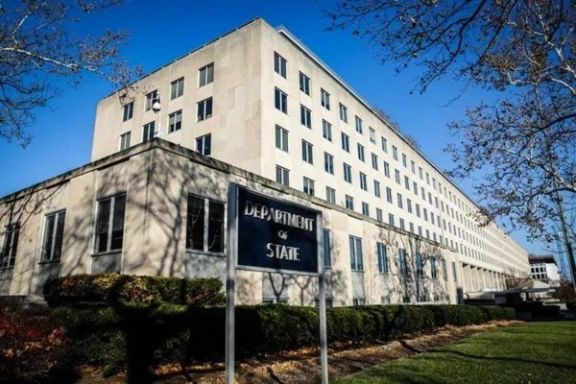
The US State Department building

A US State Department spokesperson has told Iran International that Washington is still interested in reviving the 2015 deal but is also preparing for alternative scenarios with its allies.

The spokesperson made the remarks on Thursday against the backdrop of visits to Tehran by the European Union’s coordinator of the nuclear talks, Enrique Mora, and Qatar’s ruler, Emir Sheikh Tamim bin Hamad Al-Thani. “The administration, along with our Allies, is preparing equally for scenarios with and without a mutual return to full implementation of the JCPOA.”

About the trips by Mora and Al-Thani, the spokesman said Washington is in close contact with the EU coordinator, who continues to convey messages back and forth, and appreciated “the constructive role Qatar has played in our efforts to achieve diplomatic resolutions of important and difficult issues between the US and Iran, including the unjust detention of US citizens and our effort to achieve a mutual return to full implementation of the JCPOA”.

In response to a question about Iran’s demand to remove the Revolutionary Guard (IRGC) from the list of Foreign Terrorist Organization, the spokesperson said that "if Iran wants sanctions lifting that goes beyond the JCPOA (the Joint Comprehensive Plan of Action), they will need to address concerns of ours beyond the JCPOA”.

The official added, “Conversely, if they do not want to use these talks to resolve other bilateral issues beyond the JCPOA, then we are confident that we can very quickly reach an understanding on the JCPOA and begin reimplementing the deal”.

On Friday, the EU's foreign policy chief Josep Borrell said Mora’s trip has unblocked the negotiations, expressing hope for the prospect of reaching an agreement.

Most Viewed

Ideology may be fading in Iran, but not in Kashmir's ‘Mini Iran'
1
INSIGHT

Ideology may be fading in Iran, but not in Kashmir's ‘Mini Iran'

2
INSIGHT

Hardliners push Hormuz ‘red line’ as US blockade tests Iran’s leverage

3
VOICES FROM IRAN

Hope and anger in Iran as fragile ceasefire persists

4

Iran International says it won’t be silenced after London arson attack

5

US sanctions oil network tied to Iranian tycoon Shamkhani

Banner
Banner

Spotlight

  • Hardliners push Hormuz ‘red line’ as US blockade tests Iran’s leverage
    INSIGHT

    Hardliners push Hormuz ‘red line’ as US blockade tests Iran’s leverage

  • Ideology may be fading in Iran, but not in Kashmir's ‘Mini Iran'
    INSIGHT

    Ideology may be fading in Iran, but not in Kashmir's ‘Mini Iran'

  • War damage amounts to $3,000 per Iranian, with blockade set to add to losses
    INSIGHT

    War damage amounts to $3,000 per Iranian, with blockade set to add to losses

  • Why the $100 billion Hormuz toll revenue is a myth
    ANALYSIS

    Why the $100 billion Hormuz toll revenue is a myth

  • US blockade targets Iran oil boom amid regional disruption
    ANALYSIS

    US blockade targets Iran oil boom amid regional disruption

  • Iran's digital economy battered by prolonged blackout
    INSIGHT

    Iran's digital economy battered by prolonged blackout

•
•
•

More Stories

EU’s Foreign Policy Chief Says Iran Nuclear Talks Unblocked

May 13, 2022, 10:28 GMT+1

The EU's foreign policy chief says the trip by the coordinator of the talks to Tehran has unblocked the negotiations to revive the 2015 nuclear deal between Iran and world powers.

Josep Borrell made the remarks at a G7 meeting in northern Germany on Friday as Enrique Mora arrived back in Europe, saying he believes that two months of deadlock in diplomatic efforts has ended.

He described Iran's response as being "positive enough" after Mora had delivered a message that things could not continue as they were, describing his trip as “better than expected.”

He did not say what "unblocked" means and if the suspended talks in Vienna will resume.

"These things can not be resolved overnight. Let's say the negotiations were blocked and they have been unblocked and that means there is the prospect of reaching a final agreement."

Enrique Mora arrived in Tehran for a two-day trip on Tuesday and met with Ali Bagheri-Kani and other Iranian officials, but with no news about the results of the meeting until late evening in Iran.

Talks to restore the deal with world powers have stalled since March, chiefly over Tehran's insistence that Washington remove the US designation of Foreign Terrorist Organization of Iran’s Revolutionary Guard (IRGC), which is the only example of a sovereign state’s armed forces to be included.

A member of Iran’s nuclear negotiating team said on Thursday that removing the terrorist designation of the IRGC is not enough and Tehran wants other guarantees.

EU Envoy To Nuclear Talks Detained On His Way Back From Tehran

May 13, 2022, 08:12 GMT+1

The European Union’s coordinator of the nuclear talks was briefly detained with colleagues at Frankfurt Airport as he was returning to Brussels from Tehran after two days of talks.

Enrique Mora said in a tweet on Friday that “not a single explanation” was given to him, adding that they airport police also took his passport and phones.

The Spanish diplomat criticized the breach of diplomatic rules, emphasizing that he is “an EU official on an official mission holding a Spanish diplomatic passport”.

About an hour later, he said on twitter that he was released. “Now released along with my two colleagues, the EU ambassador to UN Vienna and the head of the EEAS (the European External Action Service) Iran task force”.

Mora added that they “were kept separated” during the short detention and denounced “the refusal to give any explanation for what seems a violation of the Vienna Convention”.

Moreover, Mora said, “While still waiting for continuing my trip to Brussels I want to underline that in Tehran I raised the need to stop execution of Ahmadreza Djalali and asked for his release on humanitarian grounds”.

His comment about Djalali was among the few bits of information that was announced by any official about the content of his meetings in his two-day trip to Iran.

US Intelligence: Iran Probes While Wary Of Full-Scale Conflict

May 13, 2022, 01:05 GMT+1
•
Iran International Newsroom

While wishing to avoid escalation, Iranian officials think they have not “sufficiently retaliated” for killing of Qasem Soleimani, US military intelligence believes.

In the ‘Worldwide Threat Assessment” report presented this week to the Senate Armed Services Committee, Lieutenant General Scott Berrier, Director of the Defense Intelligence Agency, said Iran was probably “planning covert actions against US officials to retaliate” for Soleimani’s death “while attempting to maintain plausible deniability and minimize escalation.” General Soleimani, commander of Iran’s extra-territorial Al-Qods Force (QF), was killed by a US drone strike in Baghdad in January 2020.

Berrier’s report, submitted May 10, suggests Iran wants to avoid “an escalation in regional tensions or full-scale conflict” and therefore “probably calibrates its attacks to pressure adversaries and proportionally retaliate for real or perceived transgressions…”

Iran’s approach to Soleimani’s demise, Berrier argues, reflects its wider military strategy “based on deterrence and retaliation,” including “the region’s largest arsenal of UAVs [unmanned aerial vehicles, or drones]” and missiles, favored for cost and sometimes plausible deniability.

An Iranian command center during military drills. October 12, 2021  Credit Alternative text Important for SEO and accessiblity. Connection lost. Reco
100%
An Iranian command center during military drills. October 12, 2021

Iran has also gained “strategic depth,” the report says, through supporting “partner and proxy networks in Iraq, Lebanon, Syria, and Yemen” that facilitate attacks on US and allied interests in line with Iran’s aim of “attempting to force a US military drawdown” from the region, a goal inherited by Soleimani’s successor as QF commander Esmail Ghani.

Capable partners, fiscal pressures

The report highlights Hezbollah as Iran’s “most important and capable substate partner” whose strategic interests “rarely diverge.” It notes the 2021 first use in Iraq by Iran-allied militias of UAVs against US targets, and by Iranian forces in Syria deploying UAVs “in the most sophisticated attack against a US military base in the country to date, reportedly in retaliation for an Israeli airstrike...”

In Yemen, Iranian advisers and weapons – including in the past year the supply of the relatively advanced Shahed-136 – had enabled Ansar Allah, or Houthis, with “long-range strike capacities” whose use is on hold since mid-April with the de facto truce between the Houthis and the Saudi-led coalition.

The report suggests Iran’s military expenditure, despite a rising defense budget, had been curtailed by the fiscal consequences of US ‘maximum pressure’ sanctions since 2018 impeding “Tehran’s access to traditional government funding streams, including oil exports.”

The report says little about Tehran’s nuclear program other than noting its attempts to gain “leverage” by diminishing adherence to the 2015 deal (the JCPOA, Joint Comprehensive Plan of Action), which the US left in 2018 and which world powers have been struggling to revive for over a year.

Looking ahead, Berrier anticipates a year in which Iran’s response to US and allied “operations…probably would seek to demonstrate strength, reduce Western regional influence, and reestablish deterrence following repeated attacks on Iranian interests in Iran and Syria.” This would likely involve deniable attacks, including cyberoperations, while Tehran sought to avoid “escalation it expects would undermine JCPOA negotiations or impede its goal of compelling a US withdrawal from the region.”

New CENTCOM Commander Calls Iran Most Destabilizing Force In MidEast

May 12, 2022, 23:42 GMT+1

The new CENTCOM commander calls Iran the most destabilizing force in the Middle East, reiterating the position that the United States will not allow a nuclear Iran.

General Erik Kurilla, who was on a tour of Saudi Arabia and Egypt as part of what he called a “listening tour”, told Al Arabiya on Thursday that countering the threat posed by Iran needs regional cooperation.

“I view Iran as the most destabilizing force in the Middle East. The United States’ position is that we will not allow a nuclear Iran. However, our concerns about Iran go beyond its nuclear capability,” the top US military general for the Middle East said.

Describing Iran’s ballistic missile program and its support for proxies and Iran-backed militias in the region as other concerns for the US, Kurilla said, “The Iranian threat requires a firm effort from us and our security partners in the region... CENTCOM is committed to that effort.”

About Iran-backed Houthi attacks on Saudi Arabia and the United Arab Emirates, with the support of weapons being smuggled in, he said, “We are concerned about the smuggling of advanced conventional munitions by sea to support Houthi operations. Therefore, anti-smuggling operations with the Royal Saudi Naval Forces will serve as an area of focus for me”.

His predecessor General Kenneth F. McKenzie said during his farewell visit before stepping down that the Islamic Republic is the region’s “principal bad actor” and “biggest threat to security”.

Qatari Emir Meets With Khamenei, No Mention Of Nuclear Issue

May 12, 2022, 19:05 GMT+1
•
Maryam Sinaiee

Sheikh Tamim bin Hamad Al Thani, the Emir of Qatar, who arrived in Tehran Thursday met with Iran's Supreme Leader Ali Khamenei and President Ebrahim Raisi.

An informed source told Reuters on Sunday that the Emir would focus on how to “bridge the gap” in the talk aimed at restoring the 2015 nuclear deal, Joint Comprehensive Plan of Action (JCPOA) which have been in limbo since mid-March.

The Qatari Emir's visit coincided with the presence of EU coordinator of the nuclear talks, Enrique Mora, in Tehran.

Most of Iran's official and semi-official media on Thursday downplayed or completely excluded any mention of possible mediation in the nuclear talks by the Emir and instead focused on reporting the Iranian leader and president's remarks about regional issues and Israel.

However, in a commentary Wednesday, the IRGC-linked Fars news agencydrew attention to the Qatari Emir's and Mora's visits coinciding and also mentioned the visit of a second European official, Polish Foreign Minister Zbigniew Rau, to Tehran this week.

"Sheikh Tamim wants to play the role of a mediator between the Islamic Republic and the United States, a role previously entrusted to the Omani king … Russians have also lost the position of mediation between Iran and the United States in the Vienna [talks] after the Ukraine war," Fars wrote. "There is evidence that the common factor in the three visits is energy," Fars also said, surmising that this was because Europe is now after Iranian and Qatari gas to replace supplies from Russia.

Iran made a last-minute demand, when all sides said technical matters have been resolved and a deal was imminent, for the removal of the Revolutionary Guards (IRGC) from the list of Foreign Terrorist Organizations (FTO) to which the US has not consented.

During his meeting with the Emir, Khamenei emphasized that regional problems can be solved through dialogue among regional countries without any interference of “foreign players.”

“The issues of Yemen and Syria can also be solved through dialogue," he said, adding that "dialogue should not be undertaken from a weak position at a time that the opposite parties, mostly America and others, rely on military and financial power.”

Apparently referring to normalization of relations between Israel and regional Arab countries, Khamenei said regional countries should boost relations with each other as much as possible, because Israel "foments corruption wherever it goes".

In the case of what he called Israeli attacks on the Palestinian neighborhood of Sheikh Jarrah in Jerusalem, Khamenei alleged, some Arab countries had offered even less support to Palestinians than some European countries. "Even now, they are still acting like that.”

Arab countries must know that the Israeli regime in not in a strong position to be feared or be relied on, he claimed. The Qatari Emir also condemned the attacks in the meeting and said all regional countries must confront Israeli crimes.

The joint press conference of the Iranian President and the Qatari Emir was also largely focused on regional issues, the Palestine-Israel issue, and the recent killing of an Al Jazeera reporter in Jenin by Israeli forces.

“The existing problems in the region must be settled through constructive dialogue,” Sheikh Tamim told reporters, adding that Tehran and Doha had also discussed the ongoing situation in Palestine, Syria, Yemen and Iraq.