• العربية
  • فارسی
Brand
  • Iran Insight
  • Politics
  • Economy
  • Analysis
  • Special Report
  • Opinion
  • Podcast
  • Iran Insight
  • Politics
  • Economy
  • Analysis
  • Special Report
  • Opinion
  • Podcast
  • Theme
  • Language
    • العربية
    • فارسی
  • Iran Insight
  • Politics
  • Economy
  • Analysis
  • Special Report
  • Opinion
  • Podcast
All rights reserved for Volant Media UK Limited
volant media logo

Iran To Exploit Visit Of A UN Rapporteur On 'Unilateral Sanctions'

Maryam Sinaiee
Maryam Sinaiee

Iran International

May 7, 2022, 13:59 GMT+1Updated: 17:40 GMT+1
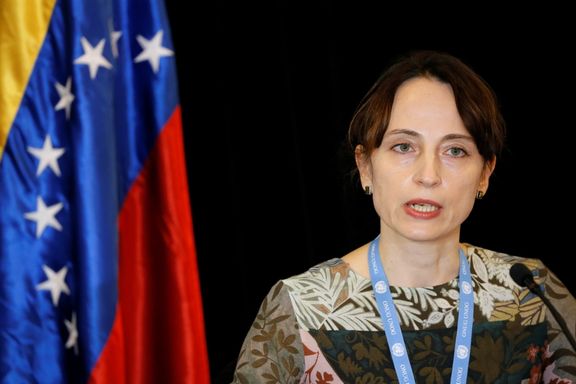
Alena Douhan, the UN Special Rapporteur on the negative impact of unilateral sanctions.

By allowing a UN Special Rapporteur on unilateral sanctions to visit the country, Iran seeks to deflect attention from its human rights violations, critics say.

Alena Douhan, the UN Special Rapporteur on the negative impact of the unilateral coercive measures on the enjoyment of human rights, will arrive in Iran Saturday. Douhan, a professor of international law at the Belarussian State University is an expert in international law, sanctions, and human rights law.

During her eleven-day visit, Douhan will hold meetings with various Iranian officials as well as officials of various UN agencies in Tehran, non-governmental organizations, representatives of business and civil society organizations, and academics.

"We denounce the government's instrumentalization of the system of UN human rights monitors in a cynical attempt to deflect attention from its well-documented record of human rights violations," eleven human rights organizations said in a joint statement Friday in reference to the visit.

The signatories of the statement including Abdorrahman Boroumand Center for Human Rights in Iran, All Human Rights for All in Iran, and Article 19, criticized the UN for sending Douhan to Iran although in the past seventeen years the Islamic Republic has denied access to all UN special rapporteurs for human rights.

Iran has not allowed visits to any of the fourteen UN human rights experts who have made requests to monitor the situation of human rights in Iran, including to the special rapporteurs appointed by the UN Human Rights Council.

"The mandate on unilateral coercive measures is unique in that it calls on the mandate-holder to assess primarily – if not exclusively – the responsibility of sanction imposing states for rights violations in the jurisdiction of sanctioned states," the rights organizations' statement said, adding that Iranian authorities are exploiting the visit by the only expert whose mandate is to look at external actors' liability, to blunt scrutiny of their own record of non-cooperation with the UN human rights system.

"By inviting the UN Special Rapporteur, Iran’s ruling clerics, which have been condemned 68 times by the United Nations for brutal and systematic human rights abuses, seek to undermine international sanctions and dodge blame for their incompetency and shortcomings," a commentary in Iran Wire website April 25 said about Iran's alleged agenda.

The role of this rapporteur was created at the UN Human Rights Council by the adoption of a resolution proposed by Iran on behalf of Non-Aligned Movement in 2014.

The resolution stresses that unilateral sanctions, meaning those not approved by the UN Security Council, are contrary to international laws and highlights that on long-term, these measures may result in social problems and raise humanitarian concerns in the targeted states.

Douhan has a track-record of only condemning sanctions imposed on non-democratic countries while virtually remaining silent on violations by countries like Iran, Syria and her native Belarus. The argument that only Security Council sanctions are legal ignore the fact that countries such as Russia and China can easily veto any resolution meant to punish an authoritarian government for massive rights violations.

Since her appointment in March 2020, Douhan has served as the UN rapporteur on US unilateral sanctions against Venezuela (August 2020) and Saudi Arabia's sanctions against Qatar (November 2020). In December 2020, Douhan said US sanctions against Syria's government may inhibit rebuilding of Syria’s civilian infrastructure destroyed by the conflict, and could “violate the human rights of the Syrian people.”

Most Viewed

Iran negotiators ordered to return after internal rift over Islamabad talks
1
EXCLUSIVE

Iran negotiators ordered to return after internal rift over Islamabad talks

2
ANALYSIS

US blockade enters murky phase as tankers spoof signals and buyers hesitate

3
ANALYSIS

Why the $100 billion Hormuz toll revenue is a myth

4

US tightens financial squeeze on Iran, warns banks over oil money flows

5
ANALYSIS

US blockade targets Iran oil boom amid regional disruption

Banner
Banner

Spotlight

  • Hardliners push Hormuz ‘red line’ as US blockade tests Iran’s leverage
    INSIGHT

    Hardliners push Hormuz ‘red line’ as US blockade tests Iran’s leverage

  • Ideology may be fading in Iran, but not in Kashmir's ‘Mini Iran'
    INSIGHT

    Ideology may be fading in Iran, but not in Kashmir's ‘Mini Iran'

  • War damage amounts to $3,000 per Iranian, with blockade set to add to losses
    INSIGHT

    War damage amounts to $3,000 per Iranian, with blockade set to add to losses

  • Why the $100 billion Hormuz toll revenue is a myth
    ANALYSIS

    Why the $100 billion Hormuz toll revenue is a myth

  • US blockade targets Iran oil boom amid regional disruption
    ANALYSIS

    US blockade targets Iran oil boom amid regional disruption

  • Iran's digital economy battered by prolonged blackout
    INSIGHT

    Iran's digital economy battered by prolonged blackout

•
•
•

More Stories

Two Iranian Grand Ayatollahs Call For Calm During Hajj

May 7, 2022, 12:31 GMT+1

Two leading Shiite clerics in Iran have urged Iranian pilgrims to respect Saudi law during ‘the Hajj,’ the annual pilgrimage to Mecca due July 7-12.

Grand Ayatollahs Naser Makarem Shirazi and Jafar Sobhani made their call during meetings Friday with Abdolfattah Navvab (Abdul Fattah Nawab), representative for Hajj and pilgrimage affairs of Supreme Leader Ali Khamenei.

Makarem Shirazi said Iranian pilgrims should not behave in ways that could provoke the sensitivities of the Saudis, and that given Iran’s strained relations with Saudi Arabia, Hajj was a chance “to create optimism and dispel pessimism.”

The statements by the two clerics loyal to Khamenei could be a public signal to Saudi Arabia, amid attempts to improve ties between Tehran and Riyadh.

Makarem noted that Hajj was “indirectly” a political issue. Iran and Saudi Arabia broke off formal diplomatic relations in 2016 and the Hajj has sometimes over centuries revealed tensions between Shia Iranian pilgrims and the Saudis, who follow the Wahhabi tradition in Sunni Islam. In 1987 over 400 Iranians died in clashes with Saudi security forces.

Sobhani suggested that Iranian officials should advise pilgrims to “respect the laws of Saudi Arabia and to refrain from doing what is not right.".After two years of pared-down pilgrimage due to Covid-19 pandemic restrictions, this year Saudi authorities will permit 1 million Muslims from inside and outside the country to participate. About 40,000 Iranians are set to attend.

Activist On Hunger Strike To Protest Possible Execution Of Swedish Hostage

May 7, 2022, 11:24 GMT+1
•
Maryam Sinaiee

A jailed Iranian civil activist, Farhad Meysami, went on hunger strike Saturday to protest the possible execution of a Swedish Iranian doctor accused of Spying.

In a note published Friday on a Telegram channel run by his supporters, Meysami said he will not end his hunger strike, which he said he would begin Saturday morning, unless authorities stop the execution of Swedish-Iranian national Ahmadreza Djalali (Jalali). Meysami, who is a doctor, said he will refuse all food and only take a little water and a medication which if not taken will cause quick bleeding in his digestive system.

Quoting unnamed "informed sources," semi-official media in Iran reported this week that the 51-year-old Djalali's death sentence was impending.

This is not the first time Iran has threatened to execute Djalali. In November 2020, Djalali told his family he was being sent to solitary confinement in preparation for his execution which the authorities eventually did not carried out, without offering any explanation.

The Iranian state television at the time aired a video of Djalali confessing to spying for Israel but he subsequently released an audio message from prison saying he had been coerced into making the confession. The father of two has always denied any wrongdoing.

Dr. Djalali and his wife before he was taken hostage in 2016 by the Islamic Republic.
100%
Dr. Djalali and his wife before he was taken hostage in 2016 by the Islamic Republic.

Djalali's wife, Vida Mehrannia, told Iran International at the time that he was being used as pawn by Iran in its relations with Europe. Mehrannia on Friday told Radio Farda, that this time authorities have not informed Djalali, his family, and his lawyer of their intention to carry out the death sentence.

Meysami, a doctor and teacher who has been serving a five-year sentence for his anti-hijab activities, said in his message that he had met Djalali at Tehran's Evin prison over three years ago. "He had been on hunger strike in protest to repeated threats of his execution and the effects of which on his body and soul were clearly visible," he wrote.

"Imagine subjecting a human being to this repeatedly. Not once, not twice… Is there any torture worse than this?" Meysami said about repeated threats of execution made against Djalali.

"I don't want to just oppose Dr Djalali's execution, I want to draw attention to something much more important, to draw attention to the fact that they send a man to his death many times and bring him back," he wrote. "Regular and intentional torture like this is definitely crime against humanity."

Sweden's Foreign Minister Ann Linde in a tweet Wednesday expressed concern over Djalali.

“We’re aware of the egregious case of arbitrary detention of Swedish-Iranian doctor Ahmadreza Djalali by Iranian authorities. We echo concerns from UN experts that Djalali’s case is ‘truly horrific,’ and urge his release,” a US State Department spokesperson said in response to a query by Iran International Friday.

Earlier this week the Swedish foreign ministry confirmed that Iran has recently arrested a Swedish tourist.

Tehran's relations with Stockholm have escalated further following Swedish prosecutors asking a sentence of life imprisonment for Hamid Nouri, a former Iranian judiciary official, for crimes against humanity committed during the prison purges of 1988 in Iran.

Calling Nouri's arrest and trial "unlawful and unfair", Secretary of Iran’s High Council for Human Rights Kazem Gharibabadi on Monday accused Sweden of violating Nouri's human rights.

Concern Rises Over An Iran-Backed Attack On Israeli Embassy In India

May 7, 2022, 10:59 GMT+1

Security measures are tight around the Israeli embassy in the Indian capital New Delhi reportedly over a serious possibility of an attack by Iran-backed elements, Iran International has learned.

An Israeli informed source told Iran International on Saturday that the Indian police and counter-terrorism forces have also carried out a security maneuver on the streets leading to the Israeli diplomatic mission.

During the drills, which were held to prepare for possible attacks, all streets around the Israeli embassy in New Delhi were blocked and the gunfire and explosions could be heard, according to the source.

The source also said that the Israeli embassy in the city has become one of the likely targets for militias affiliated with the Islamic Republic since last year.

The streets around the Israeli embassy in India have also been equipped with CCTV cameras and are under tight round the clock patrols.

An explosion took place near the embassy on the 29th anniversary of establishment of India-Israel diplomatic ties on January 29, 2021.

Immediately after the blast, Israel claimed that Iran was behind the attack, an allegation that was confirmed by Indian intelligence agencies. A letter was also found at the site of the explosion, claiming the attack was to avenge the killings the Iranian Revolutionary Guard’s Quds Commander Qasem Soleimani, and Abu Mehdhi Al Muhandis, who were killed in a US drone attack in January 2020, as well as an Iranian nuclear scientist Mohsen Fakhrizadeh, who died in a car bomb attack in Iran in November 2020.

Iran Burning Natural Gas From Oil Wells For Lack Of Investments

May 6, 2022, 23:21 GMT+1
•
Dalga Khatinoglu

Iran’s gas flaring levels increased by 32% year-on-year to 17.4 billion cubic meters (bcm) in 2021, according to a new report, released by Word Bank.

Iran ranked third globally after Russia and Iraq in terms of gas flaring levels during last year.

The country has failed to develop and install needed equipment to collect associated gas, produced from oil fields during last two decades.

According to the Oil Ministry’s estimates, some $5 billion is needed for curbing gas flaring, which sonstitutes about 7% of the country’s total gas production, while the annual worth of such a volume is more than $5 billion in regional markets. For comparison, it is equal to 30% of Turkey’s total gas consumption in 2021 or Iran’s total gas exports to Iraq and Turkey during last year.

Iran has failed to make significant investments in its oil and gas sectors for at least 10 years as international sanctions (2011-2015) and US oil export sanctions since 2018 have limited the country’s financial resources. In November, oil minister Javad Owji said that at least $160 billion in investments is needed to revitalize the sectors.

In 2017, a French company signed a deal with Iran to help install technology to trap natural gas escaping from oil producing wells, but the reimposition of US sanctions in May 2018 scuttled all such projects.

The Word Bank says the ratio of the flared gas to produced oil in Iran is 15.36 cubic meters per one barrel, the highest level in the world after Venezuela and Algeria.

Gas flaring also shares 8% of Iran’s greenhouse gas emissions. Iran, with 745 million tons of greenhouse gas emissions, ranked 6th globally in 2020, of which 60 million tons came from gas flaring, according to the Global Carbon Atlas’s latest statistics.

There is no new report about Iran’s greenhouse emissions level, but regarding the 32% growth in flaring gas volume, as well an end to Covid-related quarantines, it should be continuing to rise.

Iran’s greenhouse gas emissions increased by 18% since 2015, when the international community, including Iran, decided to decrease emissions, based on the Paris Climate Agreement.

Word Bank said the global flaring gas level stood at 144 bcm in 2021, almost unchanged year-to-year, and resulted in 328 million tons of carbon dioxide emission.

Last year, total greenhouse gas emissions in the world hit a historic record, reaching above 36 billion tons, which was about 2 billion tons more than in 2020, according to the International Energy Agency.

Reports Indicate Bread Price Protests In Southwestern Iran

May 6, 2022, 22:11 GMT+1

Reports trickling in from Iran indicate unrest in southwestern oil-rich province of Khuzestan on Friday after bread prices rose significantly in recent days.

First came the news Friday morning that internet connection was shut off or significantly slowed down in Khuzestan, a development usually signaling protests in Iran. Authorities disrupt the Internet to prevent news of unrest reaching the rest of the country and abroad. It is also done to prevent protesters from galvanizing support in nearby regions.

Later came reports of a curfew in the city of Susangerd and gunshots heard in the Abuzar neighborhood. Some reports that Iran International cannot independently confirm speak of security forces forcefully entering homes and warning citizens not to join protests.

A source told Iran International that “Security forces went up to the roofs of buildings and homes and fired tear gas into the courtyards of some houses,” adding that they were trying to intimidate Susangerd residents to prevent them from joining the protests.

Apart from this general picture, there are no details about how large the protests were, possible clashes, injuries, or if the unrest continues.

Khuzestan was a hotbed of protests in May and June 2021 when for consecutive days people in many cities came into streets to demand water, amid government mismanagement of water resources and drought. At least ten people were shot by security forces in the unrest.

With the sudden quadrupling of bread prices, many Iranians expect widespread protests, since a persistent 40-percent inflation has depleted people’s finances and bread is the last food item poorer families can afford.