• العربية
  • فارسی
Brand
  • Iran Insight
  • Politics
  • Economy
  • Analysis
  • Special Report
  • Opinion
  • Podcast
  • Iran Insight
  • Politics
  • Economy
  • Analysis
  • Special Report
  • Opinion
  • Podcast
  • Theme
  • Language
    • العربية
    • فارسی
  • Iran Insight
  • Politics
  • Economy
  • Analysis
  • Special Report
  • Opinion
  • Podcast
All rights reserved for Volant Media UK Limited
volant media logo

Exclusive: Audio Recording Reveals Details Of Iran Speaker, IRGC
Iran International Newsroom
May 6, 2022, 14:59 GMT+1Updated: 17:36 GMT+1
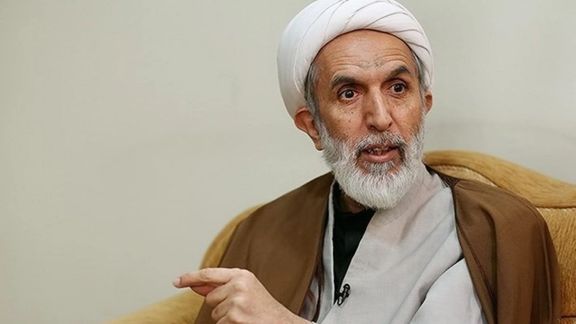
Hardliner cleric Mehdi Taeb. Undated

A hardliner cleric in Iran has said the parliament speaker visited Turkey in the past to help the Qods (Quds) Force, an audio received by Iran International shows.

The non-public conversation (link to audio) took place in the past two weeks after a scandal broke out about the family of the speaker, Mohammad Bagher Ghalibaf, travelling to Turkey for luxury shopping, but the exact date is not known.

The influential hardliner is cleric Mehdi Ta’eb, brother of the Revolutionary Guard’s (IRGC) Intelligence Organization chief Hossein Ta’eb. He oversees a propaganda outfit promoting the cult of Supreme Leader Ali Khamenei.

In the recording Ta’eb is speaking with an unnamed reporter who asks him why Ghalibaf visited Turkey on several occasions. First, Ta’eb denies it, but when the reporter says he accompanied him once, the cleric says Ghalibaf was assisting the Qods Force and its former commander Qasem Soleimani, who was killed in January 2020 by a US air strike in Baghdad, Iraq.

It is well-known that Soleimani was close to the former mayor of Tehran and the current parliament speaker over the years, and both had support from Khamenei, but this is the first claim that he was helping Soleimani to carry out Qods business.

Ta’eb also confirmed reports in Iranian media and social media that the disclosure about Ghalibaf family’s scandalous trip to Turkey amid rising poverty in Iran was leaked by circles close to President Ebrahim Raisi. He said that the brother of Raisi’s son-in-law engineered the leak.

Qasem Soleimani (L) and Mohammad Bagher Ghalibaf. Undated
100%
Qasem Soleimani (L) and Mohammad Bagher Ghalibaf. Undated

Videos emerged in April showing Ghalibaf’s wife and daughter returning from a shopping trip to Istanbul, allegedly with more than 20 pieces of luggage. The revelation coincided with rising prices that are further impoverishing millions of Iranians and it led to a political shock. Many called for his resignation from the post of parliament speaker.

The scandal got worse as a whistle blower claimed that during the trip, Ghalibaf’s wife had bought two apartments in Istanbul for $1.6 million.

A few days after the scandal broke, some Ghalibaf supporters claimed that the “an intelligence organization”, presumably the intelligence ministry controlled by Raisi was behind tracking the Ghalibaf family during the trip and publishing the videos and images.

Ta’eb in the recording says he is not certain if the intelligence ministry was involved in revealing the Ghalibaf scandal. He also said that the family first traveled to Syria and from there to Turkey.

Ta’eb also defends Ghalibaf, saying that former president Mahmoud Ahmadinejad’s supporters, the ultraconservative Paydari front, religious elements calling themselves “seekers of justice” and Iran’s “reformists” have joined forces to prevent him from getting re-elected as speaker in mid-May.

However, Ta’eb says that Khamenei had sent a hand-written note to some hardliners last year saying that Ghalibaf should be speaker of parliament.

The cleric also mentions Turkey in the recording and says that Ankara cooperates with Iran in circumventing US sanctions. He claims that despite Turkish pronouncements of acting forcefully in Syria, when Iran wants, Ankara retreats in Syria’s Idlib, where Turkish supported rebels have their last refuge.

Ta’eb also says that Turkey is dependent on oil imports and “in case of a war Iran can hit Turkish ports with [ballistic] missiles and it won’t have fuel for its tanks.”


Most Viewed

Hardliners push Hormuz ‘red line’ as US blockade tests Iran’s leverage
1
INSIGHT

Hardliners push Hormuz ‘red line’ as US blockade tests Iran’s leverage

2

Iran International says it won’t be silenced after London arson attack

3
VOICES FROM IRAN

Hope and anger in Iran as fragile ceasefire persists

4

US sanctions oil network tied to Iranian tycoon Shamkhani

5

Iran halts petrochemical exports to supply domestic market

Banner
Banner

Spotlight

  • Hardliners push Hormuz ‘red line’ as US blockade tests Iran’s leverage
    INSIGHT

    Hardliners push Hormuz ‘red line’ as US blockade tests Iran’s leverage

  • Ideology may be fading in Iran, but not in Kashmir's ‘Mini Iran'
    INSIGHT

    Ideology may be fading in Iran, but not in Kashmir's ‘Mini Iran'

  • War damage amounts to $3,000 per Iranian, with blockade set to add to losses
    INSIGHT

    War damage amounts to $3,000 per Iranian, with blockade set to add to losses

  • Why the $100 billion Hormuz toll revenue is a myth
    ANALYSIS

    Why the $100 billion Hormuz toll revenue is a myth

  • US blockade targets Iran oil boom amid regional disruption
    ANALYSIS

    US blockade targets Iran oil boom amid regional disruption

  • Iran's digital economy battered by prolonged blackout
    INSIGHT

    Iran's digital economy battered by prolonged blackout

•
•
•

More Stories

Rights Groups Decry UN Official’s Visit To Iran As Diversion From Abuses

May 6, 2022, 12:53 GMT+1

Several human rights advocacy groups have protested the visit of a UN official to assess the impact of sanctions on Iran, calling it Tehran’s attempt to divert attention from its human rights violations.

Eleven rights groups issued a statement on Friday, on the eve of the visit by Alena Douhan, the UN Special Rapporteur on the negative impact of the unilateral coercive measures on the enjoyment of human rights, slated from May 7 to 18. 

They denounced the Iranian government's instrumentalization of the system of UN human rights monitors in an attempt to deflect attention from its well-documented record of human rights violations, and also criticized the Islamic Republic for not allowing similar trips to UN Special Rapporteurs focusing on human rights in Iran since 1992.

They pointed out that the mandate of this rapporteur is unique as it is meant primarily – if not exclusively – to assess the responsibility of sanction imposing states for rights violations. 

Describing the visit as “a banal ploy to divert blame for Iran's current human rights situation”, they said that by inviting only the expert whose mandate is to look at external actors' liability for rights violations in the country, “Iranian authorities exploit this visit in an inconspicuous attempt to blunt scrutiny of its record of non-cooperation with the UN human rights system”.

The role of this Special Rapporteur was created by a 2014 resolution at the UN Human Rights Council introduced by Iran on behalf of the Non-Aligned Movement.

Iranian Nobel Peace Prize Laureate Shirin Ebadi wrote to High Commissioner for Human Rights Michelle Bachelet in April and called for the postponement of the visit until Iran lets in the UN Special Rapporteur on Human Rights. 

Canada, Sweden Committed To Hold Iran Accountable For Downing Ukrainian Plane

May 6, 2022, 12:03 GMT+1

Canada and Sweden have reaffirmed their commitment to hold Iran accountable for the downing of Ukrainian Airlines Flight PS752 in January 2020. 

In a joint statement published on Friday, Canadian Foreign Minister Mélanie Joly and her Swedish counterpart Ann Linde said that they are committed to “hold Iran accountable for the actions and omissions of its civil and military officials that led to the illegal downing of Flight PS752 by ensuring that Iran makes full reparations for its violations of international law”. 

They also reiterated their “commitment to working with partners within the International Coordination and Response Group in pursuit of transparency, accountability and justice for the victims of Flight PS752”. 

All 176 passengers and crew on the plane died in the disaster. Some relatives of victims have described the firing of two missiles by Iran’s Revolutionary Guard (IRGC) as a “premeditated act.” A 2021 report from the Canadian government found that the action was “reckless” but not premeditated. The passengers list – according to the Ukrainian official manifesto – included 63 Canadians and 10 from Sweden, as well as 82 Iranian citizens.

Iran has not allowed an independent and transparent investigation in more than two years, claiming the missiles were fired “by human error”. Families of victims in February told the Iranian government that instead of compensation they want “justice”. 

They urged the authorities to end their “lies and cruel behavior” and “psychological pressure on the bereaved families” following the shooting down of the airliner.

Iran Detains Swedish Tourist In Suspected Hostage Taking

May 6, 2022, 11:59 GMT+1
•
Maryam Sinaiee

Pundits say the reported arrest of a Swedish national in Iran last week is yet another case of hostage-taking of foreign nationals to pressure other countries.

The Swedish ministry of foreign affairs has confirmed that a Swedish national is in Iranian custody now but has offered no further information or comments. Iranian authorities have not yet commented on the issue.

The news came just days after Iran threatened to execute a Swedish-Iranian scientist detained on “espionage” charges since 2016 and sentenced to death.

Sweden's Aftonbladet newspaper Thursday reported the arrest of an unnamed 30-year-old Swedish man last week and said the embassy in Tehran was working on his case in contact with Iranian authorities.

The newspaper said the detained tourist who had been traveling with other Swedes was arrested when he wanted to leave the country. According to Aftonbladet, the man had no connection with Iran other than being there as a tourist.

An "informed source" told Aftonbladet that the arrest relates to the case of former Iranian prosecutor Hamid Nouri who is on trial in Sweden. Swedish prosecutors have asked for a sentence of life imprisonment for Nouri for crimes against humanity committed during the prison purges of 1988 in Iran.

The source also said Iran has demanded Nouri's release through various channels, but the Swedish government has made it clear its courts are independent from the government and it cannot interfere with their decisions.

"Iran takes citizens of other countries hostage every time it is in trouble with a country. The international community considers [this kind of] hostage-taking as terrorism," the Washington Post journalist and former prisoner in Iran, Jason Rezaian, told Iran International.

Many cite Rezaian's own case as hostage-taking by the Islamic Republic. Rezaian and his wife, Yeganeh Salehi, also a journalist, were arrested in July 2014. He was accused of espionage and propaganda against the Islamic Republic and in October 2015 was convicted.

Iran did not disclose the length of his prison term but released him in January 2016 with three other American prisoners in exchange for the release of seven Iranian prisoners. On the day of Rezaian's release Washington also released $1.7 billion of Iran's frozen funds in the US.

Speaking to Iran International, Mohsen Sazegara, expatriate political dissident, called the arrest of the Swedish tourist as hostage taking and putting another Swedish national, Hamidreza Djalali (Jalali), on death row "the height of the Islamic Republic's impudence and shamelessness".

"Nouri's trial has turned into a matter of honor for the Islamic Republic. With the case moving forward, the matter of seeking justice for crimes and executions of the 1980s in which the current [Iranian] president is also involved will gain more importance," political analyst Ali Afshari told Iran International. "That's why authorities of the Islamic Republic have resorted to distraint."

Sweden last week advised its citizens to avoid unnecessary travel to Iran in view of the impending announcement of Nouri's sentence on July 14.

Tehran's relations with Stockholm have been on a downward slope since Nouri was arrested.Foreign minister Ann Linde in a tweet Wednesday expressed concern over Djalali. Linde has not commented on the arrest of the Swedish tourist yet but in a joint statement Friday with her Canadian counterpart, Mélanie Joly, referred to another matter in relations with Tehran that involves Swedish nationals.

The two foreign ministers said they are committed to holding Iran accountable for the "actions and omissions of its civil and military officials" that led to the downing of Flight PS752 in January 2020 by "ensuring that Iran makes full reparations for its violations of international law." Seven Swedish citizens died on the flight downed by Revolutionary Guards missiles.

Flour Price Soars In Iran, Impacting Bread, Pasta, As Subsidy Stops

May 6, 2022, 01:40 GMT+1
•
Maryam Sinaiee

Pasta, the rice of the poor, disappeared from many supermarket shelves in Iran this week or is sold only in smaller quantities after its price suddenly tripled.

In the past few decades, pasta has gradually replaced expensive rice in the diet of lower-income Iranian families. The tripling of the price of pasta announced this week may make it unaffordable to many, critics say.

The price hike is a result of a government decision to scrap the subsidy for imported wheat, flour and other essential items. The higher cost of flour is also affecting a wide variety of breads, cakes and pastries including children's snacks, fast food such as hamburgers and sandwiches, and even the traditional noodles used for making a thick noodle soup called ash-e reshteh. The soup is often served as a main course.

The Student Basij, a pro-government student union, warned President Ebrahim Raisi Thursday that the abrupt end to the flour subsidy could cause unrest. "The society is not prepared for this level of price increases and this level of disorganization in its execution," the union said in a letter to Raisi and urged him to "speak candidly to the people" to explain the reasons, and the measures that will be taken to prevent too much pressure on vulnerable families.

The cost of flour, since the announcement of the new measures on May 1, has hiked to around 160,000 rials a kilo, around 60 US cents. The same flour used to be sold for 27,000 rials (less than 10 cents) last week. It is expected to further rise to around 184,000 (65 cents).

The average monthly salary of a worker with two children, including child and housing benefits, has been set at around 64,300,000 rials (around $230).

A bakery in Iran selling traditional flat breads. FILE PHOTO
100%
A bakery in Iran selling traditional flat breads

People's income should be at international levels, "calculated in dollars, not worthless rials," if the cost of living is the same as in other countries, Jalil Rahimi, a lawmaker, tweeted Tuesday. "Let's not test people's patience. The threshold of people's patience is at the lowest possible level in years," he warned.

The price of traditional flatbreads such as barbari, sangak, and lavash will not be affected as the government says it will continue to subsidize them but instead of subsidizing flour, it will pay a cash handout directly to the consumers.

Non-traditional breads such as baguettes and hamburger buns will, however, not be subsidized anymore. These types of bread are also widely consumed by Iranian families. The higher cost of these breads is likely to badly affect fast food joints and sandwich shops. A hamburger bun now costs several times as much as a burger at a fast-food place only a few years ago, social media users say.

The government claims it has made elaborate plans to ensure traditional flatbreads cost the same as before to consumers although bread at the subsidized rate will be rationed.

The plan has yet not been fully explained by the government, but some lawmakers have said that at bakeries people will pay the same price as now for their ration of bread with registered debit cards to which the government pays cash handouts.

But bakers will not take the brunt, the government says. They will be reimbursed for the difference in the cost of flour based on their sales figures. For anything above their family's rations, people will have to pay the full price.

Tabnak news website said Thursday the total cost of basic food items on average hasnow increased by 200 percent and criticized the government for announcing the hike in flour prices during the long Eid al-Fitr holiday. The announcement has shocked the society, it said.

Many Question Hardliners’ Sway In Iran Amid Rising Food Prices

May 5, 2022, 17:05 GMT+1
•
Iran International Newsroom

Ten months after conservatives in Iran gained full control of the government, many are now complaining about lack of efficient governance amid economic crisis.

While the assumption behind the idea of creating a consolidated conservative government was to make it agile and efficient, even supporters of the government say a hardliner president and parliament have been unable to feed the people.

In recent weeks, prices of essential food items, such as cooking oil, flour and sugar have at least doubled.

According to moderate conservative Khabar Online, what was initially a dream, has become a challenge for the Islamic Republic. The heavy political cost of consolidation, wrote the website, fell on the shoulders of everyone including those who had designed the new system in which the main criterion for appointment of government officials is their loyalty to a single political group.

That group has one single trait and that is loyalty to the Supreme Leader Ali Khamenei.

The process started with facilitating a landslide victory for hardliners in the 2020 parliamentary elections and completed by doing the same in the 2021 presidential election, mainly by eliminating all the candidates that were not part of the hardliner conservative camp. Later in 2021, Khamenei appointed a well-known hardliner as Judiciary Chief, completing the handover of all power to loyal hardliners who soon got rid of anyone in the government who was not in their camp.

Ali Larijani, a leading moderate-conservative. May 2021
100%
Ali Larijani, a leading moderate-conservative was denied the chance to run for president in June 2021

The keyword throughout the entire process was "change." And what was to be changed was presumably the worsening economic situation. However, ten months later, government officials including the president still blame "those who created the current situation.”

However, few openly say that the economic crisis, reflected in rapidly increasing food prices, is to an extent the result of sanctions imposed by the United States that can only be lifted if Khamenei agrees to resolve Iran’s nuclear dispute with the West.

Analysts coming from various political factions, even those at the IRGC-linked Fars news agency were saying that "the root cause of the country's problems was corruption, coupled with plundering of national resources by a well-connected few." They also thought a consolidated government can put an end to all that by getting rid of political rivalries.

But rivalries did not end. Last week, Majles Speaker Mohammad Bagher Ghalibaf suggested that the controversy about his family's luxury shopping in Turkey was engineered by his political rivals with the assistance of some intelligence agencies. Later in the week, a letter signed by 233 out of the 290 lawmakers was sent to Khamenei expressing support for Ghalibaf. This week, several lawmakers complained that the letter was supposed to be containing a pledge of allegiance to Khamenei and that they were not told it was to express support for Ghalibaf.

Meanwhile, while Raisi had promised to form a non-factional cabinet, he chose nearly all his ministers from among the ultraconservative Paydari Party and the officials of former President Mahmoud Ahmadinejad's cabinet. The parliament also became divided into at least four factions of Paydari, Ahamdiejad's men, Ghalibaf's neo-con aides and traditional conservatives.

Former lawmaker Gholam Ali Jafarzadeh Imanabadi has said that the government has failed and now those who engineered the consolidated system should be held accountable. Some lawmakers includingMostafa Reza Hosseini Ghotbabadi have gone further and called on parliament to table a motion to unseat the President for incompetence. Ghotbabadi said that the Majles has been mulling the idea of Raisi's incompetency at least twice in recent months.