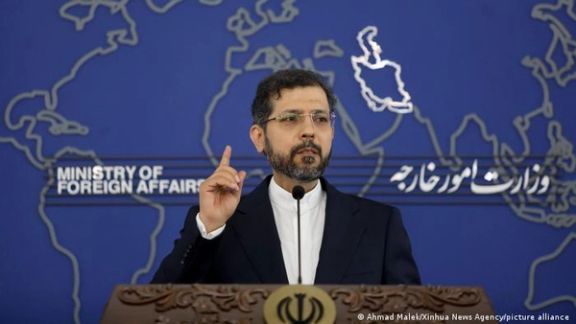
Iran said Monday "agreements" during a recent diplomatic visit over releasing blocked Iranian funds by a third country "is not up to Washington to decide."
Commenting on US State Department Spokesman Ned Price’s recent remarks over Iranian frozen funds at his weekly press briefing Monday, foreign ministry spokesman Saeed Khatibzadeh said a "delegation" had visited Tehran last week during which "certain agreements" were made. "This neither has anything to do with the US, nor we would allow the US to interfere in its details," he said defiantly.
Price said Thursday that all reports about Washington having agreed with the release of Iranian funds frozen by third countries were false.
The Iranian foreign ministry spokesman also indicated that Tehran was not going to offer any guarantees not to take revenge on American officials responsible for the Killing of the Revolutionary Guards (IRGC) commander, Ghasem Soleimani, in Baghdad on January 3, 2020, in return for Washington's delisting of the IRGC. "Bringing these individuals to justice is a fundamental principle in Iran's foreign policy," he said.
Negotiations in Vienna over reviving the 2015 nuclear agreement known as JCPOA came to a halt last month over a reported Iranian demand to remove its Revolutionary Guard from the US foreign terrorist designation. Media reports have mentioned that a US counter proposal asked Iran to renounce threats it made against former American officials for Soleimani’s killing.
Iranian officials and media said recently that Iran is set to recover $7 billion of its frozen assets "soon" independent of any outcome to the Vienna nuclear talks.
Khatibzadeh also categorically denied any relationship between unfreezing Iran's frozen assets and a possible Iran-US prisoner swap. "We separate humanitarian issues from debts," he claimed.
Iran’s Foreign Minister Hossein Amir-Abdollahian, however, on April 13 said that a foreign visit did take place the previous day and an agreement was made regarding Iranian money blocked in a "foreign bank". He made the announcement in a joint press conference with visiting Iraqi foreign minister Fuad Hussein, but his statement about the agreement did not refer to Baghdad.
Iraq is highly dependent on Iranian gas and electricity which it has continued to purchase thanks to Washington's regularly issued sanctions waivers. Baghdad, however, has not paid Iran for its energy imports due to US third-party sanctions that prohibit other countries to conduct financial transactions with Iran.
Payments for Iran’s gas and electricity imports by Iraq go to a special account in the state-owned Trade Bank of Iraq. Iran can only use the money for humanitarian commodities.
The amount of money frozen in Iraq banks was over $6 billion in September, and given that the amount has grown since then, it is quite possible that the $7 billion officials are promising to get released is money in Iraqi banks rather than South Korea which is also holding $7 billionof frozen Iranian assets.
Khatibzadeh on Monday also said that the 2015 nuclear deal has not been working for Iran for years. "Iran's economic benefits have been neglected for years. We are a responsible country, and we adhere to a commitment once we sign it," he said, adding that Tehran has its Plan B and C, regardless of the Vienna talks.
"Sanctions removal is a key issue in ministry of foreign affairs, but neutralizing sanctions has always been on the agenda too. Iran is continuing to neutralize sanctions according to its B and C plans," he said.
Faezeh Hashemi, daughter of former Iranian president, Akbar Hashemi Rafsanjani
Outspoken former lawmaker Faezeh Hashemi Rafsanjani in Iran has said that the Revolutionary Guard, IRGC, should remain on the United States' terrorist list.
Speaking in the social audio app Clubhouse, the political activist added that removing the IRGC from the list of Foreign Terrorist Organizations (FTO) is not in Iran's interest.
Negotiations to restore Iran’s 2015 nuclear deal came to a halt in March as Tehran reportedly demanded that the IRGC be removed from the terrorist list.
Hashemi, who is the daughter of former president Akbar Hashemi Rafsanjani and a pro-reform politician, said "The IRGC fires missiles and announces that it was our job”.
Calling IRGC's actions detrimental for the country, she added, “The only way for the IRGC to return to the barracks is to keep them on the sanctions list”.
What the Iranian society gets from IRGC is negative consequences and this must be stopped at some point, she noted.
Hashemi is known for her critical remarks about the Islamic Republic, its leaders, and policies. Her father, who for decades was the second most powerful man in the Islamic Republic, helped bring Supreme Leader Ali Khamenei to power in 1989 and allowed the IRGC to become an economic player in the country.
US opponents of removing the IRGC from the FTO – including lawmakers from both sides of the aisle, as well as current and former American officials and military leaders -- have urged President Joe Biden not to take such a move.
Iran's official news website IRNA has again claimed that a deal is in place to free the country’s frozen funds, despite a categoric denial by the United States.
In a report on Sunday IRNA claimed that an unnamed official of the Central Bank of Iran (CBI) confirmed the existence of an agreement and even said that a “regional delegation” visited Iran to facilitate its implementation.
Iran has billion of dollars frozen in various foreign countries because of United States sanctions on its banking sector and the threat of retaliation against third parties conducting financial transactions with Iran.
One of these countries is South Korea, where two banks hold an estimated $7 billion accrued from Iranian oil purchases prior to full US sanctions imposition in May 2019 on Tehran’s oil exports.
Iran has been putting pressure on Seoul to free the funds and last January it seized a South Korean tanker in the Persian Gulf and held it for weeks.
A top Seoul diplomat visited Vienna in January where talks were taking place to revive the 2015 nuclear deal known as JCPOA. The diplomat met various delegations involved in the talks, raising expectations that a deal was in the offing to free the funds in case of a nuclear agreement.
On April 11, IRNA claimed that frozen funds will be releasedsoon, saying that a “high-level regional” official was to visit Tehran to finalize the details. In an odd turn of events, Iran’s foreign ministry immediately denied that any such visit was in the cards.
Hossein Yaghoubi Miab, appointed as head of Iran's central bank international affairs.
The US State Department spokesman Ned Price on Thursday denied the existence of any agreement to free blocked funds.
Sunday’s IRNA report has several odd points. One was a reference to Ned Price’s denial “yesterday”, meaning Saturday. It appeared that either IRNA mixed up the dates or perhaps its text was written on Friday, the day after Price’s statement.
The other strange point is that the report quoted the “manager of international affairs” of the central bank as its source, without naming him.
A search revealed that four days ago Hossein Yaghoubi Miab was appointed as the head of CBI’s international department. He was sanctioned in November 2018 by the US Treasury Department for being part of an illicit network facilitating Iranian-Russian oil shipments to Syria.
IRNA quoted the central bank official, presumably Yaghoubi Miab, as saying that a considerable part of the frozen funds from “a country” will be freed and a delegation has already visited Iran. Asked about how much the funds in question are, the official only said it is much more than what was recently freed by the United Kingdom
In March, the UK paid Iran more than $500 million for the release of two dual nationals held hostage by the Islamic Republic for years.
Periodic claims by Iranian officials about frozen funds being released might be intended to support the battered national currency, rial. As nuclear talks came to a halt in March, the rial has been falling against major currencies once again.
On Sunday, the US dollar rose against the rial to 280,000. Just a few weeks ago the rial was trading at around 255,000 to the dollar.
The CBI official told IRNA that Iran is exporting more oil and receiving more hard currency, a claim often made by officials in recent months. But the impact of more revenues from oil sales is not visible in the local market, with consumer prices rising fast and criticism intensifying even among hardliner supporters of the government.
IAEA cameras that are installed at Iran's nuclear sites.
The Atomic Energy Organization of Iran (AEOI) reiterated Saturday that it would not hand camera footage from nuclear sites to the International Atomic Energy Agency if a new nuclear deal is not reached with world powers.
AEIO spokesman Behrouz Kamalvandi said in an interview with Iran's al-Alam television channel Saturday the camera footage might be deleted.
Since Iran last year reduced access of the IAEA to that required under the Nuclear Non-Proliferation treaty, a temporary arrangement has been in place allowing the agency to maintain surveillance equipment at nuclear sites while no longer having instant access.
Kamalvandi reiterated that the AEOI had transferred manufacturing equipment from a complex at Karaj, west of Tehran, to Natanz and Esfahan. He said this followed an act of sabotage, a reference to an attack in June 2021 widely attributed to Israel: “We had to tighten security measures.”
The IAEA announced earlier in the week that a new workshop at Natanz would begin making parts for centrifuges, which enrich uranium. Iran began expanding its nuclear program in 2019 − the year after the United States left the 2015 nuclear deal − beyond the limits set by the deal, in levels of enrichment, in stockpiles of enriched uranium, and in the use of more advanced centrifuges, the machines used for enriching uranium.
Year-long Vienna talks with world powers, following the commitment of the Biden administration to revive the 2015 agreement, the JCPOA (Joint Comprehensive Plan of Action), are stalled.
Iranian and South Korean representative meeting in Vienna in January 2022.
Iran must close the Strait of Hormuz to South Korean vessels until Seoul releases $7 billion frozen funds said a newspaper funded by Supreme Leader on Saturday.
"We can and must close the Strait of Hormuz to South Korean cargo ships and oil tankers and all ships that carry South Korean commodities … and not allow them to navigate through the Hormuz Strait as long as they have not paid their $7 billion debt to our country," Hossein Shariatmadari, the chief editor of Kayhan, wrote in an editorial note entitled "Let's Begin Imposing Sanctions From South Korea".
Since former US President Donald Trump's introduction of ‘maximum pressure’ sanctions in 2018 after withdrawing from the 2015 nuclear deal, Joint Comprehensive Plan of Action (JCPOA), the US has threatened punitive action against any third-party buying Iran’s oil or dealing with its financial sector. The funds held in South Korea by two banks are Iran’s proceeds from oil exports before the Trump sanctions.
Shariatmadari argued that countries such as South Korea use US secondary sanctions as an excuse to freeze Iranian assets, but Tehran also has effective tools to counteract US sanctions.
"We can show that their actions are not without cost and could even entail heavier costs than if they violate US sanctions [on Iran]," the firebrand editor of Kayhan, an appointee of Supreme Leader Ali Khamenei, wrote.
Hossein Shariatmadari, hardline editor of Kayhan newspaper in Tehran
Shariatmadari, a well-known opponent of the JCPOA and relations with the West, also claimed Iran is entitled to close the Hormuz Strait to oil tankers and cargo ships including those carrying weapons based on the 1956 Geneva Convention on the Law of the Sea and 1982 Jamaica Treaty, if they cause harm to Iran's security. South Korea is to be punished, therefore, for harming Iran through enforcing US sanctions, he argued.
On April 6, the government mouthpiece, Iran newspaper, quoted an unnamed official as saying that a large sum of Iran's frozen assets would be released in a deal separate from the nuclear talks which have come to a halt since mid-March due to sticking issues including Iran's demand that the US remove the Revolutionary Guards (IRGC) from its list of Foreign Terrorist Organizations (FTO).
American journalist Laura Rozen wrote on Friday that the Biden administration has apparently decided not to send a counter proposal to Tehran to close the final outstanding issues. "Iran would either get a deal with the IRGC remaining on the FTO list, or no deal,” she quoted Ali Vaez, director of the Iran program at the International Crisis Group, as saying.
Farhikhtegan newspaper in Tehran said in an article titled “Releasing Iran’s Frozen Assets Through Non-Nuclear Means” on April 7 that Iran had been negotiating in parallel with the nuclear talks in Vienna to access its frozen assets and quoted an unnamed "informed source" as saying that Iran would free three American-Iranians held in Iran in exchange for the $7 billion Seoul owes to Tehran.
Tehran and Seoul have been in a diplomatic standoff since February 2020 over the frozen money. Iran’s chief negotiator Ali Bagheri-Kani who met the Korean diplomat in Vienna on January 5 demanded the unconditional release of the funds, but Washington said it would waive third-party banking sanctions for Seoul only with “everything” agreed in the nuclear talks and a final deal.
Iranian negotiators in the Vienna nuclear talks sitting on the right.
A lawmaker in Tehran says Iranian nuclear negotiators had the go-ahead to start direct talks with American diplomats, but some politicians prevented the move.
The statement by Gholamreza Nouri, a conservative parliament (Majles) member means that Supreme Leader Ali Khamenei had issued the authorization to hold direct talks with the United States in Vienna, but others, most likely ultraconservative Paydari party elements such as former nuclear negotiator Saeed Jalili who are believed to have Iran’s current chief negotiator Ali Bagheri under their influence prevented the move.
Nouri characterized those elements as "a few loud individuals" who have used their influence to derail the negotiations.
The statement was made on the same day that a hardliner political figure close to Paydari, who accompanies Iranian negotiators, Mohammad Marandi, accused US President Joe Bidenof not being courageous enough to make a deal and being pressured by Congress not to give any concessions to Iran.
Despite promises made by President Ebrahim Raisi during his election campaign, nine months after he took office, the negotiations have remained inconclusive for various reasons including Russia’s shifting position after the invasion of Ukraine.
Member of Iranian parliament Gholamreza Nouri
During a meeting with Iranian journalists on April 10, Raisi said his government follows the Supreme Leader's strategy about the nuclear talks," meaning that he does not have a plan of its own about furthering the negotiations.
Nouri expressed hope that the government would try to get results from the negotiations so that it can solve the country's economic problems by having US sanctions lifted. He reminded Raisi that during his election campaign he had promised to prevent the nuclear talks from becoming a "negotiation of attrition."
He also urged the government to start direct talks with the United States as the main party to the nuclear deal because others who are acting as mediators pursue their own interests rather than the interests of Tehran or Washington.
On the opposite end of the political spectrum, in an interview with Didban Iran website, another lawmaker, Ali Asghar Annabestani charged that Iranian negotiators in Vienna have violated the red lines defined by Supreme Leader Ali Khamenei.
Annabestani, who is close to Paydari Party, said: "We told Raisi to seek guarantees from Americans and verify the US side's fulfilment of its commitments before signing any agreement. But based on evidence at the disposal of the parliament, he has already accepted matters that are not in the country's interests."
"In a letter we sent to Raisi, we called on him to pay attention to the Supreme Leader's directives before it is too late," Anabestani said, referring to a letter signed by more than 250 lawmakers earlier this week.
However, Annabestani insisted that the parliament needs guarantees from the United States: "What if after we sign an agreement, the United States refuses to lift the sanctions and release Iran's frozen assets?" He said, adding that Washington should give guarantees that would be acceptable for Iran.
The hardliner lawmaker added that because of the war in Ukraine, the United States needs an agreement more than Iran. So, the negotiators should patiently continue the talks and refuse to sign anything before they get the necessary guarantees from the United States.
Both these lawmakers are in the same “priniciplist” political camp as Raisi. This means that opposition to the government policies and performance are on the rise even among the president's political allies.