• العربية
  • فارسی
Brand
  • Iran Insight
  • Politics
  • Economy
  • Analysis
  • Special Report
  • Opinion
  • Podcast
  • Iran Insight
  • Politics
  • Economy
  • Analysis
  • Special Report
  • Opinion
  • Podcast
  • Theme
  • Language
    • العربية
    • فارسی
  • Iran Insight
  • Politics
  • Economy
  • Analysis
  • Special Report
  • Opinion
  • Podcast
All rights reserved for Volant Media UK Limited
volant media logo

Iran Spokesman Says Nuclear Deal With US Uncertain

Maryam Sinaiee
Maryam Sinaiee

Iran International

Apr 11, 2022, 11:45 GMT+1Updated: 17:24 GMT+1
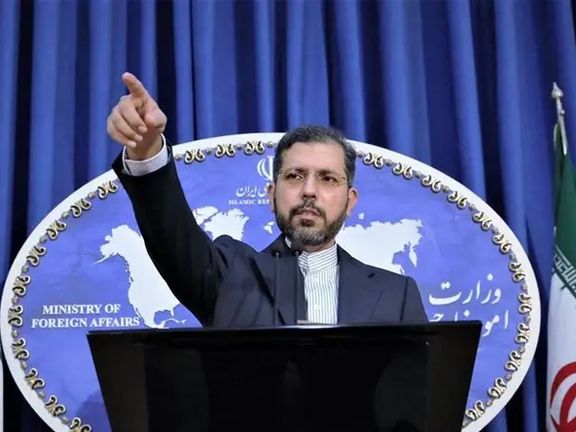
Iran's foreign ministry spokesman Saeed Khatibzadeh

The US has not yet “shown the necessary will” to agree on renewing the 2015 Iran nuclear deal, the Iranian foreign ministry spokesman said Monday.

"What has remained is more than one issue,” Saeed Khatibzadeh told reporters at his weekly press briefing. “All components of maximum pressure need to be removed.”

US ‘maximum pressure’ sanctions have been in place since 2018, when President Donald Trump withdrew the US from the 2015 agreement, the JCPOA (Joint Comprehensive Plan of Action), prompting Tehran by 2019 to expand its nuclear program beyond JCPOA limits.

A deal could have been concluded "months ago" had Tehran surrendered to US demands over its “red lines,” Khatibzadeh said. The spokesman reiterated that the "opportunity for dialogue" would not "remain open forever."

The US and Iran reportedly disagree over whether reviving the JCPOA should see the US remove the Iranian Revolutionary Guards (IRGC) from its list of ‘foreign terrorist organization,’ where Trump placed them in 2019. President Joe Biden’s administration, while committed to restoring the JCPOA, has apparently decided not delist the Guards, the only part of any state’s armed forces so designated, in the face of Congressional opposition to delisting from most Republicans and some Democrats.

The foreign ministry spokesman repeated Iran’s view that the sticking point in talks was the US and not the other world powers with whom Iran has for a year been discussing restoring the JCPOA – China, France, Germany, Russia, and the United Kingdom.

Referring to criticism of lawmakers from the principlist Paydari group, who have claimed Iranian negotiators have made too many concessions in a draft agreement over JCPOA revival, Khatibzadeh said there was "no final text."

"We have not yet reached the point where the American side demonstrates that it is fulfilling its obligations," Khatibzadeh said, claiming the US wanted to maintain as many of its sanctions as possible. His comments came a day after Foreign Minister Hossein Amir-Abdollahian said Sunday the US had presented "new conditions" for removing ‘maximum pressure.’

Iranian media and politicians who support the JCPOA have criticized the government over the talks. In a commentary Monday, Jomhouri Eslami newspaper said it should not have claimed over recent months that talks were near agreement or that Iran’s current economic problems would be solved irrespective of sanctions. "What matters is delivering on these promises,” the conservative paper noted.

Jomhouri Eslami linked US sanctions to rising prices. "Seven months appears to be enough time for the new government to take control of the affairs of the country and stop prices from rising,” it opined. “But many commodities have risen by between 50 to 80 percent during this time and pressure on people has doubled.”

Jomhouri Eslami urged the government of President Ebrahim Raisi "to seek help from those who have successful experience in this matter," presumably a reference to those who conducted earlier international talks under the presidency of Hassan Rouhani.

Most Viewed

Ghalibaf defends Iran-US talks amid hardline backlash
1
INSIGHT

Ghalibaf defends Iran-US talks amid hardline backlash

2
INSIGHT

100 days after carnage: Iran economy reels from war, inflation, unemployment

3
INSIGHT

A nation in limbo: 100 days after the massacre, has the world moved on?

4
ANALYSIS

From instability to influence: Pakistan’s pivotal role in US-Iran diplomacy

5
ANALYSIS

100 days on: why Iran’s January protests spread across social classes

Banner
Banner

Spotlight

  • War-hit homeowners feel abandoned as Iran’s reconstruction aid fades

    War-hit homeowners feel abandoned as Iran’s reconstruction aid fades

  • 100 days on: the anatomy of Iran’s January crackdown
    INSIGHT

    100 days on: the anatomy of Iran’s January crackdown

  • Ghalibaf defends Iran-US talks amid hardline backlash
    INSIGHT

    Ghalibaf defends Iran-US talks amid hardline backlash

  • 100 days on: why Iran’s January protests spread across social classes
    ANALYSIS

    100 days on: why Iran’s January protests spread across social classes

  • From instability to influence: Pakistan’s pivotal role in US-Iran diplomacy
    ANALYSIS

    From instability to influence: Pakistan’s pivotal role in US-Iran diplomacy

  • A nation in limbo: 100 days after the massacre, has the world moved on?
    INSIGHT

    A nation in limbo: 100 days after the massacre, has the world moved on?

•
•
•

More Stories

Do Iranian Lawmakers Have A Copy Of Draft Nuclear Deal?

Apr 10, 2022, 21:37 GMT+1
•
Iran International Newsroom

Iran's former nuclear chief Fereydoun Abbasi says Iranian lawmakers have not officially received a copy of a new nuclear agreement drafted in the Vienna talks.

However, several members of the Iranian parliament (Majles) claim that they have read the text of a new agreement between Iran and the United States.

Abbasi, who is currently an member of parliament from Kazeroun in Fars province and a member of the parliament's Energy Committee, told the Iranian Labor News Agency (ILNA) on Sunday that Iran’s negotiators have never briefed lawmakers on the nuclear talks, and the speaker of the Majles has also not shared an official text with MPs.

Abbasi’s remarks come while 250 lawmakers who wrote a letter to President Ebrahim Raisi telling him not to accept any agreement without a US guarantee to uphold the deal, claim to have seen the draft of an agreement.

Last week, hardliner lawmaker, Mahmoud Nabavian, a Paydari Party member, said in an interview with Fars News Agency that he and some other members of the parliament have already read the text exchanged between the Iranian and US negotiators. Incidentally, what the lawmakers wrote in the letter to Raisi on Sunday, was identical to what Nabavian had called for in terms of guarantees.

Reading Abbasi’s remarks carefully, he did not explicitly deny that a text is circulating among lawmakers. What he said was that an official version was not shared with parliament members.

He reiterated that "Unfortunately, no one in Iran has told us what has been going on between the Iranian and US negotiators." He stressed that both the Energy Committee and the National Security Committee have been left in the dark about the negotiations.

Abbasi sounding upset warned that [the officials] should not play with the Majles, adding, "under the circumstances, we cannot offer any advice to the Majles."

When he was told that it appears to outsiders there are good ties between the parliament and the administration, Abbasi said: "The information we need is not communicated to us. I have even asked other MPs whether they have been given any new insight, but it appears that we lack the information that would enable us to defend the negotiators."

Abbasi further said: "We still do not know why the other side refuses to lift the sanctions. We do not know if they have a point to make about the Islamic Revolution, Iran's defensive power, or Iran being an emerging global power.”

He added: "The two sides have no problem regarding the nuclear issue. The 2015 agreement, the Joint Comprehensive Plan of Action (JCPOA) had made everything clear and we had accepted it, although it was not in our interest. And we were carrying it out. Why didn't they [the US side] fulfil their commitments? This is what the negotiators should come forward and tell us."

Asked why Paydari members oppose the nuclear talks, Abbasi said: They are wise men, and they are not obstructionists. Of course, they are party members, but at the same time, they have their independent ideas.

Meanwhile, Abbasi who is known to be linked to Paydari, denied his membership in the party. "My problem with the negotiations is that the negotiators haven not told us anything about it."

Iranian MPs Call For Credible Guarantees From US For Renewed Deal

Apr 10, 2022, 13:41 GMT+1

A large majority in Iran's parliament have written to President Ebrahim Raisi calling for credible guarantees from Washington for the renewed nuclear agreement.

In a statement read out at the parliament on Sunday, 250 lawmakers insisted that Washington should provide the necessary guarantees that it would not pull out of the deal again, noting that verbal promises, including speeches by President Joe Biden, do not count as guarantees.

The lawmakers said US decision-making bodies, such as Congress, should approve the agreement so nothing can hinder its implementation in the future.

They also described the existence of a snapback mechanism as a practical failure of the talks, urging assurances against its use under various pretexts.

The MPs reiterated that imposing new sanctions on Iranian organizations and individuals should be prohibited as part of the agreement and it should be noted that the lifted sanctions will not be re-imposed.

They also highlighted that Iran should be able to sell its oil and receive the revenues freely, adding that Iran’s frozen assets should also be released.

While the hardliners’ victory in the 2020 parliamentary election strengthened critics of the 2015 nuclear deal in the 290-seat body, Iran entered talks in Vienna one year ago saying that it would agree to restore the 2015 nuclear deal if the United States lifted ‘maximum pressure’ sanctions.

On Saturday, Raisi insisted Iran will not back down from the "nation's rights" in talks to restore the 2015 nuclear deal with world powers.

Iran FM Says US Should Show Goodwill In Nuclear Talks

Apr 10, 2022, 10:40 GMT+1
•
Iran International Newsroom

Iran’s foreign minister said Sunday that US President Joe Biden should show some “goodwill”, if his statements about reviving the 2015 nuclear deal are serious.

Hossein Amir-Abdollahian, who was speaking at a meeting of officials dealing with foreign economic relations in Tehran, referred to Washington’s requests for direct talks with Iran and said that the United States should show goodwill. He emphasized that Tehran had asked the USto release some of Iran’s frozen funds prior to a final nuclear agreement but had received no positive reaction.

Amor-Abdollahian first made a direct demand in September 2021, while visiting New York, for the US to greenlight the release of $10 billion from Iran’s frozen funds.

Amir-Abdollahian once again on Sunday reiterated that Iran stands and will continue to stand on its “red lines” in the Vienna nuclear talks.

“The Americans continuously speak of the need for direct talks with Iran. After examining the issue and considering the views the Americans have, we did not find a benefit in direct talks,” he said. Amir-Abdollahian added, that the US “has not done anything positive” to provide confidence.

The chief Iranian diplomat’s remarks did not seem to be suggesting a new formal pre-condition for an agreement in Vienna, but it did appear that he wanted to emphasize the need for some sort of “goodwill” by the Biden Administration.

The negotiations stalled in mid-March after 11 months of talks among the original signatories of the 2015 nuclear agreement known as JCPOA, apparently because of Iran’s demanded from the US to remove its Revolutionary Guard from the list of foreign terrorist organizations.

At one point in his remarks, Amir-Abdollahian said that talks came to a halt after Russia’s invasion of Ukraine and the Western side told Iran that even if all outstanding issues were resolved, Russia would not agree to finalize a deal. In fact, Russia did make a new demandright before the talks ended in Vienna asking the US for waivers from Ukraine sanctions in its dealings with Iran.

Amir-Abdollahian maintained that instead of showing any goodwill, the United States imposed new sanctions on certain Iranian individuals and companies. He suggested that President Biden could release frozen funds with just one “executive order.”

He repeated that Tehran told Washington, “Not to create hurdles” and delay an agreement. “If our red lines are observed,” we can reach a good and lasting agreement, and now “it is the American side that must demonstrate goodwill,” Amir-Abdollahian said.

He added that the diplomatic path is open and claimed that the three European participants in the talks, the United Kingdom, France and Germany are also unhappy about unreasonable American demands.

The foreign minister emphasized that the people of Iran should know the government is striving for an agreement and lifting of sanctions, but he also repeated government’s policy of self-reliance in overcoming the impact of sanctions.

Iran’s economy continues to struggle amid a 40-percent annual inflation rate and a host of other serious issues mainly caused by US sanctions imposed by former president Donald Trump after he withdrew from the JCPOA in 2018. Criticisms and a general mood of despair has intensified in recent weeks as food prices continue to climb, and the government has no immediate solution to offer.

Iran Not To Back Down In Nuclear Talks, Raisi Insists

Apr 9, 2022, 18:52 GMT+1
•
Maryam Sinaiee

President Ebrahim Raisi on Saturday insisted Iran will not back down from the "nation's rights" in talks to restore the 2015 nuclear deal with world powers.

While stressing that "nuclear weapons have no place in Iran's defense doctrine," Raisi said his government will not back off "even one iota" in the Vienna nuclear talks from what it considers to be Iranian people's right to peaceful nuclear energy.

Raisi who was speaking at a ceremony to mark the National Nuclear Technology Day in Iran said Tehran "hasn't left [the Vienna talks] and will not leave them. "But our strategy is the same strategy announced by the Supreme Leader [Ali Khamenei]," he said, based on which his government and nuclear negotiators are obliged to support "the rights of the nation".

Vienna talks were abruptly paused in mid-March when negotiators returned to their capitals for what they said was consultations. Tehran and Washington have exchanged some messages through the European coordinator of the talks regarding unresolved issues.

Tehran and Washington, negotiating indirectly because of Iran refusal to sit down with the Americans, both blame the other side for the pause in the talks, insisting that the other party should make "political decision". Tehran's demands that its Revolutionary Guards (IRGC) be removed from the US list of Foreign Terrorist Organizations (FTO).

In his speech Saturday, Raisi made no mention of the IRGC and Tehran's demand.

An Iranian diplomat has told Reuters that Tehran has rejected a US proposal to resolve the issue by keeping the IRGC’s extraterritorial arm, the Qods (Quds) Force, under FTO sanctions, while delisting the IRGC as an entity.

There has been much opposition in Washington to the delisting of the IRGC and the Biden Administration has apparently not decided on Iran’s demand. The US State Department said in a statement Friday that President Joe Biden regards the Qods Force a terrorist group.

It is not clear from the statement whether Biden considers the whole of IRGC a terrorist organization or is trying to only keep the Qods Force on the terror list and remove the larger organization to reach a deal with Tehran.

The Biden administration believes that the revival of the 2015 deal can delay Iran’s nuclear breakout timeline, while opponents insist on continuing President Donald Trump's ‘maximum pressure’ sanctions until the regime is crippled or collapses.

Raisi also visited an exhibition by Iran's Atomic Energy Agency (AEOI) on Saturday and unveiled several new products and technologies including the first sample of silicide fuel disks to replace Tehran Research reactor's spent fuel, a detoxification system for pistachios using cold plasma, a cold plasma system and three radiopharmaceuticals for cancer treatment, sustainable zirconia powder production technology, and a laser source for micromachining used in making very small parts.

On the Nuclear Technology Day last year, in parallel with the start of nuclear talks in Vienna, Tehran launched advanced centrifuges for higher enrichment of uranium while reiterating that it was committed to nuclear non-proliferation.

Also addressing the ceremony in Tehran to mark the Nuclear Technology Day was the Head of AEOI Mohammad Eslami who said Tehran expects the International Atomic Energy Agency (IAEA) that monitors non-proliferation issues, not to succumb to pressures exerted by Tehran’s enemies, especially Israel.

Biden Opposed To Removal Of IRGC From Terror List But Questions Remain

Apr 9, 2022, 10:29 GMT+1
•
Mardo Soghom

Opponents of a deal with Iran welcomed signals that President Joe Biden is opposed to delisting the Revolutionary Guard as a terror group, but questions linger.

One report suggested that the United States has refrained so far from sending a counterproposal to Iran regarding its demand that the Revolutionary Guard be removed from the US Foreign Terrorist Organization list as a pre-condition to reviving the 2015 nuclear deal, the JCPOA.

Talks in Vienna that have lasted one year were close to completion at the end of February as the Russian invasion of Ukraine began. But then Iran that was insisting all along for the removal of all US sanctions imposed since 2018, demanded the delisting of the IRGC. The US position in the talks is that it will remove major sanctions related to Iran’s nuclear program, but not other sanctions that are related to terrorism or human rights violations.

Once the issue became public, opposition in the United States grew. Most Republicans and many Democrats openly put pressure on the White House not to delist the Guards, that are known to have caused mayhem in the Middle East by supporting a large network of militant groups, all the way to the Mediterranean shores and beyond.

The opposition made it less likely for the Biden team to agree to Iran’s demand, specially as Democrats face an uphill battle in the November elections.

Commander of Qods Force Esmail Ghaani in Iraq in February 2022
100%
Commander of Qods Force Esmail Ghaani in Iraq in February 2022

But a nuance in White House statements leads to the possibility that President Biden might be thinking to delist the IRGC but not its extraterritorial Qods (Quds) Force, which is Iran’s direct arm for building up anti-US, anti-Israeli, and anti-Saudi forces in the region.

An opinion piece by David Ignatius in the Washington Post on Friday mentioned that sanctioning the IRGC in 2019 was somewhat of a controversial issue, as some in the government and outside experts believed the multi-faceted entity was not only Iran’s main military force but also a major player in Iran’s economy and the public sector in general.

But opponents of giving a reprieve to the IRGC argue that separating it from the Qods force would be a wholly artificial distinction, just as trying to distinguish between the political and military wings of Hamas or Hezbollah. The US has traditionally rejected such a distinction.

Frequent Iranian threats directed at the United States and Israel are officially pronounced by the Revolutionary Guard, not just by the Qods Force, which speaks occasionally. Practically, the IRGC might even officially disband the Qods and create another outfit overnight that would carry out the same mission in the region.

The issue is Iran’s anti-West ideology kept alive by Supreme Leader Ali Khamenei who reinforces it in every public speech. Every Iranian government entity is supposed to fight against the archenemy, America, and Israel, according to the official dictum of the Islamic Republic.

Even at the height of improved ties in the wake of the JCPOA, Khamenei declared in 2016 that the Islamic Republic had no intention of cooperating on regional disagreements with main enemy the United States and “evil” Britain. He repeated the same message in November 2017, before former president Donald Trump had pulled out of the JCPOA and imposed sanctions.

The Biden administration, however, believes that the revival of the JCPOA is important to delay Iran’s nuclear breakout timeline, while opponents believe in continuing ‘maximum pressure’ sanctions until the regime is crippled or collapses.