• العربية
  • فارسی
Brand
  • Iran Insight
  • Politics
  • Economy
  • Analysis
  • Special Report
  • Opinion
  • Podcast
  • Iran Insight
  • Politics
  • Economy
  • Analysis
  • Special Report
  • Opinion
  • Podcast
  • Theme
  • Language
    • العربية
    • فارسی
  • Iran Insight
  • Politics
  • Economy
  • Analysis
  • Special Report
  • Opinion
  • Podcast
All rights reserved for Volant Media UK Limited
volant media logo

The Lives Of Iran's Shiite Clerics - Studying In A Seminary
Iran International Newsroom
Mar 22, 2022, 21:11 GMT+0Updated: 17:27 GMT+1
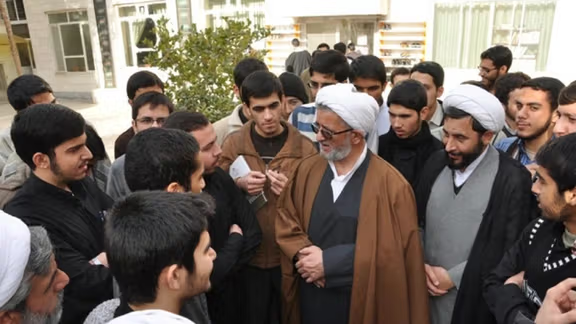
Seminary students mingle with their teachers.

This article is the first in a series about Iran’s Shiite clerics, explaining how they study, get a clerical rank, get married and what they do for a living.

-----------------------------------------------------------------------------------------------------------------------------

Before clerics came to power in Iran in 1979, mullahs as we know them in the West, or akhunds as they were called in Iran, used to solemnize marriages, tell stories about the martyrdom of the 12 imams to set the stage for the pious villagers and small-town dwellers to weep, or to recite verses from the Koran to usher the dead into paradise.

Some say the Islamic revolution was in fact a revolt that brought fundamentalist clerics to power, who often had no professional training or academic background for the government positions they later occupied.

Iranians and Iran watchers might remember that during the televised debates among presidential candidates in 2021, one candidate revealed that Ebrahim Raisi, who eventually won the election, had been to regular school for only six years. Now, he must make modern-day economic decisions, meet and interact with foreign leaders and run a huge bureaucracy.

Seyyed Ahmad Bathaei, born in 1987, studied at the Qom Seminary and is now a Ph.D. candidate in Philosophy and at the same time works as deputy dean at the Islamic Art Institute. "All of us have quit official schooling at one point to join the seminary and become a renowned scholar. I never know what it was I wanted to do to earn a living. As a young man, I had no dream, no future. But life grabs you by the neck at one point and makes you decide," he says.

"Many of my friends thought I would be a cleric like my dad. But my father left it to me to decide. He said: 'He can do anything he wants to do. No pressure.' I finally made the decision after nine years at a normal school. I applied for studying at the seminary. On the exam day I was so nervous I threw up on my papers. When the results came out and I passed the exam, I did not know exactly how to feel. I was amazed, happy, and at the same time helpless. I was not ready for the challenge. My father once again left me to decide for myself to continue at grade 10 at a normal school or to start from the scratch at the seminary," Bathaei remembers.

Seminary entrance exam in Iran. Undated
100%
Seminary entrance exam in Iran

"When he found me undecided, he said that I could go to the seminary, complete the clerical studies and then continue my "normal" education to become a doctor or an engineer. In fact, in those days there was a cleric in Qom who was a medical doctor. So, what my dad said could be true. And I chose to become an akhund, an Iranian Shiite cleric," he maintains.

According to Bathaei, seminary teachers prefer students who come to Qom as a younger man because their character is still not rigid and they can shape it in the 'right' way. The seminary starts after an interview to assess your character and the classes start in September. The best students end up at one of Qom's 24 madrassahs.

Courses start with minimal Arabic grammar and continue with elementary Islamic ideology and the attestations of big scholars on various matters of everyday life. The clerics have to learn the Arabic to be able to read the textbooks, but very few learn even a basic Arabic.

Famous ayatollah Makarem Shirazi bestowing an ammameh to a seminary graduate. Undated
100%
Famous ayatollah Makarem Shirazi bestowing an ammameh to a seminary graduate

After classes during which a teacher lectures the basics, the students get together, often in groups of three to discuss what they have learned. One of them repeats the teacher's lecture and the other two keep asking questions. Every day, there are usually four one-hour lectures followed by four discussions. At the beginning, all the students wish to be a Seghat ul-Islam or a learned scholar of Islam, but many end up becoming a simple cleric.

The muqaddamat (introductory) and the sat’h (advanced) levels continue for about six years. Many stop at the introductory level, but still they are believed to have turned from seminary students to clerics. That is when they get their robe (aba) and turban (ammameh) from their teacher. The costume is supposed to make the clerics look like the prophet. At this stage, the clerics become Hojjat ul-Eslam. They can no longer go out in jeans and T-shirts. Their behavior should show their dignity.

Nontheless, after the Islamic revolution, many clerics have chosen to be "amphibious" which means they can separate their daily life as clerics or as laymen and choose what they wear at different times. Former presidential adviser Hesamoddin Ashna and former vice-president Mohammad Nahavandian are examples of such clerics. They appear both in clerical garb and in Western suits.

To become an ayatollah, the Hojjat ul-Eslam needs to take at least another two or three advanced courses (dars-e kharej). The title has nothing to do with politics. Many clerics like to be called ayatollahs and in fact many do call them as such. But influential clerics such as Ayatollah Ali Khamenei do not buy that and refuse to call those clerics ayatollah and simply refer to them as "Hojjat ul-Eslam".An ayatollah who can teach the dars-e kharej, and does it for several years, may become an ayatollah ul-ozma (grand ayatollah). Out of a thousand clerics, a few can become ayatollahs and perhaps only one or two will become as high-ranking as a grand ayatollah.


Most Viewed

Ideology may be fading in Iran, but not in Kashmir's ‘Mini Iran'
1
INSIGHT

Ideology may be fading in Iran, but not in Kashmir's ‘Mini Iran'

2
INSIGHT

Hardliners push Hormuz ‘red line’ as US blockade tests Iran’s leverage

3
VOICES FROM IRAN

Hope and anger in Iran as fragile ceasefire persists

4

US sanctions oil network tied to Iranian tycoon Shamkhani

5

Iran halts petrochemical exports to supply domestic market

Banner
Banner

Spotlight

  • Hardliners push Hormuz ‘red line’ as US blockade tests Iran’s leverage
    INSIGHT

    Hardliners push Hormuz ‘red line’ as US blockade tests Iran’s leverage

  • Ideology may be fading in Iran, but not in Kashmir's ‘Mini Iran'
    INSIGHT

    Ideology may be fading in Iran, but not in Kashmir's ‘Mini Iran'

  • War damage amounts to $3,000 per Iranian, with blockade set to add to losses
    INSIGHT

    War damage amounts to $3,000 per Iranian, with blockade set to add to losses

  • Why the $100 billion Hormuz toll revenue is a myth
    ANALYSIS

    Why the $100 billion Hormuz toll revenue is a myth

  • US blockade targets Iran oil boom amid regional disruption
    ANALYSIS

    US blockade targets Iran oil boom amid regional disruption

  • Iran's digital economy battered by prolonged blackout
    INSIGHT

    Iran's digital economy battered by prolonged blackout

•
•
•

More Stories

Tehran Says Improving Iran-Saudi Ties Benefits All Regional Countries

Mar 22, 2022, 20:00 GMT+0

Iran’s Foreign Ministry spokesman attending an Islamic gathering on Tuesday has said improving Tehran-Riyadh relations would benefit all regional countries.

In an interview with IRNA Tuesday in Pakistan’s capital Islamabad at the 48th session of the Council of Foreign Ministers of the Organization of Islamic Cooperation (OIC), Saeed Khatibzadeh said that the OIC was one platform that could facilitate Iran-Saudi relations within the context of unity among Muslim nations.

Iranian President Ebrahim Raisi (Raeesi), who took office last August, has stressed the importance of improving relations with neighbors, and Tehran has conducted four rounds of talks with Riyadh facilitated by Iraq. Diplomatic relations were severed in 2016 after Tehran protestors attacked the Saudi embassy following the execution of Shia cleric Nimr al-Nimr.

Earlier this month Iran suspended the talks a day after Saudi Arabia announced it had beheaded 81 men, including seven Yemenis and a Syrian, for “heinous crimes.” Forty one were Saudi Shiites, Human Rights Watch reported, apparently convicted over protests.

Khatibzadeh welcomed Iran’s renewed participation in OIC since it reopened its representative office in Jeddah, the OIC base, in February. With 57 member states, the OIC represents around a quarter of the world’s population. Iran’s trade with OIC countries was reportedly $42 billion in the first ten months of the last Iranian year, ending January 20.

"From Yemen to Afghanistan, the Islamic world's unity is the key to address the crises,” Khatibzadeh tweeted.

Egypt, Israel, UAE Summit Focuses On Economic Challenges As Iran Looms

Mar 22, 2022, 16:55 GMT+0
•
Iran International Newsroom

Leaders of Egypt, Israel and the United Arab Emirates met Tuesday for talks focused on economic fallout from the Ukraine crisis, while Iran was also discussed.

Egypt said discussions covered energy markets and food security. Both Russia and Ukraine are major exporters of agricultural products to the Middle East and North Africa.

Analysts said Iran’s regional policies were also brought up, but rising food and oil prices were more on the mind of Egyptian President Abdel Fattah al-Sisi in hosting Sheikh Mohammed bin Zayed al-Nahyan, Crown Prince of Abu Dhabi and de facto UAE leader, and Israel's Prime Minister Naftali Bennett. This was the first three-way summit since Israel and the UAE ‘normalized’ relations in 2020.

Egypt, the world’s largest wheat importer takes half of its imports from Russia and another 30 percent from Ukraine. Cairo Monday devalued its currency by 14 percent, and its Red Sea resorts are losing tourist income from wealthy Russian and Ukrainian visitors. The Egyptian military government that seized power in 2013 has strengthened links to Israel but despite over $1 billion aid from the US in 2021 may now seek financial assistance from the UAE.

Inadequate food

Egypt’s apparent priorities at Sharm el-Sheikh summit reflect increasing international concern over food supplies. Human Rights Watch reported Monday that regional governments needed urgently to find ways to protect their populations from the consequences of losing imports from Ukraine and Russia. Nearly one in three people in the Middle East and North Africa did not have access to adequate food in 2020, the HRW watch report said, an increase of 10 million people in just one year.

Israel, despite its links to Russia and Russian-speakers making up around 15 percent of its population, has broadly supported the US over Ukraine, while UAE has remained neutral and along with Saudi Arabia has resisted calls from Washington to increase oil exports to meet shortfall in Russian exports.

The Saudi government Tuesday stressed the “essential role” of the ‘Opec+’ agreement (production deals agreed by the Organization of Petroleum Exporting Countries with Russia) in balancing global oil supplies. The statement was taken as a sign it was unlikely the grouping would agree at its March 31 meeting to raise output as the US and some European states have requested in the face of rising prices. Benchmark Brent was at $111 a barrel Tuesday.

Iran Nuclear Deal

While the Gulf Arab states and Israel remain critical of efforts to revive Iran’s 2015 nuclear deal with world powers, the JCPOA (Joint Comprehensive Plan of Action), Iran is not topping the agenda in Sharm el-Sheikh. Bennett has moderated his past attacks on the JCPOA as some former Israel intelligence officials have cautiously supported the deal’s revival.

After the Gulf Arab states’ close relationship with the previous US administration of President Donald Trump, when they stepped up arms deals, their links had cooled under President Joe Biden.

But while the Biden administration has expressed concern over the humanitarian crisis in Yemen, where 4 million have been displaced, it has also lately increased military support for Saudi Arabia, including reportedly Patriot missiles, after Ansar Allah – the Houthis – have brought the war from Yemen, where Saudi Arabia has been involved since 2015, to missile strikes on the kingdom.

Iran's Vice President Says 'Enmity' With US Will Not End With Talks

Mar 22, 2022, 15:38 GMT+0

Iran’s problem with the “enemy” is fundamental and will never be resolved with negotiations, Vice President Mohammad Mokhber told reporters on Tuesday.

Without naming the United States, Mokhber said, “Some think [the problem with the enemy] will be resolved through talks, but it is not so, although we should negotiate to lift the sanctions.”

Praising what he called the people’s readiness to sacrifice, the vice president added, “In negotiating with the West we need to be in a position of power and the enemy should accept that it cannot eradicate us. This crucial need cannot be addressed with ballistic missiles, but with people’s support and their high spirits.”

He compared the current situation with the 8-year war between Iran and Iraq in the 1980s, to highlight the importance of sacrifices by the people.

Mokhber’s comments come as Iran’s decade-old economic crisis has led to repeated protests and labor strikes since 2017 and the weakening of regime’s legitimacy. The June 2021 presidential elections also saw the lowest turnout in the 43-year history of the Islamic Republic.

Mokhber was a top business manager in the office of Supreme Leader Ali Khamenei before becoming President Ebrahim Raisi’s first vice president. He was the director of the Execution of Imam Khomein’s Order, an entity meant to be a charitable organization, which has become a business conglomerate by controlling companies, banks and businesses.

Iran Moves Its Ukraine Embassy To Moldovan Capital

Mar 22, 2022, 12:34 GMT+0

Iran says its embassy in Ukraine will temporarily relocate to Moldova due to the Russian invasion of the country.

The Embassy of the Islamic Republic in Kyiv issued a statement on Tuesday, announcing the temporary transfer of the embassy to the Moldovan capital.

The statement said that “due to the ongoing war in Ukraine and the impossibility of continuing the embassy’s operations” the embassy moves to Chișinău “until the situation normalizes”.

About a month into the invasion, Russia continues its bombardment of several Ukrainian cities while its troops and artillery remain on the outskirts of Kyiv.

Dozens of Iranian students stranded in the first week of invasion in Ukraine later left the country via land corridors to Romania and other Eastern European countries.

Tehran has backed Moscow in the invasion baling the United States and Nato for the crisis. However, clear media divide has emerged in Iran over the war in Ukraine, with some hardliner media repeating Moscow’s propaganda and others trying to reflect reality.

Russia's ambassador in Iran has said that Moscow will continue its "special military operation" in Ukraine until its objectives are attained.

However, former senior Iranian lawmaker Heshmatollah Falahatpisheh has said that the crisis in Ukraine provides a golden opportunity for Iran to get a foothold in international energy markets.

Republican Lawmaker Says IRGC Is Plotting To Kill Americans In US

Mar 22, 2022, 09:47 GMT+0

A Republican Congresswoman has criticized the Biden administration for considering removing Iran’s Revolutionary Guards from the US foreign terrorist blacklist.

Representative Claudia Tenney said in a tweet on Monday that “the IRGC is actively plotting to kill Americans in the United States and has already killed Americans abroad”.

“Why is the Biden Administration even considering removing the group’s terrorist designation?” she asked.

The talk of removing the IRGC from the list has drawn sharp criticism from Republicans as well as Democrats since sources told Axios and Reuters last week that Washington is weighing the option in return for unspecified Iranian assurances.

Democratic congresswoman Elaine Luria, a naval veteran, said last week that reviving the JCPOA would “put Iran and Israel on a collision course,” echoing remarks by Israel’s ambassador to the United States Michael Herzog.

In addition to American officials, Israel’s prime minister and foreign minister have called on Washington to keep IRGC on the list, saying “The Revolutionary Guards are a terrorist organization that has murdered thousands of people, including Americans”.

Iranian officials have been publicly raising the issue since at least November, saying a ‘good deal’ would mean lifting sanctions on the Revolutionary Guard.

Such a step would reverse former President Donald Trump's 2019 blacklisting of the group, the first time the US had formally labeled part of another sovereign government as a terrorist group.