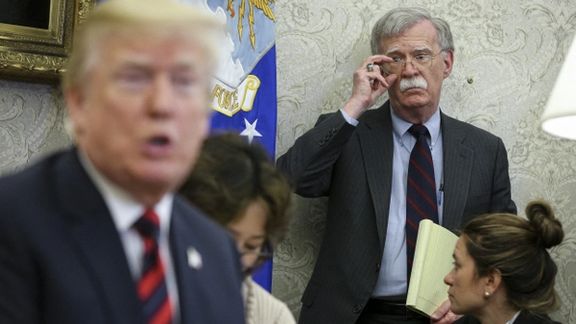
President Donald Trump speaks as National security advisor John Bolton listens during a meeting in the Oval Office of the White House. May 22, 2018
Former US national security adviser John Bolton says restoring the 2015 nuclear deal is a "terrible mistake" and insists the Iranian regime must be overthrown.
Calling the 2015 deal, Joint Comprehensive Plan of Action (JCPOA) a "bad deal," Bolton told Iran International television on Thursday that going back to it is a "terrible mistake for the United States and anyone who believes in peace and regional security."
"The concessions that were made to the mullahs in Tehran to get the deal put back together make it even worse. It was supposed to be about nuclear matters and not about terrorism. If it's about terrorism, there is a lot more to do, to discuss with Iran. But to take the IRGC off the terrorism list I think would be a big mistake," he said, adding that it is the fundamental elements of the deal itself that are bad too.
"That's the real problem," he said, adding that the administration of President Joe Biden is making a "strategic mistake" in seeking to restore the JCPOA. "It's a sign of weakness and lack of strategic vision."
American and Israeli sources told Reuters and Axios that the Biden Administration is considering removing the Revolutionary Guards (IRGC), which was blacklisted by the Trump administration in 2019 as a terrorist organization, in return for a commitment by Iran to "reign in" the guards.
Bolton also referred to the recent Russian demand for US guarantees that its cooperation with Tehran would not be blocked by Ukraine sanctions, criticizing the Biden administration for granting a waiver to Moscow for nuclear work in Iran. He Russia won "one more concession from the Biden administration", and they will continue to have the same role they had in the 2015 deal and perhaps an "expanded role" in the revived agreement. "This gives Russia a legitimacy that it doesn't deserve at this point."
Bolton who has always advocated regime change in Iran sought complete withdrawal from the 2015 nuclear deal with Iran and said the deal was so bad it could not even be fixed. Bolton, Israeli Prime Minister Benjamin Netanyahu and Secretary of State Mike Pompeo in 2019 preventedTrump’s attempts to open diplomatic channels with Iran.
The Iranian regime is "rogue", Bolton said, emphasizing that it must be "overthrown" and "the Iranian people get to have a say who their government is."
Trump did not go along with some of Bolton's major hardline positions such as seeking regime change in Iran and in September 2019, he said on Twitter that he had dismissed him due to the many disagreements between them. Bolton later told the media the president had never asked for his resignation and that he had resigned of his own accord.
Iran on January 8 added Bolton's name to its blacklist of US nationals it accuses of having a role in the decision-making, planning, organizing, financing, directing or carrying out the strike that killed the IRGC Qods Force commander Ghasem Soleimani at Baghdad airport in January 2020.
Earlier this month, the Washington Examiner quoteda Justice Department official as saying that there was enough evidence to indict two IRGC agents who allegedly had plotted to assassinate Bolton but the Biden administration was resisting any public measures for fear that it could derail the Vienna negotiations with Tehran.
Bolton said he could not reveal the details of the alleged assassination plot but considers being sanctioned by Iran, Russia, and China "a badge of honor".
Senator Ted Cruz (R -Texas) and other push for a Congressional ban on a deal with Iran.
Republicans continue to campaign against President Joe Biden’s diplomacy to lift Iran sanctions, which involves also exempting Russia from Ukraine sanctions.
The Republican push against nuclear talks in Vienna since April 2021 is not new, but a decision by the Biden Administration earlier this week to accept last-minute Russian demands has added a new twist to the dynamics of the opposition.
The State Departmentannounced Tuesday that the Biden administration would “not sanction Russian participation in nuclear projects that are part of resuming full implementation”
Senator Ted Cruz (R-Texas) is sponsoring a bill to prohibit the administration from waving sanctions imposed for the invasion of Ukraine, allowing Russia to continue nuclear projects with Iran worth at least $10 billion.
"The Biden administration is dismantling sanctions and is aching to secure a new agreement with the Iranian regime that is even weaker than the original catastrophic Obama-Iran nuclear deal," Cruz told the Washington Free Beacon. "The Biden administration is so committed to their deal that they are willing to make Iran a nuclear client for Putin, including work that amounts to a $10 billion subsidy for his war machine."
Free Beacon also reported that Rep. Darrell ISS (R- Calif.) is authoring a parallel House version of the bill.
The Biden administration has repeatedly defended its policy of negotiating a revival of the 2015 nuclear deal, the JCPOA, although it had promised a stronger deal last year, when talks began in Vienna. Officials insist that their top priority is to make sure Iran never becomes a nuclear weapons state, but critics argue that what is being negotiated will not guarantee that.
As the Vienna talks with Iran seemed to be coming to an end, Russia demanded written guarantees from the United States that Western sanctions imposed for Ukraine should not impede its trade and other relations with Iran. After more than a week of behind-the-scenes diplomacy, Russian Foreign Minister Sergei Lavrov announced on March 15 that Moscow has received guarantees from Washington it can continue its nuclear cooperation deals with Iran.
Although this fell short of Russia’s demand for full waivers, but some argued that it would still mean a $10 billion windfall for Moscow while West is trying to turn screws on the Kremlin amid high tensions in Europe.
Sen. Cruz regards the administration’s move on offering the waiver as a circumvention of Congressionally approved sanctions and his bill intends to block the concession. The Senate is almost evenly split between Republicans and Democrats, and any bill to succeed must have bipartisan support. Some Democrats might join the bill, but it needs a Democratic cosponsor to gain more traction.
So far, Senate Foreign Relations Committee Chairman Bob Menendez (D-NJ) has voiced strong reservations about the Vienna talks, but it he has still not endorsed the Cruz bill.
Not only the waiver of Ukraine sanctions on Russia will generate cash for Moscow, but its commercial dealings on nuclear projects might also provide a window to international banking and money laundering through Iran, which has vast experience in evading US sanctions.
Senate Foreign Relations Committee Republican Ranking Member Jim Risch tweeted on Thursday, “Russian enterprises involved in the invasion of Ukraine stand to gain significantly from a bad deal with Iran. It’ll unlock billions for the Kremlin, helping fuel Russian war crimes.”
Iran’s foreign minister said Thursday that a draft agreement in Vienna is almost ready, awaiting a US response on just two issues. One issue reportedly is delisting the Revolutionary Guard (IRGC) from the US Foreign Terrorist Organization designation, a move Israel and others strongly object to.
This week, 49 Republican Senators issued a statementtelling the White House not sign a deal to revive the 2015 JCPOA, especially if IRGC sanctions are to be lifted.
If finalized, the renewed nuclear agreement between Iran and world powers lets Russia cash in on a $10-billion contract to build atomic reactors in Iran.
Washington Free Beacon reported on Wednesday that Russia’s top state-controlled energy company Rosatom has a contract with the Atomic Energy Organization of Iran for development projects at Bushehr nuclear plant in southern Iran.
Negotiations in Vienna after 11 months hit a bump in the road on March 5 when Russia asked that sanctions for its invasion of Ukraine should not impact implementation of a revived 2015 nuclear deal, the JCPOA (Joint Comprehensive Plan of Action).
Moscow said on Tuesday it received US assurances that the Biden administration will waive the sanctions, noting that “Additions were made to the text of the future agreement on JCPOA restoration to ensure that all the JCPOA-related projects, especially with Russian participation, as well as Bushehr Nuclear Power Plant, are protected from negative impact of anti-Russian restrictions by US and EU”.
US State Department spokesman Ned Price confirmed on Tuesday, "We, of course, would not sanction Russian participation in nuclear projects that are part of resuming full implementation of the JCPOA”.
Foreign Minister Hossein Amir-Abdollahian said Wednesday that two of the outstanding matters in talks have been settled, “but two issues remain, including economic guarantees”.
Senior IRGC commanders, including Qasem Soleimani (L) who was killed in a US drone strike in January 2020
The Biden Administration is considering removing the Revolutionary Guards from its foreign terrorist blacklist in return for unspecified Iranian assurances.
Sources told Axios and Reuters that Washington had not decided what might be an acceptable commitment from Tehran in exchange for such a step, which would reverse former US President Donald Trump's 2019 blacklisting of the group and draw sharp Republican criticism.
The move was the first time Washington had formally labeled part of another sovereign government as a terrorist group.
Iranian officials have been publicly raising the issue since at least November, saying a ‘good deal’ would mean lifting sanctions on the Revolutionary Guard.
The Islamic Revolutionary Guard Corps (IRGC) is a powerful faction in Iran that controls a business empire as well as elite armed and intelligence forces that Washington accuses of carrying out a global terrorist campaign.
A source, who spoke on condition of anonymity with Reuters, said the Biden administration was weighing whether to drop the terrorist designation "in return for some kind of commitment and/or steps by Iran, with respect to regional or other IRGC activities."
The Biden administration's consideration of such a tradeoff was first reported by Axios, citing Israeli and US sources.
Multiple sources have said dropping the designation is one of the last, and most vexing, issues in wider indirect talks on reviving the 2015 deal under which Iran limited its nuclear program in return for relief from economic sanctions.
IRGC’s proxies in the region continue attacking US and allied targets. On Sunday, IRGC fired 12 ballistic missiles at Erbil, in Iraq hitting an area near A US consulate building.
Asked about the possibility of removing the IRGC from the US terrorism list, State Department spokesman Ned Price declined comment beyond saying that sanctions relief is at the heart of negotiations to revive the nuclear deal.
Last week an Iranian official said the IRGC's removal from the blacklist had been under discussion as far back as June but that the issue had become more complicated after last summer's election of hardliner Ebrahim Raisi as Iran's president.
The Iranian official, who spoke on condition of anonymity, said the United States had made clear "they cannot remove it without major concessions from Iran," a stance he said had been rejected by Iran's lead nuclear negotiator, Ali Bagheri Kani.
The IRGC's political influence in Iran's complex power structure has increased since the election of Raisi, who took office in August and whose government includes dozens of Revolutionary Guard commanders.
Raisi's election led to a five-month gap in the indirect US-Iranian talks over reviving the nuclear deal, which Trump abandoned in 2018 and reimposed U.S. sanctions, prompting Iran to start violating its nuclear limits about a year later.
US envoy in Iran nuclear talks, Rob Malley meeting Russia's envoy Mikhail Ulyanov. December 15, 2021
Two of four outstanding matters in Iran’s nuclear talks with world powers have been settled in the past three weeks, Foreign Minister Hossein Amir-Abdollahian said Wednesday.
"We had four issues as our red lines in our near-final negotiations,” Amir-Abdollahian said. “Two of them have been almost resolved…and we have reached an agreement. But two issues remain, including economic guarantees.”
Iran has sought assurances that the US would honor commitments set by the deal over Iranian access to foreign markets and inward investment. Russian foreign minister Sergei Lavrov said Tuesday that Russia had received US assurances he had asked for March 5 that sanctions against Russia would not impact implementing a revived 2015 nuclear deal, the JCPOA (Joint Comprehensive Plan of Action). United Nations nuclear chief Rafael Mariano Gross also said Tuesday that “doubt” over the JCPOA implementation due to Ukraine sanctions had been cleared up.
Amir-Abdollahian said he had spoken earlier in the day with Ali Bagheri Kani, who has led Iranian negotiators in talks with world powers in Vienna. The foreign minister said “we continue to exchange our messages to the Americans through non-paper with Enrique Mora [the senior European Union official chairing the Vienna talks].”
If the US was “ready to settle” the two remaining matters, Amir-Abdollahian said, then Iran was “ready to conclude” with a gathering of foreign ministers in Vienna: “If the American side fulfills our remaining two demands today, we will be ready in Vienna tomorrow.”
Tehran and six world powers are on the verge of agreeing to revive the 2015 Iran nuclear deal, the head of the International Atomic Energy Agency said Tuesday.
Contrary to claims by some US and western European officials, Grossi said “the problems that emerged in the past few days were real” as sanctions against Russia over Ukraine had cast doubt on “some of the actions and activities contemplated under the JCPOA.”
“The JCPOA is an extremely complex instrument that has a number of limitations – things that Iran shouldn’t or couldn’t do,” Grossi explained. “But at the same time, it has some incentives, some technical cooperation projects and things that could be facilitated in Iran under the inspectors of the IAEA, and carried out in cooperation mainly with China and Russia…All of a sudden, these activities of commercial nature that require buying equipment, exchanging expertise, etc appeared to be in doubt.”
The US has in recent years employed third-party sanctions against Iran, leaving open anyone dealing with Tehran to punitive US action. The IAEA would play a role monitoring a restored JCPOA, with the enhanced inspection powers under the agreement. “I hope we can have this agreement soon, and start working - my inspectors are ready to go,” Grossi maintained.