• العربية
  • فارسی
Brand
  • Iran Insight
  • Politics
  • Economy
  • Analysis
  • Special Report
  • Opinion
  • Podcast
  • Iran Insight
  • Politics
  • Economy
  • Analysis
  • Special Report
  • Opinion
  • Podcast
  • Theme
  • Language
    • العربية
    • فارسی
  • Iran Insight
  • Politics
  • Economy
  • Analysis
  • Special Report
  • Opinion
  • Podcast
All rights reserved for Volant Media UK Limited
volant media logo

Ukraine Fall-Out Adds Heat To Iran Nuclear Talks
Iran International Newsroom
Mar 7, 2022, 20:17 GMT+0Updated: 17:39 GMT+1
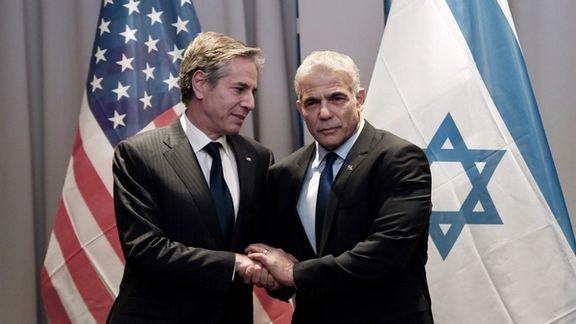
US Secretary of State Antony Blinken meets with Israeli Foreign Minister Yair Lapid in Riga, Latvia March 7, 2022.

Rafael Mariano Grossi, the UN nuclear monitoring chief, highlighted Monday Ukraine and Iran as “two major issues high on the international community’s agenda.”

In his statement to the board of the International Atomic Energy Agency (IAEA), Grossi said the IAEA was monitoring the “precarious situation at Ukraine’s nuclear sites” where there had been an “unprecedented danger of a nuclear accident,” following a Russian shell hitting the Zaporizhzhya nuclear power plant.

Over Iran, Grossi confirmed that following his visit to Tehran Saturday, the agency was expecting by March 20 “written explanations, including related supporting documents” from Iran over the agency’s questions about Iranian nuclear work at three sites before 2003.

Grossi agreed in meetings with Mohammad Eslami, head of the Atomic Energy Agency of Iran (AEOI), to clear up these matters by June 20. This timetable eased fears in Vienna they might stymie talks in the Austrian capital aimed at reviving the 2015 Iran nuclear deal, the JCPOA (Joint Comprehensive Plan of Action).

Further consultations

Iran’s official news agency IRNA reported Monday that Iran’s lead negotiator Ali Bagheri-Kani was returning to Tehran for further consultations as expert groups continued work in Vienna.

While the nuclear talks have since April 2021 struggled to agree which United States sanctions contravene the JCPOA, and exactly how the expanded Iran nuclear program could be returned to JCPOA limits, the Ukraine crisis has stirred the pot.

Russian foreign minister Sergei Lavrov suggested Saturday that any sanctions against Russia over Ukraine should not affect the JCPOA and trade relations with Iran. "And we'd like to receive an answer, a very clear answer; we need guarantees that these very sanctions won't affect the regime of trade-economic and investment ties embedded in the Joint Comprehensive Plan of Action on the Iranian nuclear program," Lavrov told reporters in Moscow.

"Agreements on reinstating the JCPOA imply a set of reciprocal obligations, such as Iran's obligations as to the volume and parameters of its civilian nuclear program, and obligations of the other participants to make sure that projects for the development of civilian nuclear energy in full compliance with the Treaty on the Non-Proliferation of Nuclear Weapons, in full compliance with and under control of the IAEA, with support from Russia, China, and other countries, will be implemented," Lavrov explained.

Nuclear blackmail

Anonymous diplomats, including a French presidential official, called this “blackmail,” suggesting Moscow intends to use the JCPOA as a way to circumvent Ukraine sanctions. Some Iranian media outlets claimed Russia wanted to wreck the Vienna talks, perhaps to keep Tehran’s oil off world markets.

But the Iranian foreign ministry Monday reported a phone call between Foreign Minister Hossein Amir-Abdollahian and Lavrov in which Amir-Abdollahian agreed that Tehran’s relations with Russia should not be upset by further sanctions.

"We are against both war and sanctions,” the Iranian foreign minister said, while Lavrov had again backed Iran’s “logical demands” in the Vienna talks.

Also dealing with the fallout of the Ukraine crisis, Israeli foreign minister Yair Lapid, meeting US Secretary of State Anton Blinken in Riga, admitted to “differences” with Washington over Iran. Lapid called the agreement being readied in Vienna “bad and ineffective.”

Most Viewed

Ghalibaf defends Iran-US talks amid hardline backlash
1
INSIGHT

Ghalibaf defends Iran-US talks amid hardline backlash

2
INSIGHT

A nation in limbo: 100 days after the massacre, has the world moved on?

3
ANALYSIS

From instability to influence: Pakistan’s pivotal role in US-Iran diplomacy

4
ANALYSIS

100 days on: why Iran’s January protests spread across social classes

5

War-hit homeowners feel abandoned as Iran’s reconstruction aid fades

Banner
Banner

Spotlight

  • War-hit homeowners feel abandoned as Iran’s reconstruction aid fades

    War-hit homeowners feel abandoned as Iran’s reconstruction aid fades

  • 100 days on: the anatomy of Iran’s January crackdown
    INSIGHT

    100 days on: the anatomy of Iran’s January crackdown

  • Ghalibaf defends Iran-US talks amid hardline backlash
    INSIGHT

    Ghalibaf defends Iran-US talks amid hardline backlash

  • 100 days on: why Iran’s January protests spread across social classes
    ANALYSIS

    100 days on: why Iran’s January protests spread across social classes

  • From instability to influence: Pakistan’s pivotal role in US-Iran diplomacy
    ANALYSIS

    From instability to influence: Pakistan’s pivotal role in US-Iran diplomacy

  • A nation in limbo: 100 days after the massacre, has the world moved on?
    INSIGHT

    A nation in limbo: 100 days after the massacre, has the world moved on?

•
•
•

More Stories

Israel's Lapid Says Iran Deal To Be Signed Is 'Bad And Ineffective'

Mar 7, 2022, 18:02 GMT+0

The nuclear deal to be signed with Iran is “a bad and ineffective” agreement, Israeli foreign minister Yair Lapid said Monday after meeting US Secretary of State Antony Blinken in Riga.

Although the main topic of discussion was Israel’s diplomatic efforts to end the Ukraine crisis, the pair also discussed the talks in Vienna on a possible return to the 2015 nuclear deal between Iran and world powers.

After the meeting Lapid said Israel “is continuing its effort to prevent Iran from becoming a nuclear threshold state. The nuclear agreement which stands to be signed in Vienna is a bad and ineffective agreement.

Before the start of discussion Lapid said his meeting with Blinken comes at a time "when the world order is changing," referring to both the war in Ukraine and the nuclear talks.

While not a party to the nuclear negotiations between Iran and world powers in Vienna, Israel has conferred with the US administration in hope of wielding more clout over any revival of a 2015 deal with Tehran that was reached over its objections.

"It’s not secret we have our differences on this, but it is a conversation between allies that have a common goal which is to prevent Iran from becoming a nuclear threshold country," Lapid said before the meeting.

Meanwhile, Iran's chief nuclear negotiator Ali Bagheri Kani will return to Tehran on Monday for consultations, Iranian media reported.

France Warns Russia Not To Resort To Blackmail Over Iran Talks

Mar 7, 2022, 13:14 GMT+0
•
Iran International Newsroom

France warned Russia Monday not to resort to blackmail in Iran nuclear talks by demanding a US guarantee that Ukraine sanctions would not hurt its trade with Tehran.

Iran’s foreign ministry spokesperson Saeed Khatibzadeh said Iran was awaiting an explanation of the Russian demand via "diplomatic channels", adding however that the talks should not be affected by sanctions imposed on Moscow, whose contribution to negotiations so far had been “constructive.”

Russian Foreign Minister Sergei Lavrov said on Saturday that Moscow wanted a written US guarantee that Russia's trade, investment and military-technical cooperation with Iran would not be hindered by Western sanctions imposed since Russia invaded Ukraine.

On Saturday, a senior Iranian official speaking to Reuters had called Russia's move unconstructive.

Russia's Ambassador to Tehran Levan Dzhagaryan said on Monday Moscow plans to give Iran an explanation of the guarantees it has requested.

A French presidency official told reporters that diplomats tended to treat each issue on its merits and not conflating them.

"Because otherwise, in reality, it's just blackmail and not diplomacy," he told reporters.

Western officials say compartmentalizing the Iran nuclear dossier has been possible due to a common

A European diplomat added: "The Russians are really trying it on and the Iranians aren’t happy although of course not saying too much publicly. We’re trying to find a way through.",

Iran's top security official Ali Shamkhani said on Monday that negotiators were evaluating new components that had affected the Vienna talks and that Iran was adapting initiatives to accelerate an agreement.

US Secretary of State Antony Blinken sought on Sunday to dispel talk of obstacles, saying the sanctions imposed on Russia over Ukraine had nothing to do with the nuclear deal. Lavrov’s statement on Saturday, however, went farther than Russia’s role in facilitating a nuclear deal with Iran as he demanded a US waiver from Ukraine sanctions in all its dealings with Tehran.

Wall Street Journal, cited a “western diplomat” Saturday that Lavrov might be “using this as a play to try to carve a huge hole out of the overall Ukraine sanctions.” This would be “a different story,” the diplomat suggested, from guarantees simply over work directly linked to a restored JCPOA.

Diplomats said Washington and Tehran were also still trying to resolve other outstanding issues, which were also stalling an agreement.

European negotiators have temporarily left the talks as they believe they have gone as far as they can and it is now up to the two main protagonists to agree, three diplomats said.

With reporting by Reuters

Iran Says Prospect Of Nuclear Deal Unclear Due To US Delays

Mar 7, 2022, 12:03 GMT+0

Iran's top security official says the fate of the Vienna nuclear negotiations is tied to delays in the political decisions by the United States.

The secretary of Iran’s Supreme National Security Council, Ali Shamkhani, repeated an Iranian argument on Monday that the “prospect of a deal in Vienna talks remains unclear due to Washington's delay in making political decisions”.

The priority of Iranian negotiators is to resolve the remaining issues that are considered as the red lines for Tehran, he added, calling for “new initiatives from all parties” for a swift conclusion to a “strong deal.”

In another tweet earlier in the day, Shamkhani said, "Vienna participants act and react based on [their own] interests and it's understandable. Our interactions with 4+1 are also solely driven by our people's interests. Thus, we're assessing new elements that bear on the negotiations and will accordingly seek creative ways to expedite a solution”.

Iran’s foreign ministry said Monday that Tehran is awaiting clarification from Moscow over its demand to be exempted from Ukraine sanctions in its dealing with Iran.

"We have seen and heard about [Russian Foreign Minister Sergei] Lavrov's comments in the media. We are awaiting to hear its details through diplomatic channels," the ministry’s spokesman Saeed Khatibzadeh said at his weekly press conference.

Senators Say Biden Using Ukraine Distraction To Seal 'Bad Deal' With Iran

Mar 7, 2022, 11:30 GMT+0

More US Republican senators say the Biden administration is taking advantage of the Russia invasion of Ukraine to seal the nuclear deal with Iran.

Senator Bill Hagerty said on Sunday that President Joe Biden hopes Russia’s invasion “offers a distraction while he enters another nuclear deal that gives Iran and its terrorist proxies tens of billions in sanctions relief”.

He added, “I assure you I am not distracted and will do everything I can to stop this bad deal”.

Slamming Biden over his response to President Vladimir Putin's deadly attack, Hagerty said Biden must "demonstrate resolve" because Putin only responds to "people that show a spine" and stand up to the authoritarian leaders in order to help the country fight back.

Senator Dan Sullivan, another Republican lawmaker, also said on Sunday that “the courageous struggle of Ukrainians has united the West to a degree that hasn’t been seen in a long time” and “Biden is aiming a sledgehammer at that unity by resuscitating the dangerous Iran nuclear deal”.

He added, “The Biden administration is desperate to revive the dangerous Iran nuclear deal, and the mullahs in Tehran know it”, stressing that “This is how bad policy is made”.

On Saturday, Senator Kevin John Cramer said the revival of the 2015 nuclear deal between Iran and world powers only emboldens Iran and endangers the security of the United States and Israel.

Iran Walking Tightrope After Russian Demand Of Sanctions Exemption

Mar 7, 2022, 09:49 GMT+0

Iran’s foreign ministry said Monday that Tehran is awaiting clarification from Moscow over its demand to be exempted from Ukraine sanctions in its dealing with Iran.

"We have seen and heard about [Russian Foreign Minister Sergei] Lavrov's comments in the media. We are awaiting to hear its details through diplomatic channels," the ministry’s spokesman Saeed Khatibzadeh said at his weekly press conference.

The comment showed that Tehran is in an uncomfortable position with its close ally making demands from the United States amid nuclear talks crucial for Iran, apparently without coordination.

Three days have passed since Russian foreign minister Sergei Lavrov said that international sanctions related to Ukraine had created "problems from the point of view of Russia's interests" regarding the restoration of the 2015 deal, Joint Comprehensive Plan of Action (JCPOA), and that sanctions on Russia could complicate Moscow's involvement in Tehran's civilian nuclear program as well as arms sales to Iran.

Khatibzadeh made the comment when asked by a reporter if Lavrov's demands did not mean taking the Iran nuclear talks hostage to its own interests. Iran’s Tasim news agency in its report mentioned the loaded question, a rare practice for government-run media when an issue relates to an ally.

This was Tehran's first official reaction to Lavrov's controversial remarks which some say amounts to ruining prospects of a deal to restore the JCPOA in the coming days by pulling out of the talks. "We haven't heard about Russia's intention to withdraw from the JCPOA, this is only media speculation," Khatibzadeh said and insisted that Russia should raise any concerns it may have "within the Vienna talks".

He said Russia's concerns over Ukraine sanctions are "understandable" but appeared to be suggesting that in regard to Iran and the restoration of the JCPOA, Russia could demand exemption from US sanctions only in connection with its nuclear cooperation with Iran withing the JCPOA framework.

"Vienna participants act and react based on [their own] interests and it's understandable," Ali Shamkhani, Secretary of Iran's Supreme National Security Council, said in a tweet Monday. "Our interactions with 4+1 are also solely driven by our people's interests. Thus, we're assessing new elements that bear on the negotiations and will accordingly seek creative ways to expedite a solution," he added.

Khatibzadeh also insisted that the process in Vienna continues "along its own path". "It's clear that Iran's peaceful nuclear cooperation with other countries, including Iran's peaceful cooperation with Russia and China, should not be restricted or affected by any sanctions. We understand [Lavrov's] remarks within the same context," Khatibzadeh told reporters.

"The path of Vienna [talks] is very clear… In the past few months, we have made every effort for the dossier to proceed with a meaningful distance from other international dossiers," he said. "We are in difficult negotiations. We have seen different reactions from different actors on different days. We are not alarmed by the positions of countries [involved in the talks], whether some stances announced by [some] countries in the past or what we are hearing these days," he added.

khatibzadeh also said that Russia's approach towards reaching an agreement in Vienna has been constructive "so far" and reiterated that Iran is awaiting to hear further details from the Russian side in Vienna, "if there is any".

The Iranian delegation's media advisor, Mohammad Marandi, told Al Jazeera on Sunday that Iran is "waiting for verification from Russians" about their demands from the US because "it's not quite clear exactly what the Russians mean".

US Secretary of State Antony Blinken on Sunday dismissed Russian demands of guarantees that Ukraine sanctions would not hamper its trade with Iran. They "just are not in any way linked together, so I think that's irrelevant," he said, adding that it is in the interests of both Russia and the US that Iran is not able to "have a nuclear weapon or the capacity to produce a weapon on very, very short order."

Some media in Tehran and many Iranian social media users have interpreted Lavrov's remarks Saturday as "blackmail" and "taking the JCPOA hostage" to secure Russia's own interests.