• العربية
  • فارسی
Brand
  • Iran Insight
  • Politics
  • Economy
  • Analysis
  • Special Report
  • Opinion
  • Podcast
  • Iran Insight
  • Politics
  • Economy
  • Analysis
  • Special Report
  • Opinion
  • Podcast
  • Theme
  • Language
    • العربية
    • فارسی
  • Iran Insight
  • Politics
  • Economy
  • Analysis
  • Special Report
  • Opinion
  • Podcast
All rights reserved for Volant Media UK Limited
volant media logo

Iranians Slam Hardliners For Trying To Restrict Social Media
Iran International Newsroom
Mar 3, 2022, 08:40 GMT+0Updated: 17:39 GMT+1
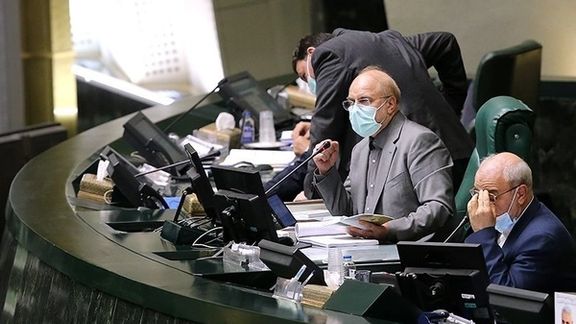
Speaker of Iran's parliament running a session on the budget. February 21, 2022

In a rare glitter of real journalism, news anchor Elmira Sharifi grilled a hardliner lawmaker for his attacks on those who oppose restrictions on social media.

Mehrdad Veis Karami, one of the 18 members of the Iranian parliament (Majles) who support a highly controversial bill to restrict social media access, called opponents "dogs on long leashes." The group of 18 hardliners last week claimed that they had ratified the bill in a committee and that there was no need to put the bill to vote by all the 290 lawmakers.

Later 167 Iranian members of parliament objected to the unlawful act and subsequently the parliament officially annulled the result of the voting. The bill is to be put to vote at the Majles later.

In the meantime, Karami started a campaign on social media against the opponents of the restrictive bill who in fact supported freedom of expression on social media. When critics lashed out at him, he said the "long leash" comment was a quote from a statement made by a former CIA chief. Iranian social media users quickly responded to remind him that no former or current CIA chief had made any such comment and suggested that the hardliner lawmaker do a google search before attributing fake statements to anyone.

Hardliner Iranian lawmaker Mehrdad Veis Karami speaking in parliament. FILE
100%
Hardliner Iranian lawmaker Mehrdad Veis Karami speaking in parliament

In a telephone conversation with Karami on live TV, Ms. Elmira Sharifi questioned Karami's presence on Twitter, which is officially banned in Iran, leaving the hardliner speechless. She further told him that he has insulted millions of opponents of the restrictive bill. The lawmaker slightly changed his complacent tone and said that he was not talking about the nation and that he was criticizing the opponents of the bill at the Majles. But the news anchor did not take that either and accused Karami of insulting nearly 200 of his colleagues at the Majles.

Although Iran's state TV is strictly controlled by the government, still anchors at times criticize some parliament bills before they are approved and become laws. Nonetheless, not every news anchor is brave enough to challenge even low-key politicians such as most members of parliament.

On the other hand, grilling Karami appeared absolutely legitimate, considering that even some clerics had lashed out at him for the controversial comment and his support for a legislation that would restrict people's freedoms and hurt millions who use Western apps, such as Instagram for commerce. In a video posted on Twitter, Iranian cleric Vahid Heroabadi returned the insult to Karami.

Numerous Iranians on social media lashed out at Karami and he had to take back his comment in a series of tweets. Some of the comments about Karami's insulting tweets were made by hardliner users and supporters of the government. As an example, Farid Modarresi said Karami was a mad dog who attacked the people and accused him of making the people angry by spreading irrational statement.

Nonetheless, most of Karami's critics called on him to leave social media platforms that are officially banned in Iran because of restrictions he and his likeminded colleagues have imposed.Thousands of small businesses operate from social media platforms and many Iranians, including the children use social media to voice their ideas or to vent their frustration

Over 220 of Iran's 290 predominantly hardliner lawmakers have their own Twitter accounts and use them for messaging as they are not important enough to be quoted on traditional media outlets.


Most Viewed

Ghalibaf defends Iran-US talks amid hardline backlash
1
INSIGHT

Ghalibaf defends Iran-US talks amid hardline backlash

2
ANALYSIS

From instability to influence: Pakistan’s pivotal role in US-Iran diplomacy

3
VOICES FROM IRAN

Bread shortages, soaring prices strain households in Iran, residents say

4
ANALYSIS

100 days on: why Iran’s January protests spread across social classes

5

War-hit homeowners feel abandoned as Iran’s reconstruction aid fades

Banner
Banner

Spotlight

  • Iran diplomacy wobbles as factions compete to avoid looking soft on US
    INSIGHT

    Iran diplomacy wobbles as factions compete to avoid looking soft on US

  • The politics of pink: how Iran uses cuteness to rebrand violence
    ANALYSIS

    The politics of pink: how Iran uses cuteness to rebrand violence

  • Bread shortages, soaring prices strain households in Iran, residents say
    VOICES FROM IRAN

    Bread shortages, soaring prices strain households in Iran, residents say

  • 100 days on: the anatomy of Iran’s January crackdown
    INSIGHT

    100 days on: the anatomy of Iran’s January crackdown

  • Ghalibaf defends Iran-US talks amid hardline backlash
    INSIGHT

    Ghalibaf defends Iran-US talks amid hardline backlash

  • From instability to influence: Pakistan’s pivotal role in US-Iran diplomacy
    ANALYSIS

    From instability to influence: Pakistan’s pivotal role in US-Iran diplomacy

•
•
•

More Stories

Turkey Seeks Long Jail Terms Over Alleged Plot To Nab Iranian Major

Mar 2, 2022, 21:38 GMT+0

Turkish prosecutors seek a 30-year prison sentence for 11 defendants, including at least one Iranian, charged over an alleged scheme to abduct Mehrdad Abdarbashi, an Iranian military pilot who fled to Turkey rather than serve in Syria.

Turkey's official news agency Anadolu (Anatolia) reported Wednesday that the 30-year term was demanded by the Prosecutor General's Office of Van province. The agency alleged Iranian intelligence had set up a $30,000 network in Van that had attempted three times to take Abdarbashi back to Iran. Anadolu earlier reported that the National Intelligence Organization (MIT) and police had arrested eight people, including an Iranian, in Van, south-east Turkey, September 24.

Speaking to Türkiye newspaper, Abdarbashi, a major and air-force helicopter pilot, said he had fled Iran and sought asylum after refusing to go to Syria. He told the newspaper a female Iranian intelligence agent had invited him to a house. He alerted Turkish authorities, and after she drugged him and others were preparing to abduct him, Turkish agents swooped.

In 2019 a ‘honey-trap’ was allegedly used to lure Ruhollah Zam, who ran a social-media channel on Telegram, to Iraq where he was abducted. Zam was executed in December 2020 after confessions aired on state television.

In February, Turkey arrested eight in an alleged Iranian plot to assassinate Israeli-Turkish businessman Yair Geller in revenge for the killing of nuclear scientist Mohsen Fakhrizadeh in 2020.

Iran Abstains On UN Resolution Deploring Russian Invasion

Mar 2, 2022, 19:48 GMT+0

The Islamic Republic abstained from voting on a UN General Assembly resolution deploring the Russian invasion of Ukraine and urging the immediate withdrawal of the troops.

In an emergency session on Wednesday, the United Nations General Assembly overwhelmingly voted to condemn Russia over its attacks and demanded that Moscow stop fighting.

The resolution "deplores"Russia's "aggression against Ukraine." Although General Assembly resolutions are non-binding, they carry political weight.

Some 141 of the 193 member states voted for the resolution, and 35, including Iran and China, abstained the move aimed at diplomatically isolating Russia at the world body.

Russia itself, North Korea, Syria, Belarus and Eritrea were the only five that voted against the resolution.

A similar resolution was not upheld in the Security Council on Friday because Russia – as one of the five powers with a veto power – vetoed it. Ukraine’s allies referred the matter to the general assembly.

The last time Security Council referred a crisis to the Assembly was in 1982. It is only the 11th time an emergency session of the UN general assembly has been called since 1950.

Iran’s president and other officials have supported Russia’s move by blaming the United States and NATO for provoking the invasion

Iran’s state media and hardliner outlets have avoided using the word ‘invasion,’ while conservative and reformist media have in some instances criticized Russia for the invasion or expressed more nuanced views.

Banks Jittery Over Ties With Russia Following Sanctions Similar To Iran

Mar 2, 2022, 18:01 GMT+0
•
Iran International Newsroom

Fear of uncertainty and possible legal entanglements have made global banks jittery about dealing with Russia, similar to Iran's experience with sanctions.

Faced with an unprecedented level of sanctions on Russia, banks are taking a dim view of business with all Russian entities and dropping clients if there is even a slight doubt on their ties to that country, Reuters quoted bankers and lawyers as saying.

While European and North American governments have introduced serious banking and other business sanctions, countries in Asia and Elsewhere are introducing their own restrictions.

Sanctions experienced by Iran went a bit farther than those announced against Russia, such as cutting off all banks, instead of a select group, and the central bank from the global SWIFT. But the overall psychological and legal impact appear not be too different.

While global banks have extensive experience with sanctions and have invested billions of dollars in compliance programs in recent years, the curbs on Russia are unmatched in their scale, speed and complexity and may yet grow, said executives. Russia was a much larger financial player before the sanctions than Iran ever was.

To avoid falling foul of the rules and having assets and capital ensnared by new curbs, banks are adopting extreme caution in all of their dealings with Russian entities, actions that will likely exacerbate global trade disruptions, said bankers and lawyers.

The United States alone fined banks billions of dollars for breaching its OFAC (Office of Foreign Asset Control) restrictions since 2010. BNP alone was fined $8.9 billion in 2014, while Commerzbank and HSBC were also fined in billion-dollar figures. From 2010-2019, the US took action against 32 banks and all paid penalties.

Many of these cases were related to Iranian sanctions violations, which has made international banks extremely careful in their dealings.

A senior Hong Kong-based Asia trade finance banker with a global lender told Reuters that his compliance colleagues are asking more questions even if a financing deal involves a non-sanctioned Russian entity, directly or indirectly.

The issue is not just current sanctions, but what may still come. "It's not just managing risk from the existing sanctions, but also thinking about what more could possibly happen on that front," an Asian banker told Reuters. "No one would like to sign a billion-dollar trade finance deal only to be told a week later that the entity in Russia has also been added to the sanction list."

There is also the danger of aftereffects even when sanctions are removed. Iran experienced this syndrome when it resolved its nuclear issue with world powers in 2015 and international sanctions were lifted.

From 2016-2018 when most economic sanctions were removed, Iran had a hard time to get major deals and joint ventures. While the country needed tens of billions of dollars in investment, it was able to secure just a few billion dollars.

The fear that a regime is unpredictable and sanctions can be reimposed for new unacceptable actions, will keep the financial sector and corporations away from a country which has emerged from sanctions.

Charlie Steele, partner at Washington-based consultancy Forensic Risk Alliance and a former US Treasury Department sanctions attorney told Reuters, "Banks generally, and certainly the global banks, often tend to be very cautious and conservative with respect to sanctions, especially U.S. sanctions.”

With reporting by Reuters

Iranian Lawmaker Says Tehran's Position Closer To Moscow Over Invasion

Mar 2, 2022, 16:55 GMT+0

A senior Iranian lawmaker says the Islamic Republic’s position is close to that of Moscow on the issue of the Russian invasion of Ukraine.

The spokesman of the parliament's National Security and Foreign Policy Committee, Mahmoud Abbaszadeh-Meshkini, said on Wednesday that NATO has gone far beyond its territory in recent years and has faced a response from Russia.

He described the Russian attack on Ukraine as “a precautionary measure” to push NATO back to its place, noting that NATO did the same to Iran. “To surround us, they occupied Iraq and Afghanistan and imposed war on Syria, and the Islamic Republic helped to prevent larger wars at the request of their governments”, he added.

Abbaszadeh-Meshkini noted that there is a common problem in the world, and that is “the Westerners have expanded their hegemony with the help of NATO and are occupying wherever they want under the name of ‘preventive war’”.

The Islamic Republic has subtly supported Russia since the invasion began by accusing the United States and NATO of provoking the conflict.

Pundits and media in Iran are still heatedly debating the Russian invasion of Ukraine, West's reaction and Iran's official stance of implied support for Russia.

Iran’s state media and hardliner outlets have avoided using the word ‘invasion,’ while conservative and reformist media have in some instances criticized Russia for the invasion or expressed more nuanced views.

Iranians Continue Lively Debate Over Russian Invasion Of Ukraine

Mar 2, 2022, 16:04 GMT+0
•
Maryam Sinaiee

Pundits and media in Iran are still heatedly debating the Russian invasion of Ukraine, West's reaction and Iran's official stance of implied support for Russia.

In a televised speech Tuesday, Iran's Supreme Leader detected a ‘colored coup’ in Ukraine, referring to past United States-backed ‘colored revolutions’ in eastern Europe.

Ali Khamenei said Iran was “in favor of stopping the war,” which he blamed on the United States and Nato, following President Ebrahim Raisi earlier explaining the Ukraine crisis in terms of Nato’s eastern expansion, which has taken in 13 countries since 1999.

Iran’s state media and hardliner outlets have avoided using the word ‘invasion,’ while conservative and reformist media have in some instances criticized Russia for the invasion or expressed more nuanced views.

Kayhan newspaper, the hardliner flagship, has blamed Nato and the US. A note published Wednesday contrasted Iranians who defended their country against the 1980 Iraqi invasion, while Ukrainians did not even "pretend to resist as much as a scarecrow" and fled across the borders.

Kayhan’s statement was labeled as an insult to the Ukrainian people on social media, while the comment obviously contrasts with international admiration for Ukrainian people’s resistance.

The conservative Alef has both censured Russia over the invasion and argued out Nato had set Ukraine up as a victim. Like most other countries in the Middle East, Alef said, Iran should remain neutral and try to contribute to a diplomatic solution.

Destruction of a whole Russian armored column near Kyiv . February 27, 2022
100%
Destruction of a whole Russian armored column near Kyiv on Saturday.

Double standards

Jafar Mohammadi, editor of the conservative Asr-e Iran website, was also nuanced. "Russia's attack on Ukraine is a clear breach of international regulations and a crime against humanity," he wrote Tuesday, while criticizing Nato for failing to stop Russia. Mohammadi also highlighted double standards over Ukrainian refugees compared to Syrians and Afghans, as well as over Israeli occupations and Saudi Arabia bombing cities in Yemen.

"That they have driven the invading Russia to a corner of isolation and sanctions is a very good measure,” Mohammadi wrote. “That's what an aggressor deserves, but they must show the same response to other aggressions, which they don't, and the outcome is an unsafe world in which even the value of children's blood is measured by the color of their eyes.”

Russia appears to see Iran as an ally in the war against Ukraine. The Russian embassy in Tehran Wednesday published on Twitterand Instagram photos from Iran including an Iranian flag with ‘We Support Russia’ in Persian. It claimed these were from a "flash mob of Iranians in support of the Russian army with the sign 'Z'". A few photos published in the tweet do not show a ‘flash mob.”

Blind enmity

In February, some Iranians expressed anger on social media when the Russian embassy honored Alexander Griboyedov – ambassador, promising writer and friend of Aleksandr Pushkin – who along with all the Russian embassy staff was murdered by a Tehran mob in 1829.

Hundreds of Iranians on social media have been expressing anger at the invasion in the past six days and criticizing the government’s position. Some are attacking Supreme Leader Ali Khamenei, calling him a lackey of Russia.

Reformist commentator Sadegh Zibakalam suggested phobia towards the West and "blind ideological enmity" had prevented Iranian officials from having a realistic understanding of developments such as the Ukraine crisis.

For Zibakalam, this explained notions that Ukraine had been “deceived by the West” or that “Western [powers] are responsible for the war because they wanted to expand Nato towards Russia." Zibakalam took it upon himself Tuesday to apologize to Ukrainians for the Iranian government's stance.





