• العربية
  • فارسی
Brand
  • Iran Insight
  • Politics
  • Economy
  • Analysis
  • Special Report
  • Opinion
  • Podcast
  • Iran Insight
  • Politics
  • Economy
  • Analysis
  • Special Report
  • Opinion
  • Podcast
  • Theme
  • Language
    • العربية
    • فارسی
  • Iran Insight
  • Politics
  • Economy
  • Analysis
  • Special Report
  • Opinion
  • Podcast
All rights reserved for Volant Media UK Limited
volant media logo

Ukraine Crisis Casts Hazy Shadow On Iran Nuclear Talks
Mar 1, 2022, 18:09 GMT+0Updated: 16:36 GMT+0
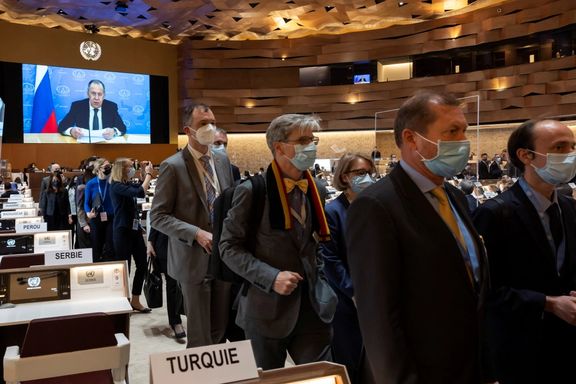
Diplomats walk out of UN human rights meeting in Geneva as as a taped message from the Russian foreign minister begins playing. March 1, 2022

Separating non-proliferation from other issues has been a core assumption for 11 months of talks in Vienna aimed at reviving the 2015 Iranian nuclear deal.

That may be changing. The crisis in Ukraine threatens to impinge on negotiations between Tehran and six world powers – China, France, Germany, Russia, the United Kingdom, and the United States. Exactly how, diplomats are unsure.

Since the Biden administration took office in January 2021, Washington has eased closer to the western European trio (the ‘E3’), while taking part at Vienna only indirectly as the US maintains ‘maximum pressure’ sanctions introduced by President Donald Trump in 2018 on withdrawing from the 2015 deal, the JCPOA (Joint Comprehensive Plan of Action).

There is no obvious fall-out from the Ukraine crisis on the Vienna talks. Mikhail Ulyanov, Russia’s lead negotiator, has continued his generally optimistic videos and pictures on Twitter showing his meetings with the US and the E3.

But there is a general wariness. "There's a good chance that a crisis of this magnitude will pollute not only the Iranian file, but many others," a French presidential official told Reuters."This is one of the many subjects on which the relationship with Russia is very severely, very significantly changed by the behaviour of President Vladimir Putin."

Iran’s Supreme Leader Ali Khamenei Tuesday, in a televised speech, said Ukraine was “another victim” as the “US regime creates crises, lives off of crises and feeds on various crises in the world.” Khamenei emphasised that the “US and western powers could not be trusted.”

Trust, guarantees, interests

One of the biggest challenges in the Vienna talks, which those involved have generally said are nearing their end, is Iran’s search for guarantees, both that the US will not again renege on the JCPOA and that neither the US nor the European powers will restrict Iran’s access to world markets. The US ‘maximum pressure’ sanctions threaten punitive action against third parties buying Iran’s oil or dealing with its financial sector.

Three diplomats close to the talks told Reuters that developments in Ukraine had heightened a sense of urgency in Vienna, to the point that agreement on restoring the JCPOA needed to be reached this week before the atmosphere soured. A senior US State Department official said Friday that Washington still thought Moscow wanted to negotiate JCPOA revival, which the official called a “common interest” of the US and Russia.

But there has also been speculation that Iran might feel its position strengthened by a desire in Washington to avoid a second crisis and to see Iranian oil returning to world markets, given the Ukraine conflict has sent oil above $100 a barrel.

Sanctions

Another complication lies is that Russia, with a renewed JCPOA, would be expected, as in the past, to ship out stocks of Iranian enriched uranium. Tehran now has around 12 times the 208kg limitset by the JCPOA. While US and western European sanctions on Russia remain limited, and far less than sanctions on Iran or Afghanistan, they might increase if the crisis in Ukraine continues.

In the Financial Times Tuesday, Alistair Milne, professor of financial economics at Loughborough university, wrote that the experience of Iran showed that the “curious narrative” of barring Russia from the international Swift bank-messaging system would not lead to “cutting Russian money out of global finance” – and that broader measures, similar to those used against Iran since 2004, would be needed.


Most Viewed

Ghalibaf defends Iran-US talks amid hardline backlash
1
INSIGHT

Ghalibaf defends Iran-US talks amid hardline backlash

2
VOICES FROM IRAN

Bread shortages, soaring prices strain households in Iran, residents say

3
ANALYSIS

From instability to influence: Pakistan’s pivotal role in US-Iran diplomacy

4
ANALYSIS

The politics of pink: how Iran uses cuteness to rebrand violence

5
ANALYSIS

100 days on: why Iran’s January protests spread across social classes

Banner
Banner

Spotlight

  • Is Iran entering its Gorbachev moment?
    INSIGHT

    Is Iran entering its Gorbachev moment?

  • Iran crackdown reaches cemeteries as graves of slain protesters defaced
    EXCLUSIVE

    Iran crackdown reaches cemeteries as graves of slain protesters defaced

  • Iran diplomacy wobbles as factions compete to avoid looking soft on US
    INSIGHT

    Iran diplomacy wobbles as factions compete to avoid looking soft on US

  • The politics of pink: how Iran uses cuteness to rebrand violence
    ANALYSIS

    The politics of pink: how Iran uses cuteness to rebrand violence

  • Bread shortages, soaring prices strain households in Iran, residents say
    VOICES FROM IRAN

    Bread shortages, soaring prices strain households in Iran, residents say

  • Ghalibaf defends Iran-US talks amid hardline backlash
    INSIGHT

    Ghalibaf defends Iran-US talks amid hardline backlash

•
•
•

More Stories

IRGC-Linked Newspaper Slams Iranians Supporting Ukraine

Mar 1, 2022, 11:45 GMT+0

Javan newspaper, linked to Iran’s Revolutionary Guard, has criticized the support voiced for Ukrain by many ordinary Iranians and activists on social media.

The daily said in its Monday issue that those who portrayed the Iranian government as a proponent of the Russian invasion are "Western puppets" and “extremist reformists".

The article added that they are more concerned about the fall of the US-backed government in Ukraine than the lives of the Ukrainian people.

It also described the crisis in Ukraine the result of NATO's eastward expansion that stem from “US and European sedition”.

The IRGC-linked paper called President Volodymyr Zelenskyy “a comedian and actor” who plugged his country to the abyss of a devastating war.

Many Iranians on social media have praised Zelensky, who has refused to leave Kiev in order to stiffen resistance, with some comparing him to former Afghan President Ashraf Ghani who fled the country as the US-trained army collapsed last summer when the Taliban advanced.

The debate about Russia’s invasion of Ukraine continues in Iran, with divisions reflecting wider disagreements among various factions over foreign policy. While reformists have been more critical of Russia, and social media has aired decidedly anti-Russian sentiments, hardliner media has sided with Russia.

Many ordinary Iranians invariably support Ukraine and condemn the government pro-Russia policies.

Iran's Khamenei Omits Russia's Invasion In Speech, Blames US For Crisis

Mar 1, 2022, 10:15 GMT+0

Iran's Supreme Leader on Tuesday said Iran is against war in Ukraine but held the US responsible for disrupting its stability and "creating a colored coup".

Reiterating that the US and Western countries cannot be trusted, Supreme Leader Ali Khamenei said Ukraine has fallen victim to US policies and the crises created by Washington without mentioning Russia's invasion in his speech.

He added that Iran opposes the killing of people and the destruction of the infrastructures belonging to other nations and added that Iran wants the war in Ukraine to end. "But resolving any crisis is only possible if its root causes are identified. The Ukrainian crisis is rooted in American policies, Western policies".

“The US disrupted the stability of the country by interfering in its affairs and organizing rallies and creating a colored coup,” he said, possible referring to the revolution in 2014 that toppled Ukraine’s former president Viktor Yanukovych. In a televised speech Khamenei claimed that people in Ukraine "did not enter the scene [to defend their country] because they did not recognize [the legitimacy of] their government."

Khamenei’s distortion of the facts on the ground were obvious. The world has been in awe as Ukrainians of all walks of life have joined volunteer forces to fight against Russia’s invading forces.

After widespread protests following the disputed re-election in 2009 of ultra-conservative Mahmoud Ahmadinejad, Khamenei blamed Western powers, particularly Britain, for instigating "sedition" in Iran. The protests became known as the ‘Green Movement’.

"What they did in 2009 was a new initiative which was Americans' initiative…It was a color revolution, actually a color coup, an unsuccessful color coup," he said in a speech on January 9, 2016. "The coup was an attempt to incite a full-scale civil war in Iran [to pave the way] for foreign domination."

Calling the governments of President Volodymyr Zelenskyy and former Afghan president Ashraf Ghani "puppet regimes", he said they had both confessed that the US had abandoned them when crises arose at home.

Zelenskyy’s Twitter account has jumped to nearly four million followers in recent days and his determination to resist the invasion has changed long-held European policies of low defense spending and transfer of weapons.

In the speech that marked Eid al-Mab’ath – the anniversary of the Prophet Mohammad's announcement of his prophethood, Khamenei drew a parallel between the early Islamic history and current times and said the US is a perfect example and manifestation of modern "ignorance", as were the opponents of the Prophet in his time.

In the past few days, Iranian officials including President Ebrahim Raisi and Foreign Minister Hossein Amir-Abdollahian, also attributed the crisis in Ukraine to NATO and American “provocations".

Raisi also held a phone call with the Russian President Vladimir Putin on the first day of the Russian invasion. "The President of Iran expressed understanding with respect to Russia’s security concerns caused by the destabilizing actions of the United States and NATO," a Kremlin press release said Thursday evening.

Many Iranians and media outlets have a different view. "Contrary to the government's stance, the hearts of many Iranians are with the people of Ukraine and they condemn this aggression,” reformist commentator Sadegh Zibakalam tweeted February 26.

Some Iranian journalists and media have criticized Raisi's call. "What is the justification for Raisi's call to Putin on the first night of Russia's invasion of Ukraine and subtly supporting Russia?" Behrouz Azizi, an Iranian journalist who identifies himself a "moderate conservative", tweeted Thursday.

US Says It Would Walk Away From Talks If Iran Displays Intransigence

Feb 28, 2022, 20:38 GMT+0

Washington is prepared to walk away from nuclear negotiations in Vienna if Iran displays intransigence, State Department spokesperson Ned Price said on Monday.

“We are prepared to walk away if Iran displays an intransigence to making progress," Price told reporters at a regular press briefing of the indirect talks taking place in Vienna.

The United States and its allies and partners will pursue "alternatives" if Iran is "unwilling to engage in good faith," he added, without detailing those alternatives.

Reuters on Monday quoted two sources close to the talks in Vienna as saying that Iran had submitted new demands, while continuing to insist on existing ones, including the removal of a US foreign terrorist organization (FTO) designation against Iran's Revolutionary Guards (IRGC).

"Iran's stance after Bagheri's trip to Tehran has become even more uncompromising .... they now insist on removal of sanctions on the IRGC and want to open issues that had already been agreed," one of the sources said.

Tehran has been demanding the lifting of more sanctions than the US is willing to accept, including removing its Revolutionary Guard from the list of Foreign Terrorist Organizations. It also demands firm guarantees that in the future the US will not act contrary to the agreement.

Russia Says Intensive Work Ahead To Wrap Up Iran Nuclear Talks

Feb 28, 2022, 19:53 GMT+0

Russia’s top negotiator in Iran nuclear talks says intensive work is ahead and a last effort is needed to wrap up the negotiations to revive the 2015 agreement.

Mikhail Ulyanov twitted photos of the Monday evening meeting with JCPOA participants in Palais Coburg, saying, “Tremendous progress has been made since April 2021, when the talks started. But there is a rule: nothing is agreed until everything is agreed.”

He also tweeted about his meeting with chief Iranian negotiator Ali Bagheri-Kani saying that “intensive work is ahead of us to wrap up the negotiations on restoration of the JCPOA”.

Bagheri Kani returned to Vienna on late Sunday to continue the eighth round of talks with representatives of the five remaining parties of the JCPOA to resolve the remaining issues.

The Iranian diplomat, who had gone to Tehran last week to hold consultations and receive necessary directives, flew back from the capital as some Basij hardliners gathered at the airport to protest against the agreement.

They held placards with sentences echoing remarks by Supreme Leader Ali Khamenei and chanted “Death to the America.”

Iran's foreign ministry said on Monday that "97-98 percent" of a draft agreement is ready but three key issues remain that the West has not agreed with.

Debate Continues In Tehran If Ukraine Crisis Helps Iran In Nuclear Talks

Feb 28, 2022, 18:09 GMT+0
•
Iran International Newsroom

Media in Iran are hotly debating whether the Ukraine crisis will help Iran in its nuclear talks in Vienna or altogether lead to the failure of the negotiations.

Some commentators see benefits for the Islamic Republic as world powers are entangled in the biggest international confrontation since the 1960s Cuban Missiles crisis.

International relations analyst Mohammad Javad Jamali Nobandegani told Nameh News in Tehran, "We do not support the war, but problems created for some of the negotiators in Vienna could turn out to be in Iran's interest." He added that Russia as a country under sanctions could help Iran against “a common enemy."

He argued the West's inability to support Ukraine, might lead to a change of approach among Iran's neighbors who usually rely on the United States in their confrontation with Tehran.

This could have been a reference to the United Arab Emirates and other regional countries with good ties with Washington.

Former lawmaker Heshmatollah Falahatpisheh, on the other hand belives that the invasion of Ukraine has revealed Russia's weakness and that it is time for Iran to engage in direct talks with the United States and get rid of Russia as a mediator who is normally motivated by its own interest as Iran's rival in the global oil and gas market.

Iranian state TV commentator Jafar Ghannadbashi agreed with Falahatpisheh and said in an interview with Farda News that the situation is ripe for Iran to get concessions from the West. He said Russia's problems in Ukraine can affect Iran's nuclear talks although the extent of the impact of the Ukraine crisis on the nuclear talks depends on many factors.Ghannadbashi added that some analysts have exaggerated the impact of the Ukrainian crisis on the fate of the nuclear talks.

As a result of this crisis, Europe and America on the one hand, and Russia on the other, wish to garner support for their positions. This situation prompts both to offer concessions and this could end up in Iran’s interest, he said, adding that confrontations between big powers, which is reminiscent of the Cold War, can always serve the interests of countries like Iran.

Meanwhile, International relations expert and former diplomat Jalal Sadatian told Nameh News that there is no direct link between the war in Ukraine and the nuclear negotiations in Vienna. He said Iran might change its positions based on new developments but aggression against another country is absolutely not acceptable.

No politician in Iran has taken a tough stance in condemnation of Russia's aggression. This behavior has been criticized by some experts. However, those who support Russia's position expect Moscow to influence the negotiations in Vienna, Sadatian said.

However, he insisted that Iran should not act based on its ties with Russia and should condemn the war. "There is no justification for aggression against another country.

Meanwhile, he ruled out the hypotheses about the West and particularly the United States are tied up with the Ukraine crisis and will possibly cave in to Iran’s demands.

However, Sadatian agreed that the crisis in Ukraine could indirectly affect Iran. "For instance, now that we can sell more oil, the rise in the price of oil is in our interest. But this should not mislead us to believe that Russia, China, the European troika and the United States will forget about Iran's ambitions. I believe that is a simplistic analysis," Sadatian, a former adviser to former President Akbar Hashemi Rafsanjani, said.