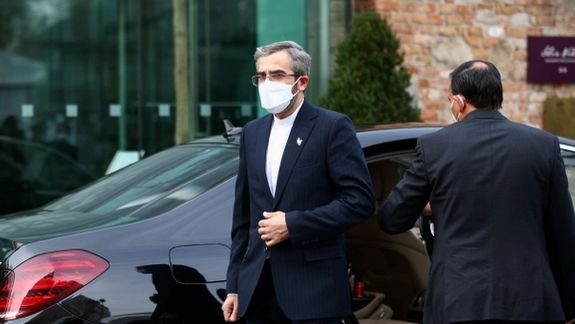
Ali Bagheri-Kani arriving to start nuclear talks in Vienna on November 29, 2021
Iran's top nuclear negotiator Ali Bagheri-Kani, who returned to Tehran Wednesday, is returning to Vienna Sunday evening to resume talks, local media reported.
Bagheri-Kani will leave for Vienna with a "clear working plan" to resolve the remaining issues and "significant challenges", Nour News which is affiliated with the secretary of Iran's Supreme National Security Council (SNSC), Ali Shamkhani, said Sunday in an "exclusive report".
Nour News said the talks have reached an "agreement or dead-end borderline". "Continuation of the Western sides' unacceptable approach to resolving the remaining issues has unnecessarily dragged the talks and brought about unpredictable circumstances," it said.
Reports received by Iran International on Saturday spoke of a “an immediate deadline” imposed by Washington for receiving a clear answer from Tehran on a draft agreement.
Iran insists on the removal of more sanctions that the United States is willing to lift, verification of sanctions removal, and presentation of “absolutely necessary objective guarantees for the fulfilment of commitments,” Foreign Minister Hossein Amir-Abdollahian said in an address at the Munich Security Conference on February 19.
Some pundits say the Ukraine crisis may delay an agreement on the restoration of the JCPOA, particularly because there has yet been no concrete agreement on exactly which sanctions are to be lifted, the timeframe for the lifting of sanctions and verification, the guarantee that Iran insists on, and the fate of Iran's advanced IR-6 centrifuges.
Iran standing firm on its deamnds
Nour News added that an SNSC meeting last night, which was also attended by members of the negotiation team and Parliament Speaker Mohammad-Bagher Ghalibaf, has decided that the acceptance of a deal would depend on a decision on these issues.
This means there is no real change in Iran’s position as Bagheri-Kani returns to Vienna. The Biden Administration must decide to continue talks or resort to another strategy as it has said before. So far, the administration seems willing to continue engagement, even with Russia as an active participants in the talks.
Amir-Abdollahian in a tweet Saturday said he had held a phone talk with the EU foreign policy chief Joseph Borrel and that Bagheri-Kani had also been in contact with Enrique Mora, European Union's lead negotiator on Iran's nuclear issue. "Our red lines are made clear to western parties. Ready to immediately conclude a good deal, should they show real will," he wrote.
Deputy Speaker of the Parliament, Abdolreza Mesri, on Sunday said the National Security and Foreign Policy Committee is going to hold an extraordinary session with Amir-Abdollahian Tuesday on the latest developments in Vienna. The parliament held a closed session Sunday morning during which, according to Tasnim News Agency, Ghalibaf offered a report on the current situation of the talks.
Last week over 250 of the 290 lawmakers of the Iranian parliament in a letter to President Ebrahim Raisi demanded that all sanctions, including those related to terrorism, missile development and human rights and those imposed by the Iran Sanctions Act (ISA), the Countering America's Adversaries Through Sanctions Act (CAATSA), and CAATSA U-Turn, should be lifted.
Morteza Mahmoudvand, a member of the National Security and Foreign Policy Committee on Sunday said news from agreements made in Vienna were worrying and the government should be held to account if it failed to comply with the parliament's controversial legislation of December 2020.
The legislation which the administration of President Hassan Rouhani said unnecessarily escalated the nuclear standoff with the West obliged the government to start 20 percent uranium enrichment, in breach of the JCPOA) and to halt Iran's voluntary implementation of the Additional Protocol of the Non-Proliferation Treaty (NPT).
Iran's Supreme Leader Ali Khamenei speaking as President Ebrahim Raisi looks on. August 2021
Meetings convened in Iran to come up with a response to Western proposals on a nuclear deal have ended without results, Iran International has learned.
Other information points to a deadline set by the United States, which the hardliner Iranian news website Mehr in Tehran has quickly denied.
Western diplomatic sources and sources in Iran have told Iran International TV correspondents that if remaining issues in the talks are not resolved in the next few days and an agreement not reached, the Joint Comprehensive Plan of Action, JCPOA, will be deemed “dead.”
On the other hand, information obtained shows that meetings in Tehran after the return of chief nuclear negotiator Ali Bagheri-Kani have ended inconclusively.
Sources in Iran’s foreign ministry have told Iran International that Washington had presented “an immediate” deadline to Iran for proposals for reviving the 2015 agreement submitted by “the West” – possibly meaning the US and the three western European signatories France, Germany, and the United Kingdom.
These foreign ministry sources said that in one meeting, the Supreme National Security Council Friday, in the presence of Ali Khamenei, the supreme leader, did not reach consensus and took no decision over “a draft agreement presented in Vienna.” It was not clear which of the world powers in the Vienna talks, which include Russia and China, had endorsed the “draft agreement.”
The United States and its three European partners, the United Kingdom, France and Germany have not accepted Iran’s demand to provide guarantees regarding the permanent nature of the agreement and demands of economic nature Supreme Leader Khamenei has been insisting on.
One of the challenges in the talks has been Iran’s request for guarantees that the US would not again leave the JCPOA, and that Iran, as under JCPOA terms, would not be impeded in its economic relations internationally. The official news agency IRNA on Saturday once again highlighted this issue of guarantees.
The Biden Administration has said that constitutionally it cannot provide guarantees that the US would not leave the JCPOA. Neither the 2015 deal, nor the 2018 withdrawal, nor the many sanctions introduced by President Trump as executive orders after 2018, went to Congress for approval.
Iran International’s information indicates that Iran is insisting on the lifting of “all US sanctions” and “the closure of a pending case at the International Atomic Energy Agency” regarding alleged clandestine nuclear activities before 2003, when Iran reportedly imported machinery from the network of Pakistani scientist AQ Khan.
The US and its three European allies have been warning for months that time to reach an agreement in Vienna is limited and Iran must make a decision.
Tehran has been enriching uranium up to 60 percent since early 2021 and stockpiling fissile material. The West and other countries are concerned that this is taking the Islamic Republic closer to nuclear weapons or at least brings it to point of a nuclear threshold state.
A senior US State Department official on Friday told reporters that “significant progress” has been made in the past week or so, but “serious issues remain” unresolved.
It is not clear what impact the Russian invasion of Ukraine would have on the Vienna process, as Moscow has been playing an active role in the talks. The unprecedented crisis in the international order triggered by Russia’s actions could convince Iran to make a deal with the West or equally it could convince Tehran to insist on its demands, waiting to see how the unfolding events
Iran nuclear talks resumes after a five-month break. November 29, 2021
Nuclear talks with Iran have made significant progress in the last week or so, but very tough issues remain, a senior US State Department official said Friday.
The US official, quoted by Reuters, said he hoped Iran's lead negotiator would return in the coming days to Vienna, where the talks are taking place, "with a positive view" but that even if he did, there were still difficult issues on the table.
"There's been significant progress over the last week or two," the US official told reporters on condition that he not be named. "But at the same time, it's important to note that very serious issues remain."
Iran’s official news website IRNA on Saturday drew attention to the “serious issues”in an unsigned article. While it said that no one is privy to the details of disagreements between Washington and Tehran, it is clear what Iran does NOT want.
IRNA elaborated that Tehran does not want a JCPOA+ type of a new agreement or any temporary deal.
A report by Reuters earlier this month said that a draft agreement is being shaped which points toward a step-by-step or sequenced approach starting with the release of some of Iran’s frozen funds in exchange for a five-percent cap on uranium enrichment by Iran. In the following weeks and months, the two sides take more steps to get closer to a final restoration of the JCPOA.
While the Western side in the Vienna talks did not deny the Reuters report, Iran rejected it as fakeWestern disinformation to influence the talks. IRNA’s reference to a “temporary deal” might be about a sequenced deal, which does not lift US sanctions in one step.
IRNA also said Iran does not want “implicit promises” and “verbal guarantees” in the negotiations, adding that mentioning what Tehran does not want, can shed light on the situation of the talks in Vienna.
This refers to Iran’s position since at least November insisting it wants an iron-clad guarantee by the United States that it would never renege on a new agreement, pointing to former president Donald Trump’s decision in 2018 to withdraw from the JCPOA. The Biden Administration in response has said that it cannot constitutionally provide such a guarantee. A future US president can make his own decisions if the agreement is not a treaty ratified by the Senate.
The US official talking with media on Friday said a deal, if one can be reached, would in many ways track the terms of the original accord on Iran's levels of uranium enrichment, the stockpile of enriched uranium it may hold, and the numbers of centrifuges it may operate.
However, he left open the possibility of some modifications to account the additional sanctions that president Trump imposed on Iran in 2018 and the nuclear advances that Iran has since made.
"We hope that when Iran comes back, it comes back in with a pre-disposition to try to resolve this quickly," the official said, saying there were still disagreements "for which there is not a solution that's on the table."
He also declined to name the sticking points, as did IRNA, and would not be drawn into whether Washington had persuaded Tehran to agree to follow-on negotiations on its nuclear program, its development of ballistic missiles or support for regional proxies.
He also said there has not been any deal reached in separate negotiations about the release of four U.S. citizens whom the United States believes have been wrongfully detained by Iran.
A rally in New York City to support Ukraine. February 24, 2022
One day after the invasion of Ukraine began the United States announced that it will continue to work with Russia on reviving the 2015 Iran nuclear agreement.
Washington will continue to engage with Moscow over efforts to prevent Iran from developing nuclear weapons, even though Moscow's invasion of Ukraine had made it a "pariah on the world stage," State Department spokesperson Ned Price said on Friday.
Price said US officials would now only engage with Russia counterparts on issues of "fundamental to our national security interest."
Some have expressed reservations about continuing to involve Russia in high-stakes diplomatic and security issues, while Moscow has up-ended the international security structures by its attack on Ukraine with the declared aim of replacing its elected government and deciding its foreign policy course.
Many in Iran are criticizing their government for having given Russia control over the nuclear talks. Moscow has increasingly acted as a mediator between Tehran and Washington, while critics in Iran say its intentions cannot be trusted.
"The fact that Russia has now invaded Ukraine should not give Iran the green light to develop a nuclear weapon," Price added.
Iran’s chief negotiator left the negotiations just days before the invasion and returned to Tehran ostensibly for consultations.
Another US official was quoted by Reuters as saying that significant progress has been made in the talks but serious issues remain to be resolved.
Iran will continue to enrich uranium to 20% purity even after sanctions are lifted and the 2015 nuclear deal is revived, the country's nuclear chief said Friday.
"(Uranium) enrichment ... continues with a maximum ceiling of 60%, which led Westerners to rush to negotiations, and it will continue with the lifting of sanctions by both 20% and 5%," the head of Iran's Atomic Energy Organization, Mohammad Eslami, was quoted by the semi-official news agency Fars as saying.
The 2015 deal, known as JCPOA, restricts the purity to which Iran can enrich uranium to 3.67%, far below the roughly 90% that is weapons-grade or the 20% Iran reached before the deal. Iran is now enriching to various levels, the highest being around 60%.
Iran began exceeding the JCPOA enrichment limit up to 20 percent purity after the United States withdrew from the agreement in 2018 and imposed sanctions on Tehran.
After US elections in 2020, Iran raised the enrichment level to 60 percent, once the US signaled it was ready to start negotiations to return to the JCPOA.
Reuters reported last week that a draft agreement partially ready after more than 10 months of talks in Vienna stipulates that Iran will return to 5 percent enrichment and the US would start loosening sanctions.
Ukrainian forces guarding a position near Kharkiv. February 24, 2022
A prominent Iranian politician has expressed cautious optimism that the Russian invasion of Ukraine might speed up a nuclear deal between Tehran and Washington.
Negotiations between Iran and world powers to revive the 2015 nuclear deal, known as JCPOA have unofficially paused in Vienna as Iranian envoy Ali Bagheri-Kani returned to Tehran earlier this week ostensibly for consultations.
Former chairman of Iranian parliament’s national security committee, Heshmatollah Falahatpisheh told Aftab News in Tehran on Friday that “the JCPOA became a victim of the war in Ukraine.” He added, “Although I am pessimistic about the long shadow of the war on JCPOA talks, but I still believe that Putin’s attack on Ukraine might lead to a willingness in the West to bring talks with Iran to a conclusion.”
Falahatpisheh noted two possible reasons for his belief that the Ukraine war might speed up an agreement in Vienna. He argued that the United States and its European allies do not want to see Iran fall further into the Russian orbit. Second, they want to end Russia’s influence in the talks.
Falahatpisheh speaking in parliament when he was a senior lawmaker. Undated
Indeed, Moscow’s chief negotiator Mikhail Ulyanov has assumed an increasingly prominent role in the talks since November, when Iran’s new delegation headed by hardliners resumed the talks in Vienna.
Many in Iranian media have questioned his role as an active mediator, showcasing his photos sitting alone with US chief envoy Robert Malley in hotel conference rooms on several occasions. Even in Tehran’s press controlled by the government, many questioned why Iran does not directly negotiate with the Biden Administration instead of allowing Russia to act as a broker.
In the same vein, some might wonder if Bagheri-Kani’s sudden return to Tehran a few days ago might not have been related to Russia’s impending attack on Ukraine.
There are some questions about what path Tehran will choose after the unmistakable jolt to international relations by Putin’s invasion.
Tehran might now calculate that it does not need an agreement with the West as long as it is able to break US sanctions and export oil, given the global need for fossil fuels amid heavy sanctions on Russia. Shipments have already reached above one million barrels a day, mainly to China. In the meantime, it can continue its uranium enrichment, become a nuclear threshold state, and have more leverage in any future talks.
The wreckage of an unidentified plane in a residential area in Kiev. February 25, 2022
The opposite is also possible, though less likely. Tehran might see Russia as isolated and not useful any longer as a diplomatic backer. It might decide to make concessions to the West now, rather than live with US sanctions, amid an environment of Western unity reminiscent of the Cold War.
But remaining a Russian ally in these circumstances might offer Iran even some military cover and weapons systems, as some sort of a ‘Cold War satellite’ for Moscow.
Falahatpisheh in his interview argued that he has repeatedly expressed his preference for a quick agreement before an external factor derails the nuclear talks. Russia is bound to use every card in its pocket now, including the Iran nuclear issue, he said.
The former senior lawmaker even went as far as indirectly hinting that Moscow has already used its influence in the Vienna talks to detriment of Iran. “Russia knew very well that in case of an agreement in Vienna and the lifting of sanctions, Iran could boost its potential for oil and gas exports to Europe and elsewhere in a short period of time and tried to control the Vienna negotiations.” He added, “If Iran had reached an agreement, now it could sell its oil at above $100 a barrel and regain its global market share.”
Falhatpisheh expressed deep regret that President Ebrahim Raisi and chief negotiator Bagheri-Kani “relinquished the management of the talks to the Russians, paving the way for a suitable environment for the Kremlin to pursue its interests”.