• العربية
  • فارسی
Brand
  • Iran Insight
  • Politics
  • Economy
  • Analysis
  • Special Report
  • Opinion
  • Podcast
  • Iran Insight
  • Politics
  • Economy
  • Analysis
  • Special Report
  • Opinion
  • Podcast
  • Theme
  • Language
    • العربية
    • فارسی
  • Iran Insight
  • Politics
  • Economy
  • Analysis
  • Special Report
  • Opinion
  • Podcast
All rights reserved for Volant Media UK Limited
volant media logo

Israeli Strikes Cause Casualties Among Iran-Backed Forces In Syria
Feb 24, 2022, 10:58 GMT+0
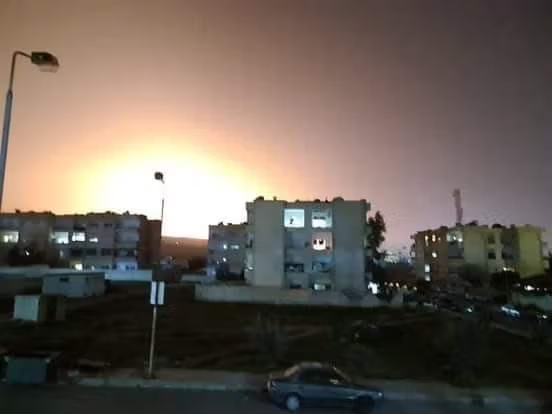
An Israeli air raid on targets in Syria in February 2021

Syria says Israel launched several missiles from the Golan Heights at targets around Damascus, causing several casualties and material damage.

According to the Syrian Observatory of Human Rights (SOHR), a war monitor, the attacks in the early hours of Thursday, targeted posts and weapons warehouses of Iran-backed militias in the vicinity of Damascus international airport.

There were also reports of missile attacks in areas around the border province of Quneitra on Wednesday, where Israel allegedly fired surface-to-surface missiles, causing material damage to an observation post and a building.

Iran International reported earlier this month that Iran-backed militias are setting up settlement along the Israeli border, to be used for attacks against Israel.

Some other missiles targeted the air-defense system in areas along Al-Keswah and Al-Syidah Zaynab districts in south of Damascus. The official Syrian Arab News Agency (SANA) said several explosions were seen over the skies of the capital and its outskirts as Syria’s air defenses intercepted some of the strikes.

Syria’s state media said three people were killed in the attacks while SOHR put the number of casualties at six, saying the attacks killed two members of the Syrian forces and four members of Iran-backed militias, whose nationalities remain unknown.

In a rare statement earlier in February, the Israeli army acknowledged attacks inside Syria, saying it struck Syrian facilities used in targeting Israeli aircraft, including a radar and anti-aircraft batteries.

Israel has launched hundreds of strikes on targets inside government-controlled parts of Syria mostly since 2017, but it rarely acknowledges or discusses such operations.

Most Viewed

Ideology may be fading in Iran, but not in Kashmir's ‘Mini Iran'
1
INSIGHT

Ideology may be fading in Iran, but not in Kashmir's ‘Mini Iran'

2
INSIGHT

Hardliners push Hormuz ‘red line’ as US blockade tests Iran’s leverage

3
VOICES FROM IRAN

Hope and anger in Iran as fragile ceasefire persists

4

Iran International says it won’t be silenced after London arson attack

5

US sanctions oil network tied to Iranian tycoon Shamkhani

Banner
Banner

Spotlight

  • Hardliners push Hormuz ‘red line’ as US blockade tests Iran’s leverage
    INSIGHT

    Hardliners push Hormuz ‘red line’ as US blockade tests Iran’s leverage

  • Ideology may be fading in Iran, but not in Kashmir's ‘Mini Iran'
    INSIGHT

    Ideology may be fading in Iran, but not in Kashmir's ‘Mini Iran'

  • War damage amounts to $3,000 per Iranian, with blockade set to add to losses
    INSIGHT

    War damage amounts to $3,000 per Iranian, with blockade set to add to losses

  • Why the $100 billion Hormuz toll revenue is a myth
    ANALYSIS

    Why the $100 billion Hormuz toll revenue is a myth

  • US blockade targets Iran oil boom amid regional disruption
    ANALYSIS

    US blockade targets Iran oil boom amid regional disruption

  • Iran's digital economy battered by prolonged blackout
    INSIGHT

    Iran's digital economy battered by prolonged blackout

•
•
•

More Stories

US Sanctions Houthi Financing Network Run By Iran Guards

Feb 23, 2022, 22:21 GMT+0

The United States Wednesday sanctioned an international network run by Iran’s Revolutionary Guard and a Houthi financier providing tens of millions of dollars to Yemen’s Houthi rebels.

The complex web of individuals and front companies shipped fuel, other petroleum products and commodities throughout the Middle East, Africa and Asia, with the proceeds financing Houthi attacks in Yemen and on its neighbors, a Treasury statement said.

The action freezes any assets of the designated entities and individuals that are subject to US jurisdiction and generally bars Americans from doing business with them.

The US closely coordinated the designations with its Gulf partners, Secretary of State Antony Blinken said in a statement. He urged the Houthis to "end their campaign of violence" and renew peace talks.

The new designations come as the United Arab Emirates, Saudi Arabia and some American lawmakers press the White House to return the Houthi movement to the US list of foreign terrorist groups in response to recent Houthi drone and missile strikes on the UAE and Saudi Arabia.

Republican former President Donald Trump placed the Houthis on the list 10 days before leaving office, triggering financial sanctions. Democratic President Joe Biden reversed the move, a year ago.

The individuals and firms targeted on Wednesday are part of a network overseen by the Qods Force, the elite arm of Iran's Islamic Revolutionary Guard Corps, and Said al Jamal, a Houthi financier sanctioned last year, the Treasury said.

Latest Covid Figures Show Omicron’s Spread In Iran

Feb 23, 2022, 17:22 GMT+0

Iran is enduring its sixth wave of infections by the Covid-19 as the daily death roll reached 227 on Wednesday, with 70 in Tehran.

The health ministry out the total number of people infected with the coronavirus since the outbreak of the pandemic at nearly 7 million: 15,340 had tested positive in the past 24 hours, with 2,333 in hospital.

Tehran constitutes 10 percent of Iran’s population and if the capital had 70 Covid deaths in one day, the nationwide toll could have been higher than the 227 figure the government announced on Wednesday.

Iran has the Middle East’s highest official figures for Covid fatalities with around 135,500 deaths in an 85 million population with 67 percent fully vaccinated. Egypt, with 29 percent of its 104-million population fully vaccinated, has reported just under 29.000 deaths.

Iran’s statistics, announced daily by the health ministry, have been questioned by – among others – the principlist newspaper Javan and BBC Persian. While health authorities have warned the figures are likely to increase over the next two months with the onset of the Omicron variant, President Ebrahim Raisi has rejected proposals for a nationwide shutdown.

This week, Iran returned about 820,000 doses of AstraZeneca vaccines donated by Poland, with a media report alleging they had been made in the United States.

Tehran’s Embassy In Kiev Asks Iranian Nationals To Leave Ukraine

Feb 23, 2022, 16:55 GMT+0

The Islamic Republic has called on Iranian nationals livening in Ukraine, especially students, to leave the country "temporarily".

Iran’s embassy in Kiev issued a statement on Wednesday as the situation in Ukraine is growing increasingly tense.

The embassy has also urged the Iranian citizens to refrain from traveling to "high-risk areas" and to “temporarily leave the country” if their presence in Ukraine is not absolutely necessary.

The statement also called on Iranians to maintain contact with the embassy for "necessary coordination in case of emergency."

Iran has blamed NATO for the recent escalation in the Ukraine crisis, calling for restraint from both sides, as Russia has moved to dismember the country.

"Unfortunately, NATO's provocative measures and interventions, led by the US, have further complicated the situation in the region” Foreign Ministry spokesman Saeed Khatibzadeh said.

President Vladimir Putin announced late Monday that Russia recognized the independence of two breakaway regions of Donetsk and Lugansk in eastern Ukraine held by separatists, practically paving the way for the deployment of Russian troops.

The decision by Moscow has triggered international condemnation and a promise of targeted international sanctions by the United States and the European Union.

An urgent meeting of the United Nations Security Council (UNSC) was held on the deepening crisis as the United States said the announcement by Putin was an “unprovoked violation of Ukraine’s sovereignty and territorial integrity”.

Iran Supplies Could Fall Short Of Oil Market Hopes

Feb 23, 2022, 16:29 GMT+0
•
Mardo Soghom

Oil market watchers await a nuclear deal with Iran that can lift United States' sanctions and boost crude exports offsetting a decline in global supplies.

Oil prices hover around their eight-year highs and reaching the psychologically unsettling $100 a barrel mark reminiscent of a the early 2010s.

In analysis Wednesday, John Kemp wrote for Reuters that “time is ripe for a renewed agreement between the United States and its allies and Iran that swaps sanctions easing for limits on enrichment and other nuclear activities.”

OPEC and its oil-producing allies known as OPEC+ have reduced daily oil supplies by around 650,000 barrels after larger cuts in 2020 in the wake of COVID-19 and declining demand. Now, they have agreements in place not to increase production to pre-pandemic levels, although demand is approaching that volume.

Some also argue, that irrespective of agreements among OPEC+ countries it is simply hard to revive production at oil fields that were partially or fully shut down for two years.

Therefore, hopes focus on a nuclear deal with Iran, which analysts hope can add another 500,000 barrels a day to global supplies and prevent prices from braking through the $100pb threshold.

But it is not certain that Iran can deliver that extra volume in the coming months. By all indications Tehran is already exporting around 1.2 million barrels per day, mostly to China and its capacity to export much more is questionable.

Iran’s domestic consumption is well over two million barrels pd and in order to export 1.7 or 1.8 million per day, its total production should come very close to four million bpd, which would be almost impossible, at least this year.

Iran’s parliament Speaker Mohammad Bagher Ghalibaf, urging caution in drafting the budget this week, warned lawmakers that pinning more hopes on oil revenues is unrealistic. He explicitly said that Iran cannot produce four million bpd and its maximum export capacity is 1.4 million barrels. This is just 200,000 more than its current estimated daily exports.

Before the US withdrew from the 2015 nuclear deal known as JCPOA and imposed sanctions in 2018, Iran was exporting around 2 million bpd, but that capacity seems to have slipped away for now.

Before the 1979 revolution Iran was producing well over 5 million pd, but that capacity has declined over the last four decades because of lack of investments and technology.

Iran’s oil minister Javad Owji said last November that the country needs $160 billion in investments in its oil and gas industry to prevent further declines in production.

That is not a task to be accomplished in one or two years, even if Iran’s relations with West improve far beyond an impending nuclear dealseen by many as a partial or temporary agreement.

Lifting of US sanctions can nevertheless add some Iranian oil to global supplies, but whether it would enough to lower prices is related to other factors such as the Ukraine crisis and the how much production will increase in the United States at current high prices.

Reuters notes that the Biden administration, under the political pressure of high inflation, is interested in a deal with Iran to boost oil supplies. Washington is facing a three-pronged crisis with Russia, China and Iran. “Prioritization implies US policymakers need to concentrate on the immediate policy problem (Russia) and their long-term top priority (China) while de-escalating a conflict with is neither pressing nor of the first order (Iran),” the article argues.

UAE's Nuclear Plant 'Well Protected', Regulator Says Amid Houthi Threats

Feb 23, 2022, 09:25 GMT+0

The United Arab Emirates' only nuclear power plant is "well protected" against security threats, the regulator said Wednesday, following a series of drone and missile attacks by Iran-backed Houthis.

Yemen'sHouthis said in 2017 they fired a cruise missile towards the Barakah plant, a report which the UAE denied. The group has repeatedly threatened to target critical infrastructure in the UAE.

The Houthis have claimed three drone and missile assaults on the UAE this year. A January 17 strike killed three people in Abu Dhabi and wounded more.

The United States and United Nationas experts have said Iran is supplying the sophisticated drone and missile technology to Houthis.

"The nuclear power plant is designed according to high security principles and we have issued regulations for physical and cyber security," Federal Authority for Nuclear Regulation (FANR) Director General Christer Viktorsson said.

"The sensitive parts of the power plant are well protected for any event," he told reporters. The UAE overall has "robust security", he added.

The plant in Abu Dhabi, one of the UAE's seven emirates and the nation's capital, is the Arab world's first nuclear power station and part of the oil producer's aim to achieve net zero emissions by 2050.

Barakah will have four reactors with 5,600 megawatts (MW) of total capacity - equivalent to 25% of the UAE's needs. The first unit began delivering 1400 MW to the national grid in April 2021.

Reporting by Reuters