• العربية
  • فارسی
Brand
  • Iran Insight
  • Politics
  • Economy
  • Analysis
  • Special Report
  • Opinion
  • Podcast
  • Iran Insight
  • Politics
  • Economy
  • Analysis
  • Special Report
  • Opinion
  • Podcast
  • Theme
  • Language
    • العربية
    • فارسی
  • Iran Insight
  • Politics
  • Economy
  • Analysis
  • Special Report
  • Opinion
  • Podcast
All rights reserved for Volant Media UK Limited
volant media logo

Iran Agency Claims Tehran Imposed Its Ideas On US In Vienna
Feb 24, 2022, 21:59 GMT+0
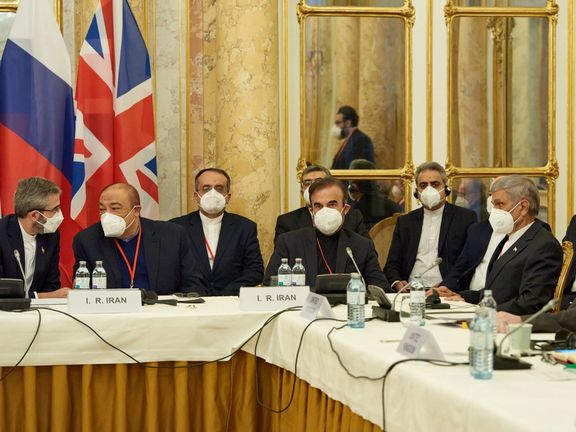
Iran's negotiating team in Vienna. November 29, 2021

Iran's official news agency IRNA has claimed that Tehran managed to impose its will on the US side and leave Washington empty handed at nuclear talks in Vienna.

Meanwhile, the government owned newspaper Iran which is the mouthpiece of the Raisi Administration wrote on Thursday that Iran might still withdraw from negotiations.

The IRNA commentary on Thursday said that the former US administration had tabled the 12 conditions when it withdrew from JCPOA in 2018. It also claimed that Secretary of State Antony Blinken started indirect negotiations with Iran in 2021 with the same conditions while extending a velvet hand. The US side wanted to include the issues of Iran's ballistic missiles and its regional ambitions in the talks, but Tehran resisted against the "exceeding demands."

IRNA’s claims aside, the Biden Administration, in fact, has been criticized for not including Iran’s missile and regional aggression in the talks, as it always labelled the Vienna negotiations aimed at reviving the JCPOA.

On the other hand, according to the commentary, Tehran demanded lifting US sanctions in a verifiable way and called for guarantees from the United States to ensure that the next US government will not pull out of a new agreement. However, the commentary did not say that Washington has rejected these deamds.

The commentary said that Former US President Donald Trump wanted a deal with Iran that would go beyond the 2015 Joint Comprehensive Plan of Action (JCPOA), which he called a longer, stronger deal.

The IRNA commentary quoted Pompeo as having said in May 2018 that the US will impose strong financial pressures on Iran but at the same time will be prepared to start negotiations with Tehran. Within a year, IRNA said Iran convinced the US it will not accept any conditions beyond the JCPOA.

Iran, said the commentary, did not want any issues other than the nuclear to be raised, let alone to be discussed during negotiations. It was at that stage that that Pompeo called for negotiations without preconditions. However, Supreme Leader Ali Khamenei said that Iran would never go to war with the United States nor start negotiating, IRNA said. When President Joe Biden replaced Trump, Iran realized that the United States was not going to step back from its excessive demands.

"While the US claimed there was no will in Iran to resume negotiations, Washington presented a new JCPOA which it called "JCPOA Plus." The new model also called for an agreement on Iran's missile program and regional policies, but Khamenei insisted that negotiations should be limited to the nuclear issue," the commentary claimed, adding that "the Iranian negotiating team did not accept any solution that would violate Iran's red lines and limit its capabilities. It was this that led the US and its western allies to limit the "new agreement" to the nuclear issue.

Meanwhile, the Iranian government's mouthpiece, Iran newspaper, on Thursday quoted Mostafa Khoshchashm, a political commentator as having said that the United States is likely to start reneging on a deal.

Khoshchashm added that Iran might decide to pull out of the negotiations if this happens. "One of our conditions to start this round of negotiations was that we might react to the other side's dishonesty at any stage. This reaction might lead to our withdrawal from the talks, and this will be unpleasant for the other side," he said, adding that "during the past two or three days the relative optimism about the other side's goodwill has been replaced by pessimism."


Most Viewed

100 days after carnage: Iran economy reels from war, inflation, unemployment
1
INSIGHT

100 days after carnage: Iran economy reels from war, inflation, unemployment

2
INSIGHT

Ghalibaf defends Iran-US talks amid hardline backlash

3
INSIGHT

A nation in limbo: 100 days after the massacre, has the world moved on?

4
ANALYSIS

From instability to influence: Pakistan’s pivotal role in US-Iran diplomacy

5
ANALYSIS

100 days on: why Iran’s January protests spread across social classes

Banner
Banner

Spotlight

  • War-hit homeowners feel abandoned as Iran’s reconstruction aid fades

    War-hit homeowners feel abandoned as Iran’s reconstruction aid fades

  • 100 days on: the anatomy of Iran’s January crackdown
    INSIGHT

    100 days on: the anatomy of Iran’s January crackdown

  • Ghalibaf defends Iran-US talks amid hardline backlash
    INSIGHT

    Ghalibaf defends Iran-US talks amid hardline backlash

  • 100 days on: why Iran’s January protests spread across social classes
    ANALYSIS

    100 days on: why Iran’s January protests spread across social classes

  • From instability to influence: Pakistan’s pivotal role in US-Iran diplomacy
    ANALYSIS

    From instability to influence: Pakistan’s pivotal role in US-Iran diplomacy

  • A nation in limbo: 100 days after the massacre, has the world moved on?
    INSIGHT

    A nation in limbo: 100 days after the massacre, has the world moved on?

•
•
•

More Stories

Iran Negotiator: ‘Creativity’ Needed In Nuclear Talks

Feb 24, 2022, 10:16 GMT+0

Being near a finishing line was different to crossing it, Iran’s chief negotiator in the Vienna nuclear talks tweeted Thursday.

Reaching agreement over reviving the 2015 Iran nuclear deal, Ali Bagheri Kani wrote, “requires extra caution, much perseverance, additional creativity and balanced approach to take the last step… To finish the job, there are certain decisions that our western interlocutors need to take.”

Talks in Vienna have faced the challenge of identifying which United States sanctions contravene the 2015 agreement, which the US left in 2018, and exactly how Iran’s nuclear program, expanded since 2019, would be brought back within the limits of the agreement, the JCPOA (Joint Comprehensive Plan of Action).

Bagheri-Kani returned to Tehran Wednesday night for consultations, leaving colleagues to continue discussions. Iran’s foreign ministry announced his return to Tehran should not be seen as a sign of imminent agreement in Vienna.

Iranian Foreign Minister Hossein Amir-Abdollahian spoke by phone Thursday with his British counterpart Liz Truss, saying that restoring the JCPOA needed “a serious will to make a courageous and realistic political decision” that recognised Iran's interests and secured stability. Tehran has sought guarantees that the US would not again leave the JCPOA.

Amir-Abdollahian told Truss that the United Kingdom needed to pay a £400-million (around $540-million) debt owed Iran since 1971.

Another Politician In Iran Calls For Direct Talks, ‘Ceasefire’ With US

Feb 24, 2022, 08:53 GMT+0
•
Iran International Newsroom

A former senior Iranian lawmaker, Heshmatollah Falahatpisheh, has joined other prominent figures calling for direct talks with Washington and a "ceasefire".

Falahatpisheh, the former chair of parliament's national security and foreign policy committee, told the Iranian Labour News Agency (ILNA), that although it appears a nuclear agreement is within reach, still Iran and the United States need “a cease-fire” whereby Iran stops any nuclear activity beyond what was agreed in the 2015 deal (JCPOA) and accepts a series of inspections. The United States would release Iran's frozen assets and loosen sanctions on Iran's oil export.

In the past few weeks several top politicians as well as business leaders have called for direct talks with Washington.

Falahatpiseh added that the idea espoused by diplomats that "Nothing is agreed until everything is agreed," imposes hardships on the Iranian people by prolonging US sanctions and is far from the standards of diplomacy. Sticking to this rule will prolong the negotiations and the side which is under sanctions will have to pay a higher cost.

He added that based on information by Western news agencies such as Reuters, and the information given away by Russian negotiator Mikhail Ulyanov, the two sides are headed toward an interim agreement. Such an agreement means that every 90 or 120 days the US president should present a report on Iran's commitment to the deal to maintain the suspension of sanctions. This will continue until a final agreement is made.

"The time wasted in the meantime means losses for both Iran and the United States. Besides, as Tehran has refused to negotiate directly with Washington, the other parties to the JCPOA have defined spheres of interests for themselves," said Falahatpisheh, while the main protagonists are the United States and Iran.

Falahatpisheh explained that Tehran’s problem is that for a long time it has insisted that accommodation with the United States is bad and now it is finding it difficult to convince the nation and even its own supporters that it is moving in the right direction. At the same time, Biden needs to thread carefully not to antagonize the US Congress. All this makes an agreement an arduous and drawn-out process.

This comes while Iran and the United States need to reach to an agreement as soon as possible. Iran particularly needs this to start economic dealings with the rest of the world. At the same time, the world's priority now is the Ukraine crisis.

Another complicating factor is Iran’s insistence that all secondary and non-nuclear sanctions be lifted because these could still adversely affect Iran's economy.

Meanwhile, in interview with reformist Ensaf News website, US-based Iranian political commentator Dariush Sajadi, who usually supports the position of Iran's hardliners, also said that although individuals on both sides ae hopeful about an imminent agreement in Vienna, it is unlikely that the negotiations would lead to a tangible result. Sajadi added that he believes neither Iran, nor the United Stats are really after the revival of the JCPOA.

In America only the democrats are interested in the matter, but they have a fragile situation in the Congress and fear that giving concessions to Iran will be harmful to their narrow majority. He added that although the US side insists that time is running out for an agreement, they do not mind if the negotiations drag beyond the Congressional elections in November.

In Iran, however, Sajadi said, the harsh economic impact of the sanctions has made the people anxious to see results as soon as possible. "If it were not for the pressure of the sanctions, Iran would have never agreed to take part in the negotiations," he added.

Asked how, in his opinion, an agreement will be made between Iran and America, Sajadi said: "I believe they will not reach an agreement."

Iran Plays Down Nuclear Negotiator’s Trip Home For Consultation

Feb 23, 2022, 18:44 GMT+0
•
Iran International Newsroom

Ali Bagheri Kani, Iran's lead negotiator, returned to Tehran Wednesday night for consultations, leaving colleagues to continue the Vienna nuclear talks.

Behrouz Kamalvandi, spokesman for Atomic Energy Organization of Iran, meanwhile travelled to Vienna for discussions with the International Atomic Energy Agency.

But Iran’s foreign ministry announced that Bagheri Kani’s return to Tehran should not be seen as a sign of imminent agreement between Iran and world powers over reviving the 2015 nuclear deal, the JCPOA (Joint Comprehensive Plan of Action).

Reuters also cited an Iranian official that "if the talks collapse, Washington will be responsible for it and also for its consequences." While accepting “good progress” had been made in the talks, the official said decisions were still needed elsewhere. “Our country's fate is not linked to this deal,” the official said.

Iran’s official news agency IRNA also appeared to play down the significance of Bagheri Kani’s trip to Tehran, noting that senior negotiators from the three western European countries in the talks – France, Germany, and the United Kingdom – had also taken consultative trips away from Vienna this week.

The head of the French delegation in the talks, Philippe Errera, told Iran International Wednesday evening there would be "no pause" in negotiations. "We will continue until we reach an agreement or announce the collapse of negotiations next week,” Errera said.

Participants in the talks have spoken more openly in recent weeks that has been usual in the ten months of the talks, which have run, with pauses, since April. United Kingdom lead negotiator Stephanie Al-Qaq tweeted Wednesday that she had met with Bagheri Kani before he set off for Tehran.

Expectations that the talks were near concluding have been building for over a week. Mikhail Ulyanov, Russia’s lead negotiator in Vienna, tweeted Tuesday that negotiations were “apparently… about to cross the finish line.” Both Al-Qaq and Enrique Mora, the EU official chairing the talks, said Tuesday that crucial issues remained to be agreed.

In a joint news conference with his visiting Omani counterpart earlier Wednesday, Iranians Foreign Minister Hossein Amir-Abdollahian said a “sensitive and important point” had been reached. “We wonder whether the western side can adopt a realistic approach to go through the remaining points of the talks,” he told reporters.

Oman has several times facilitated Iran-United States contacts, both over prisoner swaps and in setting up ‘back door’ meetings before open talks led to the 2015 JCPOA (Joint Comprehensive Plan of Action), the nuclear agreement that the current Vienna process seeks to revive after the US left in 2018.

Iran Calls For Realism As Nuclear Talks Continue

Feb 23, 2022, 12:29 GMT+0

Foreign minister Hossein Amir-Abdollahian said Wednesday that a “sensitive and important point” had been reached in Iran’s nuclear talks with world powers.

"We wonder whether the western side can adopt a realistic approach to go through the remaining points of the talks,” Amir-Abdollahian told a news conference alongside his Omani counterpart Badr Albusaidi in Tehran.

Oman has several times facilitated Iran-United States contacts, including ‘back door’ talks before open talks led to the 2015 JCPOA (Joint Comprehensive Plan of Action), the nuclear agreement that current Vienna talks seek to revive after US withdrawal in 2018.

Muscat has also operated as a channel for discussions over prisoner releases. There has been growing speculation, fed by US Iran ‘special envoy’ Rob Malley and a Reuters story citing Iranian officials, that Tehran and Washington are preparing a prisoner exchange as an adjunct to the Vienna talks.

Amir-Abdollahian said he had underlined to Josep Borrell, European Union High Representative for Foreign Affairs, during the recent Munich Security Conference that Tehran was set on securing guarantees that the US would uphold commitments to restore the JCPOA and would lift ‘maximum pressure’ sanctions imposed since Washington left the deal in 2018.

Mikhail Ulyanov, Russia’s lead negotiator in Vienna, tweeted Tuesday that the talks were near concluding. Both United Kingdom lead negotiator Stephanie Al-Qaq and Enrique Mora, the EU official chairing the talks, said that crucial issues remained to be agreed.

Iran Reiterates A Nuclear Deal Is Very Close If West Shows Flexibility

Feb 23, 2022, 10:36 GMT+0

Iran says it has showed flexibility and seriousness in talks with the West over its nuclear policy, now it is time to see initiatives and flexibility in return.

In an interview with Euronews on Tuesday, Hossein Amir-Abdollahian said the agreement could be reached in a matter of hours, but also warned again that some of Iran’s “red lines” remained, reiterating that “We’ve never been so close to such a deal”.

When asked to explain about Iran’s “seriousness and initiatives” at the Vienna Talks, Amir-Abdollahian, said, “we need to make sure there’s harmony between how we’re negotiating in Vienna and the realistic approach of Dr. Raisi’s government”.

“We do not believe that Iran is an isolated country. Unilateral and unlawful US sanctions have led to some problems for us. Inaction since 2015, especially from three European countries…has caused some problems for Iran. But despite all their efforts…the isolation of Iran hasn’t happened”, he added.

Commenting on the issue of a prisoner swap with the West, he described the dual-nationals held by Iran as spies, saying, “We’ve announced that we’re ready, either outside the Vienna talks or alongside them, to exchange prisoners when the other side is ready. We consider this to be a 100% humanitarian issue. We don’t see any necessity to link this humanitarian dossier to the Vienna Talks.”

Iran has arrested several Westerners and dual citizens of Iranian descent on trumped-up charges, described by international human rights organizations as hostage taking.