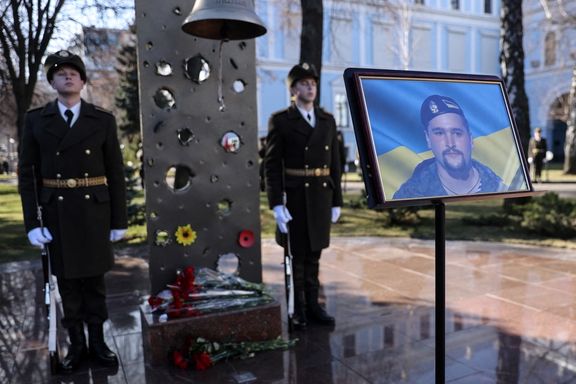
Ukrainian soldiers stand behind the portrait of a serviceman killed on February 19 in a shelling of Ukrainian positions. February 22, 2022
Iran's foreign ministry Tuesday urged all parties to the Ukraine crisis to avoid escalation while accusing NATO and the United States of being “provocative.”
Etemad Online, website of reformist Etemad newspaper, quickly portrayed Saeed Khatibzadeh words as "Iran's siding with Russia."
"The Islamic Republic of Iran invites all sides to have restraint and believes that any action that caused escalation of tension should be avoided," Saeed Khatibzadeh said in a statement on the foreign ministry website. He said that NATO, under US leadership, had worsened the situation in by "meddling and provocative actions,” a likely reference to NATO refusing to rule out Ukrainian membership.
Reza Ghobeishawi, of the editorial board of conservative Asr-e Iran newspaper, tweeted Tuesday that the state broadcaster (IRIB) was biased. "IRIB's two o'clock news report on the Ukrainian crisis was fully supportive of Russia,” he wrote. “It censored the Russian troops' arrival into Ukraine.”
While social media had been awash with opinions and theories, most media in Iran stuck to reporting news with little analysis. Interest has warmed up since Russian President Vladimir Putin's decree recognizing two breakaway regions in eastern Ukraine.
Sacrificial meat
In tweets, supporters of Mahmoud Ahmadinejad have repeated his allegations in late January of a US-Russian “dirty deal” to invade Iran and Ukraine. The former president said he had “accurate knowledge” that the US would “allow Russia to invade Ukraine…[and] the US to move onto Iran.”
Amir Tafreshi, a founding member of the Justice-Seeking Student Movement, an Islamic student union, tweeted that Iran should condemnNATO for provocation and Russia for not respecting Ukraine's territorial integrity. "Any delay in the announcement of this policy will strengthen the suspicions that Russia dominates Iran's foreign policy,” he opined.
Iran's state broadcaster in its reports has highlighted that Yemen's Houthis, Cuba, Syria, and Venezuela have supported Russia's position. Among Iran's neighbors and allies, so far Turkey has condemned Putin's recognition of the breakaway Ukrainian regions.
Etemad-e Melli newspaper published a commentary by political analyst Ahmad Zeidabadi saying that a Russian invasion of Ukraine would not affect the nuclear talks between Iran and world powers in Vienna, even if it had “a destructive effect on circumstances” once agreement was reached in Vienna on reviving the 2015 nuclear deal.
Afifeh Abedi, researcher at the Center for Strategic Research, an arm of the Expediency Discernment Council, tweeted that Ukraine was “the living and perfect example of the sacrificial meat that Russia and the West have divided between themselves … It's Iranian statesmen's duty to only seek maximal securing of Iran's own national interests … as the sensitive stage of Vienna talks coincides with the developments in Ukraine…”
Iran has blamed NATO for the recent escalation in the Ukraine crisis, calling for restraint from both sides, as Russia has moved to dismember the country.
Foreign Ministry spokesman Saeed Khatibzadeh said on Tuesday that provocative measures and interventions by the United States led to drastic escalation of tensions.
"Unfortunately, NATO's provocative measures and interventions, led by the US, have further complicated the situation in the region”, he said.
The Islamic Republic is monitoring the developments with sensitivity and urges all sides of the conflict to exercise restraint and avoid any actions that could aggravate the tensions, Khatibzadeh said.
President Vladimir Putin announced late Monday that Russia recognized the independence of two breakaway regions of Donetsk and Lugansk in eastern Ukraine held by separatists, practically paving the way for the deployment of Russian troops.
Hours after Putin’s move, Ukrainian President Volodymyr Zelenskyy said his countrymen “are not afraid” announcing that it would deploy troops there to “maintain peace”.
The decision by Moscow has triggered international condemnation and a promise of targeted sanctions and a promise of targeted by the United States and the European Union.
An urgent meeting of the United Nations Security Council (UNSC) was held on the deepening crisis as the United States said the announcement by Putin was an “unprovoked violation of Ukraine’s sovereignty and territorial integrity”.
There is no need for OPEC+ to expand its oil production, Nigeria's petroleum minister said on Tuesday, as the group sees a potential deal between Iran and world powers unlocking more supplies.
"We don't have do anything extraordinary this time because we are expecting a lot of production," Timipre Sylva said on the sidelines of a gas exporters conference in Qatar's capital Doha.
OPEC+ cut supplies in 2020 as the COVID pandemic reduced global demand but began marginally increasing supplies. However overall production has remained well below pre-pandemic levels bossting prices to 7-year highs of close to $100 per barresl.
"We are expecting more production if a nuclear deal with Iran works out (since) there will be production from them," Sylva added.
Months of indirect talks between Iran and the United States to revive a 2015 nuclear deal abandoned in 2018 by then-US President Donald Trump are in their final stage, diplomats have been saying, although some still believe major issues remain to be resolved.
A deal could pave the way for OPEC member Iran to raise its oil exports further, helping to ease what many analysts see as an acute tightness in the oil market.
Brent crude traded just below $100 a barrel on Tuesday, its highest since September 2014, as the possibility of a Russian invasion of Ukraine heightened the risk of supply disruptions.
In tweets, Mostafa Arani, chief editor of 7Sobh newspaper has said Iranian authorities are restricting bandwidth and slowing broadband as a means of censorship.
Arani has warned of a plunge in the rate of data transfer (bandwidth) allocated to Instagram, the only major social media platform not filtered, and a reduced general speed of mobile and fixed broadband.
On Monday check-host.net data showed a ping server time of 85.4 milliseconds (ms) for Instagram from IP addresses in Tehran, 16.5 ms from Istanbul, 1.0 ms from Paris, and 54.4 ms from Karaganda, Kazakhstan.
Unlike Instagram, WhatsApp messaging applications is filtered but nearly every Iranian with a smartphone has installed anti-filtering software that allows access to filtered applications and websites. Anti-filtering software, however, will time out if the internet speed is low. Nonetheless, with over 50 million users, WhatsApp is the most popular messaging and social media platform in Iran.
Shargh, the reformist newspaper, said Monday its investigation showed serious disruption in Instagram traffic over two months. According to Shargh, the disruption happened every day after 5:00 pm – which would make Instagram obsolete if continued.
World Speedtest rankings
Iran now ranks 77th, two places behind Israel, six behind Ireland, and two ahead of Ethiopia in the Speedtest Global Index for mobile internet. Fixed broadband speedis 141st, almost at the same level as Benin, the Western Sahara, and Nigeria, while 18 places ahead of Lebanon, which has suffered years of civil war and instability. Afghanistan was last of 179 countries in the list.
Two months ago Iran ranked 70th in mobile internet speed and it has dropped by 7 points. Social media users complain that the speed of mobile internet and fixed broadband has dropped and their access to social media and messaging applications has noticeably diminished in the past few weeks.
Some businesses relying on Instagram now say they fear bankruptcy, with online meetings impossible despite the Covid pandemic. Taxis and cars are getting lost because their GPS devices fail to function. Students who have to study online, with classes and exams disrupted, are frustrated.
Maryam Shokrani, journalist with 23,000 Instagram followers, shared a screenshot on TwitterMonday flashing "Session not found" as an example of how her online activities were curtailed.
"We are kicked out of online sessions all the time, the sound comes and goes, and at the end we don't know what happens in the session,” she wrote. “Now the minister of communications, Isa Zarepour, says those who complain about low speed are making a fuss!"
"The clandestine filtering of Instagram and WhatsApp through gradual reduction of bandwidth is much more unethical than official filtering because it is a sign of deceit, weakness, irresponsibility," Roozbeh Alamdari, editor of Jamaran, a reformist news website, tweeted Monday.
Hossein Mousavian, a faculty member at Princeton University
A former Iranian diplomat who is currently a Princeton University scholar has been sentenced to 11 months in prison over his role in a corruption case in Iran.
Iranian Judiciary Spokesman Zabihollah Khodayian said on Monday Hossein Mousavian was an advisor in a €2-billion case in the Persian Gulf island of Kish in the 2000s.
According to Khodayian, Mousavian brokered a deal to give 200 hectares of the island and 100 thousand square meters of its territorial waters to a third party but the resort project was never carried out.
Earlier in January, his remarks in a documentary to mark Qasem Soleimani’s second death anniversary led to controversy when he gloated about how Iran’s threatto avenge Soleimani killing frightened the wife of Brian Hook, Washington’s special envoy for Iran at the time.
Advocacy group United Against Nuclear Iran (UANI) has also called on Princeton “to dismiss him from any association or affiliation with the university without delay”, noting that “Mousavian’s affiliation with Princeton is a stain on the university’s reputation and credibility”.
UANI described him as “an agent of the Iranian regime” who is currently employed as a Middle East and nuclear policy specialist at the university.
Late in December, an American academic who was imprisoned in Iran for 1,216 days, said Mousavian is sympathetic to the Iranian regime, claiming that he stymied efforts to free him from prison.
Mousavian, who traveled to Iran to attend the funeral service of Soleimani, was Tehran’s ambassador to Germany when four Iranian dissidents were assassinated at Berlin's Mykonos restaurant in 1992.
A massive anti-government protest in Iran's historic city of Esfahan in November 2021
Eleven Iranian opposition groups have urged three European nations participating in nuclear talks with Iran to stop the negotiations with the Islamic Republic.
The letter, which was signed by Western-based secular and liberal groups opposed to the Islamic Republic, addressed the leaders of France, Germany, and the United Kingdom, calling on them to end “the failed and catastrophic policy of negotiating with and appeasing the Islamic Republic”.
They told Emmanuel Macron, Boris Johnson, and Olaf Scholz that the regime with which they are engaged in talks “is the same fundamentalist regime that since its inception 43 years ago, has had terror, hostage-taking, and sabotage, as an integral part of its ideology and nature, and its most important tools for blackmailing the free world”.
Diplomats have said that nuclear talks, which began last April to revive the 2015 nuclear agreement (JCPOA), have made significant progress and a final deal is imminent soon. In case agreement is reached, Iran is set to receive billions of dollars of blocked funds and massive sanctions relief.
The signatories highlighted that the “Islamist revolutionary regime has carried out hundreds of terrorist attacks around world”, emphasizing that it has engaged in killings, bombings, and hostage taking, as well as issuing fatwas (decrees) for murder of innocent people.
This is “the same inhumane, misogynist, and anti-LGBTQ oppressive regime that, despite decades of attempts at dialogue and resolutions by the international community, still enforces medieval Sharia law,” which includes stoning, amputation, and flogging, the letter read.
Mass protests broke out in November 2019 as security forces received orders to shoot demonstrators, killing hundreds.
The opposition groups stressed that the clerical government “carries out large-scale executions and imprisonments, often with the aim of suppressing and silencing political opponents”.
The Islamic Republic soon after its establishment cracked down on opposition and independent groups and has continued to ban civil society initiatives. Practically all opposition has been sent into exile or imprisoned.
They criticized the policy of the West, especially Europe, towards “this anti-Semitic regime,” saying “appeasement and the payment of ransoms in order to normalize and attempt to change the behavior of this inherently abnormal regime” have only emboldened it “in its terrorist activities, criminality, and nuclear and military ambitions”.
The signatories highlighted Iran’s track record of “insolence on the international stage and criminal suppression of the people”, stating that “Nearly two decades of counterproductive negotiations and flawed deals such as the JCPOA have only given the Islamic Republic a chance to buy time. By deceiving the international community, it has brought its nuclear and ballistic missile programs to an irreversible stage”.
Then opposition groups called for action, urging the three European powers “to put aside, once and for all, the failed and catastrophic policy of negotiating”, saying that now when the Islamic Republic is at the lowest level of popular legitimacy in its history it “is the time to choose another policy: Maximum support for the Iranian people to end more than four decades of medieval rule and replace it with a secular democratic system that serves Iran's national interests through peaceful coexistence and cooperation with neighbors and all countries in the world”.
“This is the only way to prevent the world's largest terrorist state from achieving the atomic bomb -- a catastrophe that will plunge the entire region into a nuclear arms race”, they wrote.
They asked the European leaders that instead of the Vienna talks they should “enter into a serious and effective dialogue with the democratic and national opposition of Iran, which wants a free and secular Iran”.
“Sooner or later, the Islamic Republic will be overthrown by the brave and courageous people of Iran, and the day after liberation, the Iranian people will remember who stood by them in difficult times and who aided their oppressors”, they concluded.