• العربية
  • فارسی
Brand
  • Iran Insight
  • Politics
  • Economy
  • Analysis
  • Special Report
  • Opinion
  • Podcast
  • Iran Insight
  • Politics
  • Economy
  • Analysis
  • Special Report
  • Opinion
  • Podcast
  • Theme
  • Language
    • العربية
    • فارسی
  • Iran Insight
  • Politics
  • Economy
  • Analysis
  • Special Report
  • Opinion
  • Podcast
All rights reserved for Volant Media UK Limited
volant media logo

Demanding Higher Pay, Iran Teachers Continue Strikes And Protests
Feb 19, 2022, 16:23 GMT+0

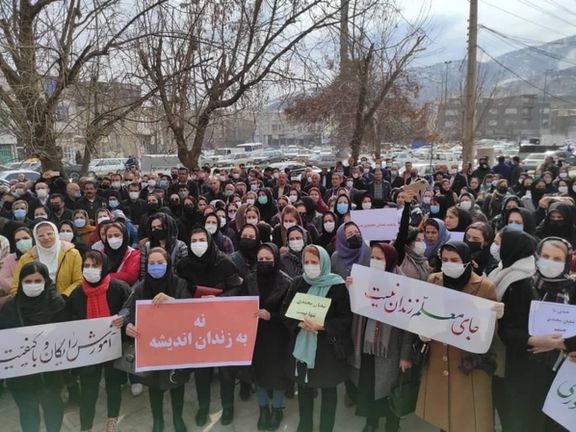
Thousands of teachers staged another round of nationwide protests Saturday to demand higher salaries and the release of colleagues arrested in previous rallies.

The demonstrations were held in at least 100 cities and towns, while teachers have announced their rallies and strikes will continue until Thursday, the end of the week in Iran.

According to Teachers’ Trade Associations, which organized the protests, security forces “attacked” a rally in the city of Karaj, beating teachers and arrested 15 (video) Videos posted on social media show crowds shouting slogans against unfulfilled promises by the authorities and asking for an imprisoned teacher to be freed. “From Tehran to Khorasan; Teachers are in prisons,” they chanted.

As in earlier protests, teachers gathered in front of the parliament building in Tehran and the provincial offices of the education ministry, protesting against ministry directives asking principals to warn teachers not to leave work to take part in protests and sit-ins.

Two years of deep recession in Iran following the introduction of United States ‘maximum pressure’ sanctions in 2018 led to sharp increases in living costs and to labor unrest. According to social media posts, officials in the labor ministry also held a protest Saturday. In January hundreds of firefighters and staff from the judiciary took to the streets in several cities. Prison guards have also picketed to protest their salaries.


Most Viewed

100 days after carnage: Iran economy reels from war, inflation, unemployment
1
INSIGHT

100 days after carnage: Iran economy reels from war, inflation, unemployment

2
INSIGHT

Ghalibaf defends Iran-US talks amid hardline backlash

3
INSIGHT

A nation in limbo: 100 days after the massacre, has the world moved on?

4
ANALYSIS

From instability to influence: Pakistan’s pivotal role in US-Iran diplomacy

5
ANALYSIS

100 days on: why Iran’s January protests spread across social classes

Banner
Banner

Spotlight

  • War-hit homeowners feel abandoned as Iran’s reconstruction aid fades

    War-hit homeowners feel abandoned as Iran’s reconstruction aid fades

  • 100 days on: the anatomy of Iran’s January crackdown
    INSIGHT

    100 days on: the anatomy of Iran’s January crackdown

  • Ghalibaf defends Iran-US talks amid hardline backlash
    INSIGHT

    Ghalibaf defends Iran-US talks amid hardline backlash

  • 100 days on: why Iran’s January protests spread across social classes
    ANALYSIS

    100 days on: why Iran’s January protests spread across social classes

  • From instability to influence: Pakistan’s pivotal role in US-Iran diplomacy
    ANALYSIS

    From instability to influence: Pakistan’s pivotal role in US-Iran diplomacy

  • A nation in limbo: 100 days after the massacre, has the world moved on?
    INSIGHT

    A nation in limbo: 100 days after the massacre, has the world moved on?

•
•
•

More Stories

What Ordinary Iranians Say About Direct Talks With US

Feb 19, 2022, 07:59 GMT+0
•
Maryam Sinaiee

Except for the state-run broadcaster (IRIB), street interviews about controversial issues such as direct negotiations with the US are rare in Iranian media.

But a reformist website, Ensaf News, on Friday published vox pops from several provinces and explained that due to media restrictions it has edited out some of the remarks.

The initiative is quite unique because when it comes to controversial matters, most news websites in Iran do not even allow readers to comment, or edit the comments before publishing, to prevent the closure of their publication by the authorities.

"What are they expecting to happen that they are dallying so much? Why are they delaying it when eventually they will accept to directly talk with the US? Why shouldn't we do it when we can live better if we make a deal with the US, so we won't need Russia and China?", Ensaf News quoted Sattar, a carpenter in Sabzevar in eastern Iran, as saying.

Mohammad-Hesam, a student at Khorasan seminary, told Ensaf News that direct negotiation with the US is banned by Supreme Leader Ali Khamenei because it "entails many harms and no benefit at all." He added that if the US changes its “wolfish behavior” there will not be a problem to "negotiate with the enemy".

A professor of Tabriz University in northwestern Iran whose first name was not mentioned in the article noted the "bitter experience of the JCPOA" during which Iran and the US engaged in direct negotiations with Khamenei's permission, but former US president Donald Trump unilaterally left the deal. He said repetition of that experience is "not only stupid but also treachery". "Authorities should take action against those who still speak about this subject and sadly are not few even in universities," he added.

"The alternative to negotiation with the US is war with that country. Are we prepared for such a war? Even if we are militarily prepared, do we have enough financial resources for such a war? a lawyer in Ahvaz in the southwestern province of Khuzestan, told Ensaf News while Faezeh, a photographer in Tabriz, said what people think and want is clear. "But nobody cares what people want. They do whatever they please," she said.

"To resolve this issue, they must hold a referendum. The most peaceful and legal solution, as long as people and the authorities think differently, is to hold a referendum and let people's vote decide the matter. Rouhani spoke about holding a referendum a few times but did not follow it with action. There wouldn't be so many problems now if a referendum had been held about negotiations between Iran and the US," Saleh, a student at Isfahan University of Technology said according to Ensaf News.

A retired teacher in Isfahan, Nahid, argued that the US is a country like all other countries but has been unduly singled out. "In fact, Israelis hope for the enmity between Iran and the US to continue because it them who profit from it."

Conspiracy theories are abundant too. Mojtaba, a taxi driver in Mashhad, accused the government of secretly negotiating with the US. "The president's visit to Russia was to make a deal with Russia and the US [over Ukraine]. They don't announce it in order not to contradict themselves, otherwise, they have always negotiated behind the scenes and the rest is only a game because they don't want to tell people."

Iran Impounds Smuggled Rare Antiques At Turkish Border

Feb 18, 2022, 21:35 GMT+0

Iran has seized a cargo of antique goods and ancient artifacts smugglers planned to take out through Turkey.

Rouhollah Latifi, spokesperson for the Customs Administration office, said Friday that 570 items confiscated included old coins and books.

The shipment was found in a truck loaded with second-hand home furniture in transit to Canada at the Bazargan border crossing, West Azarbaijan province, the spokesman said. The coins were worth several billion rials, Latifi added.

Within the haul were 18 bronze pieces dating from the first millennium BC, antique daggers, seven glass chandeliers, 322 silver coins, a one-dollar coin minted in 1845, some Qajar-era (1795-1925) plates, and a handwritten gold-gilded Qur'an.

Under Iranian law, such artifacts are deemed part of "national heritage" and illegal to export unless expressly authorized by the relevant authorities. Smuggling antiques can lead to years of imprisonment and fine equal to twice the value of the smuggled items.

Iranian items legitimately for sale in western auction houses or by dealers – including carpets, manuscripts, painting, ceramics, and woodcrafts – can fetch from a few hundred dollars to hundreds of thousands, or more. London’s Victoria and Albert Museum bought the 16th-century ‘Ardabil carpet’ in 1893 for £2,000.

Hezbollah Drone Penetrates Israeli Airspace, Warplanes Buzz Beirut

Feb 18, 2022, 19:52 GMT+0

A drone flown by Lebanese militant group Hezbollah crossed into northern Israel on Friday, triggering air defenses and the scrambling of fighter jets.

The drone apparently returned to Lebanon but it is not clear how long it lingered in Israeli airspace (video).

Iran-backed Hezbollah, which fought a month-long war against Israel on the Lebanon border in 2006, said Friday's flight was a 40-minute reconnaissance mission. Earlier this week, it said it had started producing its own drones in Lebanon.

Hours later and roughly 100 km to the north, a thundering roar was heard in the Lebanese capital Beirut caused by Israeli planes passing in the lowest overflight in years, according to many videos recorded by residents.

On Wednesday, Hezbollah chief Hassan Nasrallah said in a televised speech that his group has the ability to convert rockets into precision missiles with the help of "experts from the Islamic Republic."

Israel's military said Hezbollah's radio-controlled drone had set off air raid sirens in the Galilee region of northern Israel warning residents to take cover.

"Aerial defense systems identified and tracked the threat along with helicopters and fighter jets that were dispatched," it said, adding that its Iron Dome defense system had tried to intercept the drone but it made it back.

On Thursday, Israel said it had downed a drone that belonged to Hezbollah after it crossed into Israeli air space.

With reporting by Reuters

Halfway Through Its Term, Iran’s Parliament Seen As A Failure

Feb 18, 2022, 16:40 GMT+0
•
Iran International Newsroom

While Iran’s parliament is halfway through its four-year term, commentators say most of the lawmakers are unlikely to convince voters to re-elect them in 2024.

Some observers have expressed concern that the disappointing performance of Iran's 11th parliament (Majles) since the 1979 revolution might lead to another record voter low turnout in 2024. The parliament's performance already led to an extremely low turnout in the 2020 by-election.

Nearly under every social media post about the parliament, users point out that lawmakers have broken their promise of making the voting process in the parliament transparent. In early November, the parliament rejected a bill that called for open voting and a renewed push in February was supported by only 66 of the 290 lawmakers. However, the Majles might approve the bill towards the end of its term only to leave it as an annoying legacy for the next Majles.

While the current Majles started its work with criticism of the Rouhani administration's economic performance, it has not yet approved any bill meant to bring about improvement in Iran's ailing economy. Majles speaker Mohammad Bagher Ghalibaf said in a rare admission in October, “We could not accomplish anything,” and added, “We were not able to work correctly.”

Speaker Ghalibaf seen haggling with lawmakers. October 17, 2021
100%
Speaker Ghalibaf seen haggling with lawmakers in October last year.

Meanwhile, in July 2021, Khabar Online, a leading news website in Tehran characterized the current Majles as a "minority parliament" that should avoid provocative legislation opposed by most Iranians. The website noted that the ultra-conservative parliament has already annoyed a major part of the population by considering a bill to limit citizens’ access to the Internet and opposing a long-awaited salary increase for the country's low-paid teachers who have been taking to the streets in recent months.

Khabar Online also said that 38 lawmakers at the Majles had won between 2 to 10 percent of the votes in their constituencies, when they got elected in February 2020. Two members won around 2 percent of the votes in their districts, while at least 3 lawmakers in this group chair various parliamentary committees despite their less than 10 percent voter base.

A few lawmakers chatting on the sidelines of
100%
A few lawmakers chatting on the sidelines of

While at times the Majles joined other critics to lash out at the Raisi administration for nepotism and giving big jobs to small men with no merits, it turned out in November that some of the insiders who got the big jobs were the relatives of lawmakers.

The parliament has also been harshly criticized for not objecting to the appointment of IRGC generals as state officials or allowing them to run for President.

The Majles has also been criticized by the press for not being able to carry out its supervisory role. A group of lawmakers tabled motions during the past months to impeach several ministers including the ministers of labor, industry and health for breaking laws and shortcomings in their performance, but each time, the Majles Presidium refused to officially acknowledge the call for impeachment.

Based on what the Majles has done or failed to do during the past two years, some Iranian media outlets, including the moderate Rouydad24, have said that many of the current lawmakers might find it hard to convince Iranian voters to vote for them in 2024 when the turnout is likely to be even lower than in 2020.

The parliament’s record of coordination with the government has also been criticized. While most commentators in Iran believed that a hardliner Majles would work well with the ultraconservative government of Ebrahim Raisi, the first signs of a rift between the two emerged in late February as the parliament disagreed with key parts of the government's budget bill.

Iranians Stage Demo In Tehran To Protest Hijab Ban In India

Feb 18, 2022, 15:40 GMT+0

Tens of Iranian students staged a protest outside the Indian embassy in Tehran to protest a ban on hijab in colleges in the southern Indian state of Karnataka.

The students also issued a statement calling on the Iranian authorities to take measures against the new law by the Indian government.

The Bharatiya Janata Party (BJP), which runs the governments in Karnataka as well as control the national government, has for decades campaigned for the application of a Uniform Civil Code (UCC), which some minorities believe would be tantamount to the imposition of Hindu laws.

The Iranian students who participated in the state-sponsored rally described the new hijab restrictions as discriminatory against Muslims and called it a violation of the basic human right to freedom of clothing. However, it is decades that the Islamic Republic has imposed its compulsory hijab rules and anyone who dares to protest will face persecution or heavy-handed jail terms.

Choosing which clothes to wear is an important part of expression as confirmed under Article 19 of the Universal Declaration of Human Rights.

More than four decades after the Islamic Revolution of 1979, there is still much resistance to the prescribed standards of hijab promoted by the state, which many women refuse to accept even at the cost of being arrested, fined or even lashed.