• العربية
  • فارسی
Brand
  • Iran Insight
  • Politics
  • Economy
  • Analysis
  • Special Report
  • Opinion
  • Podcast
  • Iran Insight
  • Politics
  • Economy
  • Analysis
  • Special Report
  • Opinion
  • Podcast
  • Theme
  • Language
    • العربية
    • فارسی
  • Iran Insight
  • Politics
  • Economy
  • Analysis
  • Special Report
  • Opinion
  • Podcast
All rights reserved for Volant Media UK Limited
volant media logo

Group Brings Iran's Role In Syrian Conflict To International Court
Iran International Newsroom
Feb 16, 2022, 19:49 GMT+0Updated: 17:34 GMT+1
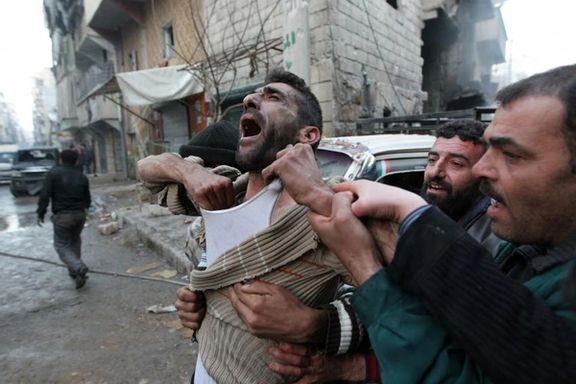
A scene of destruction and agony in Syria's civil war

An Iranian human rights group and a UK barrister have submitted a request to the International Criminal Court to examine Iran's role in the Syrian conflict.

The Iran Human Rights Documentation Center (IHRDC) has brought the request to open a Preliminary Examination of the role played by Iran and the armed groups it controls in crimes committed during the conflict in Syria to the office of the ICC prosecutor in conjecture with UK barrister Haydee Dijkstal.

In a statement Wednesday, the IHRDC said that it had submitted the request in accordance with Article 15 of the Rome Statute. The Rome Statute refers to the treaty adopted at a diplomatic conference in Rome in 1998 that established the International Criminal Court. Neither Iran nor Syria are parties to the Rome Statute.

The IHRDC has alleged that agents from the Islamic Republic of Iran and its Revolutionary Guards (IRGC) have perpetrated, aided and abetted the commission of certain crimes such as deportation and persecution against Syrian civilians which forced them to flee to Jordan for safety.

In its statement, the IHRDC said it has included evidence of Syrian victims directly impacted by the Syrian Government and the armed groups from Iran or controlled by Iran who attacked and intimidated them.

The IHRDC said forces led or supported by Iran were involved in hostilities across the entirety of Syria that led to more than 650,000 Syrians fleeing to Jordan from the violence.

According to The Guardian, the victims, including Syrian journalists, were targeted between 2011 and 2018 for their professional journalistic activities and for their actual and perceived opposition activities and came from predominantly Sunni towns and cities in Syria that the Alawite Assad regime and Shia Iran perceived as opponents.

The Guardian called the move to bring the case to the ICC "a groundbreaking attempt" to make Iranian and Syrian military officials answerable for war crimes.

“Up until now, little public attention has been paid to the legal responsibility of the Islamic Republic of Iran in the decade-long Syrian conflict, despite the significant intervention of Iranian officials in Syria and perpetration of atrocities,” Gissou Nia, the board chair of IHRDC said in the statement.

Nia said Iran has provided a vast range of military and non-military support to prevent the fall of Bashar al-Assad at any cost. "Unfortunately, that goal has been fought at the cost of hundreds of thousands of killed, injured and displaced Syrian civilians,” she added.

In the civil uprising phase of the Syrian Civil War, Iran provided technical support to the Assad regime to suppress the protests. The IRGC's Qods Force then began providing combat troops to support the Syrian military. Since then, Iran has spent tens of billions of dollars to send troops, arms, and equipment to Syria and to train Syrian forces as well as Iran-back militia groups including the Lebanese Hezbollah to assist the Assad regime.

In May 2020, a member of the Iranian parliament, Heshmatollah Falahatpisheh, in an interview with Etemad Online said Iran spent between $20 and $30 billion in Syria which he said has to be reimbursed.

Registered in 204 as a non-profit organization, IHRDC is based in Connecticut, United States. The organization which aims to document the patterns of human rights abuse in Iran and promote accountability has received funds from the US State Department, the government of Canada as well some private foundations and individual donors.


Most Viewed

Iran diplomacy wobbles as factions compete to avoid looking soft on US
1
INSIGHT

Iran diplomacy wobbles as factions compete to avoid looking soft on US

2
VOICES FROM IRAN

Bread shortages, soaring prices strain households in Iran, residents say

3
ANALYSIS

The politics of pink: how Iran uses cuteness to rebrand violence

4

Scam messages seek crypto for ships’ safe passage through Hormuz, firm warns

5
EXCLUSIVE

Family told missing teen was alive, then received his body 60 days later

Banner
Banner

Spotlight

  • Diplomacy tolls at Hormuz as conflict returns to its doorstep
    OPINION

    Diplomacy tolls at Hormuz as conflict returns to its doorstep

  • Opposition to US talks grows in Tehran as ceasefire deadline nears
    INSIGHT

    Opposition to US talks grows in Tehran as ceasefire deadline nears

  • Tehran moderates see ‘no deal–no war’ limbo as worst outcome
    INSIGHT

    Tehran moderates see ‘no deal–no war’ limbo as worst outcome

  • The future has been switched off here
    TEHRAN INSIDER

    The future has been switched off here

  • Lights out, then gunfire: Witnesses recount Mashhad protest crackdown
    VOICES FROM IRAN

    Lights out, then gunfire: Witnesses recount Mashhad protest crackdown

  • Is Iran entering its Gorbachev moment?
    INSIGHT

    Is Iran entering its Gorbachev moment?

•
•
•

More Stories

East Tehran Water To ‘Run Out In Days’, As Dry Summer Looms

Feb 16, 2022, 17:22 GMT+0

Tehran is set for severe drinking water supply shortages in the coming summer due to low precipitation and evaporation from dams.

Mohsen Mousavi Khansari, board member of NGO aimed at raising awareness of Iran’s water and soil issues, made the projection in an interview with Tasnim news agency Wednesday.

Khansari said that the five dams around Tehran, the main sources of drinking water for the metropolitan region, currently have 300 million cubic meters (m3) of water, which is not enough to avert a water shortage in the summer.

Latyan and Lar dams, which supply water to the eastern parts of Tehran province, have a total 20 million m3 of water that will run out in coming days, he said. Water in Amirkabir Dam, in the west of Tehran, is down two thirds from a year ago to 30 million m3, “which is deeply worrying,” Khansari told Tasnim.

“If we add Mamlu and Taleqan Dams to the other dams, there will be a total of 300 million cubic meters of water, and if we consider the rate of evaporation and decrease in precipitation, we will definitely have many problems in the summer to supply drinking water to Tehran,” Khansari concluded.

Hezbollah Says It Can Produce Precision Missiles With Iran's Help

Feb 16, 2022, 17:04 GMT+0

The leader of Iran-backed Hezbollah group said for the first time on Wednesday that it can convert thousands of rockets into precision missiles within Lebanon.

"We have been producing drones in Lebanon for a long time, and whoever wants to buy them, submit an order," Sayyed Hassan Nasrallah said in a televised speech to followers.

He said Hezbollah was able to transform standard rockets into precision missiles with the cooperation of "experts from the Islamic Republic of Iran". Such production had been spurred by arch-foe Israel's increased use of drone technology, he said.

Hezbollah and Israel fought a month-long war in 2006 and have at times in the years since traded fire across Lebanon's southern border.

There was no immediate Israeli response to Nasrallah's statements. While the Israeli military outguns Hezbollah guerrillas, Israel worries that in a future war they could use precision-guided missiles to knock out parts of its national infrastructure like ports or power stations.

Israel has said in the past that it has brought down several Hezbollah drones that had crossed into Israeli air space. Hezbollah says its increased anti-drone capabilities have led to a decline in Israeli drone overflights.

Israel last week published the names of three Lebanese companies that it accused of supplying materials for Hezbollah's precision-guidance missile project, a move designed to generate international economic pressure on the Shi'ite Muslim group.

"Hezbollah are endangering the citizens of Lebanon and the state of Lebanon," Israeli Defense Minister Benny Gantz said in a statement. Israel, he added, would "act resolutely in the face of the Iranian precision project operating from the heart of Lebanon".

Reuters Report

Bahraini Prince To Visit Israel As Bennett Rebukes Iran’s ‘Chaos And Terror’

Feb 15, 2022, 21:42 GMT+0
•
Iran International Newsroom

Bahrain's Crown Prince Salman bin Hamad Al-Khalifa has accepted an invitation from Prime Minister Naftali Bennett to visit Israel in "the near future.”

Abdullatif Al-Zayani, the Bahraini foreign minister, announced the plan during the visit to the kingdom Tuesday of Israeli Prime Minister Naftali Bennett, which Al-Zayani said had included discussions of the "Iranian nuclear file and terrorism."

Bennett said he was seeking a “new regional architecture” with Arab Gulf states – referring principally to Bahrain and the United Arab Emirates, who in 2020 normalized relations with Israel – against "enemies who are fomenting chaos and terror."

Bennett portrayed his two-day trip largely as a common stance against Iran and its allies, including Yemen's Ansar Allah, known as the Houthis, whose battle in Yemen against Saudi- and UAE-led forces has spilled over this year into missiles fired at the UAE.

Bahraini opposition activists said Tuesday that at least four people had been arrested in protests against Bennett’s visit in several villages inhabited by Shia, who make up the majority in the country ruled by the Sunni Khalifa family. Bahrain, which crushed protests in 2011 with Saudi help, blames unrest on Tehran.

Bahrain's King Hamad bin Isa al-Khalifa receives Israeli Prime Minister Naftali Bennett at Sakhir Palace, Bahrain, February, 15, 2022.
100%
Bahrain's King Hamad bin Isa al-Khalifa receives Israeli Prime Minister Naftali Bennett at Sakhir Palace, Bahrain, February, 15, 2022.

After meeting King Hamad bin Isa Al Khalifa, Bennett stressed the importance of a variety of links that have mushroomed between Israel and some Arab Gulf states since the 2020 ‘normalization.’ "We don't have enough trade, we don't have enough tourism - and that is what this visit is all about," Bennett said. "I'm going to be your ambassador there (in Israel). I want to 'sell Bahrain'.”

The two sides announced a research and development accord and that talks would continue on facilitating investment flows. Bahrain’s has severe fiscal problems with public debt running at around 130 percent of GDP. A bilateral security accord reached in February could give Bahrain access to controversial Israeli technology used to monitor dissidents.

Israel’s Growing Military Role

The proposed visit to Israel by Crown Prince Salman will irk the Palestinians, who see ‘normalization’ as a betrayal of their aspiration for a state. Qatar this month reiterated its support for a Palestinian state as a precondition for ‘normalization,’ the stance agreed in the 2001 Saudi-drafted Arab Peace Initiative.

Bennett’s visit Tuesday to the Bahrain base of the US Navy’s Fifth Fleet highlighted Israel’s growing military role in the Persian Gulf. A US official said Tuesday the navy was considering adding unmanned Israeli boats to its joint regional operations and was also interested in Israeli-made drones.

Officials also said Israel would become the 29th country to post an attaché to the fleet's Manama headquarters. Meeting Fleet commander Vice-Admiral Brad Cooper Tuesday, Bennett said he expected "the cooperation among the region's countries and powerful ally the United States will keep getting closer.”

After the warm relationship between former Israeli premier Benjamin Netanyahu and former US president Donald Trump, Israel’s relationship with the US has been strained by its leaders’ continued opposition to the 2015 Iran nuclear deal, which world powers including the US are trying to revive in talks with Iran in Vienna.

Iranians Slam Russian Envoy For Honoring A Controversial Predecessor

Feb 15, 2022, 13:44 GMT+0

The Iranian public and the government have criticized Russia's ambassador for honoring a 19th-century forerunner, whom they blame for humiliating their country.

The fracas arose after the embassy’s posted February 10 a photo of the Russian ambassador, Levan Dzhagaryan, laying a wreath at the foot of a monument to Alexander Griboyedov inside the embassy compound on Diplomats Day.

The social-media posts expressed outrage because of Griboyedov’s role in the 1828 Torkmanchay Treaty, ending the Russo-Persian War (1826-1828) and under which the Persian Empire ceding areas in the south Caucasus to the Russian Empire. Griboyedov was killed by a mob in Tehran in 1929 after being appointed Russia's ambassador.

In recent months anti-Russian sentiments have been quite high in Iran. Many Iranians interpreted the embassy's recent post as a reminder of Iranians' “humiliation” by Tsarist Russia, as some criticized its coincidence with the Islamic Revolution's anniversary, and others saying it amounted to a threat.

Foreign ministry spokesman Saeed Khatibzadeh said Monday that while the ministry had registered a protest, Tehran and Moscow had "excellent relations."

"Any prominent diplomat and seasoned ambassador knows that he must not do things that hurt the feeling of the people of his host country,” the spokesman said. “These matters have obviously been relayed [to Moscow] through the appropriate channel and will be relayed in the future.”

Lingering in history

"We should learn from history but not linger in it,” assistant foreign minister Raoul Mousavi wrote Tuesday. “Lingering in history does not benefit relations between nations.” Mousavi shared a photo showing damage to the minaret of Imam Reza Shrine in Mashhad from Russian artillery shells in 1912, part of the instability that led the Cossack-trained Reza Khan seizing power in 1921 and proclaiming himself Shah.

Former Iranian diplomat Kourosh Ahmadi in a Telegram post quoted by Hamshahri newspaper argued that while killing Griboyedov was unjustifiable, the ambassador had treated the Iranian government, royalty, and people with disrespect in enforcing the Torkmanchay treaty, a staple of Iranian school text-books. "It's very strange for an ambassador to honor a person with such [unfavorable] background in the country where he is posted and even to publicize it there," Ahmadi wrote.

The Russian embassy has explained that the wreath-laying ceremony is held annually as part of Diplomats Day and was unconnected to any commemoration of the 1979 Revolution. "We consider these publications provocative and aimed at undermining friendly and cordial relations between Russia and Iran,” the embassy said. “The Russian Embassy will respond firmly in the same way to such fake insinuations in the future.”

The Russian embassy suggested in a series of tweets on February 11 that Iran International TV, the United States-funded Radio Farda, and BBC Persian had all blown up social media comments.

Israeli’s Bennett Backs Bahrain Against Iran's ‘Bloodthirsty Terrorists’

Feb 15, 2022, 11:17 GMT+0

Israeli Prime Minister Naftali Bennett who is on a landmark trip to Bahrain has called efforts to revive the 2015 Iran nuclear deal a “strategic mistake.”

Bennett arrived in Manama Monday in the highest-level visit since the countries established diplomatic relations in late 2020 under the United States-brokered ‘Abraham Accords’, seen by Palestinians as a betrayal of their aspirations to statehood.

In an interview with Bahraini daily Al-Ayyam published Tuesday, Bennett said Israel and its “allies” faced "great security challenges that stem from the same source – the Islamic Republic of Iran.”

“We fight Iran and its proxies every day, and we will help our friends in strengthening peace, security and stability”, Bennett said before meeting King Hamad bin Isa Al Khalifa, and crown prince and prime minister, Salman bin Hamad Al Khalifa.

“Iran seeks to destroy moderate states that care for the welfare of their people... replacing them with bloodthirsty terrorist groups,” Bennett said.

Earlier this month Israel and Bahrain signed a security agreement, Israel's first with a Gulf nation, and Israeli contractors advise Bahraini security forces. The regime put down protests in 2011 with Saudi help.

The Bahraini opposition Wifaq party last month reiterated condemnation of Saudi “aggression” in the Yemen war, where Iran has backed opposing Ansar Allah forces.

“Over recent years, we have strengthened our military cooperation with countries in the region, whether Arab or non-Arab,” Bennett said.