• العربية
  • فارسی
Brand
  • Iran Insight
  • Politics
  • Economy
  • Analysis
  • Special Report
  • Opinion
  • Podcast
  • Iran Insight
  • Politics
  • Economy
  • Analysis
  • Special Report
  • Opinion
  • Podcast
  • Theme
  • Language
    • العربية
    • فارسی
  • Iran Insight
  • Politics
  • Economy
  • Analysis
  • Special Report
  • Opinion
  • Podcast
All rights reserved for Volant Media UK Limited
volant media logo

Israel Gets ‘Frank’ Russian Response Over Iran Nuclear Talks
Feb 15, 2022, 17:02 GMT+0
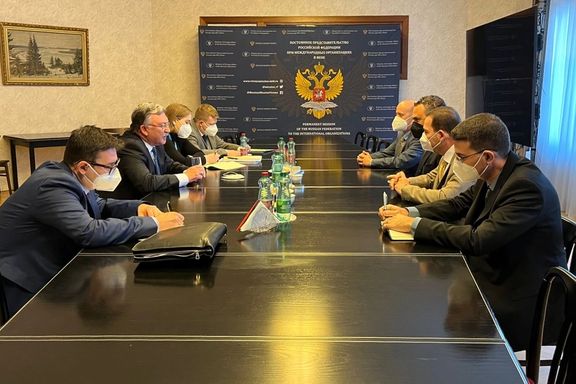
The Israeli delegation meeting with Russian envoy Mikhail Ulyanov in Vienna. February 15, 2022

Israel has sent officials to Vienna to meet participants in talks trying to revive the 2015 Iran nuclear deal, which Israel has opposed.

Nour News – an official Iranian outlet affiliated to the Supreme National Security Council –tweeted that “the overt and unexpected presence of the Zionists in Vienna is undoubtedly a deterrent to progress in the current sensitive situation.”

The Israeli delegation, headed by Joshua Zarka, the foreign ministry’s deputy director general for strategic affairs, met Tuesday with Mikhail Ulyanov, Russia’s top negotiator in the Vienna talks, and Monday with Rafael Grossi, director-general of the International Atomic Energy Agency (IAEA). Although Israel is a member of the IAEA, its nuclear arsenal is not subject to IAEA monitoring as Israel is not a signatory of the Nuclear Non-Proliferation treaty.

Ulyanov played down the significance of Zarka’s trip, tweeting that he had met with “Israeli colleagues from the capital and their Permanent Mission in Vienna” to discuss issues related to the IAEA. Russia has long called on both Iran and the US to return to the JCPOA.

Zarka tweeted in reply: “Thank you for a frank and important discussion.”

The Israeli delegation also met the United States Special Envoy on Iran Robert Malley, who leads a US delegation taking part indirectly in the Vienna talks, as well as representatives from China, France, UK, and Germany.

“Zarka went to Vienna to check what is cooking,” a senior Israeli official told the Axios website. “He met everyone other than the Iranians."


Most Viewed

Ideology may be fading in Iran, but not in Kashmir's ‘Mini Iran'
1
INSIGHT

Ideology may be fading in Iran, but not in Kashmir's ‘Mini Iran'

2
INSIGHT

Hardliners push Hormuz ‘red line’ as US blockade tests Iran’s leverage

3
VOICES FROM IRAN

Hope and anger in Iran as fragile ceasefire persists

4

Iran International says it won’t be silenced after London arson attack

5

US sanctions oil network tied to Iranian tycoon Shamkhani

Banner
Banner

Spotlight

  • Hardliners push Hormuz ‘red line’ as US blockade tests Iran’s leverage
    INSIGHT

    Hardliners push Hormuz ‘red line’ as US blockade tests Iran’s leverage

  • Ideology may be fading in Iran, but not in Kashmir's ‘Mini Iran'
    INSIGHT

    Ideology may be fading in Iran, but not in Kashmir's ‘Mini Iran'

  • War damage amounts to $3,000 per Iranian, with blockade set to add to losses
    INSIGHT

    War damage amounts to $3,000 per Iranian, with blockade set to add to losses

  • Why the $100 billion Hormuz toll revenue is a myth
    ANALYSIS

    Why the $100 billion Hormuz toll revenue is a myth

  • US blockade targets Iran oil boom amid regional disruption
    ANALYSIS

    US blockade targets Iran oil boom amid regional disruption

  • Iran's digital economy battered by prolonged blackout
    INSIGHT

    Iran's digital economy battered by prolonged blackout

•
•
•

More Stories

US Senator In Israel Evokes Holocaust, Calls For ‘Guardrails’ Around Iran

Feb 15, 2022, 16:33 GMT+0

Visiting Israel Monday, United States Republican Senator Lindsey Graham compared Iranians to the Nazis and said they “cannot be ignored.”

Graham repeated his attacks on negotiations underway between Iran and world powers in Vienna to renew the 2015 Iran nuclear program. “When it comes to the Iranian nuclear program, guardrails are missing around Iranian nuclear ambitions”, Graham said, calling for “red lines” over Iran’s stockpile of enriched uranium, ‘weaponization’ of that stockpile, and ability to ‘deliver’ potential weapon.

A supporter of former President Donald Trump withdrawing the US from the 2015 agreement, the JCPOA (Joint Comprehensive Plan of Action), Graham said that while the crisis in Ukraine, or China’s relationship with Taiwan were “important, consequential moments in history… the one we’re not talking about enough is even more consequential: that the Iranians break out and acquire nuclear capability.”

While Russia and China were “rational” if “thuggish,” Graham said, “Iran is a theocracy motivated by religion [Shia Islam] that compels them to purify their faith and have the world submit. The Nazis wanted a master race, and the Iranians want a master religion. People like that cannot be ignored.”

‘There will be war’

Graham then evoked the Nazi holocaust: “I guarantee you the Jewish people can’t live that way…One Holocaust was enough. There will be war. Why can’t Iran have nuclear weapons? Because Israelis say, ‘Never again.’”

As some Israelis pointed out on social media that former top Israeli security and defense officials had supported the JCPOA, Graham met with Prime Minister Naftali Bennett, Foreign Minister Yair Lapid, Defense Minister Benny Gantz, and former premier and close Trump ally Benjamin Netanyahu, who faces a raft of corruption charges.

“I mentioned the idea of formalizing a mutual defense agreement, in very limited circumstances that would involve existential threats to the Jewish state [Israel],” Graham said. “What I’m trying to say is that I want a clear message to be sent in the 21st century, that destruction of the Jewish state means war with the United States.”

Netanyahu discussed a possible defense agreement with Trump in 2019 but Gantz opposed the idea as a departure from Israeli security policy. Rights group Amnesty International recently called for a halt in the US’s substantial arms sales to Israel.

On Friday, Democrat Bob Menendez and Graham introduced a bipartisan resolution that would ‘allow’ any Middle Eastern state access to nuclear fuel if they agree not to enrich or reprocess uranium. As a signatory of the Nuclear Non-Proliferation treaty Iran has the right to enrich uranium for peaceful purposes under international inspections but restricted the program under the JCPOA. Israel maintains a nuclear arsenal outside the NPT without international monitoring.

Saudi Arabia Says It Backs US Efforts To Stop Iran From Getting Nukes

Feb 15, 2022, 12:40 GMT+0

Saudi Arabia's government expressed on Tuesday its support for "US efforts to prevent Iran from acquiring a nuclear weapon," state news agency SPA reported.

The government also thanked the US for supporting the kingdom defending its territory against attacks by Yemen's Iran-aligned Houthi group, SPA said, citing a statement issued after a cabinet meeting.

Negotiations on a new nuclear accord with Iran are underway in Vienna amid growing Western fears about Tehran's accelerating nuclear advances, seen by Western powers as irreversible unless a deal is struck soon.

Saudi Arabia, along with Israel, opposed the 2015 nuclear agreement, JCPOA, and supported former US president Donald Trump's decision to withdraw from it in 2018. So far, Riyadh had not particularly endorsed the Biden Administration's decision to return to the agreement and the talks in Vienna.

State Department spokesperson, Ned Price, said on Monday that the current rounds of talks "is the final decisive stage", adding that “we are going to be a bit more circumspect in terms of progress."

US Will Be 'More Circumspect' About Vienna Progress

Feb 15, 2022, 09:32 GMT+0

US State Department says this is the final decisive stage in nuclear talks with Iran to determine whether a mutual return to compliance with the JCPOA remains a possibility.

During his press briefing on Monday, department spokesperson Ned Price said, “we are going to be a bit more circumspect in terms of progress that we may be seeing on the ground in Vienna precisely because we are in the final stages of what is by any measure a complex negotiation with key stakeholders”.

Asked about the positive comments on the progress made in Vienna by European Union foreign policy chief Josep Borrell and by the Russia’s envoy, he said, “Our European partners as well as China and Russia – all of us urgently seek to achieve an understanding, but time is almost out. Time is very quickly ticking away”.

“We have been very clear that at the current rate of Iran’s nuclear advances, we have little time left, and that’s precisely because at a certain point very soon those nuclear advances will obviate the advantages that the JCPOA, as it was finalized in 2015 and implemented in 2016, initially conveyed”, he added.

Earlier in the day, Iranian Foreign Minister Hossein Amir-Abdollahian discussed with Borrell the latest status of the talks in Vienna, blaming the West for lack of an agreement in nuclear talks and emphasizing that Tehran will not back down from it "red lines."

Iran Says It Will Not Retreat From Its 'Red Lines' In Nuclear Talks

Feb 14, 2022, 23:00 GMT+0

Iran's foreign minister blamed the West for lack of an agreement in nuclear talks in Vienna and stressed that Tehran will not back down from it "red lines."

Iranian Foreign Minister Hossein Amirabdollahian discussed with European Union foreign policy chief Josep Borrell the latest status of the talks in Vienna, Iran's foreign ministry said in a tweet on Monday.

Amirabdollahian said "a lack of serious will on the part of the West to reach a good and credible agreement in Vienna has led to unnecessary prolongation of the talks," the ministry added.

Amirabdollahian also stressed in the call that Iran will not back down from its red lines.

Iran interrupted the negotiations last June for five months as it said its new government needed time to organize. After returning to talks in late November, it demanded to renegotiate issues already agreed upon in the first six rounds of talks from April to June.

Reuters quoted an Iranian official on Monday that Tehran is demanding 300 more US sanctions to be lifted in addition to nuclear-related ones that Washington has already indicated ready to remove.

Iran Reportedly Insisting On More US Concessions In Nuclear Talks

Feb 14, 2022, 16:56 GMT+0

A senior Iranian official commenting on nuclear talks has said, "some 30% of difficult issues remain to be resolved but it is possible to reach a deal by early March".

A Western diplomat also said, "reaching a deal is possible around early March, if all goes well," Reuters has reported. US officials have implied an unofficial deadline to reach agreement by the end of February.

After eight rounds of talks, key bones of contention include Iran’s demand for a US guarantee of no more sanctions or other punitive steps in future, and how and when to restore verifiable restrictions on Iran’s nuclear activity.

A second Iranian official said Tehran was also insisting on being able to seal and store its advanced centrifuges inside Iran, rather than dismantling and sending them abroad, as Western powers have called for.

He said Iran further wants the removal of some 300 extra sanctions on Iranian entities and individuals not related to the nuclear deal.

US President Joe Biden's administration has said it will remove curbs inconsistent with the 2015 pact if Iran resumes compliance with it, implying Washington would leave in place sanctions imposed under terrorism or human rights measures.

US officials have said the Biden administration cannot guarantee that a US government would never renege on the agreement because it is classified as a non-binding political understanding, not a legally binding treaty.

Reporting by Reuters