• العربية
  • فارسی
Brand
  • Iran Insight
  • Politics
  • Economy
  • Analysis
  • Special Report
  • Opinion
  • Podcast
  • Iran Insight
  • Politics
  • Economy
  • Analysis
  • Special Report
  • Opinion
  • Podcast
  • Theme
  • Language
    • العربية
    • فارسی
  • Iran Insight
  • Politics
  • Economy
  • Analysis
  • Special Report
  • Opinion
  • Podcast
All rights reserved for Volant Media UK Limited
volant media logo

IRGC Spokesman Denies Soleimani Had Role In Massive Corruption
Feb 14, 2022, 20:11 GMT+0Updated: 22:25 GMT+0
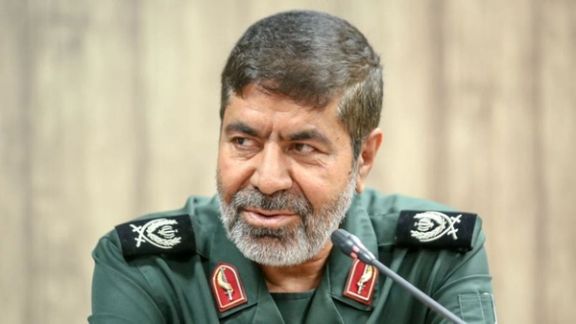
IRGC spokesman Ramezan Sharif.

Commenting on corruption involving the Revolutionary Guards and Tehran Municipality, the IRGC spokesman denied Ghasem Soleimani had any role in the dealings.

Ramazan Sharif was commenting on a story and a 50-minute recording published by the United States-funded Radio Farda based on an audio recording of a conversation in 2018 between former Guards (IRGC) commander Mohammad-Ali Jafari and his Economic Affairs Deputy Sadegh Zolghadr.

Sharif said that the case cited in the recording had been dealt with, presumably referring to the judiciary announcing last year that four defendants had been sentenced to two to 30 years in prison over embezzlement in the case. Human-rights campaigner Emadeddin Baghi has pointed out that the tape had been published on a Telegram channel two years ago. At the time it went unnoticed by media and then the channel closed down and the recording disappeared.

In the audio file, Jafari tells Zolghadr that Soleimani, who was killed by a United States drone attack in Baghdad in 2020, knew about 80,000 billion rials (around $3 billion at the time) held by Tehran municipality and Yas Holding, a firm controlled by the IRGC's Cooperatives Foundation, and had also been aware of corruption allegations before any public indictment and trials.

Supreme Leader Ali Khamenei had high regards for Soleimani. FILE photo
100%
Supreme Leader Ali Khamenei had high regards for Soleimani.

The tape even reveals that Soleimani was upset about the action taken by Jafari and Zolghadr against those who had embezzled the money and spoke to Supreme Leader Ali Khamenei about it.

The funds had been due to reach the Qods (Quds) Force, the IRGC extraterritorial arm, which Soleimani commanded. In the recording, Zolghadr says that Ali Khamenei, Iran’s Supreme Leader, had ordered 90 percent of the money, earned by Yas Holding, to be used to finance the Qods Force with the remainder going to the IRGC for general needs.

In a note Monday, Hossein Shariatmadari, chief editor of the flagship hardliner Kayhan daily, defended Soleimani and others – including Tehran mayor Mohammad Bagher Ghalibaf and the head of IRGC intelligence Hossein Taeb – mentioned in the recording. Most other hardliner media such as the IRGC-linked Javan newspaper are still completely silent about the highly controversial contents of the audio recording but in a note Monday

‘Cleverly lured’

"It was said that the Qods Force was supposed to have a share of the revenues of the said firm,” he noted. “What is wrong or dirty about this?" He claimed the IRGC and judiciary had shown their integrity by prosecuting corrupt individuals.

Shariatmadari also defended Mohammad Bagher Ghalibaf, Tehran mayor at the time, saying he had "cleverly lured" his ex-deputy, Isa Sharif, back to Iran from Canada so he could be prosecuted.

Mahmoud Abbaszadeh Meshkini, spokesman for parliament’s national security committee, Saturday detected “psychological war” in Radio Farda’s publication of the recording. “The ill-wishers have failed to achieve what they sought and use as an excuse to tarnish the IRGC’s image.”

But critics of the Islamic Republic, and specially the economic and political power held by the IRGC were quick to show the recording as proof of deep corruption, that Soleimani and other senior figures were aware of.

The problem for the regime is that in its infinite lack of transparency, once such a scandal reveals itself, all officials involved fall under suspicion. There is no proof in the recording that Soleimani personally benefitted from the corruption, but critics have a right to question everyone's role, since there is no free media in the country or independent courts to investigate the matter.

Former reformist interior minister Mostafa Tajzadeh tweeted Saturday that the case showed a conflict of interest within the military and political establishment. "Can you see the outcome of putting weapons, intelligence, money, and media [in the same hands]?” he wrote. “Is this anything other than the military's control over diplomacy and economy? Is there anyone to hold to account? Is there anyone who dares to prosecute?"


Most Viewed

Ideology may be fading in Iran, but not in Kashmir's ‘Mini Iran'
1
INSIGHT

Ideology may be fading in Iran, but not in Kashmir's ‘Mini Iran'

2
INSIGHT

Hardliners push Hormuz ‘red line’ as US blockade tests Iran’s leverage

3
VOICES FROM IRAN

Hope and anger in Iran as fragile ceasefire persists

4

Iran International says it won’t be silenced after London arson attack

5

US sanctions oil network tied to Iranian tycoon Shamkhani

Banner
Banner

Spotlight

  • Hardliners push Hormuz ‘red line’ as US blockade tests Iran’s leverage
    INSIGHT

    Hardliners push Hormuz ‘red line’ as US blockade tests Iran’s leverage

  • Ideology may be fading in Iran, but not in Kashmir's ‘Mini Iran'
    INSIGHT

    Ideology may be fading in Iran, but not in Kashmir's ‘Mini Iran'

  • War damage amounts to $3,000 per Iranian, with blockade set to add to losses
    INSIGHT

    War damage amounts to $3,000 per Iranian, with blockade set to add to losses

  • Why the $100 billion Hormuz toll revenue is a myth
    ANALYSIS

    Why the $100 billion Hormuz toll revenue is a myth

  • US blockade targets Iran oil boom amid regional disruption
    ANALYSIS

    US blockade targets Iran oil boom amid regional disruption

  • Iran's digital economy battered by prolonged blackout
    INSIGHT

    Iran's digital economy battered by prolonged blackout

•
•
•

More Stories

Media Charge 'Managerial Genocide' At Iran Labor Ministry

Feb 14, 2022, 17:32 GMT+0
•
Iran International Newsroom

In a major purging operation dubbed by Iranian media as a "managerial genocide" populist Labor Minister Hojjat Abdolmaleki says he will fire 1,000 managers.

Abdolmaleki, himself under fire by the Iranian parliament (Majles) for "incompetence" has made many controversial comments during the past six months and has been involved in more controversies by what he did or failed to do.

He started his work as minister last August by promising to create 750,000 jobs at low cost during his first year in office, but after a few weeks he claimed that creating jobs is not part of his responsibilities. Later he had to distance himself from another controversial comment about manufacturing low-price versions of the Italian luxury sportscar Lamborghini in Iran. He even told Iranians to resize the doors of their garages to make them suitable for the new cars.

Abdolmaleki was the first cabinet minister in the President Ebrahim Raisi administration whom lawmakers decided to impeach, but Speaker Mohammad Bagher Ghalibaf temporarily saved him by postponing the procedure for six months.

Now, according to Sazandegi newspaper, Abdolmaleki, a former TV show host, says he has sent 1,120 corruption cases to the court, adding that most of these managers have been charged with financial corruption.

Abdolmaleki is not alone among Raisi aides who are labelled as unfit for senior positions, but hardliners with little experience have dominated the president’s roster of nominees.

According to Aftab News, major purging operations in the administrative system in Iran started in 1981, two years after the establishment of the Islamic Republic, when the Planning and Budget Organization fired at least 750 experts. Later in the same year, the Iranian Oil Ministry fired 2,900 of its employees.

Reformist daily Etemad wrote that since Abdolmaleki was nominated, a catalogue of worrying news about his controversial decisions, behavior, comments and appointments have found their way into the press. The daily stated that concerns caused by the minister's decisions and actions have been so serious that both President Ebrahim Raisi and Vice President Mohammad Mokhber have warned him to avoid adding to the government's problems.

Regardless of the warnings by his superiors Abdolmaleki has been constantly creating new controversies including asking the State Administrative and Employment Organization to approve the employment of 12 of his friends regardless of regulations that preclude their hiring.

According to Etemad, not only Abdolmaleki lacks practical experience and academic credentials, but he also seems to be adamant to repeat his errant behavior.

Abdolmaleki has also been criticized for giving top jobs to the relatives of other officials particularly the members of the ultraconservative Paydari Party. The media in Iran say that the purging operation at the ministry is partly intended to cover up these actions.

Aftab news wrote that the firing of more than half of the labor ministry's managers will cause problems for its subsidiary offices including the Pension Fund and will badly affect businesses and several state-owned companies.

Lawmaker Naser Musavi Largani accused Abdolmaleki of being biased against around 1,200 managers who have graduate degrees. Largani also charged that Abdolmaleki has distributed the ministry's resources among his friends like the spoils of war.

Meanwhile, the Iranian press accused Abdolmaleki of appointing one of his wife's friends as the chief inspector at the ministry. The media charged that this inspector has fabricated cases against the managers Abdolmaleki wanted to fire. Aftab News called on Iran's Public Prosecutor to act. The website reminded that if there were more than 1,000 corrupt managers at the ministry the intelligence agencies and the State Auditing Organization would have certainly known about them.

Fire Breaks Out At IRGC Military Base In Western Iran

Feb 14, 2022, 09:32 GMT+0

A fire broke out in a Revolutionary Guard (IRGC) military base in western Iran, local media reported, but the cause of the blaze was not immediately clear.

The fire started in a stockroom where motor oil and other flammable materials were stored in the Mahidasht district of Kermanshah province Monday morning, according to what government-controlled media said.

Initial reports said an industrial shed was damaged in the fire, which was put out by firefighters.

Teams have been dispatched to the base to investigate the cause of the incident.

Earlier in mid-January, social media reports by journalists and citizens said a series of loud explosions were heard in Western Iran, around the cities of Hamedan and Kermanshah. Some reports quoted Iran's Revolutionary Guard as saying that they launched air defense drills in the region, but residents reported anti-aircraft activity in the area.

Also in January, a large fire sparked by a rupture of an underwater pipeline interrupted production at one of the transmission pipelines of phase 16 of Iran’s South Pars gas field in the Persian Gulf.

Iran has been the scene of mysterious attacks since July 2020 that twice caused explosions in its high-security Natanz uranium enrichment facility, causing major damage.

The frequency of accidents in Iran’s energy facilities is increasing with some blaming lack of proper maintenance of the aging infrastructures and some suspecting sabotage by other countries, presumably Israel.

Critic Says Iran’s Raisi 'Most Inefficient' President In Four Decades

Feb 14, 2022, 08:37 GMT+0
•
Iran International Newsroom

A reformist politician and former official has characterized President Ebrahim Raisi's team as the most inefficient Iranian government since the 1979 revolution.

Gholam Ali Rajaei, also an academic at the University of Tehran, has charged in a February 12 interview published by Rouydad24 website that some of Raisi's aides and cabinet ministers lack executive experience even at middle-management level to occupy posts in any government.

Rajaei said that Iranians are now disillusioned and desperate and have lost their confidence in the government as Iran’s economic crisis gas seriously lowered their living standards.

Similar warnings have multiplied since late 2021 as Iran’s annual inflation hovers around 40 percent and the middle class becomes impoverished.

Meanwhile, Rajai suggested that Raisi should fire his ministers of economy, labor, and industry at once as they are responsible for the administration's most significant weaknesses.

Zaynab Ghabishawi, one of the website's editors added that economic problems, lack of a roadmap, and the performance of incapable managers are to be blamed for the government's inefficiency. Rajaei added to the journalist's comment that most of Raisi's aides and cabinet ministers have never worked even at the level of director generals before being appointed as ministers. He also noted that Raisi himself has spent his entire career in the Judiciary and has no executive experience.

The academic added that although some of Iran's problems have their root in the performance of the previous government, not only the current administration has not been able to improve the situation in the past six months, but it has become worse. "When is the Raisi administration going to launch the plans he was talking about during his election campaign?" Rajai asked.

Rajaei's opinion is corroborated with criticisms made by other observers. The head of Iran's Consumer Support Organization, a price watchdog based in Tehran, told Aftab News website on Sunday that prices of 84 thousand goods in the Iranian market have risen by 120 percent during the past months.

Even some of Raisi's ministers are unhappy about rising prices. Interior Minister Ahmad Vahidi told state television on Saturday that "rising prices in Iran follow no particular logic. Price rises are normally an outcome of scarcity, but prices in Iran rise while there are plenty of goods in the markets."

Vahidi seemed to ignore the rising cost of production as a result of sanctions and other economic factors. He also ignored the fact that the rise in commodity prices inevitably lead to inflation for a range of goods.

The government's solution for the problem is returning to the 1990s punitive regulations that call for the punishment of traders and businesses rather than addressing the root cause of the problem.

Iranian lawmakers have repeatedly called for the impeachment of the same economic ministers Rajaei has mentioned in his interview but knowing that it does not have a true plan to address the problem even if ministers are replaced, the government has been exerting pressure on the parliament to shelve the petitions for impeachment.

Referring to Raisi's much-criticized habit of issuing orders without following them up, Rajaei warned him that "It is time for action, not to issue orders!"

Exclusive: Iran Settling Loyal Shiites On Syrian Border With Israel

Feb 13, 2022, 17:22 GMT+0
•
Iran International Newsroom

Iran bought large tracts of land close to the Syrian Israeli border in recent years and is settling Shiites to threaten Israel, Iran International has learned.

Taking advantage of a destructive civil war in Syria and the ensuing poverty, as well as migrations, Tehran has launched a plan to settle Shiites next to Israel’s northern border, Iran International’s correspondent in Israel reported.

The plan is to settle as many Iranian, Lebanese, Afghan and other Shiites as possible in towns and villages around the Golan Heights. Two areas in particular are Sa’sa and Qarfa where the Revolutionary Guard (IRGC) has enticed loyal Shiites to settle. Many young people in these areas, very close to Israel, are now members of Iranian-backed militia groups, such as Hezbollah or the Afghan Fatemiyoun Brigade.

These forces have been fighting under IRGC command for almost a decade in Syria to keep Bashar al-Assad in power, and when the war turned against rebels, the Iranian military moved closer to the Israeli border.

Qasem Soleimani in Syria. Undated
100%
Qasem Soleimani in Syria. Undated

The United States and Israel in 2017 began putting pressure on Russia, that wields a lot of influence in Syria, to force Iranians to withdraw from the border, and there was talk of a 20–40-kilometer zone free of Tehran militias. But according to information available to Iran International, the arrangement was never fully implemented.

The Lebanese Hezbollah’s Southern and Golan commands are now well-established in the area, in addition to IRGC’s Qods (Quds) Force unit 840.

Settling Shiites near the Israeli border could be a long-term plan by Iran to prevent any such deals between Russia, the US and Israel to have any real impact. Tehran can always argue that it has no military presence in the area, while Shiite settlers would in fact be fighting forces anytime Iran wants to stir up trouble.

The situation on the ground can easily turn into what exists in Southern Lebanon, where an indigenous Shiite population lives, dominated by Hezbollah and facing Israel, which poses a serious threat.

A border fence set up by Israel marks the border with Syria. February 10, 2022
100%
A border fence set up by Israel marks the border with Syria.

Our information also indicates that the Qods forced some Syrians living near Israel to place explosives next to the border security wall to injure or kill Israeli troops, in exchange for $20 for each improvised device.

It is not exactly clear how many settlers Iran has succeeded to bring to the area, but sources say they number in a few thousand.

Israeli sources say that it is Iran’s “dream” to create a threat belt against Israel in Syria, but so far, they claim the cost has been coffins returning to Tehran. Israel has conducted hundreds of air strikes against Iranian bases and weapons depots in Syria, with post-attack reports indicating that at least a few IRGC personnel were killed in each strike.

Israeli sources also say that they have more “surprises” in store for Iranian forces and believe that Qasem Soleimani’s killing by the United States in 2020 played an important role in slowing down Iran’s projects in Syria.

Amid these developments and tensions, the position of Bashar al-Assad is not clear. He has been trying to improve his ties with wealthy Arab states to secure needed financial assistance for rebuilding his devastated country. For him it is crucial to secure his hold over the country and appease the bitterly divided population with reconstruction. Iran’s adventures will harm this objective, but Assad might not be in a position at this time to stop his Shiite saviors unless Russia decides that Iranians should leave Syria.

Leaked Audio File Renews Allegations Of Massive IRGC Corruption

Feb 13, 2022, 12:46 GMT+0
•
Maryam Sinaiee

A leaked audio file of IRGC commanders discussing massive financial corruption involving Parliament Speaker Mohammad-Bagher Ghalibaf has raised a storm in Iran.

The 50-minute audio-file includes a conversation between the former Revolutionary Guards (IRGC) Commander Mohammad-Ali Jafari and his Economic Affairs Deputy Sadegh Zolghadr in 2018 about corruption involving IRGC's Qods Force and Tehran municipality and Ghalibaf, a former IRGC commander himself, who was Mayor of Tehran from 2005-2017. The corrupt dealing took place during Ghalibaf’s tenure as mayor.

The audio recording was published by Radio Farda, the Persian service of US-funded Radio Free Europe, on Thursday.

Some Iranian media have only cautiously reported the comments made by a member of the Parliament's National Security Committee, Mahmoud Abbaszadeh, and tweets by Ghalibaf's media advisor, Mohammad-Saeed Ahadian, both of whom tried to undermine the importance of the audio recording and its contents. The social media, however, is abuzz with hundreds of tweets about the leaked file the authenticity of which has far not been contested by anyone.

Abbaszadeh said Saturday that the publication of the recording was "enemy's psychological war" and warned about "infiltration" in the IRGC which resulted in the publication of the audio file. "We should admit that there is infiltration and that's a sad reality."

Mohammad-Ali Jafari (L) and current IGC commander Hossein Salami. FILE
100%
Mohammad-Ali Jafari (L) and current IGC commander Hossein Salami.

Ahadian, on the other hand, in several tweets claimed that the recording was leaked by Ghalibaf's enemies, he had been proven to be innocent by the Judiciary, and criticized hardliners close to former nuclear negotiator Saeed Jalili who are known as the Justice Seekers (Edalatkhah) of using the recording to attack Ghalibaf.

The discussion in the recording directly involves Ghalibaf, former Qods Force Commander Ghasem Soleimani, IRGC Coordination Deputy Jamaloddin Aberoumand, and Chief of the IRGC Intelligence Organization Hossein Taeb in covering up the embezzlement of 80,000 billion rials (around $3 billion at the time) between Tehran municipality and a firm controlled by the IRGC.

In the recording, Zolghadr tells Jafari that Ghalibaf suggested the IRGC and Tehran Municipality sign a false contract for the same amount to justify the disappearance of the money. "I told him [Ghalibaf[ that this would be a crime," Zolghadr says in the recording, claiming that Ghalibaf met him at a mosque near his house and demanded that he sign the memorandum but he did not agree. "It will harm me, it will harm Jafari, I will not sign it," he tells his boss in the recording.

Jafari tells Zolghadr that Soleimani who was well aware of the corruption, which prevented the funds from reaching the Qods Force, spoke to Supreme Leader Ali Khamenei about it. In the recording Zolghadr says Khamenei had ordered 90 percent of the money earned by Yas Holding to be used to finance Qods Force and the remaining 10 percent to go to the IRGC for its general needs. He also says Taeb who has close ties to Khamenei's office and his son Mojtaba supports Ghalibaf in the matter.

Hossein Taeb, chief of IRGC intelligence (C), with Qasem Soleimani (R). Undated
100%
Hossein Taeb, chief of IRGC intelligence (C), with Qasem Soleimani (R). Undated

Taeb has been accused of corruption in the past and is part of an inner circle of war veterans who served with Mojtaba Khamenei and have an influential network.

The money was mainly intended for funding the activities of Qods Force but somehow disappeared in the dealings between the municipality and Yas Holding, a subsidiary of IRGC's Cooperatives Foundation active in services, dealership, and subcontracting in the housing sector.

Yas Holding was officially dissolved in 2018, two years after its establishment, following the arrest of some of its officials. Four of the accused, including Ghalibaf's deputy in Tehran municipality, Isa Sharif, were put on trial and were sentenced to long prison terms and returning some of the huge sums they had embezzled.





