• العربية
  • فارسی
Brand
  • Iran Insight
  • Politics
  • Economy
  • Analysis
  • Special Report
  • Opinion
  • Podcast
  • Iran Insight
  • Politics
  • Economy
  • Analysis
  • Special Report
  • Opinion
  • Podcast
  • Theme
  • Language
    • العربية
    • فارسی
  • Iran Insight
  • Politics
  • Economy
  • Analysis
  • Special Report
  • Opinion
  • Podcast
All rights reserved for Volant Media UK Limited
volant media logo

Iran's Hardline Kayhan Daily Claims It Voices Khamenei's Policies

Maryam Sinaiee
Maryam Sinaiee

Iran International

Feb 8, 2022, 13:23 GMT+0Updated: 17:40 GMT+1
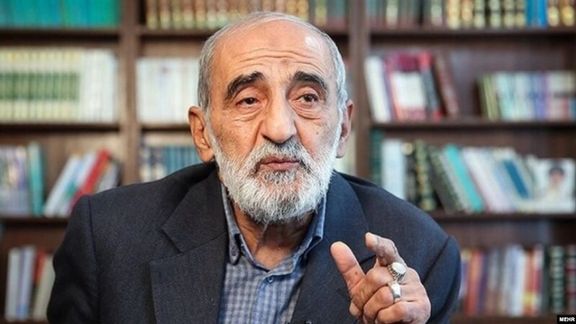
Kayhan's editor Hossein Shariatmadari

An editorial in Kayhan claimed views expressed by its hardliner editor Hossein Shariatmadari were shared by Supreme Leader Ali Khamenei and a unified ‘regime.’

Headlined "Let's Not Deceive Ourselves, Kayhan's Stance Is Leader's Stance," the missive on Tuesday responded to criticism from reformist journalist Ahmad Zeydabadi, who in a Telegram post Thursday wrote that Shariatmadari was behaving as if he is “top authority in the country” by lambasting reformist clerics who had issued a statement finding an “unmistakable crisis” in Iran.

The Kayhan editorial charged that if Zeydabadi were right, then “someone else should be appointed to take the helm of Kayhan… [as] stances put forth by the chief editor of Kayhan have nothing to do with the wish, will, and policies of the system.”

While veteran editor Shariatmadari is Khamenei’s representative at the newspaper, Khamenei has many times declined to follow Shariatmadari’s advice, including over backing talks with Europe two decades ago, with the Americans over Afghanistan and Iraq, and in Iran’s agreeing to limit the nuclear program in signing the 2015 JCPOA (Joint Comprehensive Plan of Action).

But Kayhan’s latest editorial asserted that as a "radical revolutionary," the paper’s chief editor was the first to announce stances the “regime” would subsequently adopt.

Kayhan argued that supporters of a nuclear deal claimed that Supreme Leader's support for the negotiation team led by former Foreign Minister Mohammad-Javad Zarif during the talks was proof of irrelevance of Shariatmadari's criticism, but Zarif's ill fate clearly showed that Shariatmadari's critical stance was the same as the Supreme Leader's stance.

"The one who fell to the ground in the confrontation between Kayhan and Zarif was Zarif, and the one who was honored was Hossein Shariatmadari," the editorial continued. It also reminded readers that Khamenei had last year described as a “big error” Zarif’s criticism of the role in foreign policy of Qasem Soleimani, the Iranian general and Quds Force commander killed by a US drone strike in Baghdad in 2020.

The newspaper was referring to Khamenei's harsh words against Zarif in May 2021 after a leaked audio recording of an interview with him made headlines. In the interview Zarif had strongly criticized the Revolutionary Guards (IRGC) and the former commander of its Qods force, Ghasem Soleimani for hijacking Iran's foreign policy. Without mentioning Zarif's name, Khamenei called the remarks "a big error," that was "regrettable and surprising."

"This was a big mistake that should not have been committed by an Islamic Republic official. The enemies are annoyed by the Qods Force's influence in the region," and one part of the political system should not undermine the other part, Khamenei said.

The editorial went on to suggest it had been Shariatmadari's criticism that had led recently to Ali Shamkhani, secretary of the Supreme National Security Council, retracting a suggestion of the possibility of direct bilateral talks with Washington over the nuclear issue.

Most Viewed

Hardliners push Hormuz ‘red line’ as US blockade tests Iran’s leverage
1
INSIGHT

Hardliners push Hormuz ‘red line’ as US blockade tests Iran’s leverage

2

Iran International says it won’t be silenced after London arson attack

3
VOICES FROM IRAN

Hope and anger in Iran as fragile ceasefire persists

4

US sanctions oil network tied to Iranian tycoon Shamkhani

5

Iran halts petrochemical exports to supply domestic market

Banner
Banner

Spotlight

  • Hardliners push Hormuz ‘red line’ as US blockade tests Iran’s leverage
    INSIGHT

    Hardliners push Hormuz ‘red line’ as US blockade tests Iran’s leverage

  • Ideology may be fading in Iran, but not in Kashmir's ‘Mini Iran'
    INSIGHT

    Ideology may be fading in Iran, but not in Kashmir's ‘Mini Iran'

  • War damage amounts to $3,000 per Iranian, with blockade set to add to losses
    INSIGHT

    War damage amounts to $3,000 per Iranian, with blockade set to add to losses

  • Why the $100 billion Hormuz toll revenue is a myth
    ANALYSIS

    Why the $100 billion Hormuz toll revenue is a myth

  • US blockade targets Iran oil boom amid regional disruption
    ANALYSIS

    US blockade targets Iran oil boom amid regional disruption

  • Iran's digital economy battered by prolonged blackout
    INSIGHT

    Iran's digital economy battered by prolonged blackout

•
•
•

More Stories

Khamenei Urges Iranians To Receive Covid Booster Shot

Feb 8, 2022, 11:22 GMT+0

Iran’s Supreme Leader Ali Khamenei has received his booster shot and urged people to do the same as the omicron variant of Covid-19 has gripped the country.

During a meeting with air force commanders on Tuesday, Khamenei said that he believes in and acts upon the recommendations of doctors and received his third dose of the vaccine a few months ago.

According to Alireza Marandi, Khamenei's personal physician, the supreme leader received the Iranian-manufactured Covid-19 vaccine called Cov-Iran Barakat, but some say political leaders have been inoculated by the AstraZeneca vaccine.

Khamenei had banned the purchase of US and British-made vaccines in January 2021, saying that "Importing vaccines made in the US or the UK is prohibited. They are completely untrustworthy. It is not unlikely that they would want to contaminate other nations… French vaccines are not trustworthy either”.

The number of daily Covid deaths is now over a hundred while daily cases are reported to be about 40,000.

Health authorities, who have said the country is in its sixth wave of the pandemic, warn the figures are expected to increase exponentially during the next two months, stressing that the new variant is also very difficult to detect.

Despite the highly contagious Covid-19 Omicron variant spreading fast across Iran, President Ebrahim Raisi has rejected proposals for a nationwide shutdown.

Hundreds Of Activists Ask 5 Political Prisoners In Iran To End Hunger Strike

Feb 8, 2022, 09:50 GMT+0

Hundreds of rights activists have asked five political prisoners held by the Islamic Republic to end their month-long hunger strike.

In a letter 650 activists said the hunger strike has raised awareness about the conditions of the Iranian prisoners of conscience and garnered support by many human rights organizations from inside and outside of Iran.

The letter urged the prisoners to end their strikes as reports indicate their health is deteriorating.

Shakila Monfared is being held in Qarchak Prison, also known as Rey Women Prison, while Hamid Haj-Jafar Kashani, Sina Beheshti, Mohammad Abolhasani, and Saeed Tamjidi are in Great Tehran Penitentiary, aka Fashafuyeh.

They started their hunger strike four weeks ago to protest neglect by prison authorities and the death of poet and political prisoner Baktash Abtin, who succumbed to Covid-19 complications after he was denied timely treatment by officials at Tehran’s notorious Evin prison.

Tamjidi, one of the prisoners who was arrested during the November 2019 nationwide protests, along with his fellow hunger-striking prisoners, was beaten by guards and medical staff when they were feeling sick and taken to the prison infirmary in late January.

Earlier in January, a young political prisoner, Adel Kianpour, who was on hunger strike to demand a fair trial died in detention without receiving any medical care in the Sheiban prison in the southwestern city of Ahvaz in Khuzestan province.

Pundits Debate Constitutional Change, Ahead Of Post-Khamenei Period

Feb 8, 2022, 09:12 GMT+0
•
Iran International Newsroom

Politicians are debating constitutional changes suggested by a former senior lawmaker, that might turn Iran from a presidential into a parliamentary system.

Last week, former deputy Majles Speaker Mohammad Reza Bahonar suggested to Iran's Supreme Leader Ali Khamenei to put an end to the embarrassing political impasse in Iran and allow strong political parties to compete for parliamentary seats.

Conservative politician and former lawmaker Hossein Kanani Moghaddam said in an interview with Nameh News website that the June 2021 election was probably Iran's last Presidential election and the current political system headed by a president is likely to be replaced by a parliamentary system that elects a prime minister from among the members of parliament.

Moghaddam agreed with Bahonar that Iran's current political system needs a revision. Earlier, Bahonar had suggested that Khamenei should allow forming an assembly to revise the constitution or order a referendum on constitutional changes. The idea, however, was first put forward by Khamenei himself in 2011 when serious differences emerged between him and -then- President Mahmoud Ahmadinejad.

Moghaddam said that more than three decades after the last revision, it is now time to reconsider it and give more opportunities to political parties.

The first revision of the assembly in 1988 was done shortly before Khomeini's death to prevent discord among the politicians after his death. It appears that the call for changes and the debates about how to make them follows the same rationale today.

Reformist politician Mahmoud Mirlohi agreed in an interview with ILNA, that the revision called for by Bahonar means a shift from the presidential system to a parliamentary one. Reminding that the first revision of the Constitutional Law was done under the first Supreme Leader Ruhollah Khomeini, Mirlohi said that the Constitution needs a revision at least once every 10 years. However, he noted that reformists and various conservative groups might have different ideas about such a revision.

The idea could also be a solution to prevent a post-Khamenei crisis of leadership when the new leader would be possibly not as powerful as Khamenei and might face a challenge by a popularly elected president. In a parliamentary system the head of the government would have a weaker position than a president and can be voted out by parliament.

Iran International TV analyst Morad Veisi wrote in a February 6 tweet that while a majority of Iranians favor a secular government, calling for constitutional changes will lend further legitimacy to the dictatorship of Iranian Shiite clerics.

Meanwhile, in an article in Khabar Online on Monday, Columnist Mohsen Mandegari characterized the call for constitutional change as "a dangerous plot" and wrote that what has so far prevented such a revision is the divide between the ruling hardliners and reformists who have been largely pushed out of the core. The ruling conservatives are going to have the upper hand in a constitutional assembly.

Former lawmaker Mehrdad Lahouti also said that the situation is not ripe for attempting a revision of the constitution because a parliamentary system depends on strong and organized political parties, which Iran lacks.

On the other hand, lawyer Mahmoud Alizadeh Tabatabai, a member of the Executives of Construction Party agreed with Bahonar that Iran needs a parliamentary system with two chambers., and Abolghasem Raoufian, the leader of the Islamic Iranzamin Party opined that the constitution is not the word of God, so it can certainly be changed.

Based on the current constitution, the members of a constitutional assembly should be determined by the Supreme Leader. After the assembly ratifies the changes, the Leader will call for a referendum to ratify the changes.

Renewed Push For Open Voting In Iran's Parliament

Feb 7, 2022, 22:13 GMT+0
•
Maryam Sinaiee

Sixty-six Iranian lawmakers demanded Sunday a parliamentary vote on a so-called ‘voting transparency motion.’

In a letter to speaker Mohammad-Bagher Ghalibaf (Qalibaf), the 61 complained that their motion had been “withheld” too long. They insisted any vote should be “transparent” and announced their own votes would be.

Mohammad-Hossein Asafari, a signatory, argued in Khabar Online that the parliament's presidium was obliged to call a vote on any motion backed by at least 50 lawmakers.

None of the 66 signatories was from the small reformist minority. Asafari said that opponents of the motion feared being taken to task by constituents or by rival candidates in future elections. He suggested many parliamentarians were particularly concerned they might be seen as voting against pay increases demanded by employees that the financially hard-pressed government cannot afford.

Many lawmakers might also be concerned that constituents can find out that they vote against their own campaign promises.

But Asafari said “transparency” was nonetheless just as important in parliament as in ministries, the judiciary, and the over-150 state councils that regulate in various areas. "Some of the regulations ratified by them can potentially be a source of economic rente (privilege resulting from undue influence) for certain groups," he alleged.

The term "Vote Transparency Motion" was used in 2017 when the reformist Mohammad-Javad Fathi proposed to amend parliament's procedural regulations but was unable to persuade the conservative-dominated presidium to allow a parliamentary vote despite supporters arguing that Article 69 of the Constitution ruled out secret ballots other than in emergencies, and required parliamentary sessions to be “open, and full minutes of them made available to the public.”

They also said transparency in voting would allow people to evaluate the performance of their representatives and hold them accountable and would also reduce corruption.

"The parliament is the wrong place for the lawmaker who is not brave enough to take responsibility for his vote," Fathi told Tabnak news website back then. The presidium registered a diluted version of the motion, raised by Hossein-Ali Haji-Deligani, in 2018.

But this motion took over two years to reach the parliamentary floor, where it was defeated in February 2021 as the 153 of 234 members present voting in favor was just short of the required two-thirds majority of those present.

That motion called for voting records to be announced unless, in extraordinary circumstances, a motion to the contrary was brought by 15 lawmakers and passed by a simple majority of those members present.

Hacktivist Group Releases Videos, Documents From Iran Prison

Feb 7, 2022, 20:18 GMT+0
•
Iran International Newsroom

A hacktivist group has released footage from closed-circuit cameras in an Iranian prison to prove it hacked the security system of the detention center.

Hacktivist group Edalat-e Ali (Ali's Justice) sent the videos along with some files and classified prison documents to Iran International on Monday to prove they also hacked the computers of Ghezel Heassar prison located in the city of Karaj some 20 kilometers northwest of the capital Tehran.

The video shows security guards' reactions as their camera feeds were being cut off.

The documents received by Iran International include a list of hundreds of prisoners who were arrested during the November 2019 protests and their charges.

Many were sentenced to long term prison sentences and lashes on charges such as taking photos from the protests, parking their cars where the protests were held, having PDF version of forbidden books in their phones, or shouting slogans against the leaders of the Islamic Republic.

Another document, attributed to the judiciary and signed by Tehran’s deputy prosecutor Mir-Mostafa Seyyed-Ashrafi, was about proposed strategies to counter trials and tribunals about Iran’s human rights violations that were held in Europe, including the Netherlands, Sweden, and the UK.

The document contained details about the Stockholm trial of Hamid Nouri (Noury) as a judge and torturer in the 1988 wave of prison executions, and the Iran Tribunal about the mass executions of the 1980s in The Hague, as well as Iran Atrocities Tribunal that probes the 2019 protests that were the bloodiest in Iran’s history.

The document said although the verdicts of such trials are symbolic and non-binding but they can pave the ground for the arrest of Iranian officials abroad, adding that during the tribunals there were calls for President Ebrahim Raisi’s arrest for his role in the mass executions.

The document also mentioned the Albania-based opposition Mujahedin-e Khalq (MEK) and rights activist Masih Alinejad as evidence that the United States is also involved in these tribunals “behind the scenes.”

Last week, the group had also interrupted a website for the online streaming of Iran’s state television and broadcasted a video with a strong opposition message, calling on people to come out to protest.

Edalat-e Ali also released a “highly confidential" document on Twitter Wednesday, which was apparently the minutes from a November meeting of IRGC's ‘Livelihood-Based Security Crises Prevention Taskforce,’ saying the political situation in the country was dangerous.

The group had released a similar media package from security cameras of Evin Prison in August 2021 and claimed responsibility for hacking several Iranian government entities in the past three years.







