• العربية
  • فارسی
Brand
  • Iran Insight
  • Politics
  • Economy
  • Analysis
  • Special Report
  • Opinion
  • Podcast
  • Iran Insight
  • Politics
  • Economy
  • Analysis
  • Special Report
  • Opinion
  • Podcast
  • Theme
  • Language
    • العربية
    • فارسی
  • Iran Insight
  • Politics
  • Economy
  • Analysis
  • Special Report
  • Opinion
  • Podcast
All rights reserved for Volant Media UK Limited
volant media logo

Iran Says Nuclear Issue Can Be Fast Resolved With 'Right Response'
Jan 31, 2022, 11:03 GMT+0
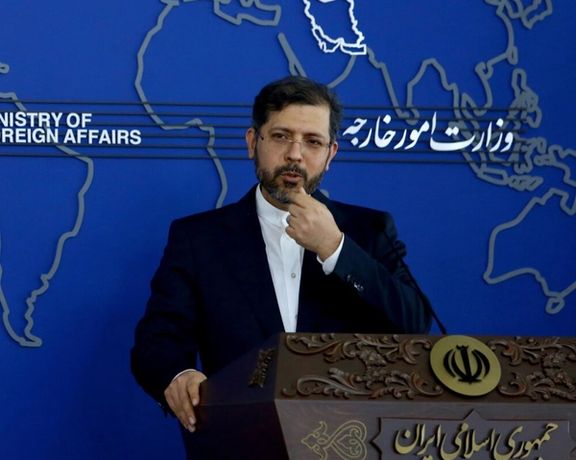
Saeed Khatibzadeh in a press briefing in Tehran. December 27, 2021

A “lasting” agreement on reviving the 2015 Iran nuclear deal is reachable as soon as negotiators return to Vienna, Iran’s foreign affairs spokesman said Monday.

With Iran’s talks with world powers in the Austrian capital paused Friday for political consultations in the various capitals, Saeed Khatibzadeh told reporters at his weekly press briefing that there would be “no need for forged deadlines if the right response is given to what are Iran's natural rights, the texts it has offered, and Iran's lawful demands.”

A “lasting agreement" was possible, the spokesman insisted, "the day after" delegations returned to Vienna as long the right decisions were taken by world powers, especially the United States. Khatibzadeh reiterated that Iran should not be asked to agree to anything beyond the 2015 nuclear agreement, the Joint Comprehensive Plan of Action (JCPOA).

The required decisions, Khatibzadeh said, concerned the "considerable issues” remaining over lifting US sanctions and in reaching "acceptable progress” over Iran’s request for both verification over lifting sanctions and guarantees that Washington would not again renege on the JCPOA.

"We are past the stage of ideas,” Khatibzadeh said. “The Iranian delegation in the past three weeks constructively put everything down in writing. We are now awaiting the response of the other sides."

In a speech Sunday, Supreme Leader Ali Khamenei quoted US State Department spokesman Ned Price to bolster his argument that Iran had beaten US sanctions, an “economic assault” that had harmed Iranians, he said. “But production did not buckle, and the spokesman of America’s foreign ministry a few days ago candidly and unequivocally announced that the maximum pressure policy has turned into a humiliating defeat for America.”

President Donald Trump introduced ‘maximum pressure’ sanctions in 2018 as he withdrew the US from the JCPOA while setting a range of demands including that Tehran end all uranium enrichment, stop its missile defense program, and break its regional alliance. In response after 2019, Iran extended its nuclear program beyond JCPOA limits.

In a telephone talk Saturday, President Ebrahim Raisi reiterated Tehran’s position that removal of sanctions, verification, and credible guarantees were basic requirements for agreement in Vienna.

A senior US official last week argued that the other five world powers − China, France, Germany, Russia, and the United Kingdom − had joined the US in rejecting proposals made by new Iranian negotiators appointed by Raisi, who took office in August, and that talks had returned to the stage reached in June. Iran's delegation met with the Chinese and Russian delegations just before the break in talks announced Friday.

But whatever technical issues remain, US, Iranian and other representatives last weekall stressed the need for political decisions. The Russian envoy to the talks, Mikhail Ulyanov, said the talks had reached an advanced stage requiring political choices.

Ulyanov said the break would not be very long. The eighth round of talks in Vienna, which began on December 27, are to resume sometime this week.

Talk of an ‘interim deal’, steps towards reviving the JCPOA, has subsided at least in public. The idea floated around for months that the US might ‘allow’ the ‘unfreezing’ of Iranian assets held in Asian banks in return for caps on Iran’s nuclear program short of the JCPOA limits.

In his Monday briefing, Khatibzadeh criticized officials in South Korea, which reportedly holds $7 billion of Iranian funds, owed mainly for past oil purchases. “Unfortunately, we don't have a good experience of what Korean officials say,” the spokesman noted.


Most Viewed

Ghalibaf defends Iran-US talks amid hardline backlash
1
INSIGHT

Ghalibaf defends Iran-US talks amid hardline backlash

2
INSIGHT

A nation in limbo: 100 days after the massacre, has the world moved on?

3
ANALYSIS

From instability to influence: Pakistan’s pivotal role in US-Iran diplomacy

4
ANALYSIS

100 days on: why Iran’s January protests spread across social classes

5

War-hit homeowners feel abandoned as Iran’s reconstruction aid fades

Banner
Banner

Spotlight

  • War-hit homeowners feel abandoned as Iran’s reconstruction aid fades

    War-hit homeowners feel abandoned as Iran’s reconstruction aid fades

  • 100 days on: the anatomy of Iran’s January crackdown
    INSIGHT

    100 days on: the anatomy of Iran’s January crackdown

  • Ghalibaf defends Iran-US talks amid hardline backlash
    INSIGHT

    Ghalibaf defends Iran-US talks amid hardline backlash

  • 100 days on: why Iran’s January protests spread across social classes
    ANALYSIS

    100 days on: why Iran’s January protests spread across social classes

  • From instability to influence: Pakistan’s pivotal role in US-Iran diplomacy
    ANALYSIS

    From instability to influence: Pakistan’s pivotal role in US-Iran diplomacy

  • A nation in limbo: 100 days after the massacre, has the world moved on?
    INSIGHT

    A nation in limbo: 100 days after the massacre, has the world moved on?

•
•
•

More Stories

Daily Close To Khamenei Says Iran’s Higher Oil Exports Give Leverage In Talks

Jan 30, 2022, 17:59 GMT+0
•
Iran International Newsroom

The ultra-conservative daily Kayhan in Tehran has claimed that Iran's oil exports have surged recently, giving leverage to its negotiators in the nuclear talks.

According to the Kayhan, "the growth in Iran's trade transactions and the boost in oil sales during the past few months have given the upper hand to Iranian negotiators in Vienna…and they insisted on the Iranian nation's essential demands and conditions."

The Kayhan, affiliated with Supreme Leader Ali Khamenei’s office, quoted Raisi as having said on social media: "Although hard work to eliminate the sanctions are seriously on the government's agenda, efforts to annul the sanctions are not limited to negotiations. Our oil sales have increased to such an extent that we have no financial concerns as the oil money is being repatriated."

The article appeared the same day when Khamenei delivered a speech to manufacturers, saying Iran has defeated the US sanctions and quoted the State Department spokesman to drive home his message.

In mid-January, Oil minister Javad Owji reaffirmed President Ebrahim Raisi's claim that Iran is exporting 40 percent more oil since August and is able to receive the money.

However, Iran’s oil exports had dropped to around 200,000 barrels per day in 2019 when the United States imposed full sanctions. But in late 2020, as former US President Donald Trump lost the election Tehran increased its sales through illicit channels. China is the biggest buyer, with shipments disguised as imports from other countries. Nonetheless, the increase can be hardly attributed to the Raisi administration's effort.

The daily also added that some US senators were annoyed by the development and called on the US President to take firm action against Iran by implementing the sanctions more rigorously.

The Kayhan was referring to a report that said ten Republican Senators wrote to President Joe Biden telling him he is endangering US national security by not enforcing Iranian oil export sanctions. The Senators, including Tom Cotton (R-Arkansas) and Ted Cruz in their letter dated January 28 told Biden that a growing fleet of non-Iranian oil tankers and buyers such as China are not afraid of US retaliation any longer and are trading in hundreds of thousands of barrels of crude oil a day.

The senators had reminded Biden that an increase in Iran's oil export will weaken the United States leverage in the nuclear negotiations in Vienna.

The Kayhan further claimed that it was Raisi's policy of expanding ties with Iran's neighbors and boosting the relations with Russia and China that has led to an increase in oil export. The daily also claimed that now it is Iran that is exerting maximum pressure on the United States. According to Kayhan, "Iran is not waiting for the JCPOA and the train of Iran's diplomacy has not stopped in Vienna."

Meanwhile, reformist daily Sharq during the week questioned the Raisi administration's "success" in boosting oil export and wrote: "As there are no official statistics about Iran's oil sales, it is not clear that the 40 percent rise in oil sales is in comparison to which period. Is it 40 percent more than last year? Or more than the same period in the previous year or more than all figures in the history of the oil industry?" Sharq also noted it is not clear how the oil money is being repatriated, "In dollars, in Euros in yens? And how and through which financial channels?"

Iranian, French Presidents Discuss Vienna Talks In Phone Call

Jan 30, 2022, 09:26 GMT+0

Iranian President Ebrahim Raisi and his French counterpart Emmanuel Macron have discussed ways to quicken the pace of Iran's nuclear talks in Vienna.

In a telephone conversation on Saturday, Raisi reiterated Tehran’s position that removal of sanctions, verification, and credible guarantees are the basic requirements for any deal in Vienna.

Raisi told Macron that "the Islamic Republic has already proven its resolve and seriousness for the realization of the agreement”, adding that any effort by the other side should incorporate Iran’s threefold demands.

Raeisi noted that the US itself has admitted that the former administration's decision to leave the 2015 deal and reimpose the so-called maximum pressure campaign had ended in failure.

During the phone call, Macron insisted that a deal is still possible if all parties give clear and sufficient commitments, stressing the need to accelerate the pace of the talk for achieving tangible progress.

The Élysée said Macron condemned Iran-backed Houthis' attack against the UAE, adding that he also expressed concern about the situation of jailed French national Benjamin Brière.

Macron also asked Raisi to immediately release 62-year-old anthropologist Fariba Adelkhah, who has been detained in Iran since 2019 on vague political charges.

The Iranian and French presidents also talked about the situation in Lebanon, where the influence of Iran-backed militant Hezbollah has sparked tensions in the sectarian country.

Republican Senators Accuse Biden Of Not Enforcing Iran Sanctions

Jan 29, 2022, 09:05 GMT+0
•
Iran International Newsroom

Ten Republican Senators have written to President Joe Biden telling him he is endangering US national security by not enforcing Iranian oil export sanctions.

The Senators, including Tom Cotton (R-Arkansas) and Ted Cruz in their letter dated January 28 told Biden that a growing fleet of non-Iranian oil tankers and buyers such as China are not afraid of US retaliation any longer and are trading in hundreds of thousands of barrels of crude oil a day.

“The vessel owners and their customers in China are taking greater risks because they believe that your administration is too weak and indecisive to punish them for their crimes,” the letter says and accuses Biden of unwillingness to enforce sanctions to keep nuclear talks alive in Vienna.

For the first time in a year, China officially reported in January that it is importing Iranian oil, with US making no public demarche.

The United States imposed partial sanctions on Iran’s oil exports in 2018 when former president Donald Trump withdrew from the Obama-era nuclear agreement known as JCPOA. Full sanctions followed in May 2019, bringing Iranian shipments down to around 200,000 bpd from a high of more than 2 million barrels before the sanctions.

The Republican Senators charged that currently Iran is shipping well over one million barrels per day because, “the boom in oil sales has refilled the Iranian regime’s once-empty coffers, removed crucial American leverage over Iran, and encouraged the Iranians to stall negotiations in Vienna and irreversibly advance their pursuit of a nuclear weapon. It is long past time to stop your dithering. You are putting U.S. national security at risk.”

Arguing that the proceeds from additional oil sales will go to finance the Revolutionary Guard, which is listed as a terrorist organization by the United States, the Senators said, “enforcing oil sanctions against Iran is also enforcing terrorism sanctions against Iran. Bipartisan laws enacted by Congress in 2011 and 2012 targeting Iran’s oil exports and energy sector require the President to enforce these sanctions.”

The Biden Administration has not officially acknowledged that Iran is exporting more oil or that it is not enforcing the sanctions vigorously. If the negotiations in Vienna succeed in restoring the JCPOA, it is expected that oil sanctions will be lifted. Republicans say the talks, which started almost ten months ago are doomed to end either in an impasse or substantial US concessions.

The Biden Administration says its priority and focus is on reviving the 2015 nuclear deal to stop Iran from building nuclear weapons and argues that Trump’s withdrawal from the agreement and its ‘maximum pressure’ sanctions have not stopped the Islamic Republic’s nuclear program or regional aggression.

Earlier in January more than 100 Republican members of Congress wrote to Biden asking him to stop the negotiations and get tough with Iran, which is fast enriching uranium to higher levels.

Iran’s enrichment picket up in early 2021, after Biden said he wants to restore the JCPOA and moved toward opening talks with Iran.

The ten Republican Senators urged Biden to enforce US sanctions, saying, “Each day you delay gives Iran more money to finance their terrorist activity and more time to develop a nuclear weapon. We would also remind you that sanctions against Iran’s oil exports are mandatory and passed Congress with bipartisan majorities. You are not above the law and must stop violating it.”

Iran Nuclear Talks Pause For Consultations And ‘Political Decisions’

Jan 28, 2022, 18:34 GMT+0
•
Iran International Newsroom

A tweet from the European chair of the Iran nuclear talks in Vienna signaled Friday a break as participants “go back to capitals for consultations.”

Enrique Mora, head of staff of European Union foreign policy chief Josep Borrell, wrote that that “political decisions are needed now,” with negotiations expected to resume next week. The eighth round of the talks beginning December 27, he noted, had been “so far the longest” since efforts began in Vienna last April to revive the 2015 Iran nuclear deal, the JCPOA (Joint Comprehensive Plan of Action).

A separate statement from the three European talks participants– France, Germany, and the United Kingdom − noted: "Everyone knows we are reaching the final stage, which requires political decisions."

The Europeans’ reference to political decisions echoed remarks from both Iranian foreign minister Hossein Amir-Abdollahian, who Monday said talks were reaching a point where “we have to make a political decision,” and Brett McGurk, the United States National Security Council Middle East coordinator, who Thursday told a webinar that talks would reach a “culmination point…pretty soon.”

The greatest task in the talks – involving remaining JCPOA signatories (China, France, Germany, Iran, Russia, and the United Kingdom), and indirectly the US – has been agreeing which US sanctions violate the 2015 agreement and how the Iranian nuclear program, which Tehran has developed since 2019, can be returned to JCPOA limits.

Many issues are both technical and political. A French presidential official, speaking to reporters Friday after a telephone call between French President Emmanuel Macron and Russian President Vladimir Putin, said clarification was still needed over nuclear steps Iran needed to take and over Iran’s demand for guarantees that the US would not again leave the agreement.

While many US sanctions introduced since 2018, when President Donald Trump left the JCPOA, are clearly contrary to the agreement, others were introduced on grounds including human rights or links to the Iranian Supreme Leader’s office.

McGurk’s claim to Carnegie that the talks had returned to a point reached last June, when they were suspended pending the Iranian presidential election, illustrated the political challenge that could face new President Ebrahim Raisi, many of whose supporters are long-term JCPOA critics.

Raisi Challenge

While much debate among Iran’s principlists has lately been over possible direct bilateral talks with the US to reach agreement in Vienna, Raisi would need to present a revived JCPOA as more favorable to Iran than anything that would have been agreed by his centrist predecessor Hassan Rouhani.

JCPOA revival is also controversial in the US, where the State Department confirmed earlier this week that Richard Nephew, the Deputy Special Envoy for Iran, had left the negotiation team for another post in the State Department. The Wall Street Journal claimed the move was prompted by Nephew, a seasoned architect of sanctions, failing to achieve a more assertive US approach in the talks.

Biden came to office pledging to revive the JCPOA, which his Republican Party predecessor President Donald Trump, left in 2018, but has faced criticism not just from Republican Congresspeople and lobbyists but from some within his own Democratic Party.

Russia's top negotiator in Vienna, Mikhail Ulyanov, tweeted Friday a cautious prediction: "My instinct tells me that agreement will be reached soon after mid-February."

Iran Lawmaker Says 'No Good News' From Vienna Talks

Jan 28, 2022, 13:38 GMT+0

An Iranian lawmaker says there is no good news from the Vienna nuclear talks because technical issues that are obstacles to revive the nuclear deal are not resolved yet.

Ali Alizadeh, the secretary of the National Security and Foreign Policy Committee at Iran's parliament, said in an interview published on Friday that it is not likely that the negotiations lead to any results in the near future.

Despite numerous reports about Tehran not considering an interim deal with the world powers, Alizadeh said Iran has not yet announced any formal position on whether to approve or reject the plan, which proposed partial steps in sanction removal and halts in the Islamic Republic’s nuclear program.

The suggestion of an interim agreement came first from a European state with the idea focused on releasing Iranian money frozen in Asia. Iran's assets frozen abroad are said to be $50 billion, including $8 billion in South Korea, $3 billion in Japan, and $6 billion in Iraq.

Commenting about the release of Iran's blocked assets, Alizadeh said that with the green light of the Western side and without a media hype, it is happening through Chinese channels instead of the EU-Iran Instrument in Support of Trade Exchanges (INSTEX).

“In other words, the sale of Iranian oil and the return of its money to the country is taking place with no trouble, which can be considered a positive step in motivating the parties to conclude the negotiations”, he said.