• العربية
  • فارسی
Brand
  • Iran Insight
  • Politics
  • Economy
  • Analysis
  • Special Report
  • Opinion
  • Podcast
  • Iran Insight
  • Politics
  • Economy
  • Analysis
  • Special Report
  • Opinion
  • Podcast
  • Theme
  • Language
    • العربية
    • فارسی
  • Iran Insight
  • Politics
  • Economy
  • Analysis
  • Special Report
  • Opinion
  • Podcast
All rights reserved for Volant Media UK Limited
volant media logo

Iran Atomic Chief Says Halting Nuclear Progress A Disillusioning Move

Maryam Sinaiee
Maryam Sinaiee

Iran International

Dec 30, 2021, 15:09 GMT+0Updated: 17:40 GMT+1
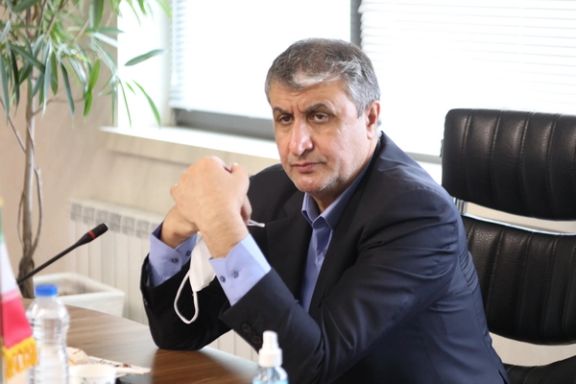
Mohammad Eslami head of Iran's Atomic Energy Organization.

The head of Iran’s atomic organization said Thursday that curbing the sector’s development would disillusion talented young people and those active in the field.

"Nuclear technology…can play an important role for other industries,” Mohammad Eslami told a seminar of nuclear science and technology professors at the Atomic Energy Organization of Iran (AEOI).

“We need to give special attention to this industry for the growth…of the country's industries. Stopping at this sensitive stage will lead to disillusionment of experienced forces and the country's elite youth in the field.”

Eslami’s speech came as discussions continued in Vienna between Iran and world powers over restoring the 2015 Iran nuclear deal, which imposed strict limits on the country’s nuclear program and opened its facilities to stringent inspections by the International Atomic Energy Agency (IAEA).

Eslami extolled the role of Supreme Leader Ali Khamenei in encouraging work on nuclear technology. While the share of nuclear power in electricity production is so far minimal, Tehran wants to build more plants to reduce the use of fossil fuels.

Iran's only nuclear power plant, launched in Bushehr in southern Iran in 2011, contributed only 1.6 percent of electricity produced in calendar year 1399 (21 March 2020 – 20 March 2021). Tehran has agreements with Russia to build two more reactors in Bushehr and last week said it had told Moscow it wanted to use domestically produced fuel in the plant.

Iran insists that its nuclear program is solely for generating electricity and other peaceful purposes including medicine and agriculture. But between 2006 and 2015 the United Nations Security Council (UNSC) passed eight resolutions on Iran's nuclear program, including one in December 2006 imposing sanctions.

Iran's nuclear program began in the 1950 with US help and Tehran ratified the Nuclear Non-Proliferation Treaty (NPT) in 1970. In 2002, the opposition Mujahedin-e Khalq (MEK), then based in Iraq and allied to Saddam Hussein, claimed to expose ‘secret’ Iranian facilities, including the Natanz site, which had not been declared to the IAEA because, Iran said, reporting nuclear material at the site was required under the NPT Safeguards Agreement only 180 days before any was introduced, which it had not been. But later the IAEA found traces of radioactive material at other undeclared sites.

UNSC sanctions were lifted under the 2015 nuclear deal, the Joint Comprehensive Plan of Action (JCPOA), but President Donald Trump in 2018 left the agreement and imposed ‘maximum pressure’ sanctions in Iran.

Iran’s economy that had already suffered setbacks because of previous international sanctions, entered a new phase of serious crisis in 2018, with high double-digit inflation and a rapidly falling national currency.

In February 2021, vice-President Es’haq Jahangiri said US ‘maximum pressure’ sanctions had cost Iran $100 billion in lost revenues, and in May that foreign currency reserves had dropped from $100 billion to just $5 billion. Other spoke of up to $200 billion loss due to the current US sanctions.

Iranian critics of Tehran’s policies and the opposition say that Islamic Republic’s enmity with the United States and its nuclear program have cost the country hundreds of billions of dollars over decades both in money spent and revenues lost. If Iran needs nuclear research for peaceful purposes, that is something available to most countries and there is no need for an ever-expanding, secretive program.

Most Viewed

Iran negotiators ordered to return after internal rift over Islamabad talks
1
EXCLUSIVE

Iran negotiators ordered to return after internal rift over Islamabad talks

2
ANALYSIS

US blockade enters murky phase as tankers spoof signals and buyers hesitate

3
ANALYSIS

Why the $100 billion Hormuz toll revenue is a myth

4

US tightens financial squeeze on Iran, warns banks over oil money flows

5
ANALYSIS

US blockade targets Iran oil boom amid regional disruption

Banner
Banner

Spotlight

  • Hardliners push Hormuz ‘red line’ as US blockade tests Iran’s leverage
    INSIGHT

    Hardliners push Hormuz ‘red line’ as US blockade tests Iran’s leverage

  • Ideology may be fading in Iran, but not in Kashmir's ‘Mini Iran'
    INSIGHT

    Ideology may be fading in Iran, but not in Kashmir's ‘Mini Iran'

  • War damage amounts to $3,000 per Iranian, with blockade set to add to losses
    INSIGHT

    War damage amounts to $3,000 per Iranian, with blockade set to add to losses

  • Why the $100 billion Hormuz toll revenue is a myth
    ANALYSIS

    Why the $100 billion Hormuz toll revenue is a myth

  • US blockade targets Iran oil boom amid regional disruption
    ANALYSIS

    US blockade targets Iran oil boom amid regional disruption

  • Iran's digital economy battered by prolonged blackout
    INSIGHT

    Iran's digital economy battered by prolonged blackout

•
•
•

More Stories

Netanyahu Berates Bennett Over Iran

Dec 30, 2021, 13:02 GMT+0

In his latest spat with current premier Naftali Bennett, former Israeli Prime Minister Benjamin Netanyahu has attacked his rival’s approach to Iran and the Vienna nuclear talks.

“Iran is racing forward while Bennett remains silent and buckles before it, “Netanyahu wrote in a Hebrew tweet Thursday.“The Bennett government is dangerous for Israel.”

Bennett said on Tuesday that Israel would not automatically oppose any agreement reached between Iran and world powers in Vienna. “We are not automatic naysayers. We’re taking a practical approach… Unlike others, we’re not looking to fight for the sake of fighting; rather, we’re trying to bring a result.”

The commitment by the United States administration of President Joe Biden to work to revive the 2015 Iran nuclear deal wrong-footed Israel, which opposed the agreement and is widely held responsible for cyber and military attacks on Iran’s nuclear sites. Bennett, who replaced Netanyahu in June, has reportedly felt a cold shoulder from Biden.

In December Bennett urged world powers to take a far harder line against Tehran in Vienna, telling the Israeli cabinet that Iran “cannot enrich uranium and negotiate at the same time” and “must begin to pay a price for its violations.”

Iranian Envoy Meets European Counterparts In Vienna Nuclear Talks

Dec 30, 2021, 09:51 GMT+0

Iran’s chief negotiator at the Vienna nuclear talks met Thursday with the three European participants in the 2015 nuclear deal, before negotiations take a New Year recess.

The Islamic Republic News Agency (IRNA) reported the meeting saying that the European Union representative at the talks Enrique Mora also took part in the meeting with diplomats from the United Kingdom, France and Germany.

Negotiations began in April to revive the Joint Comprehensive Plan of Action, or JCPOA, to bring the United States back into the agreement after former US president Donald Trump withdrew from the deal saying it was inadequate to prevent Iran from acquiring nuclear weapons.

IRNA reiterated recent optimism expressed by Tehran and Moscow about the chances of an eventual agreement, although the United States and the European troika (E3) have been guarded regarding Iran’s conduct in the negotiations, demanding a faster process.

World powers remaining in the agreement, Russia, China and the E3, met with US representatives in Vienna on Wednesday. The US is not directly participating in the formal JCPOA meetings but is in essence negotiating with Iran through its European allies.

Russian Envoy Says Coordinating With US In Iran Nuclear Talks

Dec 29, 2021, 19:32 GMT+0

The Russian envoy to the Iran nuclear talks said Wednesday that he had met with his US counterpart in Vienna, where the eighth round of talks is taking place.

Russia's Mikhail Ulyanov wrote on Twitter that he had met with the US special envoy to Iran, Robert Malley.

"Close consultations and coordination between the Russian and the U.S. delegations in the course of the Vienna talks constitute an important prerequisite for progress towards restoration of the JCPOA," he wrote.

Ulyanov also tweeted, that world powers which are patricipants in the JCPOA and the United States met Wednesday evening without Iran and "noted with satisfaction positive trens" in the talks.

The talks are about reviving the Joint Comprehensive Plan of Action (JCPOA) by bringing the United States back into the deal through sanctions lifting, and Iran through full implementation of its nuclear commitments.

The United States on Tuesday expressed caution over upbeat comments by Iran and Russia about talks in Vienna to salvage the 2015 Iran nuclear deal, saying it was too soon to say if Tehran had returned to the negotiations with a constructive approach.

With reporting by Reuters

Diplomat: US-Iran Contacts In Nuclear Talks Moving More Quickly

Dec 29, 2021, 19:25 GMT+0

Indirect talks between Iran and the United States in Vienna have picked up pace although challenges remain, a Western diplomat told Iran International Wednesday.

While the nuclear talks in Vienna aimed at reviving Iran’s 2015 nuclear deal – the JCPOA, Joint Comprehensive Plan of Action ­– formally involve remaining JCPOA members and not the US, the central issue in the discussions is squaring the lifting of US sanctions with Tehran curbing its atomic program.

It has been reported that the three western European JCPOA signatories – France, Germany, and the United Kingdom – have been liaising between the formal discussions and the American delegation, which is in Vienna in a separate hotel.

The diplomat, who did not want to be named, said that Iran continued to request a US guarantee that it would not leave the JCPOA once revived, and that Iran specifically would not be satisfied by a verbal guarantee from US President Joe Biden.

According to the diplomat, Tehran had also asked for assurances that Washington would not again impose sanctions that would impede non-American companies from trading with or investing in Iran.

The diplomat said that Iran’s ballistic missile program had not been raised in the talks, which have focused on reviving the JCPOA. Republicans in the US and Israel have been arguing that the US should insist on attaching to the talks a range of demands, including many raised by the administration of president Donald Trump when it left the JCPOA in 2018 and imposed ‘maximum pressure’ sanctions.

When the talks began in April, Biden officials talked of a ‘follow on’ agreement over regional security, but Tehran made clear it was committed to the JCPOA separation of nuclear and other issues, and that it would not make unliteral defense concessions.

Identifying which US sanctions contravene the JCPOA is a major task in the talks. Officials in the Trump administration conceded that many sanctions imposed on other grounds were designed to complicate the task of a successor administration in reviving the agreement.

Since 2018, the US has sanctioned Iranian officials for links to the office of Supreme Leader Ali Khamenei and in 2019 listed Iran’s Revolutionary Guards as a ‘terrorist’ organization.Iran argues that the whole web of US sanctions impedes its ability to trade internationally, although its special concern is US secondary sanctions threatening punitive actions against third parties buying Iran’s oil or dealing with its financial sector.

More Figures In Iran Call For Direct Talks With The United States

Dec 29, 2021, 17:40 GMT+0

After intense talks in Vienna for reviving the 2015 nuclear deal more observers in Iran expressed optimism on Wednesday that an agreement might be within reach.

International relations analyst Ali Bigdeli told the Iranian Labour News Agency ILNA that Iran is determined to reach results in the negotiations, adding that Tehran has reduced its expectations to make sure that it can achieve an agreement.

Meanwhile, Foreign policy commentator and former chief of the Iranian parliament's National Security and Foreign Relations Committee, Hershmatollah Falahatpisheh has said in an interview with Fararu news website in Tehran that "there is a higher likelihood for reaching an agreement although it will be difficult."

Falahatpisheh, who sounded more cautious, said that "generally both Iran and the United States are determined to reach an agreement, while some other JCPOA member states try to disrupt a possible deal."

Iran's top officials are silent about the matter but reports on the website of the official news agency IRNA are also optimistic about a positive change in Vienna.

However, both the United States and its three European allies in the talks sounded much more guarded on Tuesday, saying Iran is not negotiating with sufficient speed.

According to Ali Bigdeli, Iran is adamant to make the talks fruitful and has adopted a softer position. He added that that the Iranian negotiating team in Vienna is more concerned about manoeuvres by hardliners in Tehran than being mindful of what the other sides in the negotiations might say about various issues.

Like most commentators who have talked about the Vienna negotiations during the past week, Bigdeli also agreed that indirect talks with the United States has not been constructive and Iran and America should begin to directly speak with each other. He noted that when the Joint Comprehensive Plan of Action (JCPOA) was being hammered out, US secretary of state John Kerry and Iran’s foreign minister Javad Zarif were the ones who met face-to-face and made the final deal.

Bigdeli said that indirect nature of talks with the US and the influence of Iran's hardliners in Tehran are the two factors that have delayed reaching an agreement in the Vienna talks.

However, international and regional developments as well as the economic crisis in Iran make agreement with the United States an urgent matter, he said.

Meanwhile, Falahatpisheh mentioned the interests of other JCPOA member states as another obstacle in the Vienna talks. He said that France is mainly concerned about winning contracts with Arab states in the region rather than being focused on the JCPOA talks. He added that sometimes the French delegates appear to represent Israel rather than France. Falahatpisheh added that even China and Russia look at the Vienna talks and the JCPOA as a means of securing their own interests.

The former lawmaker added that the current situation is the product of Iran's miscalculations. Iran got the Europeans and others involved in the talks because Iran's hardliners had turned direct negotiations with America into a taboo.

In fact, direct negotiations with the United States has been banned by Supreme Leader Ali Khamenei since 2018.

Falahatpisheh said: "I believe Iran and America are enemies, but they are reasonable enough to solve their confrontation through diplomacy rather than by other means." He said that other players in the JCPOA were involved in the talks as mediators, but they follow their own interests rather than seeking to resolve problems between Iran and the United States.

He stressed that what serves Iran's interests is reducing tensions with the `United States.