• العربية
  • فارسی
Brand
  • Iran Insight
  • Politics
  • Economy
  • Analysis
  • Special Report
  • Opinion
  • Podcast
  • Iran Insight
  • Politics
  • Economy
  • Analysis
  • Special Report
  • Opinion
  • Podcast
  • Theme
  • Language
    • العربية
    • فارسی
  • Iran Insight
  • Politics
  • Economy
  • Analysis
  • Special Report
  • Opinion
  • Podcast
All rights reserved for Volant Media UK Limited
volant media logo

Leading Iran Website: US Hanging 'Damocles Sword' Over Tehran’s Head

Maryam Sinaiee
Maryam Sinaiee

Iran International

Dec 22, 2021, 10:28 GMT+0Updated: 17:28 GMT+1
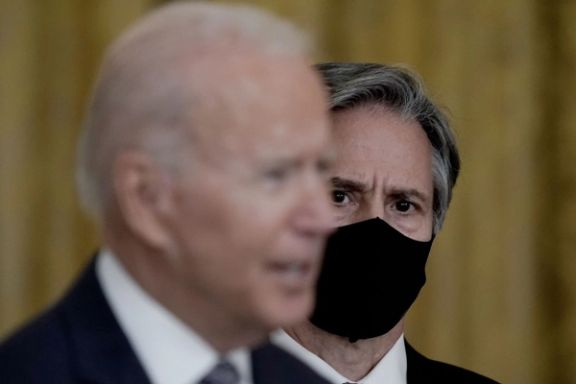
President Joe Biden and Secretary of State Antony Blinken.

A website close to Iran's national security chief Wednesday called United States warnings limiting time available to salvage the 2015 nuclear deal a “Damocles sword.”

As related by the first-century BC Roman philosopher Cicero, the tale of Damocles and his sword represents dangers hanging always above the heads of the powerful.

Nour News, which is close to the SNSC secretary Ali Shamkhani, said in an editorial that “Western” parties to the Vienna nuclear talks aimed at reviving the JCPOA (Joint Comprehensive Plan of Action) had hardened their approach with the phrase ‘time limitation.’

Both the US, which left the JCPOA in 2018 and the three western European JCPOA signatories − France, Germany, and the United Kingdom − have intimated they will soon leave the Vienna talks if Iran does not agree to their proposals, although they have not set a specific deadline.

Referring to the US Secretary of State Antony Blinken and White House Iran envoy Robert Malley's warnings Tuesday of time running out, Nour News said under the headline "Why the West Doesn't Want to Admit Progress in Talks" that they were hanging a Damocles sword over Iran.

Hardline website Jahan News also called their statements "a psychological war operation" aimed at encouraging the Iranian public to put pressure on Tehran’s negotiators to make concessions.

Ali Shamkhani, secretary of Iran's national security council. File photo
100%
Ali Shamkhani, secretary of Iran's national security council.

Malley told CNN Tuesday that “we have some weeks left but not much more than that."

Asked if Iran was “playing for time,” he replied. "If it's their plan I strongly urge them to revisit it."

Malley claimed Iran was “nearing the capability” to develop a nuclear weapon through expanding its nuclear program, referring to steps taken since 2019, the year after the US quit the JCPOA and imposed ‘maximum pressure’ sanctions. Malley said that within weeks there would be no deal to be revived and "a period of escalating crisis" would follow.

Blinken spoke Tuesday of a window rapidly closing. "It's getting very, very short,” he said. “Being able to recover full benefits of JCPOA, by [Iran] returning to compliance with it, is getting increasingly problematic by advances that Iran makes every single day in its nuclear program."

Nour News noted that the US emphasis on closing windows and time running out did not include lifting “unjust and illegal sanctions,” which had to be “one of main pillars of an agreement.” The site pointed to Iran’s nuclear program being “peaceful” and “advancing in accordance with the [Nuclear] Non-Proliferation Treaty.”

Nour News wrote that no party in the JCPOA talks – which include China and Russia: the US participates indirectly – should think one “pillar” of the 2015 agreement could remain in place, meaning restrictions on Iran’s nuclear program, while they were engaged in "destabilizing the other pillar," meaning the lifting of international sanctions.

Nour said it would be "very mistaken" to think Iran would abandon its call for "full, effective, and verifiable lifting of sanctions and a guarantee" that the US would not renege on the deal as it had done before.

Blinken on Tuesday called Donald Trump's withdrawal from the JCPOA in 2018 as "one of the worst decisions made in American foreign policy in the last decade" given that the JCPOA had "put Iran’s nuclear program in a box." He conceded that Trump’s ‘maximum pressure’ had not pushed Tehran into further concessions but rather to expand its nuclear activities and continue to “act aggressively in the region.”

Defenders of a tough policy on Iran argue that Tehran will never make a deal that would permanently stop it from obtaining nuclear weapons or reduce its destabilizing activities in the region. Negotiations with and concessions to Tehran would provide time and resources for it to pursue its current policies.

Most Viewed

Ideology may be fading in Iran, but not in Kashmir's ‘Mini Iran'
1
INSIGHT

Ideology may be fading in Iran, but not in Kashmir's ‘Mini Iran'

2
INSIGHT

Hardliners push Hormuz ‘red line’ as US blockade tests Iran’s leverage

3
VOICES FROM IRAN

Hope and anger in Iran as fragile ceasefire persists

4

US sanctions oil network tied to Iranian tycoon Shamkhani

5

Iran International says it won’t be silenced after London arson attack

Banner
Banner

Spotlight

  • Hardliners push Hormuz ‘red line’ as US blockade tests Iran’s leverage
    INSIGHT

    Hardliners push Hormuz ‘red line’ as US blockade tests Iran’s leverage

  • Ideology may be fading in Iran, but not in Kashmir's ‘Mini Iran'
    INSIGHT

    Ideology may be fading in Iran, but not in Kashmir's ‘Mini Iran'

  • War damage amounts to $3,000 per Iranian, with blockade set to add to losses
    INSIGHT

    War damage amounts to $3,000 per Iranian, with blockade set to add to losses

  • Why the $100 billion Hormuz toll revenue is a myth
    ANALYSIS

    Why the $100 billion Hormuz toll revenue is a myth

  • US blockade targets Iran oil boom amid regional disruption
    ANALYSIS

    US blockade targets Iran oil boom amid regional disruption

  • Iran's digital economy battered by prolonged blackout
    INSIGHT

    Iran's digital economy battered by prolonged blackout

•
•
•

More Stories

US Says Iran Dragging Its Feet At Talks And Speeding Up Nuclear Program

Dec 21, 2021, 10:27 GMT+0
•
Iran International Newsroom

The United States says insufficient progress in Iran nuclear talks has left Washington in an uncertain position as to whether the 2015 deal can be revived.

US Department of State spokesman Ned Price said during a press briefing Monday that there might be some modest progress in talks between Iran and the world powers but if the pace of diplomacy continues to lag, the the 2015 nuclear deal, JCPOA will be a corpse that cannot be revived.

A reporter asked that the Biden Administration has been complaining about Iran's slow pace in the talks but so far the US remains committed to the process.Price responded that progress in the talks “was better than it might have been, but it was worse than it should have been”, putting the US in an uncertain position as to whether the JCPOA is worth saving.

Price pointed out that the talks are going on in an atmosphere of provocation from the Iranians, saying that Iran is accelerating the pace of its nuclear program and leveling up its destabilizing activities in the region. “We can’t accept a situation in which Iran is dragging its feet at the negotiating table but accelerating the pace of its nuclear program back home”, he said.

He acknowledged the arrangement between Iran and the United Nations nuclear watchdog, the IAEA, to restore elements of transparency to international monitoring through reinstalling cameras at Karaj nuclear facility, calling it “a welcome step” but also “a step that never should have been necessary in the first place”.

He noted that there is still “a window of opportunity in which a mutual return to compliance with the JCPOA would be the best option for us, it would be the best option for the other members of the P5+1, it would be the best option for the international community”, because it would still be able to prevent Iran from obtaining a nuclear weapon.

Price, however, added that the US does not waste time and that it is discussing alternatives with partners in the region and beyond, saying, “We continue to watch what Iran does and what Iran says publicly, privately in the context of these indirect negotiations in Vienna… We’re prepared to lift sanctions inconsistent with the JCPOA, as long as Iran places itself back within the strict confines… in terms of the stringent verification and monitoring”.

Answering a question about Iranian-backed militias or proxies across the region, the spokesman said that the decision to walk away from the deal by the Trump administration in 2018 was supposed to “result in a so-called better deal, that would cow Iran and its proxies, that would leave the United States in a stronger position...And across every one of those promises, we’ve actually seen the opposite take place”.

“Across all of our concerns with Iran whether it’s its nuclear program, whether it’s support for terrorism, whether it’s support for proxies, whether it is destabilizing influence in the region, I think it is fair to say that every single one of our concerns has become more pronounced since 2018”, price said.

Defenders of a tough policy on Iran maintain that Iran will never make a deal that would permanently stop it from obtaining nuclear weapons or reduce its destabilizing activities in the region. Negotiations with and concessions to Tehran would provide time and resources for it to pursue its policies.

Price also spoke about the possibility that a nuclear deal might not address the concerns about the broader array of Iran’s destabilizing activities and behaviors throughout the region, noting that Washington is not sitting on its hands when it comes to Iran’s other “malign activities”.

“Iran’s support for armed groups threatens international and regional security. It threatens our forces, our diplomatic personnel, and our partners in the region and elsewhere. We as an administration are committed to countering the destabilizing influence and role that Iran is playing throughout the region, including with its support to proxies”, he said.

In another briefing on the same day, White House Press Secretary Jen Psaki said that due to the way that the Iranians have participated in the last round of talks in Vienna, President Joe Biden has asked the national security team “to be prepared in the event that diplomacy fails and to take a look at other options. And that has been work that has been ongoing, including in consultation with a range of partners around the world”.

Tehran Should Hold Direct Talks With Washington, Iran Pundits Say

Dec 21, 2021, 09:03 GMT+0
•
Iran International Newsroom

Tehran should avoid miscalculations and should convince Supreme Leader Ali Khamenei to allow direct talks with the United States, pundits say in Iran.

Asr Iran, a moderate-conservative website published an article by Amir PasadehpourMonday saying Iran should take the step before it runs out of time to reach a settlement and avoid the final blow to its extremely weakened economy.

Similar opinions are more often expressed by some Iranian media outlets and public figures recently.

The article said that decisions made by Iranian nuclear negotiators in Vienna are often based on a miscalculation that avoiding direct talks with the United States delegation will humiliate America in the same way that the seizure of the US embassy in Tehran weakened the Carter Administration in 1979.

However, Pasandehpour argued that while the US public was sensitive to the hostage crisis, it really does not care much about what is taking place in Vienna. He added that miscalculating the situation could be dangerous for Iran.

Meanwhile, Pasandehpour added that unreliability of information coming from the Iranian negotiators about the Vienna talks has forced Iranian media and pundits to make judgements solely based on Western media.

During the past weeks, while the Iranian negotiating team and its leader Ali Bagherti-Kani insisted that there were no differences of opinion between the Iranian and other negotiators, it turned out every time that Western negotiators later denied Bagheri's statements.

In the latest case, while the Iranian negotiators last week said that the talks have led to desirable results, US National Security Adviser Jake Sullivan warned that there has been no progress in the talks and stressed that time was running out for any settlement. The E3 delegates also concurred with Sullivan.

Pasandehpour said that under the circumstances it was unlikely that the two sides could reach an agreement even in the next round of the talks.

Another miscalculation Iranian negotiators make is to believe have that as mid-term Congressional elections approach, the US sides, particularly those at the White House desperately need an agreement with Iran as a winning chip in the election. In fact, the author says, domestic issues are far more important in the elections than international issues.

Meanwhile, another moderate conservative website in Iran, Aftab News, highlighted the difference of opinion between the Iranian team and other negotiators about whether Iran has accepted the agreements made in the first six rounds of the talks as a basis for further negotiations. The website wrote that it is not yet clear whether the two sides are moving toward an interim agreement or even the previous agreement is falling apart.

Jalal Sadatian, a former Iranian ambassador to the United Kingdom, told Aftab News that negotiators usually approach each other with some distrust. That is how Western negotiators look at Iran and they have made Bagheri aware of it. Moreover, Iranian analysts believe that Tehran has no roadmap for the talks about the nuclear issue, and matters relating to human rights and terrorism.

Iran also wants a guarantee that the US will never leave a new agreement. Sadatian said it is highly unlikely that the current President of the United States can provide a guarantee that on behalf of a future president.

Foreign relations commentator Ali Bigdeli told Aftab News, "Bagheri has said that Iran and Western countries agree over 80 percent of the current draft agreement. This was the same 80 percent agreement that was made under the Rouhani administration." In other words, there has been no progress in the talks since the new negotiators took over several weeks ago.

Iran Spokesman Says No Direct Talks With US In Vienna

Dec 20, 2021, 13:18 GMT+0
•
Maryam Sinaiee

Iran's foreign ministry spokesman Saeed Khatibzadeh has said there were no direct bilateral talks with the United States during the Vienna nuclear negotiations.

Jake Sullivan, the United States national security advisor, told reporters in Washington Friday that the US had “communicated…directly to Iran.” He did not explain whether this was by letter, email or face-to-face meeting.

“I’m not going to say more publicly about what those precise messages are because I believe that Iran understands them,” Sullivan explained, saying that he did not want to "negotiate publicly" with Tehran.

Khatibzadeh reiterated Monday Iran’s position that the Vienna talks were between the remaining members of the 2015 nuclear deal – China, France, Germany, Iran, Russia, and the United Kingdom – with the US, which left the JCPOA in 2018, taking part indirectly.

"Certain messages [from the US] were conveyed via Enrique Mora [the senior European Union official chairing the Vienna talks] in written and verbal form since the beginning of the talks in Vienna regarding the subject of the negotiations, nothing more than that, and they were immediately responded to," Khatibzadeh said.

Asked if Iran intended to increase its uranium enrichment from 60 to percent 90 precent if the Vienna talks failed to revive the JCPOA, the spokesman said Iran had “always adhered to its obligations under safeguards and the NPT,” a reference to the Nuclear Non-Proliferation treaty, which commits signatories to civil use of nuclear technology and accepting monitoring by the International Atomic Energy Agency (IAEA).

The spokesman noted that following legislation in December 2020, passed after the killing of an Iranian nuclear scientist widely attributed to Israel, Iran stopped implementing the NPT's Additional Protocol, which gave additional access to the IAEA and was required under the JCPOA.

"The level, amount and quality of enrichment is in line with the needs of Iran's peaceful nuclear program, and the agency was aware of what Iran has done so far," Khatibzadeh said.

Others have pointed out that Iran’s 60-percent uranium enrichment has no civilian use and can only have significance as a stepping-stone to full 90-percent enrichment needed for a bomb.

No political implications

Mikhail Ulyanov, Russian ambassador to the IAEA, last week suggested that a lack of direct contact between the US and Iran hampered the talks. The JCPOA was itself preceded by extensive contacts between the administration of President Barak Obama and Iranian officials, initially well away from media spotlight.

Ulyanov on December 15 tweeted a photo of US, Russian and Chinese diplomats at a meeting. "As you can see, Russians sit together with Americans. But it has no political implications," he noted.

Iran’s Supreme Leader Ali Khamenei has banned direct talks with the United States and when Tehran returned to the talks in Vienna on November 29, Khatibzadeh stressed that there would be no direct talks with the American team in the talks.

In an interview with Ensaf News website published Monday, foreign policy analyst Reza Nasri criticized Supreme Leader Ali Khamenei over Iran not agreeing to involve the US directly in Vienna. Nasri argued that Iran dealt directly with Saudi Arabia. "Are we only to talk to countries that are friends and ethical?" he asked.

Referring to Ulyanov's tweet, Nasri claimed the Russian envoy was suggesting the three countries had "negotiated about Iran's fate while Iran held on to its political restrictions instead of getting directly involved in the process."

Israel Cannot Destroy Iran's Nuclear Program, Former Officials Say - NYT

Dec 18, 2021, 19:00 GMT+0

Current and former Israeli military officials have said that Israel does not have the ability to inflict significant damage on Iran’s nuclear infrastructure.

In recent months Israeli officials, nervous about a new agreement between the United States and Iran, have repeatedly said they will take action to defend their nation if Iran is believed to be close to producing a nuclear bomb.

But The New York Times reported Saturday that current and former Israeli military figures and experts doubt Israel has the capability to destroy or significantly delay Iran’s nuclear program, which is dispersed throughout the large country and some hidden underground.

Experts and officials said that a small-scale attack damaging parts of Iran’s infrastructure might be possible in months while a large attack would take two years to prepare and are currently beyond Israel’s capabilities. One former Israeli general said the only air force capable of a sustained attack is the US Air Force.

Since July 2020, many mysterious sabotage attacks have hit Iran’s sensitive installations, including two devastating explosions at Natanz uranium enrichment site, widely attributed to Israel. These have caused some slowdown, but Iran continues to enrich uranium at higher levels, getting closer to having enough fissile material for a bomb.

Russian Envoy: Dialogue With US Productive, Iran Talks May Resume Soon

Dec 18, 2021, 12:38 GMT+0

Russia’s envoy in the Vienna nuclear talks with Iran has said that his talks with the US side were good and an eight round might begin on Dec. 27 or Jan. 3.

Mikhail Ulyanov, Russian ambassador to the International Atomic Energy Agency, told the official Tass news agency there was no clarity over the date but that his discussion with Robert Malley, the United States special envoy on Iran, “seems to be productive.”

"The pragmatic cooperation between our delegations in the course of the Vienna Talks is very important,” Ulyanov tweeted Friday after meeting with Malley. In his recent tweets Ulyanov has highlighted his contacts with Malley, and the Russian ambassador told Tass Friday he was “quite satisfied with the quality of our cooperation.”

Ulyanov said that both the US and Russia wanted to revive the 2015 nuclear deal, the JCPOA (Joint Comprehensive Plan of Action) and to lift “the US sanctions imposed under the Donald Trump administration.” Ulyanov said this was “the basis we can build cooperation on.”

But Jake Sullivan, the US National Security Advisor. said Friday the talks in Vienna were “not going well,” and that Washington had communicated its “alarm” through the Europeans over Iran’s expanding nuclear program.

As the US withdrew from the JCPOA in 2018 and imposed ‘maximum pressure’ sanctions on Iran, Washington takes part only indirectly in Iran’s Vienna talks with remaining JCPOA signatories – China, France, Germany, Russia and the United Kingdom.

Ulyanov noted that lack of direct communication between the US and Iran in an interview with Iran International in Vienna December 12 and said the main responsibility for mediation lay with the European Union, whose senior official Enrique Mora chairs the talks.

On December 15, Ulyanov tweeted about a meeting of Russia, China, and the US on the sidelines of the talks. "As you can see [in the photo,] Russians sit together with Americans. But it has no political implications," he wrote. Ulyanov held a separate meeting with Malleythe same day.

Russia has long argued that the US should lift ‘maximum pressure’ sanctions and that Iran should scale back the aspects of its nuclear program, expanded since 2019, that contravene the JCPOA.

Ulyanov told Tass Friday the Russian delegation in Vienna was “ready to work without breaks.” He said there were two options for continuing talks: “either to resume the work on December 27, at least the expert level within the framework of the eighth round, or on January 3, when everyone is ready...”

The European troika – France, Germany, and Britain – said Friday Iran had asked for the new halt in the talks. The lead Iranian negotiator Ali Bagheri-Kani told the Iranian Students News Agency (ISNA) Saturday that it has been agreed in advance that a break would be taken once “a draft of the agreement was made.”

Bagheri-Kani told reporters in Vienna Friday evening that the next round of talks could be the last: “We can reach an agreement in the shortest possible time.”






