• العربية
  • فارسی
Brand
  • Iran Insight
  • Politics
  • Economy
  • Analysis
  • Special Report
  • Opinion
  • Podcast
  • Iran Insight
  • Politics
  • Economy
  • Analysis
  • Special Report
  • Opinion
  • Podcast
  • Theme
  • Language
    • العربية
    • فارسی
  • Iran Insight
  • Politics
  • Economy
  • Analysis
  • Special Report
  • Opinion
  • Podcast
All rights reserved for Volant Media UK Limited
volant media logo

Military Spy Chief Confirms Israel’s Role In Soleimani Killing
Dec 20, 2021, 20:04 GMT+0
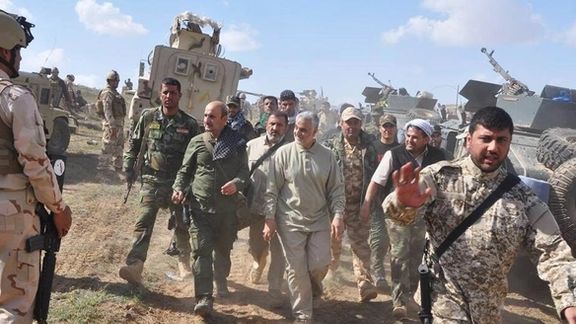
Iran's Qasem Soleimani in Iraq with pro-Iran Shiite militia. Undated

A top Israeli intelligence official has confirmed his country’s role in the assassination of Iranian Quds Force commander Qasem Soleimani last year.

The former head of Military Intelligence, Major-General Tamir Hayman, disclosed the information in an interview with an Israeli magazine.

Soleimani was killed in a targeted US drone strike as he arrived at Baghdad airport on January 3, 2020.

A few days after he was killed, NBC News reported that Israeli intelligence helped the US through its informants at the Damascus airport who tipped off the CIA about the time Soleimani's plane took off for Baghdad.

Another report published in Mayhad said that Israel gave the US access to Soleimani’s multiple cellphone numbers to help track him, but no top official had acknowledged Israel’s role before.

“The assassination of Soleimani was an achievement since our main enemy, in my eyes, is Iran,” Hayman said. “It is rare to locate someone so senior who is also the operator on the ground, the strategist and the fighter.”

He added that Israel has carried out multiple operations to disrupt the spread of Iranian weapons and funds throughout the region but described Soleimani’s killing as one of “two significant and important assassinations” during his tenure, the other being Islamic Jihad leader Baha Abu al-Ata.

“We thwarted a lot of ways they tried to smuggle weapons and money and the headline of all of this is stopping the Iranians from entrenching themselves in Syria,” he said.


Most Viewed

US blockade enters murky phase as tankers spoof signals and buyers hesitate
1
ANALYSIS

US blockade enters murky phase as tankers spoof signals and buyers hesitate

2

US tightens financial squeeze on Iran, warns banks over oil money flows

3
INSIGHT

Ideology may be fading in Iran, but not in Kashmir's ‘Mini Iran'

4
INSIGHT

Hardliners push Hormuz ‘red line’ as US blockade tests Iran’s leverage

5
VOICES FROM IRAN

Hope and anger in Iran as fragile ceasefire persists

Banner
Banner

Spotlight

  • Hardliners push Hormuz ‘red line’ as US blockade tests Iran’s leverage
    INSIGHT

    Hardliners push Hormuz ‘red line’ as US blockade tests Iran’s leverage

  • Ideology may be fading in Iran, but not in Kashmir's ‘Mini Iran'
    INSIGHT

    Ideology may be fading in Iran, but not in Kashmir's ‘Mini Iran'

  • War damage amounts to $3,000 per Iranian, with blockade set to add to losses
    INSIGHT

    War damage amounts to $3,000 per Iranian, with blockade set to add to losses

  • Why the $100 billion Hormuz toll revenue is a myth
    ANALYSIS

    Why the $100 billion Hormuz toll revenue is a myth

  • US blockade targets Iran oil boom amid regional disruption
    ANALYSIS

    US blockade targets Iran oil boom amid regional disruption

  • Iran's digital economy battered by prolonged blackout
    INSIGHT

    Iran's digital economy battered by prolonged blackout

•
•
•

More Stories

Kuwait Stops Issuing Visas For Iranian Merchants

Dec 20, 2021, 17:36 GMT+0

The head of Iran-Kuwait Joint Chamber of Commerce in Tehran says Kuwait has stopped issuing visas for Iranian businesspeople.

Hani Feysali made the remarks in an interview on Monday, clarifying that the Iranian traders who are still doing business with Kuwait are those who have already been residents there.

He added that trade ties between the two countries have dropped drastically, mentioning the covid-19 pandemic as one of the reasons behind the plunge.

Iran has been losing trade also as a result of US sanctions, which impose banking restrictions on Tehran.

According to official figures by the Iranian Customs Administration, exports to Kuwait in the first eight months of the Iranian calendar year (beginning March 21) was over $90 million. The amount of Iran’s annual exports was $190 million two years ago before the coronavirus hit the world.

Feysali had earlier said that due to Iran’s weak diplomacy, bilateral trade has been recording a downward trend in recent years as its total volume fell from $400 million in 2020 to $18 million last year.

Most trade between Iran and Kuwait is through Khorramshahr and Abadan ports. Foodstuff and construction products such as cement and plaster constitute most of Iran’s exports.

Iran Politician Says Foreign Policy Mistakes Lead To Tehran's Isolation

Dec 20, 2021, 16:40 GMT+0
•
Iran International Newsroom

A former senior Iranian lawmaker has said that by repeated foreign policy mistakes for 40 years Tehran has lost many opportunities and has isolated itself.

Heshmatollah Falahatpisheh, former chairman of parliament’s National Security and Foreign Policy Committee, in an interview with Iran Diplomacy in Tehran has said that the Islamic Republic has a habit of persisting in its mistakes until it is forced to retreat, paying a high price each time.

As an example, the former lawmaker mentioned Tehran’s decision last week to “voluntarily” cooperate with UN’s nuclear watchdog, the International Atomic Energy Agency (IAEA) and allow it to install new cameras at a nuclear workshop that it refused to permit for months. Once world powers began discussing the issue at the UN Security Council, suddenly President Ebrahim Raisi’s government retreated and announced its willingness to cooperate, Falahatpisheh said, adding that he does not believe for a moment this was a voluntary decision. It was simply the specter of the Security Council that forced Iran to cooperate.

“Tehran, with its wrong decisions opens the door to its own isolation by losing opportunities that other countries…grab,” Falhatpisheh said. In four decades, the Islamic Republic has still not learned that by “piling crisis upon crises” it cannot solve any of them, he said. “We still witness wrong and costly decisions.”

Falahatpisheh, as is customary in public discourse of politicians in Iran, also attacked Israel, calling it a “destructive power”, along with “some Persian Gulf states”.

In order to be able to criticize the government, public figures in their discourse usually attack Israel, the United States and any other country on Islamic Republic’s blacklist at a given moment.

As Iran’s economic crisis has worsened, more public figures have come out criticizing the Raisi administration’s foreign policy, particularly its strategy in the Vienna nuclear talks. Pundits can often get away with targeting the government, but no one would dare to mention Supreme Leader Ali Khamenei, who is the real foreign policy decision maker.

Falahatpisheh argued that Iran’s nuclear issue has only three sides: Iran, The United States and the IAEA. All the rest, including the European troika, China, Russia and side players like Israel and some Arab sates have entered the fray because of Iran’s wrong policies. He added that Iran’s mistake of “sticking to its taboo”, rejecting direct negotiations with the United States has only complicated the situation and allowed others to try to take advantage for their own interests.

The former influential lawmaker, who is not considered a reformist, maintained that if Iran reaches an agreement with the United States and restores the 2015 nuclear deal (JCPOA), “Israel will face isolation” if it attacks Iran.

Iran Planning To Test Higher Fuel Prices In Designated Areas

Dec 20, 2021, 16:00 GMT+0

Iran plans to increase gasoline prices in its free economic zones as a test to have better control over the possible consequences of a potentially risky move.

The chairman of the Energy Committee of Iran’s parliament, Fereydoun Abbasi, said on Monday that Kish and Qeshm free economic zones are suitable places to test the plan, to prevent the repeat of the 2019 widespread bloody protests.

In November 2019 a sudden increase in fuel prices led to immediate protests that turned into anti-regime unrest, with security forces killing hundreds of people.

Abbasi, who is the former head of Iran’s nuclear agency, added that for any energy policy to work, it must be tested in a smaller scale, and should be thoroughly examined, considering the realities of peoples’ lives, before scaling up to the national level.

“We need to compare people's incomes with their expenses. People in our society should not be malnourished,” he said

Struggling economically due to stiff sanctions and meager oil exports, the Islamic Republic cannot continue to provide heavily subsidized fuel and electricity, which are the cheapest in the world in par with Venezuela.

At the same time the government is fearful of mass protests by citizens who have become poorer in the past few years.

Iran Says Talks With Saudi Arabia Have Had No Results

Dec 20, 2021, 11:26 GMT+0

Iran says talks with Saudi Arabia have not produced any results despite a meeting between its foreign minister and his Saudi counterpart in Pakistan on Sunday.

During his weekly briefing with reporters on Monday, Iranian Foreign Ministry Spokesman Saeed Khatibzadeh said that there is no progress or development in the negotiations between Iran and Saudi Arabia.

Khatibzadeh made the comment in reaction to reports about a meeting between Foreign Minister Hossein Amir-Abdollahian and his Saudi counterpart Prince Faisal Bin Farhan Al Saud on the sidelines of the 17th Extraordinary Session of the Organization of Islamic Cooperation Council of Foreign Ministers in Islamabad.

Noting that it was an unofficial and quick meeting, the spokesman said Tehran is still waiting for Riyadh to prove its seriousness to continue the negotiations. “The fifth round of talks between Iran and Saudi Arabia has not been held or scheduled”, he stated.

Khatibzadeh also said Iran calls on the Saudis to stop "interfering in the domestic affairs of other countries", in a possible reference to the conflict in Yemen where the countries have been supporting opposite sides.

Iran and Saudi Arabia have held several rounds of talks since April aimed at mending the relations. The two countries severed diplomatic ties in 2016.

Iran Oil Minister Says Technology Needed To Boost Falling Output

Dec 20, 2021, 10:29 GMT+0

Iran’s oil minister said Monday that output at many oil wells has fallen from 50,000 barrels p/d to 1,000 and local expertise should help restore production.

Speaking at an event dedicated to research at the oil ministry, Owji urged Iranian young scientists to help the oil industry and raise production to much higher capacity, which he insisted is possible for the country. He said only 30 percent of oil reserves are currently accessible and 700 oil wells can benefit from infusion of technology to revive production.

Throughout years of American and international sanctions on finance and technology transfers, Iran’s oil and gas industry is in a bad need for infusion of investments and assistance of large oil companies with the necessary knowhow to maintain production.

In early November Owji said that Iran needs $160 billion of investments to avoid becoming a net importer of oil and gas in the future.

Sanctions and Iran’s inefficient economic system have used up most of Iran’s oil income throughout the 43-year existence of the clerical government in Tehran, leaving its most vital source of wealth in need of serious rejuvenation.

Owji also said natural gas consumption is rising 10-12 percent annually in Iran while production cannot keep. Natural pressure is falling at many extraction sites and Iran needs superior technology to prevent fall in gas production.