• العربية
  • فارسی
Brand
  • Iran Insight
  • Politics
  • Economy
  • Analysis
  • Special Report
  • Opinion
  • Podcast
  • Iran Insight
  • Politics
  • Economy
  • Analysis
  • Special Report
  • Opinion
  • Podcast
  • Theme
  • Language
    • العربية
    • فارسی
  • Iran Insight
  • Politics
  • Economy
  • Analysis
  • Special Report
  • Opinion
  • Podcast
All rights reserved for Volant Media UK Limited
volant media logo

UN Inspector Warns Of Possible ‘Gaps’ In Iran Nuclear Program
Iran International Newsroom
Dec 14, 2021, 18:13 GMT+0Updated: 17:25 GMT+1
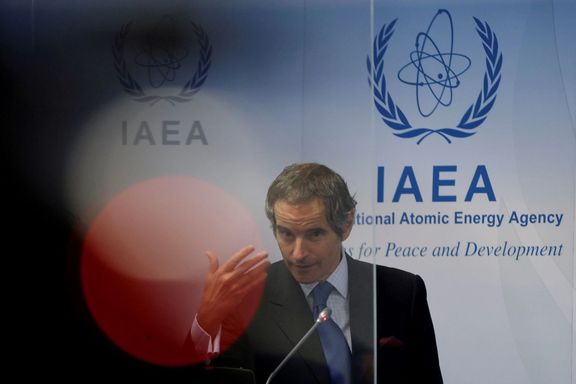
Rafael Grossi, head of the UN's International Atomic Energy Agency.

Rafael Grossi, the UN nuclear agency’s chief, has told Associated Press Tuesday that his agency’s picture of the Iranian atomic program was becoming “blurred.”

Speaking in Abu Dhabi, Grossi, head of the International Atomic Energy Agency (IAEA), said the agency faced a special problem with restricted access to the Karaj manufacturing plant, which was hit by a drone strike in June.

The IAEA chief said this would remain challenging even if better access were restored. “When we start to put that jigsaw puzzle together again there might be gaps,” he explained. Karaj’s role in producing “parts for centrifuges, radars, tubes,” Grossi continued, was “essential for the rest of the process, for the enrichment itself.”

Diminishing access

Grossi has argued for some time that Iran has backtracked over Karaj since he reached an arrangement in Tehran September over agency inspectors’ access to service monitoring equipment, including cameras.

September was the latest in temporary IAEA-Iran understandings since Tehran decided early in 2021 to limit inspections more or less to those required under the Nuclear Non-Proliferation agreement. Iran has justified limiting access to Karaj in terms of a security review following the drone strike, which was widely attributed to Israel.

The IAEA chief’s remarks to AP came as Iran’s talks with world powers continued in Vienna with the aim of reviving the lapsed 2015 nuclear deal, the JCPOA (Joint Comprehensive Plan of Action).

While the IAEA has no direct role in the talks, it would have responsibility for monitoring the JCPOA once revived. In the meantime, the agency is the main source of information on Iran’s nuclear program, both from its inspectors and as the conduit for direct Iranian reports.

Grossi told AP that the IAEA’s ability was diminishing to provide comprehensive information, including over the manufacture at Karaj of centrifuges, the devices used to enrich uranium.

Iran’s use of more advanced centrifuges than those permitted under the JCPOA has emerged as a bone of contention in talks, as more advanced models allow quicker and more efficient enrichment of uranium. Mikhail Ulyanov, Russia’s representative in the Vienna talks and its IAEA ambassador, said Monday that centrifuges were an “acute issue” in negotiations.

Grossi told AP that the agency needed a clear idea of centrifuges production. While this is not required as part of Iran’s ‘safeguards commitments’ under the NPT, which are limited to direct nuclear work, it was possible under the JCPOA.

‘An illusion’

“If the international community through us, through the IAEA,” Grossi told AP, “is not seeing clearly how many centrifuges, or what is the capacity that they may have, then…what you have is a very blurred image…an illusion of the real image, but not the real image…It sounds technical and boring, but it's very important."

Grossi noted that his contacts since September had shown the new government under President Ebrahim Raisi (Raeesi) had “a different take from the previous administration.” As well as “strong views about the interactions that Iran has been having with its counterparts within the JCPOA, and beyond,” Grossi said, “the president himself and the people around him have been saying very clearly that they have views about the nuclear program.”

Grossi said he wanted to tell Iran there was "no way around" the IAEA and its inspectors if Iran wanted to be "a respected country in the community of nations." He stressed: "We have to work together.”


Most Viewed

US blockade enters murky phase as tankers spoof signals and buyers hesitate
1
ANALYSIS

US blockade enters murky phase as tankers spoof signals and buyers hesitate

2
INSIGHT

Ideology may be fading in Iran, but not in Kashmir's ‘Mini Iran'

3
INSIGHT

Hardliners push Hormuz ‘red line’ as US blockade tests Iran’s leverage

4
VOICES FROM IRAN

Hope and anger in Iran as fragile ceasefire persists

5

US sanctions oil network tied to Iranian tycoon Shamkhani

Banner
Banner

Spotlight

  • Hardliners push Hormuz ‘red line’ as US blockade tests Iran’s leverage
    INSIGHT

    Hardliners push Hormuz ‘red line’ as US blockade tests Iran’s leverage

  • Ideology may be fading in Iran, but not in Kashmir's ‘Mini Iran'
    INSIGHT

    Ideology may be fading in Iran, but not in Kashmir's ‘Mini Iran'

  • War damage amounts to $3,000 per Iranian, with blockade set to add to losses
    INSIGHT

    War damage amounts to $3,000 per Iranian, with blockade set to add to losses

  • Why the $100 billion Hormuz toll revenue is a myth
    ANALYSIS

    Why the $100 billion Hormuz toll revenue is a myth

  • US blockade targets Iran oil boom amid regional disruption
    ANALYSIS

    US blockade targets Iran oil boom amid regional disruption

  • Iran's digital economy battered by prolonged blackout
    INSIGHT

    Iran's digital economy battered by prolonged blackout

•
•
•

More Stories

Russian Envoy Opens Lid On Iran Nuclear Talks

Dec 14, 2021, 12:24 GMT+0
•
Maryam Sinaiee

Russian envoy to the Vienna nuclear talks has revealed that Iran's centrifuges, devices used to enrich uranium, are an "acute issue" in the negotiations.

"There is an option to transfer them abroad, there is an option to destroy them,” Mikhail Ulyanov was quoted by the official news agency Tass Monday as saying. “There is also an option to stockpile them in Iran and put them under IAEA guarantees, seal them and so on. We can agree on what option to use.”

Ulyanov revealed that “this is only one of tens of issues that we will have to resolve.” Talks were progressing "not too fast", but still "moving forward," he said.

Tehran has yet not reacted to Ulyanov's disclosure. In a tweet Tuesday, top negotiator Ali Bagheri-Kani said European negotiators – those of France, Germany, and the United Kingdom – were persisting in a "blame game habit instead of real diplomacy."

The day before, senior diplomats from the ‘E3’ offered a pessimistic evaluation of the talks in a statement. Neither the E3 statement nor the Bagheri-Kani tweet referred to discussions about centrifuges, and the E3 statement seemed to contradict any notion, like Ulyanov’s, that the talks had reached nitty-gritty issues.

"We proposed our ideas early and worked constructively and flexibly to narrow gaps; diplomacy is a two-way street,” Bagheri-Kani wrote. “If there's real will to remedy the culprit's [the US] wrongdoing, [the] way for [a] quick good deal will be paved.”

The E3 statement claimed "time was running out" to rescue the JCPOA, which would become "an empty shell" as they had not yet "not been able to get down to real negotiations" with Iran.

US Secretary of State Antony Blinken said Tuesday at a news conference in Indonesia that while pursuing diplomacy, Washington was "actively engaging with allies and partners on alternatives." This followed a flurry of reports on US discussions with Israel on attacking Iran. Given it left the JCPOA in 2018, the US is involved in the Vienna talks indirectly.

According to Iranian and Russian readouts of a telephone call Monday, Russian foreign minister Sergey Lavrov told Iran’s Foreign Minister, Hossein Amir-Abdollahian, that all US sanctions are “inconsistent with the JCPOA” should be removed.

Iranian government spokesman, Ali Bahadori-Jahromi said Tuesday that the “West” wanted “to keep and even increase sanctions.”

Spinning centrifuges

Iran’s use of centrifuges has reportedly been a central issue in the talks that began in April. The JCPOA limited Iran to 6,100 centrifuges, nearly all first-generation IR-1s.

Since the US left the deal and imposed ‘maximum pressure’ sanctions, Iran has introduced more advanced and efficient centrifuges including the IR-4, IR-5, and IR-6, and used them to enrich and stockpile uranium enriched to 20 percent and 60 percent. Under the JCPOA Iran enriched only to 3.67 percent.

But returning to JCPOA limits has been complicated by Israel attacks that destroyed older centrifuges – some have claimed that 90 percent of centrifuges at the Natanz plantwere unusable – that Iran has replaced with more advanced ones. Back in April, then president Hassan Rouhani made great show of inaugurating new centrifuges following the “terrorist” strikes.

On the third day of the latest round of talks beginning November 29, the International Atomic Energy Agency said Tehran had at the underground Fordow facility started enrichment to 20 percent purity with a cascade of 166 advanced IR-6 machines.

Iran's 1044 IR-1 centrifuges, set up in six cascades, are still being used for 20 percent enrichment. According a later IAEA report of December 1, another 94 IR-6 machines have been installed at Fordow but are not yet operating.

Iran Rejects IAEA Demand To Access Karaj Nuclear Workshop

Dec 14, 2021, 11:18 GMT+0

Iran's nuclear chief said Tuesday demands by the UN nuclear watchdog IAEA for access to a workshop making centrifuges are beyond NPT and unacceptable to Tehran.

He was referring to an installation in Karaj, west of Tehran that was the target of a sabotage attack in June, IAEA monitoring cameras were damaged in the incident and Iran has been refusing access fro the UN watchdog to replace the equipment.

"Karaj ... is outside of safeguards ... We act within the framework of safeguards and NPT (nuclear Non-Proliferation Treaty) and do not accept anything else," the head of Iran's Atomic Energy Organization, Mohammad Eslami, said.

Eslami said that monitoring in the Karaj facility is related to the 2015 nuclear agreement, JCPOA, and when the United States has withdrawn from the agreement and imposed sanctions, Iran has no reason to cooperate.

The IAEA has said that without access to the Karaj facility, it cannot guarantee of being fully informed about Iran’s nuclear activities.

Nuclear talks underway since April in Vienna to restore the JCPOA have so far failed to make breakthrough. The United States and its European allies have become pessimistic over Iran’s negotiating posture.

Iran Nuclear Deal Will Soon Be 'Empty Shell', Europeans Warn

Dec 13, 2021, 21:50 GMT+0

Western diplomats say they still have not had real nuclear negotiations with Iran, and unless there is swift progress that deal will soon be "an empty shell.”

Diplomats from the United Kingdom, France and Germany, forming the E3 group in the Vienna talks with Iran to revive the 2015 deal, expressed their concerns in a joint statement on Monday.

"As of this moment, we still have not been able to get down to real negotiations," the statement said. "Time is running out. Without swift progress, in light of Iran's fast-forwarding of its nuclear program, the JCPOA will very soon become an empty shell," they said, using the deal's full name, the Joint Comprehensive Plan of Action.

Iran returned to the talks at the end of November after suspending participation for five months. The new negotiating team representing hardline president Ebrahim Raisi refused to continue the talks on the basis of understandings reached in the previous rounds from April to June. They put forth new demands, which the United States and the E3 dismissed.

As time passes without an agreement, Iran continues to enrich uranium to 60-percent purity, getting closer to a level when it would need only weeks to have a large enough stockpile for a nuclear bomb.

With reporting by Reuters

Signs Emerge Of A Softer Iranian Approach In Nuclear Talks

Dec 13, 2021, 12:28 GMT+0
•
Maryam Sinaiee

With signs that the Iran nuclear talks in Vienna are a bit more serious than two weeks ago, pundits are queuing to proclaim a softening in Tehran’s stance.

Iran's lead negotiator, Ali Bagheri-Kani told state television Sunday the atmosphere in Vienna was "very serious and based on mutual respect with the approach that [all] sides want to reach an agreement." He said Iranian negotiators remained committed to the framework of the 2015 deal, the JCPOA (Joint Comprehensive Plan of Action).

Bagheri-Kani denied that Iran had withdrawn from any earlier stances. He made no mention of three issues raised by Tehran when talks resumed two weeks ago: compensation for the billions of dollars in damages caused by United States ‘maximum pressure’ sanctions after the US left the JCPOA in 2018, guarantees that the US would not again quit the agreement, and procedures for verifying the lifting of sanctions

Iran's state media today has focused more on the European JCPOA signatories − France, Germany and the United Kingdom members in its criticism and less on the US. "The stance of the European countries is even greedier than the American side," the Tasnim news agency Sunday quoted a “source close to Iranian negotiators” as saying. The US takes part in the Vienna talks indirectly.

The official news agency (IRNA) also quoted an “informed source” in an unattributed commentary Monday headlined "Negotiators Beat Western Media Sabotage Attempts.” This highlighted negative reports in western media, after the first week of resumed talks, based on briefings from European officials rubbishing written proposals put forward by Tehran.

"Iran seriously seeks an agreement," the commentary insisted, with the source saying the media briefings had been aimed at pressing Iran into accepting demands beyond the JCPOA. There has been speculation since the talks began in April that the US wanted to extend the length of the JCPOA or add an Iranian commitment to future talks on regional security or to unilateral curbs on its missile defense.

Mikhail Ulyanov, the Russian envoy to the talks who had described Iran's most recent approach to the talks as "unfortunate," told Iran International Sunday that the atmosphere last week was more constructive. "No demarches, no breaks, just normal business-like dialogue," he noted.

In a tweet Sunday Ulyanov said all JCPOA participants – China, France, Germany, Russia, and the United Kingdom plus the United States – had met Sunday evening without Iran to discuss the way ahead. The meeting followed an earlier trilateral meeting of Russia, China, and Iran. Ulyanov also wrote Sunday that for the first time during the seventh round of the talks, which started November 29, a working group on implementation, tasked with sequencing respective steps by Iran and the US to revive the JCPOA, had met.

Some Iranian pundits have also spoken of a softening in the negotiating team's position, possibly due to a greater understanding of the positions of China and Russia.

"It appears that from inside the country [top authorities] have ordered the negotiation team that an agreement must be reached in Vienna," the reformist daily Arman-e Melli quoted Jalal Sadatian, a former ambassador to London, in an editorial headlined “Mandate for Agreement Issued.”

Sadatian suggested this might have followed a failure to gain Chinese support for a tougher stance, and from the US and E3 drawing closer. "It appears that Iran has realized that its maximum demands cannot be met and has therefore accepted to work on the basis of what was previously agreed [in June],” he said.

Talks involving the previous administration led by President Hassan Rouhani went three months − ending in June pending the Iranian presidential election − without reaching agreement.

Others have suggested Iranian negotiators were responding to senior ayatollahs. Foreign Minister Hossein Amir-Abdollahian visited Qom, the main concentration of Iranian Shiite seminaries and senior clerics, just ahead of the latest round of talks. While warning Iranian negotiators to “count their fingers” after dealing with the Western powers, Ayatollah Abdollah Javadi-Amoli told Amir-Abdollahian that Iran should negotiate and couldn’t “live in isolation.”

Exclusive - Russian Envoy Says Iran Nuclear Talks Are Now On 'Right Track'

Dec 12, 2021, 19:01 GMT+0
•
Maryam Sinaiee

Russia's envoy in Vienna told Iran International TV Sunday that after a rough start last week, Iran's nuclear talks are progressing more constructively.

Mikhail Ulyanov described the atmosphere of this week's talks as much more constructive compared to last week when he said time was wasted. "No demarches… Just normal business-like dialogue," Ulyanov said after a meeting of delegations in an apparent reference to the Iranian negotiators' approach last week.

"We are on the right track, we don't waste time, we maintain dialogue, we arrange meetings at expert level, at higher level, like this one," he said, adding that he was "fully satisfied".

He also noted that as far as he knows, US President Joe Biden is "fully committed to successful conclusion of these talks" and that Biden and Vladimir Putin both want the 2015 nuclear deal, the Joint Comprehensive Plan of Action (JCPOA) to be restored. Ulyanov also said the European Union's External Service was "doing a great job" as a mediator between Tehran and Washington.

Ulyanov stressed that talks are based on the text prepared in June after the six rounds of talks before the Iranian elections. President Ebrahim Raisi’s hardliner government trying to disregard understandings reached in talks during the former Iranian administration insists that current negotiations are based on two texts it presented to the other negotiators last week.

The Group of Seven (G7) foreign ministers meeting in Liverpool Sunday warned Tehran that time is running out to revive the JCPOA. The final communique from the G7 meeting said Iran "must stop its nuclear escalation and seize the opportunity to conclude a deal, while this is still possible.”

Britain, the current rotating president of G7, said the nuclear talks in Vienna that resumed after a five-month hiatus were the Islamic Republic's "last chance to come to the negotiating table with a serious resolution".

"There is still time for Iran to come and agree this deal," British Foreign Secretary Liz Truss told a press conference Sunday while emphasizing that the Islamic Republic will not be allowed to build a nuclear bomb.

Truss was the first among the officials of the JCPOA signatories to give a clear ultimatum to Tehran last week and she repeated the warning on Sunday.

A senior US State Department official said Saturday there was an "intense" conversation among the G7 countries, which were united in their position on the nuclear talks, adding that “time is shrinking, so we're united in that.”

Speaking after meetings with her G7 counterparts in Liverpool, Germany's foreign minister Annalena Baerbock Saturday told reporters that time was running out to revive the nuclear deal with Iran and complained that it had shown in the last days that no progress had been made.

Iran's top negotiator, Ali Bagheri-Kani told the state-run Press TV Sunday that European countries had failed to offer any constructive initiative or proposal. "European parties fail to come up with any initiatives to resolve differences over the removal of sanctions," he said.

Bagheri-Kani also told Press TV that unresolved differences over sanctions have remained from the previous talks held before President Ebrahim Raisi's election. The differences, especially on the nuclear issue, are numerous and varied,” he said.

Bagheri-Kani also told Lebanon's pro-Iranian Al Mayadeen TV Sunday that Tehran's approach during the recent negotiations was successful and good progress was made which will pave the way for "serious negotiations".