• العربية
  • فارسی
Brand
  • Iran Insight
  • Politics
  • Economy
  • Analysis
  • Special Report
  • Opinion
  • Podcast
  • Iran Insight
  • Politics
  • Economy
  • Analysis
  • Special Report
  • Opinion
  • Podcast
  • Theme
  • Language
    • العربية
    • فارسی
  • Iran Insight
  • Politics
  • Economy
  • Analysis
  • Special Report
  • Opinion
  • Podcast
All rights reserved for Volant Media UK Limited
volant media logo

State Media Say No Retreat From Iran's Demands In Vienna Talks
Dec 10, 2021, 11:37 GMT+0
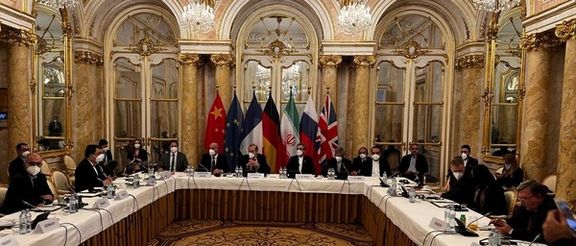
Iran nuclear negotiators in session in Vienna. December 9, 2021

After a report that Iran is ready to work on the basis of earlier nuclear talks, state media insisted there has been no change in Tehran’s negotiating posture.

A European source quoted by Reuters had said earlier Friday that Iran was willing to continue the Vienna talks on the basis of texts prepared in June and added that world powers would test in the next couple of days whether this was true.

Iran government news website IRNA claimed on Friday that talks are progressing based on proposals Iran made last week, while the United States and its European allies had dismissed two documents Iran had presented as a basis of talks.

Tasnim news agency affiliated with the Revolutionary Guard said that there has been no change in Iran’s negotiating position. The agency quoted a source close to Iran’s negotiating team that “Our negotiating position has not been changed and [Iran] has not taken back its draft [proposals]. The other parties have accepted to continue talks on the basis of Iran’s demands.”

It is not clear if Iran's denials of accepting the June agreement as basis for more talks is aimed at a domestic audience to portray toughness.

The new government in Tehran has been demanding that all US sanctions imposed since Donald Trump withdrew from the nuclear deal to be removed at once before it agrees to scale back nuclear activities it has expanded since 2019.

Talks on reviving the 2015 Iran nuclear deal resumed on Thursday with the United States and Israel ramping up the rhetorical pressure on Tehran about the possible economic or military consequences if diplomacy fails.

Iran's top negotiator said at the Thursday session that Tehran was sticking to the stance it laid out last week, when the talks broke off with European and U.S. officials accusing Iran of making new demands and of reneging on compromises worked out earlier this year.

"Iran said it accepted to work from the June texts. This will now be put to the test over the next couple of days," the source said, speaking on condition of anonymity.

Working groups to discuss sanctions Washington might lift and the nuclear curbs Tehran needs to observe convene on Friday.

"Iran's seriousness is obvious. See who has cancelled other meetings and is in Vienna and who is not," Iranian negotiator Ali Bagheri Kani told Reuters.

His comments suggested he was alluding to the United States' chief negotiator Rob Malley, who is not expected to arrive in the Austrian capital until the weekend.

"Negotiations on Iran’s (new) drafts are going on," Bagheri Kani added.

Western officials have said Iran has abandoned any compromises it had made in the previous six rounds of talks, pocketed those made by others, and demanded more last week.

Iran wants all sanctions imposed by the United States after then-U.S. President Donald Trump ditched the deal in 2018, to be lifted in a verifiable process. Iran began violating the deal's nuclear restrictions about a year after the U.S. withdrawal.

Most Viewed

Ideology may be fading in Iran, but not in Kashmir's ‘Mini Iran'
1
INSIGHT

Ideology may be fading in Iran, but not in Kashmir's ‘Mini Iran'

2
INSIGHT

Hardliners push Hormuz ‘red line’ as US blockade tests Iran’s leverage

3
VOICES FROM IRAN

Hope and anger in Iran as fragile ceasefire persists

4

Iran International says it won’t be silenced after London arson attack

5

US sanctions oil network tied to Iranian tycoon Shamkhani

Banner
Banner

Spotlight

  • Hardliners push Hormuz ‘red line’ as US blockade tests Iran’s leverage
    INSIGHT

    Hardliners push Hormuz ‘red line’ as US blockade tests Iran’s leverage

  • Ideology may be fading in Iran, but not in Kashmir's ‘Mini Iran'
    INSIGHT

    Ideology may be fading in Iran, but not in Kashmir's ‘Mini Iran'

  • War damage amounts to $3,000 per Iranian, with blockade set to add to losses
    INSIGHT

    War damage amounts to $3,000 per Iranian, with blockade set to add to losses

  • Why the $100 billion Hormuz toll revenue is a myth
    ANALYSIS

    Why the $100 billion Hormuz toll revenue is a myth

  • US blockade targets Iran oil boom amid regional disruption
    ANALYSIS

    US blockade targets Iran oil boom amid regional disruption

  • Iran's digital economy battered by prolonged blackout
    INSIGHT

    Iran's digital economy battered by prolonged blackout

•
•
•

More Stories

Iranian Media Say No Change In Nuclear Negotiating Position

Dec 10, 2021, 10:42 GMT+0

After a report Friday that Iran is willing to work on the basis of earlier nuclear talks Tehran media insisted there has been no change in negotiating posture.

A source quoted by Reuters said that Iran was willing to continue the Vienna talks on the basis of texts prepared in June and added that world powers would test in the next couple of days whether this was true.

Iran's Tasnim news agency affiliated with the Revolutionary Guard said Iran has not changed its negotiating position.

The official government news website IRNA also reiterated that diplomats in Vienna are reviewing Iran's new proposals.

Working groups to discuss sanctions and the nuclear aspects of reviving a 2015 deal will begin on Friday.

The first six rounds of nuclear talks in Vienna drafted texts that the new Iranian government did not recognize as an a basis of new talks. It argued for everything to be renegotiated, demanding that all post-2018 US sanctions be removed at once before it would return to compliance with the 2015 nuclear deal, JCPOA.

The United States and its European allies were dismayed by Iran’s new demands and have warned that time is running out for progress in the talks.

"Iran said it accepted to work from the June texts. This will now be put to the test over the next couple of days," the source said, speaking on condition of anonymity.

White House Warns Iran Sanctions Will Increase If Talks Fail

Dec 10, 2021, 08:48 GMT+0

The White House has warned Iran that if the nuclear talks fail and Tehran’s nuclear “program continues to accelerate”, it has no choice but intensify sanctions.

In her daily briefing on Thursday spokesperson Jen Psaki reiterated that President Joe Biden remains committed prevent Iran from acquiring nuclear weapons through diplomacy. “However, given the ongoing advances in Iran's nuclear program, the president has asked his team to be prepared in the event that diplomacy fails, and we must turn to other options and that requires preparations,” she said.

The Biden Administration decided to return to the 2015 nuclear agreement, JCPOA, abandoned by the former president Donald Trump, and as soon as it took office negotiations began in Vienna in April between the signatories of the agreement.

Diplomats said the talks had made some progress, but Iran has now ramped up its demands, insisting on all US nuclear sanction to be removed at once, which has led to a deadlock.

Asked about what threshold or deadline for the US is to decide that talks have failed, Psaki refused to be specific.

"I'm not going to present a deadline today, but what I can tell you is that we have presented a diplomatic path forward. That path is still open, but based on the outcome of the last round of talks and the ongoing advancements in Iran's nuclear facilities, we are laying the path, the groundwork for another path entirely. So it's just meant to be preparations,” the White House spokesperson said.

The Vienna talks resumed on Thursday, but the first session lasted just one hour, and Iran said that it is standing firm on its position.

State Department spokesman Ned Price told reporters on Thursday it will take a few days to judge whether Iran is showing flexibility in the talks.

"It will probably (be) another couple of days until we have sense of where the Iranians are in the context of the restart of this round and ... the flexibility that they may or may not be willing to show," Price said.

The complexity is that if the US lifts all sanctions at once it loses leverage it needs to make sure that Iran’s path to nuclear weapons is blocked permanently. Washington wants to restore the JCPOA and move farther, engaging with Iran to expand nuclear restrictions and discuss its ballistic missile program, as well as its destabilizing regional policies.

This is what US allies in the region, mainly Israel and Saudi Arabia, who feel threatened by Iran, are insisting on. The Israeli defense minister Benny Gantz visiting Washington and Saudi foreign minister Faisal bin Farahan on Thursday reiterated their position that restoring the JCPOA is not enough, and it would simply give Iran sanctions relief, while not preventing it from acquiring nuclear weapons.

Gantz raised the issue of joint military readiness to be able to halt Iran's nuclear aspirations, if necessary, in his meeting with US Defense Secretary Lloyd Austin.

The US will also send a senior government delegation to the United Arab Emirates next week to meet with banks over concerns about Iran sanctions compliance, a State Department spokesperson said on Thursday. The move suggests Washington is looking to crank up economic pressure on.

US And Israel Ramp Up Pressure On Iran As Diplomacy Stalls

Dec 9, 2021, 23:07 GMT+0

The United States and Israel increased pressure on Iran on Thursday as nuclear talks in Vienna stalled, with Iran reiterating that its position has not changed.

Israel's visiting defense chief Benny Gantz raised the issue of joint military readiness to be able to halt Iran's nuclear aspirations, if necessary.

Reuters had exclusively reported that Thursday's US-Israeli agenda was expected to include discussions about possible military exercises that would prepare for a worst-case scenario to destroy Iran's nuclear facilities should diplomacy fail and if their nations' leaders request it.

Defense Secretary Lloyd Austin said at the start of the meeting with, Gantz, that Iran had failed to offer constructive diplomatic engagement in talks that President Joe Biden had hoped would revive a 2015 nuclear deal abandoned by his predecessor, Donald Trump.

Austin said Biden was "prepared to turn to other options" if the current American policy on Iran fails.

"We are completely aligned in our commitment to preventing Iran from obtaining a nuclear weapon. This is a national security interest of the United States and Israel and the world," Austin said.

Gantz described Iran, Israel's arch foe, as "the biggest threat to the global and regional peace and stability."

After meeting Austin, he held talks with US Secretary of State Antony Blinken.

Iran denies seeking nuclear weapons, saying it wants to master nuclear technology for peaceful purposes. But sweeping demands by Iran's new, hardline government in talks have heightening suspicions in the West that Iran is playing for time while advancing its nuclear program.

With the 2015 deal's nuclear benefits now badly compromised, some Western officials say there is little time left before the foundation of the deal is damaged beyond repair. Under the accord, Iran curbed its nuclear program in return for relief from economic sanctions.

After meeting Blinken Gantz later tweeted, “We touched om challenges and opportunities of common strategic importance, including the growing threat of Iranian nuclear and hegemonic aspirations…”

DETERRENCE

The Pentagon declined comment on the Reuters report, which also disclosed an Oct. 25 briefing by Defense Department officials to US National Security Adviser Jake Sullivan on the full range of military options to ensure that Iran would not be able to produce a nuclear weapon.

"I know there's interest in a certain Reuters report," Pentagon spokesman John Kirby told a news briefing.

"I will tell you this: We routinely conduct exercises and training with our Israeli counterparts and I have nothing to announce to or speak to or point to or speculate about today."

State Department spokesman Ned Price told reporters he would not want to "speak to contingency planning" if diplomacy isn't viable in the short term.

Drills by the United States and Israel could address calls by Dennis Ross, a former senior U.S. official and Middle East expert, and others to signal openly to Tehran that the United States and Israel remain serious about preventing it from obtaining a nuclear weapon.

"Biden needs to disabuse Iran of the notion that Washington will not act militarily and will stop Israel from doing so," Ross wrote last month.

Ross also suggested the United States could signal a willingness to give the Israelis the US military's bunker-busting Massive Ordnance Penetrator, a 30,000-pound (13,600-kg) bomb.

Iran is enriching uranium up to 60 percent in violation of the 2015 nuclear agreement, JCPOA. This would potentially bring Tehran to within weeks of producing a nuclear device.

Central Intelligence Agency Director Bill Burns said on Monday that the CIA does not believe Iran's supreme leader has decided to take steps to weaponize a nuclear device but noted advances in its ability to enrich uranium, one pathway to the fissile material for a bomb.

Burns cautioned that, even if Iran decided to go ahead, it would still require a lot of work to weaponize that fissile material before attaching a nuclear weapon to a missile or other delivery system.

"But they're further along in their mastery of the nuclear fuel cycle and that's the kind of knowledge that is very difficult to sanction away or make disappear," he said.

US officials have also long worried about America's ability to detect and destroy dispersed components of Iran's nuclear weaponization program once enough fissile material for a bomb were produced.

Reporting by Reuters

First Session Of Nuclear Talks Ends, With Iran Reaffirming Its Demands

Dec 9, 2021, 13:27 GMT+0

The first session of Iran’s nuclear talks ended in Vienna Thursday with Tehran saying that it has returned to negotiations with its previously held positions.

Iran's top negotiator in nuclear talks said on Thursday that he had insisted Tehran was serious in the negotiations, underlining that Iran was continuing talks based on its previous positions.

The session ended in just one hour, which could be a sign that it was more of a formality and no real discussion took place.

"Iran underlined that it seriously continues the talks based on its previous position," Ali Bagheri Kani told reporters after talks resumed in Vienna.

"Iran is serious about reaching an agreement if the ground is paved …. The fact that all sides want the talks to continue shows that all parties want to narrow the gaps."

The United States and its three European allies, the United Kingdom, France and Germany, after last week’s round of talks were dismayed by Iran’s positions, saying that Tehran had retreated in agreements made earlier this year in six rounds of talks.

One point of contention is synchronization between the lifting of US sanctions and Iran’s return to its commitments under the 2015 nuclear deal, JCPOA. This was an important topic of negotiations in the first six rounds of talks from April to June. However, Iran is now demanding that the United States must lift all post-2018 sanctions at once, before it agrees to cancel escalatory nuclear steps it has been taking since 2019.

If Iran insists on its positions, it appears little progress can be made in Vienna, in what the British foreign minister had called Iran’s “last chance.”

US State Department Spokesman Ned Price said Wednesday that the “runway is getting very, very short for negotiation” and that if Iran was not in Vienna “in a substantive, a genuine, a constructive way" then the US would raise the “topic of discussion with [Israeli] Defense Minister [Benny] Gantz.” Israel has reportedly allocated $1.5 billion for an attack on Iran.

Reuters quoted an unnamed US official on Wednesday that Israeli and American defense chiefs would discuss possible joint military drills in case the nuclear talks fail, and political leaders decide to attack Iran’s nuclear infrastructure.

The US has been tightening sanctions. It sanctioned Tuesday nine Iranians – along with five Syrians and a Ugandan – as a prelude to a US ‘Summit for Democracy.’ The US announced Thursday it was next week sending a delegation, including the head of the Treasury’s Office of Foreign Assets Control, to the United Arab Emirates.

With reporting by Reuters

Iran Nuclear Talks Resume As Both Sides Seek Leverage

Dec 9, 2021, 11:22 GMT+0
•
Maryam Sinaiee

Iran's negotiator in Vienna nuclear talks has hailed China’s support for “removal of illegal US sanctions" and guarantees it would not again quit the agreement.

As talks in Austria to revive Iran’s 2015 nuclear deal resumed Thursday, Ali Bagheri Kani’s comments were reported by Fars News after his phone call with Ma Zhaoxu, China’s vice-foreign minister.

Zhao Lijian, a Chinese foreign ministry spokesman, said Tuesday that all parties should commit to serious negotiation to revive as soon as possible the 2015 deal, the JCPOA (Joint Comprehensive Plan of Action).

Zhao said that as the party responsible for the crisis, the United States should lift ‘maximum pressure’ sanctions imposed on Iran after the US left the JCPOA in 2018, while Tehran should restrict its nuclear program, ramped up since 2019, to JCPOA limits.

An "informed source" Wednesday told Fars that Iran found China and Russia in agreement with Iran on the main points of proposals Tehran presented in Vienna last week. In a television interview Sunday, President Ebrahim Raisi (Raeesi) said Iran would return its atomic activities to JCPOA limits if Washington lifted the sanctions.

Bagheri Kani met with Sergei Ryabkov, Russian deputy foreign minister, in Moscow Tuesday. Russian President Vladimir Putin told a press conference Wednesday, after a video talk with US President Joe Biden, that Moscow would brief Iran on discussions with Washington, which takes part in the Vienna talks indirectly.

"We'll continue discussing this subject during the possible visit by the Iranian president to Russia early next year," Putin said.

Bagheri Kani arrived in Vienna Thursday for the second round of talks since Raisi became president in August, with immediate meetings scheduled with Russian and Chinese representatives and with Enrique Mora, the European Union official chairing the talks, which formally involve remaining JCPOA signatories China, France, Germany, Iran, Russia and the United Kingdom.

Short runway

After a phone call Wednesday with Hossein Amir-Abdollahian, Iran’s foreign minister, the EU foreign policy chief Josep Borrell tweeted: “We need to advance much quicker in the negotiations to restore the deal.” Borrell wrote the call had been arranged at Amir-Abdollahian’s request.

In an article for the Russian daily Kommersant Tuesday,Amir-Abdollahian wrote that the ‘E3,’ who criticized the US for leaving the JCPOA but did little to counteract ‘maximum pressure,’ saw the US stance as unacceptable but were nonetheless following it.

The US State Department Spokesman Ned Price defended the US approach Wednesday by saying Russia and China should aim to “verifiably and permanently prevent Iran from ever obtaining a nuclear weapon." Price said the “runway is getting very, very short for negotiation” and that if Iran was not in Vienna “in a substantive, a genuine, a constructive way" then the US would raise the “topic of discussion with [Israeli] Defense Minister [Benny] Gantz.” Israel has reportedly allocated $1.5 billion for an attack on Iran.

The US has been tightening sanctions. It sanctioned Tuesday nine Iranians – along with five Syrians and a Ugandan – as a prelude to a US ‘Summit for Democracy.’ The US announced Thursday it was next week sending a delegation, including the head of the Treasury’s Office of Foreign Assets Control, to the United Arab Emirates.

The UAE is trying to reduce tensions with Iran, sending a senior official to Tehran for talks Monday. Iran was the Emirates’ fifth largest trade partner in the first nine months of 2021. ‘Maximum pressure’ sanctions empower the US administration to penalize any entity dealing with the Iranian financial sector.






