A controversy about a lawmaker slapping a traffic cop last year has resurfaced in Iran amid public criticism of officials who feel immune from the law.
The lawmaker involved has criticized parliament speaker Mohammad Bagher Ghalibaf for retracting his support under public pressure.
Ali-Asghar Annabestani told Rouydad24 news website Wednesday Ghalibaf (Qalibaf) had acted from his “longing for presidency. "In January 2021, Annabestani was in a melee with a conscripted soldier, Abed Akbari, who was serving as a traffic cop in Tehran and stopped Annabestani’s car in a bus lane in a busy street.
The soldier took the matter to social media immediately, garnering backing from Twitterati and others, and later sued the lawmaker for slapping him. Although there was no conclusive footage, several witnesses backed Akbari’s account.
What was notable in the incident was the public's attitude of immediately believing the cop rather than the lawmaker. Many politicians seeing an opportunity to be on the popular side of an issue, demanded accountability from the lawmaker.
Annabestani first denied any altercation, and then admitted to "shoving" the warden after Akbari had insulted him. The parliament member made a public apology, but has denied there was any more to the incident.
Police spokesperson Mehdi Hajian said a few days after the fracas that the chief of law enforcement, Brigadier General Hossein Ashtari, had ordered the police’s legal department to defend the warden's rights, but Akbari later dropped his lawsuit, feeding speculation but not explaining why.
Ghalibaf revived the controversy Tuesday when asked about the case during a question-and-answer session with university students, when he backed Annabestani’s version of events.
The speaker noted it was better not to repeat “whatever we see” on social media. “Annabestani would have committed a crime if he had slapped the warden and should then have been punished," Ghalibaf noted. "He didn't slap the warden but shoved him."
The speaker's support first drew Annabestani’s praise and gratitude. But within hours Akbari took to an Instagram live session to suggest a court had accepted his claim that he had been slapped. He accused both the judiciary and parliament of protecting Annabestani.
After hearing this, Ghalibaf noted Annabestani had found guilty of "assault without causing bodily harm" and apologized in line with his “promise of honesty” to Iranians.
Ghalibaf’s shift was “hilarious,” Annabestani responded. “He has told me several times that he watched the traffic-camera footage of the incident released by the police and it did not look like slapping and showed shoving. Now, under media pressure, he is accusing me of lying."
Amid nuclear talks with Iran, Russian President Vladimir Putin has said that he hopes his Iranian counterpart Ebrahim Raisi will visit Moscow in early 2022.
Putin was speaking to reporters on Wednesday after talks in Sochi with visiting Greek Prime Minister Kyriakos Mitsotakis.
Putin said that he discussed Iran with Mitsotakis and “I hope Iran’s president will accept my invitation” and visit Russia early next year.
President Joe Biden discussed Iran nuclear negotiations with Putin on Tuesday when they held a two-hour teleconference on tensions surrounding Russian troop concentrations on the border with Ukraine.
US National Security Advisor Jake Sullivan later told a briefing that the two presidents has “good discussion on Iran”, and announced that both oppose a nuclear Iran.
Talks in Vienna are set to resume on Thursday, but there is little certainty about a breakthrough. Russia, a diplomatic ally of Iran, is a participant in the 2015 Iran nuclear agreement, JCPOA, and takes part in the Vienna negotiations.
People gathered outside a bank foreign exchange office in Tehran. Undated
Iran’s president has blamed saboteurs after the rial fell to 300,000 to the dollar Saturday with European and US officials airing pessimism over nuclear talks.
At a meeting of a government economic taskforce Tuesday evening President Ebrahaim Raisi (Raeesi) ordered authorities to identify "manipulators and destabilizers in the forex market" while exercising their powers to manage the exchange rate.
"Some of these people in the country and others abroad are trying to push up the forex rates," he said, presumably referring to media briefings by US and European officials suggesting talks in Vienna to revive Iran’s 2015 nuclear deal had been stymied by proposals Tehran presented last week.
"We have concrete information that a group of people are trying day and night to raise the foreign exchange rate…in order to tie the [Vienna nuclear] talks to the economy and impose their own demands on the nation," Raisi had said hours before, in a speech to university students.
Blaming speculators and resorting to arrests and even executions is not new for the government. In 2018, Iran executed two men − including Vahid Mazloumin, the ‘Sultan of Coins’ arrested allegedly with two tons of gold coins − for illegal currency transactions.
The administration of President Donald Trump argued that the considerable damage inflicted, by ‘maximum pressure’ − including recession and a continuing currency depreciation − would lead Tehran into a range of concessions. President Joe Biden, who took office in January, expressed a commitment to revive the JCPOA but has continued ‘maximum pressure’ as leverage.
The rial-dollar exchange rate passed the important threshold of 300,000 Saturday, a day after European and American negotiators returned to their capital from Vienna downplaying prospects for an agreement. The dollar traded close to 310,000 Wednesday despite assurances from Raisi and the Central Bank governor that the currency would stabilize.
Local media on Wednesday criticized and even ridiculed Raisi’s attempt to blame the rial’s fall on speculators, rather than admit that US sanctions should be lifted and oil revenues to increase before Iran’s economic crisis somewhat subsides.
The conservative Jomhouri Eslami newspaper wrote Wednesday that Raisi's remarks recalled the case of forex dealer Jamshid Besmellah, arrested in 2012 after a public denunciation by vice-President Mohammad-Reza Rahimi for large-scale profiteering. Besmellah, who served two years in jail, insisted he had done nothing wrong and was a scapegoat.
"He was arrested … but the rise of the dollar and other currencies continued,” Jomhouri Eslami noted. “The market went its own way and neither orders nor arrests made any difference. We hope Mr Raisi proves in action that [his recent allegations] are not only a projection [of blame]."
While currency depreciation is not solely tied to sanctions, the squeezing of Iran’s foreign currency reserves by US third-party sanctions has led to daily liquidity growth of over 50 trillion rials a day based on Central Bank figures, and consumer price inflation that has reached 45 percent according to Iranian government figures.
Raisi identified tacking the fiscal deficit as a priority in his television interview Sunday, when he argued that his government had managed to pay civil servants' salaries without borrowing from the Central Bank.
In a commentary Tuesday, entitled "The Mystery of Printing Money", Etemad newspaper said that Raisi's government has not directly borrowed from the Central Bank but has borrowed from other banks, which are all state or quasi-state banks. Etemad argued, that this is tantamount to borrowing from the Central bank, because the other lenders in turn have to borrow from the Central Bank, which has to print money. Liquidity fueling inflation has grown fourfold since 2018 when the United States imposed sanctions.
Anti-aircraft missiles seized by the United States, shipped by Iran. Undated
The United States this week has shown little of the ‘good will’ demanded by Tehran over sanctions as deadlocked Vienna talks are set to resume Thursday.
The US Department of Justice (DOJ) issued a press release Tuesday highlighting the US’s “largest-ever forfeitures of fuel and weapons shipments from Iran.” The reason for the timing was unclear. It came the same day as the US Treasury Department designated 15 individuals – nine in Iran, five in Syria, and one in Uganda – for alleged human-rights abuses and as a prelude to a US ‘Summit for Democracy.’
The DOJ press release noted that $26.7 million in “net proceeds” of selling the Iranian oil would be directed in whole or in part to a fund for “US victims of state-sponsored terrorism.”
This followed the DOJ announcing in February the US seizure of 1 million barrels of Iranian oil in 2020. Later news reports said the US had impounded 2 million barrels from just the tanker MT Achilleas, seized in February 2021 off the United Arab Emirates, and sold it in Texas for £110 million, or around $55 a barrel. It was unclear whether the $26.7 million is net of this.
In July, the US brought a court action in a domestic court seeking approval for the previous seizure of four foreign-flagged tankers on the grounds that the sale of the oil would benefit Iran’s Islamic Revolutionary Guard Corps, designated a foreign terrorist organization by the US.
The DOJ last year, when President Donald Trump was in office, had used the procedure of civil forfeiture to sell four Iranian gasoline cargoes bound for Venezuela, seized earlier in the year, for $40 million.
Anti tank weapons seized by the US and published by the Department of Justice.
The weapons cited in Tuesday’s press release were taken from “two flagless vessels in the Arabian Sea” in November 2019 and February 2020, including anti-tank missiles and components for land attack and anti-ship cruise missiles. Forfeiture was granted on November 16 by a US court on the grounds that the government had “adequately alleged that the weapons belonged to the IRGC and that the IRGC constituted an entity engaged in planning or perpetrating a federal crime of terrorism against the United States.”
‘Pallets of currency’
In what will be seen as further sign of US toughening in Tehran, the National Defense Authorization Act, passed Tuesday by the House of Representatives, reportedly included several clauses on Iran.
With the agreed text not yet available digitally, Gabriel Naronha, who worked on Iran in the State Department under Trump, tweeted Tuesday that at least some of draft clauses covering Iran had been passed.
One barred the Defense Department from the “transfer of pallets of currency, currency, or other items of value to the Government of Iran, any subsidiary of such Government, or any agent or instrumentality of Iran.” This was apparently intended by drafters to preclude any US move, as was done under the Obama administration when the 2015 nuclear deal was agreed, to repatriate Iranian assets frozen in the US in exchange for the release of Americans detained by Iran.
Naronha tweeted “deep condolences” to John Kerry, Secretary of State at the time of the 2015 deal, the JCPOA (Joint Comprehensive Plan of Action). In an interview on Iranian state television Sunday marking 100 days in office, Iranian president Ebrahim Raisi said Tehran was prepared to scale back its nuclear program to JCPOA limits on condition that the US lifted sanctions imposed since 2018 when Trump left the agreement.
Iran has adopted a tough negotiating posture in Vienna after Raisi’s election, demanding that all post-2018 sanctions be lifted at one and prior to Iran making concessions. US and its European allies have criticized the new demands saying that Tehran has reneded on agreement made during the talks from April to June.
Iran’s customs department says exports of steel and metals have increased this year compared with last year, reaching $4.5 billion, amid US sanctions on Iran.
The spokesman of the Customs Organization, Ruhollah Latifi, told local media that in the first 8 months of the current Iranian calendar year exports have already topped all last year’s sales by $800 million.
Latifi announced that that exports of steel, iron, iron ore and construction steel constitute 14 percent of all exports that total $31 billion, in the eight-month period. Exports of metal products and iron ore last year was $3.7 billion, he said.
The World Steel Association last month said that Iran’s production fell by 15 percent in October, following smaller declines earlier this year. The declines were due to shortages of electricity.
Iran has been suffering from an power shortages in recent years as its natural gas production, feeding power plants, fails to keep up with domestic demand. Lack of investments and technology resulting from years of various sanctions have gradually reduced output in operating gas fields.
Export of non-oil products has become more important for Iran as US sanctions have reduced oil exports its main revenue-generating commodity.
Iranian students meeting President Ebrahim Raisi in Tehran. December 7, 2021
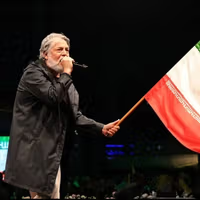
An Islamist student on Tuesday harshly attacked President Ebrahim Raisi and the ruling elite during a public meeting in Tehran’s Sharif University of Technology.
Raisi who visited the university to mark the annual student day, was peppered with attacks by the Secretary of the university’s Islamic Student Union. The group is present on all campuses and is a state-sanctioned organization whose members belong to the Basij paramilitary wing of the Revolutionary Guards.
The remarks of the student leader, Mohammad Hossein Bayat are stunning in their directness and degree of criticism. He told Raisi that “You got elected in the least competitive election in the history of the Islamic Republic, with the lowest rate of voter participation.” He added, “We are speaking to you not as a president elected with the free vote of the people in a free election. We are speaking to you as a representative of the ruling system.”
Raisi’s key rivals were barred from running in the June election by a watchdog council controlled by Supreme Leader Ali Khamenei, that ensured his victory among less popular candidates.
Bayat, addressing Raisi said that he represents a ruling system which “in the past 40 years has not opened a path for the progress of the people, despite the revolutionary ideals of freedom and justice.” But what the student leader said next was even more stunning. He told Raisi that the Islamic Republic not only has failed to serve the people, but it has “drowned itself in various crises and super crises and except some brief periods, it has not seen stability and calm.”
A student representative addressing Ebrahim Raisi on Tuesday, December 7, 2021
These remarks implicitly pointed to the Islamic Republic’s confrontational foreign policy among other issues, such as an inefficient economic system, persecution of dissidents, lack of transparency and disastrous environmental policies.
Bayat then reminded the president that he is the product of the least competitive election, organized by an “incapable and ineffective political system” which has pushed the people into “hopelessness about any change or improvement” in Iran.
He went on to accuse Raisi of stacking his administration with corrupt cliques, and he openly named the president’s top aides. Bayat also said that the current administration is the most militarized government in the history of the Islamic Republic, dividing critical posts among the Revolutionary Guard brass.
Iranian presidents have often met tough critics whenever they visited universities. But dissident students have been intimidated into silence and the Islamic Student Associations are controlled by elements who are supposed to be loyal to the Islamic Republic. Bayat’s harsh remarks should be seen in this context.
Bayat told Raisi to tell his friends that there is no glory in zero percent economic growth, political isolation, lack of transparency and all other policies that impose an “exorbitant cost on the Iranian nation.”
He continued to mention more than a dozen crises in the country, above all corruption of the “political-military elite” and the suppression of the people who are hopeless and fed up with their economic plight. In a situation where all civil society has been demolished and activists are in prison, Bayat asked Raisi, what other alternative exists except violence and protest. He added that the ruling elite has basically decided it does not want to listen to the people as long as it can fire guns to protect itself.
In the end of his remarks Bayat warned Raisi that if a rational way out of the current crises-ridden situation is not found, the ruling elite will receive “an answer from the people that might not come immediately…but will definitely be revolutionary and decisive.”