• العربية
  • فارسی
Brand
  • Iran Insight
  • Politics
  • Economy
  • Analysis
  • Special Report
  • Opinion
  • Podcast
  • Iran Insight
  • Politics
  • Economy
  • Analysis
  • Special Report
  • Opinion
  • Podcast
  • Theme
  • Language
    • العربية
    • فارسی
  • Iran Insight
  • Politics
  • Economy
  • Analysis
  • Special Report
  • Opinion
  • Podcast
All rights reserved for Volant Media UK Limited
volant media logo

Iran And US Question Each Other’s Intentions In Nuclear Talks
Iran International Newsroom
Dec 2, 2021, 18:18 GMT+0Updated: 17:25 GMT+1
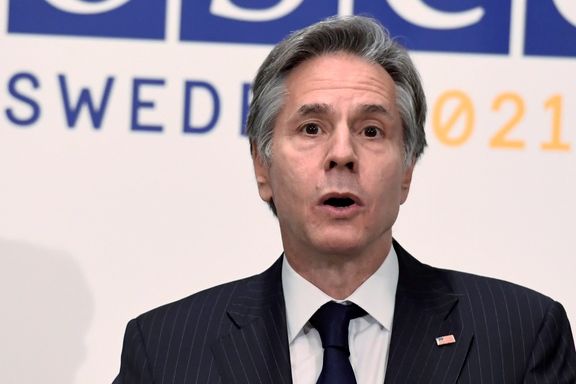
US Secretary of State speaking in Stockholm Sweden. December 2, 2021

Iran and the United States both signaled pessimism over nuclear talks in Vienna as Tehran presented proposals for reviving its 2015 deal with world powers.

Antony Blinken, US Secretary of State, told reporters in Stockholm, where he is attending the Organization for Security and Cooperation in Europe (OSCE), that “recent moves, recent rhetoric, don’t give us a lot of cause for…optimism.” Blinken put the onus on Iran to “reverse course and engage meaningfully.”

In what might have been a US reaction to new proposals circulated Thursday by Iran to remaining members of the JCPOA (Joint Comprehensive Plan of Action), Blinken said the US would “in the very near future, the next day or so…be in a position to judge whether Iran actually intends now to engage in good faith.”

In Tehran, Hossein Amir-Abdollahian, Iran’s foreign minister, said that “we are not optimistic about the will and intentions of the US and the three European countries.” Amir-Abdollahian was quoted by the official news agency IRNA saying Iran had been encouraged to return to talks over restoring the JCPOA but had nonetheless faced additional US “sanctions on individuals and entities.”

The foreign minister, quoted after a meeting with Japanese foreign minister Yoshimasa Hayashi, said Iran had gone to Vienna, where talks resumed this week after a five-month pause, with “serious determinations and a clear, logical agenda.”

The talks in the Austrian capital formally involve remaining JCPOA signatories – China, France, Germany, Iran, Russia, and the United Kingdom – with a US delegation led by special envoy Rob Malley taking part indirectly.

Iran has stressed the importance of lifting ‘maximum pressure’ sanctions, targeting its oil exports and financial sector, imposed by the US after 2018 when former president Donald Trump left the JCPOA, whereas the US has highlighted Iranian nuclear advances since 2019 beyond limits set by the deal.

‘That will not happen’

"What Iran can't do is sustain the status quo of building their nuclear program while dragging their feet on talks,” Blinken said. “That will not happen.”

Iran’s latest breach of the JCPOA, reported by the International Atomic Energy Agency (IAEA) Wednesday, is to begin enriching uranium at its fortified Fordow plant using relatively advanced centrifuges.

Iran’s lead negotiator Ali Bagheri Kani, who earlier Thursday announced Iran had circulated its new proposals, later met IAEA chief Rafael Mariano Grossi, who subsequently tweeted that they had discussed both “current exchanges in the context of the JCPOA negotiations” and “our own bilateral activities.”

The IAEA would have enhanced monitoring powers under a revived JCPOA, and is meanwhile trying to arrange better access after Iran in February limited agency inspections largely to those required under the Nuclear Non-Proliferation treaty.

Grossi told France24 television Wednesday that be believed talks in Vienna were “trying to build on what was going on before” and that he said an agreement was needed “soon.” The talks were suspended in June, with some diplomats suggesting there was 70-80 percent agreement, and there has been speculation as to how far a new Iranian negotiating team, after the election of President Ebrahim Raisi (Raeesi), would shift Iran’s position.


Most Viewed

US blockade enters murky phase as tankers spoof signals and buyers hesitate
1
ANALYSIS

US blockade enters murky phase as tankers spoof signals and buyers hesitate

2
INSIGHT

Ideology may be fading in Iran, but not in Kashmir's ‘Mini Iran'

3
INSIGHT

Hardliners push Hormuz ‘red line’ as US blockade tests Iran’s leverage

4
VOICES FROM IRAN

Hope and anger in Iran as fragile ceasefire persists

5

US sanctions oil network tied to Iranian tycoon Shamkhani

Banner
Banner

Spotlight

  • Hardliners push Hormuz ‘red line’ as US blockade tests Iran’s leverage
    INSIGHT

    Hardliners push Hormuz ‘red line’ as US blockade tests Iran’s leverage

  • Ideology may be fading in Iran, but not in Kashmir's ‘Mini Iran'
    INSIGHT

    Ideology may be fading in Iran, but not in Kashmir's ‘Mini Iran'

  • War damage amounts to $3,000 per Iranian, with blockade set to add to losses
    INSIGHT

    War damage amounts to $3,000 per Iranian, with blockade set to add to losses

  • Why the $100 billion Hormuz toll revenue is a myth
    ANALYSIS

    Why the $100 billion Hormuz toll revenue is a myth

  • US blockade targets Iran oil boom amid regional disruption
    ANALYSIS

    US blockade targets Iran oil boom amid regional disruption

  • Iran's digital economy battered by prolonged blackout
    INSIGHT

    Iran's digital economy battered by prolonged blackout

•
•
•

More Stories

Blinken Tells Russia 'We Share Interest' Against Iran Nukes

Dec 2, 2021, 12:52 GMT+0

US Secretary of State Antony Blinken Thursday told his Russia counterpart, Sergei Lavrov that the two countries have a shard interest in preventing Iran from obtaining nuclear weapons.

In a meeting of 57 foreign ministers in Stockholm, Sweden, Blinken who was urging cooperation with Russia said, “we have shared interests that we are working on together, including a shared interest in Iran not acquiring a nuclear weapon. Our colleagues are working together in Vienna as the talks proceed.”

Russia is one of six countries who negotiated and signed the 2015 nuclear agreement, the Joint Comprehensive Plan of Action, or JCPOA. The US pulled out of the agreement in 2018, but Russia, China, the United Kingdom, France and Germany who remained in the deal are holding talks with Iran to see if they could revive the agreement.

Russia is Iran’s diplomatic ally and generally backs Tehran’s position in the nuclear dispute, but Russia’s interests in the region also present a complicated picture, as it cultivates good relation with some of Tehran’s regional rivals.

Blinken referred to shared interests on Iran as he was warning Lavrov about Russia taking aggressive action against Ukraine. In recent days, European countries have become alarmed at Russian military moves that could signal action against Ukraine.

Iran Presents Its Positions In Vienna Nuclear Talks

Dec 2, 2021, 12:26 GMT+0
•
Iran International Newsroom

Iran has presented two new sets of proposals in the Vienna nuclear talks, its lead negotiator Ali Bagheri Kani told Iranian news agencies Thursday.

Bagheri Kani said these could alter whatever was agreed before talks were suspended in June. “There is a new government in Iran, and a new negotiating team,” he said. “We need changes in the text.”

After four months of talks earlier this year, diplomats suggested there was 70-80 percent agreement over renewing Iran’s 2015 nuclear agreement with world powers, the JCPOA (Joint Comprehensive Plan of Action), which the United States left in 2018. The talks formally involve remaining JCPOA signatories – China, France, Germany, Iran, Russia and the United Kingdom – with the US taking part indirectly.

Bagheri Kani said that whatever was agreed previously had been a “draft” and that there was “no doubt” it was open to renegotiation.

Iran’ new proposals, he said, covering both sanctions and Tehran’s nuclear program had been circulated in writing to all JCPOA members. A European diplomat in Vienna confirmed to Reuters that draft documents had been received.

Bagheri Kani said he had already fielded questions, referring apparently to meetings with Enrique Mora, the senior European Union official chairing the talks, and the Russian delegation. The Iranian diplomat said there was a need for “new negotiations about these documents.”

Bagheri Kani gave no indication as to what precise proposals were in the Iranian texts. Talks before April struggled to agree precisely which US sanctions violate the JCPOA and exactly how the Iranian nuclear program, expanded and enhanced since 2019, should be brought back to limits set by the JCPOA.

Bagheri Kani stressed the “international dimension” of the talks. He said that “players outside the direct theatre” were “trying to create diversions and disruptions in the nuclear talks.” It was not clear whether he was referring to the US, or to Israel, which has made a range of recent accusations over Iran’s nuclear program and, after Wednesday’s International Atomic Energy Agency report highlighting Iran’s use of advanced centrifuges at its Fordow enrichment plant, called on world powers to leave Vienna.

With Thursday the fourth day of what are the seventh round of talks, Bagheri Kani said the Iranian delegation was ready to stay in Vienna as long as was necessary, but that other delegations might prefer to return to their capitals for consultation over the new Iranian texts.

“Of course, the other side can express their opinions about these changes,” Bagheri Kani said. “Many have been saying Iran is not serious and doesn’t want to talk and reach results. These proposals show Iran is serious.”

Israel Calls On World Powers To Halt Iran Nuclear Talks Immediately

Dec 2, 2021, 09:42 GMT+0

Israel on Thursday called on world powers to halt nuclear talks with Iran immediately, citing a UN watchdog's report that Tehran has started enriching uranium with more advanced centrifuges.

"Iran is carrying out nuclear blackmail as a negotiating tactic, and this should be answered by the immediate halt to negotiations and the implementation of tough steps by the world powers," Prime Minister Naftali Bennett's office quoted him as saying in a call with US Secretary of State Antony Blinken.

The International Atomic Energy Agency (IAEA) announced Wednesday that Iran has started enrichment up to 20 percent at Ferdow with one cascade, or cluster, of 166 advanced IR-6 machines. The agency said Iran had also installed but was not yet operating another 94 IR-6 machines in a cascade at Fordow.

Tehran has accelerated higher degree of uranium enrichment this year, after its parliament passed a law in December 2020 demanding US lift economic sanctions. Uranium is being enriched to 20 and 60 percent purity and Iran has accumulated more than 200 kg of fissile material that could enable it to produce a nuclear weapon in a matter of weeks.

With reporting by Reuters

Iran Steps Up Nuclear Work At Fordow Plant: UN Agency

Dec 1, 2021, 18:59 GMT+0
•
Iran International Newsroom

In its latest breach of limits set by its 2015 nuclear deal, Iran has begun producing enriched uranium with advanced centrifuges at its underground Fordow plant.

The United Nations atomic watchdog, the International Atomic Energy Agency (IAEA), reported the move Wednesday on the third day of talks in Vienna designed to revive the 2015 agreement, the JCPOA (Joint Comprehensive Plan of Action).

European diplomats flagged up to journalists Monday Iran’s use of more advanced centrifuges, the devices used to enrich uranium. The JCPOA limited Tehran to 5060 IR-1 machines, with a limited number of more advanced ones used purely for research.

A November report from the IAEA noted Iranwas running IR-4 and IR-6 centrifuges at the Natanz site to enrich to 60 percent, far above the 3.67 percent JCPOA cap. The IAEA also reported that Iran was enriching uranium with IR-1 centrifuges while testing IR-6 machines at Ferdow, a fortified underground plant where enrichment is banned under the JCPOA.

But Wednesday’s IAEA statement said Iran had now started enrichment up to 20 percent at Ferdow with one cascade, or cluster, of 166 advanced IR-6 machines. The agency said Iran had also installed but was not yet operating another 94 IR-6 machines in a cascade at Fordow.

According to a note circulated to IAEA member states and seen by some news agencies, Iran has agreed with the agency increased frequency of agency inspectors’ verification activities at Ferdow and “practical arrangements to facilitate implementation of these activities.”

Iran has expanded its nuclear program since 2019 in response to United States ‘maximum pressure sanctions’ introduced when previous president Donald Trump left the JCPOA in 2018. By exceeded the JCPOA enrichment cap of 3.67 percent and using more efficient centrifuges that increase the speed of enrichment, Tehran has effectively reduced ‘break out,’ the time required to produce enough 90-percent-enriched ‘weapon grade’ uranium for a crude nuclear device.

The continuing expansion of the program, even if it gives Iran greater leverage in Vienna, increases the talks’ challenge of agreeing exactly how Tehran’s nuclear activities can be brought back within JCPOA limits. The talks – which resume this week after a five-month break – failed from April to June to agree not just on this, but also on which US sanctions are incompatible with the JCPOA.

Iran has also since February reduced the level of its co-operation with the IAEA to that required under the Nuclear Non-Proliferation treaty, justifying this in part as a response to a series of attacks on its nuclear sites widely attributed to Israel.

Iranian Media Rejects ‘Artificial Deadlines’ For Nuclear Talks

Dec 1, 2021, 17:49 GMT+0
•
Maryam Sinaiee

State media reported Wednesday that Iran was willing to continue nuclear talks in Vienna and would not abandon its aims to meet deadlines set by other parties.

The English-language Press TV quoted a senior Iranian negotiator that Tehran would not

“sacrifice its principled demands and the Iranian nation’s rights, for mere artificial deadlines or timetables.” The negotiator told Press TV that Iran was in Vienna "with full seriousness" and had presented “transparent demands and proposals."

Diplomats from France, German and the United Kingdom (known as the E3) told reporters Tuesday that Europe would not impose unproductive deadlines in their attempts to revive the 2015 nuclear deal, the JCPOA (Joint Comprehensive Plan of Action).

Iranian state media − including Tasnim News Agency, which is affiliated to the Revolutionary Guards − are suggesting European Union parties to the talks want to wrap up the current round of talks quickly. France and Germany are EU members and the talks are chaired by Enrique Mora, a senior EU official.

The official news agency (IRNA) arguedthat European parties, under United States pressure, had taken "certain political and media strategies" to hinder talks and direct them away from any agreement. Mehr news agency reported that the Europeans "need… item-by-item consultation with the United States."

The US, which left the JCPOA in 2018 and imposed ‘maximum pressure’ sanctions on Iran, is taking part in Vienna only indirectly – with formal talks involving only remaining JCPOA signatories China, the E3, Iran, and Russia.

In a tweet Wednesday, Wall Street Journal correspondent Laurence Norman quoted a senior European diplomat that the end of this week was not a deadline. "We have brought big suitcases and we can stay through the weekend,” Norman wrote he was told. “This is the way it worked in the rounds so far that we worked until…the point where, mostly the Iranians, had to reconnect with their capitals.”

Talks to revive the JCPOA resumed Monday with Iran's negotiators insisting their aim was to see lifted all the sanctions levied since the US left the JCPOA in 2018. Two expert groups have been formed to discuss US sanctions, which have especially targeted Iran’s oil exports and financial sector.

On Wednesday envoys from JCPOA signatories attended a working group on nuclear issues.

Also Wednesday, Iran's lead negotiator and deputy foreign minister Ali Bagheri Kani met with Mora.