• العربية
  • فارسی
Brand
  • Iran Insight
  • Politics
  • Economy
  • Analysis
  • Special Report
  • Opinion
  • Podcast
  • Iran Insight
  • Politics
  • Economy
  • Analysis
  • Special Report
  • Opinion
  • Podcast
  • Theme
  • Language
    • العربية
    • فارسی
  • Iran Insight
  • Politics
  • Economy
  • Analysis
  • Special Report
  • Opinion
  • Podcast
All rights reserved for Volant Media UK Limited
volant media logo

US Says It Will Turn To 'Other Means' If Iran Fails To Show 'Good Faith'
Iran International Newsroom
Nov 24, 2021, 08:16 GMT+0Updated: 17:41 GMT+1
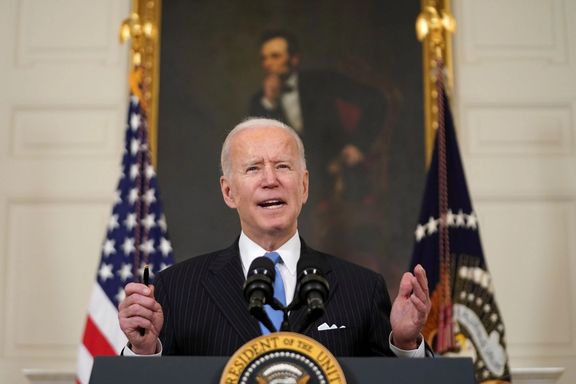
US President Joe Biden in the White House. FILE PHOTO

The State Department has reiterated that nuclear talks with Iran cannot go on indefinitely and the US will turn “to other means”, being discussed with allies.

Spokesman Ned Price in his Tuesday briefing insisted that diplomacy remains the preferred path for the Biden Administration to restore the 2015 nuclear agreement known as JCPOA, but Iran needs to show good faith.

Multilateral talks suspended in June are scheduled to resume next week in Vienna, where the United States will participate indirectly in negotiations between Iran and other world powers.

Price said, if the Iranians, “through their actions or through their inactions, demonstrate or suggest that they lack that good faith, that they lack that clarity of purpose, we’ll have to turn to other means. We have a variety of other means. We’re discussing those with our allies and partners. In the category of things that aren’t prudent to discuss from here, that’s one of them.”

Price rejected the suggestion of offering Iran any incentives, or “greasing the wheels”, ahead of an agreement, as Tehran has demanded the release of frozen funds as a sign of US goodwill. “We have been very clear that we are not prepared to take unilateral steps solely for the benefit of greasing the wheel, as you said. We are prepared to engage in a mutual return to compliance with the JCPOA,” he maintained.

The spokesman was asked if the Administration is sympathetic to the idea of an interim deal. Reported in the media last week. Price dismissed the idea, insisting that Washington is “sympathetic to testing the proposition as to whether we can achieve a mutual return to compliance with the JCPOA.”

Asked how long it would take for the US to determine if the Iranians are negotiating in good faith, Price pointed to the indirect nature of the talks and said the US has to hold “deep consultation” with the participants in the talks, meaning the United Kingdom, France, Germany, Russia, China and EU diplomats.

Price also reiterated the Biden Administration view that the JCPOA “ is the best, it’s the most effective means by which to reapply…permanent and verifiable restrictions on Iran’s nuclear program permanently, preventing Iran from obtaining a nuclear weapon.”

At the same time, former secretary of state Mike Pompeo tweeted on Tuesday that the Trump administration “rightly withdrew from the JCPOA, as it provided a clear pathway for Iran to develop a nuclear weapon. We kept Iran under max pressure while fostering new relationships among those who partnered with us. Now, the Biden Admin wants to re-enter the JCPOA.”


Most Viewed

Ghalibaf defends Iran-US talks amid hardline backlash
1
INSIGHT

Ghalibaf defends Iran-US talks amid hardline backlash

2
INSIGHT

100 days after carnage: Iran economy reels from war, inflation, unemployment

3
INSIGHT

A nation in limbo: 100 days after the massacre, has the world moved on?

4
ANALYSIS

From instability to influence: Pakistan’s pivotal role in US-Iran diplomacy

5
ANALYSIS

100 days on: why Iran’s January protests spread across social classes

Banner
Banner

Spotlight

  • War-hit homeowners feel abandoned as Iran’s reconstruction aid fades

    War-hit homeowners feel abandoned as Iran’s reconstruction aid fades

  • 100 days on: the anatomy of Iran’s January crackdown
    INSIGHT

    100 days on: the anatomy of Iran’s January crackdown

  • Ghalibaf defends Iran-US talks amid hardline backlash
    INSIGHT

    Ghalibaf defends Iran-US talks amid hardline backlash

  • 100 days on: why Iran’s January protests spread across social classes
    ANALYSIS

    100 days on: why Iran’s January protests spread across social classes

  • From instability to influence: Pakistan’s pivotal role in US-Iran diplomacy
    ANALYSIS

    From instability to influence: Pakistan’s pivotal role in US-Iran diplomacy

  • A nation in limbo: 100 days after the massacre, has the world moved on?
    INSIGHT

    A nation in limbo: 100 days after the massacre, has the world moved on?

•
•
•

More Stories

UN Nuclear Chief Ends Iran Trip With Questions Left Hanging

Nov 23, 2021, 17:24 GMT+0
•
Iran International Newsroom

The UN nuclear chief and Iran’s foreign minister stressed commitment Tuesday to continue cooperation but gave no sign that outstanding issues had been resolved.

Hosting Rafael Grossi in Tehran, Foreign Minister Hossein Amir-Abdollahian said Iran had “serious will” for “interaction” with the International Atomic Energy Agency (IAEA) “in the framework of the monitoring agreements,” the official news agency IRNA reported.

The foreign minister was apparently referring to both Iran’s cooperation with the IAEA within Nuclear Non-Proliferation treaty and a temporary arrangement, made first in February and extended in September, giving nuclear inspectors greater access. IAEA chief Grossi had said Iran has broken the terms of the September agreement by barring the agency from the Karaj plant, west of Tehran, which makes parts for Iran’s nuclear program.

Neither Grossi nor Amir-Abdollahian commented on another IAEA concern, its dissatisfaction over Iran’s explanations on uranium traces found at three sites not declared as nuclear facilities.

Grossi’s visit came shortly ahead of the scheduled resumption of talks in Vienna between Iran and world powers, due November 29, over reviving Tehran’s 2015 nuclear deal (the JCPOA, Joint Comprehensive Plan of Action), under which it limited its atomic program in return for the removal of international sanctions. The Vienna talks have been in abeyance since June.

While the IAEA would monitor Iran’s compliance with a revived JCPOA, Grossi’s more immediate task has been to continue agency inspections at a level he says allows effective monitoring. Tehran reduced IAEA access in February to that required under the NPT while subsequently agreeing a more favorable temporary arrangement.

"The agency is seeking to continue and deepen the dialogue with the government of Iran ... We agreed to continue our joint work on transparency and this will continue," Grossi told a televised news conference.

Amir-Abdollahian said that technical cooperation with the IAEA had “suffered because members of the JCPOA had not clearly acted against attacks on Iran.”

The Karaj facility was reportedly hit June by a drone attack, one among several incidents widely attributed to Israel. Iran has justified barring IAEA inspectors from the site, where they want to service monitoring equipment including cameras, because a review of security is underway.

Iran has long expressed frustration at the failure of European JCPOA signatories − France, Germany and the United Kingdom − to counter the ‘maximum pressure’ sanctions introduced by former United States president Donald Trump when he left the JCPOA in 2018. But since President Joe Biden took office in January, the US and Europe have moved closer together, and Europe has become more outspoken over Tehran’s expansion of its nuclear program beyond JCPOA limits and its restricted co-operation with the IAEA.

The Vienna talks formally involve the remaining JCPOA members – the three European states, Iran, China and Russia. The US takes part indirectly. Israeli Prime Minister Naftali Bennett said Tuesday that Israel would not feel bound by a renewed Iranian nuclear deal.

Israeli Minister Says Iran Will Get Nukes In Five Years, 'Tops'

Nov 23, 2021, 15:05 GMT+0

Israeli Finance Minister Avigdor Lieberman has said: "With or without an agreement, Iran will be a nuclear state and have a nuclear weapon within five years, tops."

Lieberman was speaking at a security conference on Tuesday where Prime Minister Naftali Bennett said Iran is at the most advanced stage of acquiring nuclear weapons and Israel reserves the right to confront Tehran, with or without a nuclear agreement.

Israel, itself widely believed to have nuclear weapons, has long argued that the 2015 deal was too weak to prevent Iran from pursuing a bomb. Former US President Donald Trump abandoned the deal in 2018, describing it as too soft, and Iran responded by violating some of the deal's restrictions. President Joe Biden's administration aims to revive it.

Israel has also complained that the nuclear agreement does nothing to rein in Iran's ballistic missile program, or hostile activity by Iranian-backed militia.

"The Iranians have encircled the State of Israel with missiles while they sit safely in Tehran," Bennett said. "To chase the terrorist du jour sent by the (Iranian covert) Qods Force does not pay off anymore. We must go for the dispatcher."

Speaking separately, the chief of Israel's air force offered cooperation with Gulf Arab partners against Iranian-made attack drones, a rare public airing of the possibility of joint operations.

Iran Claims Grossi Admitted 'No Deviation In Iran's Nuclear Program'

Nov 23, 2021, 10:38 GMT+0
•
Iran International Newsroom

In a press conference with UN's Rafael Grossi in Tehran, Iran's nuclear chief claimed that Grossi "emphasized there is no deviation" in Iran's nuclear program.

Mohammad Eslami said the IAEA chief in their meeting Tuesday had "emphasized repeatedly that no deviation has been observed in Iran's nuclear program".

Government controlled media in Iran immediately began tweeting Eslami's assertion that Grossi admitted there was no deviation in Iran's nuclear program.

Eslami also told reporters that the questions raised by the IAEA regarding the "documents provided to the agency by Iran's enemies" have been answered partly and it was agreed in their meeting to resolve the remaining cases.

Eslami also claimed that the IAEA will not be influenced by "Iran's enemies' insidious infiltration".

Grossi who was listening to a translation of Eslami’s remarks did not directly respond to his assertions.

"The agency is seeking to continue and deepen the dialogue with the government of Iran..., We agreed to continue our joint work on transparency, and this will continue, UN nuclear watchdog chief Rafael Grossi told his televised news conference Tuesday.

Grossi who arrived in Tehran Monday evening has previously criticized as inadequate explanations given by Iran over traces of uranium found at two undeclared sites and relating to work carried out before 2003.

But it is still not clear what was decided over IAEA's complaints about Iran limiting access to its monitoring work in its nuclear installations, which was an important aspect of Grossi's visit.

The IAEA chief will also hold talks with Hossein Amir-Abdollahian Tuesday afternoon for the first time since his appointment as foreign minister.

In the joint press conference, Eslami also stressed that Iran requires generation of at least 10,000 MW of electricity by nuclear technology and is adamant about its nuclear program.

The official news agency IRNA said in a report Tuesday before the press conference, that the IAEA chief and Eslami would discuss "the establishment of a clear framework for cooperation between the UN nuclear watchdog and Iran's Atomic Energy Organization.

The IAEA has issued critical reports saying Tehran has not fully cooperated with its monitors, which could make it more difficult to revive the 2015 nuclear agreement known as JCPOA, under which Iran accepted curbs on its nuclear program in return for the lifting of international sanctions.

According to IAEA reports last week, Iran had still not granted IAEA inspectors access it promised two months ago to re-install monitoring cameras at a workshop that was the site of apparent sabotage in June.

The meeting with the IAEA chief is taking place ahead of an IAEA Board of Governors' meeting this week and days before resumption of talks in Vienna to revive the 2015 nuclear deal, Joint Comprehensive Plan of Action (JCPOA) which US President Donald Trump unilaterally withdrew from in 2018, imposing draconian sanctions on Iran.

Western powers scrapped plans in September for an IAEA board resolution rebuking Iran, after Tehran agreed to prolong monitoring of some nuclear activities and invited IAEA chief Rafael Grossi to Tehran for talks. Grossi is again due in Tehran ahead of the IAEA board meeting.

Israel Says Ready To Confront Iran Regardless Of Any Nuclear Deal

Nov 23, 2021, 09:03 GMT+0
•
Iran International Newsroom

Israel’s Naftali Bennett signaled readiness on Tuesday to step up confrontation with Iran and said Israel would not be bound by any new Iranian nuclear deal.

Bennett’s tough statements come after the Biden Administration in recent weeks has kept in close touch with Israel and its Arab neighbors in the region trying to reduce concerns over its policy of seeking a diplomatic agreement with Iran.

Indirect negotiations will begin on November 29 about reviving the 2015 deal, which former US President Donald Trump withdrew from, deeming it insufficient to shut down projects with bomb-making potential - a view shared by the Israelis and Saudi Arabia.

Iran, which denies seeking nuclear arms, has since the US walkout breached the deal with expanded uranium enrichment, stockpiling more than 200 kilograms of 20-percent and 60-percent enriched uranium. This has brought Iran very close to obtaining the 90-percent enriched fissile material for making a bomb.

Bennett, who took power in June, described Iran in a speech as being at "the most advanced stage of its nuclear program".

While his government has previously said it would be open to a new nuclear deal with tougher restrictions on Iran, Bennett reasserted Israel's autonomy to take action against its arch-foe.

“The mistake we made after the first nuclear deal in 2015 will not repeat itself,” said Bennett. “With all the noise beforehand, from the moment the deal was signed, it affected us like a sleeping pill. Israel simply fell asleep on duty. We occupied ourselves with other things.”

“We will learn from this mistake,” he said. “We will maintain our freedom of action.”

"We face complicated times. It is possible that there will be disputes with the best of our friends," he told a televised conference hosted by Reichman University.

"In any event, even if there is a return to a deal, Israel is of course not a party to the deal and Israel is not obligated by the deal."

A long New York Times piece Sunday reportedconcern among United States intelligence officials over past and possible future Israeli attacks on Iran’s nuclear program. Since July 2020, several major sabotage attacks, widely attributed to Israel, have hit Iran’s sensitive nuclear facilities.

Bennett voiced frustration with what he described as Israel's smaller-scale clashes with Iranian guerrilla allies.

"The Iranians have encircled the State of Israel with missiles while they sit safely in Tehran," he said. "To chase the terrorist du jour sent by the (Iranian covert) Qods Force does not pay off anymore. We must go for the dispatcher."

Stopping short of explicitly threatening war, Bennett said cyber-technologies and what he deemed Israel's advantages as a democracy and international support could be brought to bear.

"Iran is much more vulnerable than is commonly thought," he said.

With reporting by Reuters, Times of Israel

US Says Iran's Escalatory Nuclear Steps Will Not Give It Leverage

Nov 23, 2021, 08:02 GMT+0
•
Iran International Newsroom

While voicing concern about Iran's high level of uranium enrichment, the US State Department said Monday this will not give Tehran any negotiating leverage.

Spokesman Ned Price told reporters in his daily briefing that Iran’s escalatory nuclear steps, which include stockpiling highly enriched uranium, “will not provide Iran with any negotiating leverage when talks resume in Vienna next week.”

Iran began to violate an enrichment level of 3.67 percent set by the Joint Comprehensive Plan of Action (JCPOA) in May 2019 when the United States imposed full oil export sanctions. Tehran has been enriching fissile material to 20 and 60 percent with having stockpiled more than 200 kilograms of the material, reducing the time needed to prepare 90 percent pure uranium for a nuclear bomb.

Price dismissed recent demands by Iran that the United States must lift all sanctions now in one step, saying that the Vienna talks are meant to resolve issues related to mutual steps needed for the restoration of the 2015 nuclear deal. That is what reportedly took place from April to June when the two sides were discussing which US sanctions should be lifted and when in exchange for Iran rolling back its violations of the JCPOA and moving toward the full restoration of the agreement.

But Tehran in recent weeks seems to be determined to change the nature of the talks to negotiations about first lifting US sanctions. For that reason, Washington and its three European allies (UK, France, Germany) that are members of the JCPOA have been insisting that when the talks resume on November 29, they should continue from the point where they were left off in June.

A reporter asked Price if he had a comment on a New York Times report Sunday that US officials have warned Israel that its attacks against Iranian nuclear targets are counterproductive, enabling Iran to rebuild an even more efficient enrichment system.

Price did not offer a direct comment on the report, but he said, “Look, at the end of the day, the United States and Israel, we share a common objective here, and that is to see to it that Iran is verifiably and permanently prevented from obtaining a nuclear weapon.” Price also immediately added that “diplomacy in coordination with our allies and partners – and that, of course, includes Israel – is the best path to achieve that goal.”

Another time-sensitive a key issue is the monitoring of Iran’s nuclear facilities by the UN nuclear watchdog that Iran has restricted since the beginning of the year. The Board of Governors of the International Atomic Energy Agency (IAEA) is meeting this week in Vienna while its General Director Rafael Grossi is visiting Iran on Tuesday. The Agency has issued reports strongly criticizing Iran’s lack of cooperation and France last week demanded that the Board of Governors “send a strong message” to Tehran.

In the previous meeting of Governors in September, the US and its allies decided not to censure Iran in what appeared to be an attempt not to scuttle any chance of resuming talks with Iran. It is not clear if the France’s tough stance will carry the day this week, but the State Department spokesman on Monday appeared to be suggesting a ‘wait and see’ approach.