• العربية
  • فارسی
Brand
  • Iran Insight
  • Politics
  • Economy
  • Analysis
  • Special Report
  • Opinion
  • Podcast
  • Iran Insight
  • Politics
  • Economy
  • Analysis
  • Special Report
  • Opinion
  • Podcast
  • Theme
  • Language
    • العربية
    • فارسی
  • Iran Insight
  • Politics
  • Economy
  • Analysis
  • Special Report
  • Opinion
  • Podcast
All rights reserved for Volant Media UK Limited
volant media logo

Iran Says UN Nuclear Chief Grossi To Visit Monday As Deadlines Loom
Iran International Newsroom
Nov 17, 2021, 13:28 GMT+0Updated: 17:30 GMT+1
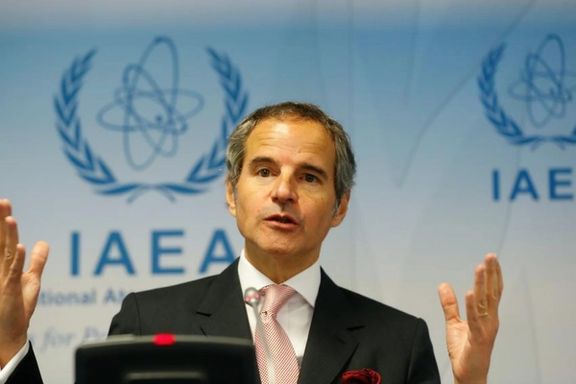
Rafael Grossi, head of the International Atomic Energy Agency. FILE Photo

Rafael Grossi, head of the International Atomic Energy Agency (IAEA) will visit Iran Monday, state media said Wednesday, before the IAEA board meets November 24.

The reports cited Behrouz Kamalvandi, spokesman for the Atomic Energy Organization of Iran (AEOI). The visit would also come ahead of the planned resumption of talks in Vienna November 29 between Iran and world powers aimed at reviving Tehran’s 2015 nuclear agreement, the JCPOA (Joint Comprehensive Plan of Action) and as an IAEA report says Iran’s stock of uranium enriched to 60 percent has jumped nearly 80 percent in under three months.

Kamalvandi said Grossi would meet with Iran's Foreign Minister Hossein Amir-Abdollahian and AEOI chief Mohammad Eslami.

IAEA access to Iran’s nuclear program would be crucial in monitoring a revived JCPOA, but Grossi, along with Western states, has expressed growing concern since February 2020 when Iran reduced access to little more than required under the Nuclear Non-Proliferation Treaty (NPT).

IAEA full access

Grossi has also criticized as inadequate explanations given by Iran over traces of uranium found at two undeclared sites and relating to work carried out before 2003.

A more pressing issue for Grossi is restoring access to Iran’s Karaj plant under terms of a temporary arrangement first made in February. While IAEA inspectors have been allowed to service monitoring equipment elsewhere, Iran has barred this at Karaj on the grounds it is carrying out a security investigation after a June attack, widely attributed to Israel.

An IAEA report this week puts Iran’s stockpile of uranium enriched to 60 percent at 17.7kg, up from 10kg in September. While this is less than the 25kg claimed by nuclear spokesman Behruz Kamalvandi November 4, it represents a large increase in a level of enrichment close to the 90 percent regarded as ‘weapons grade.’

Tehran has also now 113.8kg enriched to 20 percent, up from 84kg in September. A purity of only 3.67 percent is allowed under the JCPOA.

It also emerged Wednesday, in an agency report, that Grossi wrote to Iran October 25 complaining over excessively invasive physical searches by security officials at nuclear sites.

If Grossi fails to make progress next week, the European JCPOA signatories – France, Germany, and the United Kingdom – may discuss with the United States options to raise Iran’s lack of cooperation at the IAEA board. Speculation they might do so at a board meeting in September waned once Grossi extended the temporary monitoring agreement, which the IAEA chief later insisted covered Karaj as well as other sites.

Reuters quoted a senior diplomat Wednesday that the IAEA, given its lack of access, did not know if Iran has resumed manufacturing advanced centrifuges – the devices used to enrich uranium – at Karaj, as was reported Tuesday by the Wall Street Journal citing “diplomats familiar with the activities.” The advanced centrifuges enable quicker and more efficient enrichment of uranium, thereby reducing the time it would take to enrich to 90 percent ‘weapons grade.’

Karaj parts installed at Ferdow

“According to one of the diplomats familiar with Iran’s program, Iran has installed the centrifuges whose key parts were produced at Karaj at Iran’s underground, heavily fortified, Fordow site,” the Journal reported. The diplomat quoted said there was no evidence the equipment had been diverted elsewhere but “as the number of unmonitored centrifuges increases, the likelihood for this scenario increases.”

The Vienna talks have been in abeyance since June when Iran stopped its participation. While the US has continued ‘maximum pressure’ sanctions introduced by previous president Donald Trump on leaving the JCPOA in 2018, Iran has continued to expand its nuclear program – notably in enriching uranium to 60 percent, far above the 3.67 percent allowed under the JCPOA, and in using advanced centrifuges banned under the deal.

The new government in Tehran, which includes critics of the JCPOA, has adopted a more assertive tone, suggesting that while Iran would like to see US sanctions lifted, a return to the nuclear deal is a lower priority that it was under the previous administration of President Hassan Rouhani.


Most Viewed

Ghalibaf defends Iran-US talks amid hardline backlash
1
INSIGHT

Ghalibaf defends Iran-US talks amid hardline backlash

2
INSIGHT

A nation in limbo: 100 days after the massacre, has the world moved on?

3
ANALYSIS

From instability to influence: Pakistan’s pivotal role in US-Iran diplomacy

4
ANALYSIS

100 days on: why Iran’s January protests spread across social classes

5

War-hit homeowners feel abandoned as Iran’s reconstruction aid fades

Banner
Banner

Spotlight

  • War-hit homeowners feel abandoned as Iran’s reconstruction aid fades

    War-hit homeowners feel abandoned as Iran’s reconstruction aid fades

  • 100 days on: the anatomy of Iran’s January crackdown
    INSIGHT

    100 days on: the anatomy of Iran’s January crackdown

  • Ghalibaf defends Iran-US talks amid hardline backlash
    INSIGHT

    Ghalibaf defends Iran-US talks amid hardline backlash

  • 100 days on: why Iran’s January protests spread across social classes
    ANALYSIS

    100 days on: why Iran’s January protests spread across social classes

  • From instability to influence: Pakistan’s pivotal role in US-Iran diplomacy
    ANALYSIS

    From instability to influence: Pakistan’s pivotal role in US-Iran diplomacy

  • A nation in limbo: 100 days after the massacre, has the world moved on?
    INSIGHT

    A nation in limbo: 100 days after the massacre, has the world moved on?

•
•
•

More Stories

Hackers Launch Cyberattack On Group Opposing A Nuclear Iran

Nov 17, 2021, 08:19 GMT+0

United Against Nuclear Iran (UANI), an advocacy group has said it was the target of Iranian hackers, calling on the US impose sanctions on those responsible.

In a statement on Tuesday, UANI, based in the United States, said it suspected that APT35, also known as Charming Kitten, a well-known Iranian hacking group launched a series of cyberattacks, “Specifically targeting its leadership and members of its Advisory Board.”

UANI CEO Ambassador Mark D. Wallace was quoted as saying, “Those responsible managed to procure data outside of the public realm, impersonated our leadership in communications with former senior officials of the US government, and attempted to harvest Gmail credentials.”

He added that UANI took immediate action upon discovering these attacks “and has notified the relevant law enforcement authorities to request a criminal investigation.”

The group urged the authorities to investigate the incidents and for the US “to enhance its cyber security cooperation with its friends and allies. UANI further urges the Biden Administration to impose fresh economic sanctions against those responsible.”

UANI added that such attacks will not deter it “from achieving its goal of ensuring the regime fails in its pursuit of nuclear weapons, ends its support for terrorism, and stops its oppression of the Iranian people.”

Biden, Xi Discuss How To 'Align' Stances On Iran Nuclear Talks

Nov 16, 2021, 19:10 GMT+0

US President Joe Biden and China's Xi Jinping discussed harmonizing their positions ahead of the Nov. 29 Iran nuclear talks, a top US official said on Tuesday.

Officials from Iran and the six nations that struck the pact - Britain, China, France, Germany, Russia and the United States - will meet in Vienna to see if Tehran and Washington can agree to resume compliance with the deal under which Iran curbed its nuclear program to gain relief from US, EU and UN sanctions.

In 2018 then-President Donald Trump withdrew the United States from the pact among the major powers and Iran restoring harsh US sanctions, prompting Tehran to begin violating its nuclear restrictions about a year later.

"The two presidents had the chance to talk about how we can align our perspectives heading into that meeting so that the P5+1 is united in dealing with Iran and trying to pave the way for a return to the (deal)," White House National Security Adviser Jake Sullivan said in a virtual think tank appearance.

While China favors reviving the agreement, it has tended to place the onus on the United States, rather than Iran, blaming Washington for having abandoned the deal and giving Tehran an economic lifeline by buying Iranian oil despite US sanctions.

Report by Reuters

China Says Talks Held With Russia And Iran Over Nuclear Issue

Nov 16, 2021, 14:34 GMT+0

China’s foreign ministry has announced that it held a meeting on Monday with Russian and Iranian diplomats over nuclear talks scheduled to resume in Vienna.

The statement on Tuesday said that Vice Foreign Minister Ma Zhaoxu held a video conference with Russian Deputy Foreign Minister Sergei Ryabkov and Iranian Deputy Foreign Minister Ali Bagheri-Kani.

“The three sides exchanged in-depth views on the Iranian nuclear issue and reached broad consensus. China, Russia and Iran will continue to strengthen coordination and cooperation, ensure that the talks on resuming compliance with the Joint Comprehensive Plan of Action are on the right track, and strive for positive results as soon as possible,” the statement said, without providing any further details.

The Vienna talks suspended by Iran in June are set to resume in less than two weeks, with Iran presenting a much tougher posture, demanding all US sanctions to be lifted at once and also guarantees that no future US administration would withdraw from an agreement.

Six rounds of talks from April to June were focused on how the Joint Comprehensive Plan of Action (JCPOA) could be restored, including which US sanctions would be lifted and the sequence of mutual steps in reviving the agreement.

Signs of Madness, Signs Of Weakness? How Trump Blinked On Iran

Nov 16, 2021, 13:12 GMT+0
•
Iran International Newsroom

The latest book about the Trump presidency has a vivid moment when Christopher Miller, acting defense secretary, dissuades the president from attacking Iran by acting like a “f***** madman.”

Jonathan Karl’s Betrayal: The Final Act of the Trump Show, released today, describes a November 12, 2020 meeting, shortly after the disputed November 3 election, when Miller talked through with Trump and top officials a response to an International Atomic Energy Agency report. The IAEA warned that Iran had increased its stockpile of enriched uranium to the point where it could make enough weapons-grade uranium for two bombs within six months.

Trump turned to Miller, according to Karl’s book, and asked if Iran’s nuclear sites could be taken out from the air. "Yes, Mr President," replied Miller. "We can absolutely do that."

But 100 manned flights would be needed, given Iran’s air defense, and “three, four or six planes” would probably be shot down, Miller told Trump. “I just want to make sure you are comfortable with that.” Trump was worried about things going wrong, especially Boeing’s involvement in air-to-air refueling as “they can't build s**t anymore."

Miller’s tactic worked. An alarmed Mike Pompeo, the secretary of state, phoned Bill Barr, the attorney general, to get him onside.

"I would play the f***ing madman," Miller told Karl. "And everybody else would be like, ‘All right, he’s the new guy. He's fucking insane…I have found oftentimes with provocative people, if you get more provocative than them, they then have to dial it down.”

The Trump emerging in Karl’s account is unpredictable and ignorant – but a man consistently skeptical of force and committed to withdrawing US troops from foreign theaters, an aim more common among the left of the Democratic Party than amid right-wing Republicans.

US Navy aircraft carrier landing In the Persian Gulf region.
100%
US Navy aircraft carrier landing In the Persian Gulf region.

The writing had been on the wall for at least a year. Trump had in 2018 withdrawn from the 2015 Iranian nuclear deal and imposed ‘maximum pressure’ sanctions that he and apparently Pompeo believed would force Iran into broad concessions over its missile and nuclear programs and to curb its regional alliances.

Ten minutes to go

But did Trump have a plan B? A long piece in the New York Times in September 2019 highlighted Trump’s June 20 decision not to retaliate against Iran for shooting down a US surveillance drone. With ships aiming Tomahawk missiles, jets in the sky, and 10,000 sailors and airmen mobilized, Trump called of strikes with ten minutes to go after being told 150 Iranians would die.

The Times argued that the “about-face, so typically impulsive, instinctive and removed from any process” was a turning point in Trump’s presidency, one that

“was taken by Iran as a sign of weakness, emboldening it to attack” Saudi oil facilities at Buqaiq and Khurais in September 2019.

Trump’s response to the Buqaiq-Khurais attack – in which Iran denied involvement – was just to tighten financial sanctions.

But the Times even before that attack had noted that “as eager as he is to fight with 280 characters on Twitter, Mr Trump has proved profoundly reluctant to fight with live ammunition on a real battlefield.” The paper highlighted the influence on Trump of Fox News, especially presenter Tucker Carlson, always keen to remind the president he had been elected to stop wars, not start them.

Not ready to respond

In a meeting in Congress over the drone shooting down, Trump, according the NYT piece, “rambled on about how bad Mr Obama’s deal [the 2015 nuclear agreement] had been and insisted over and over again …that his pressure campaign would force Iran to the bargaining table. He seemed less certain about what to do in response to the drone shootdown.”

The picture emerging from Karl’s Betrayal: The Final Act of the Trump Show confirms the NYT portrayal. Trump essentially repeated a mistake made by Barak Obama in failing to act in 2013 when President Bashar al-Assad apparently crossed a “red line” set by Obama over the use of chemical weapons.

In that sense, Miller’s “f***ing madman” act had more sense than the president’s responses. “Trump is in a box of his own making,” Philip Gordon, a Middle East adviser to Obama, told the Times in 2019. “He has put in place policies…guaranteed to provoke an aggressive Iranian response, but he’s not prepared to respond aggressively in turn, and the Iranians know it.”

Iran's Elite Increasingly Pessimistic And Anxious Over Nuclear Talks

Nov 16, 2021, 08:39 GMT+0
•
Iran International Newsroom

Politicians and commentators in Iran express doubt if the upcoming nuclear talks can succeed, and some voice anxiety about the worsening economic crisis.

Ezzatollah Yousefian Molla, a hardline conservative lawmaker at the Iranian parliament (Majles), said on November 15 that there is no hope in the successful continuation of the nuclear talks.

Yousefian called on Iran's President Ebrahim Raisi to be honest with the people and tell them that he does not believe in negotiations. Meanwhile, like many other conservative lawmakers and reformist figures in Iran, he charged that Raisi and the parliament have no plan whatsoever for running the affairs of the state.

Yousefian further said that Raisi should tell the people that the country's economic situation might get even worse because “we do not want to negotiate with the West.”

"They keep telling we want to negotiate, but in 2 to 3 months from now. However, they have been saying this for 3 to 4 months now," Yousefian said. "They should tell the people honestly about their plan for negotiations. They should tell them how far the government is ready to compromise and give concessions," he added.

Iran’s economic crisis deepens by every passing day and some politicians feel they must be on the record for having warned the government.

Yousefian went on to cast doubt on the commitment of Iran’s negotiators to the concept of an agreement with the West. He argued that members of president Raisi’s foreign policy team have been telling the people for a long time that they do not believe in negotiations. “They have said the JCPOA should be laid to rest.”

Yousefian charged that the current negotiating team does not even clearly know whether they want to talk about the JCPOA or they would go further and address other issues. "Even the cabinet ministers do not know that. When they came to the Majles they even did not know each other," he said.

Meanwhile, a prominent hardline lawmaker called on Europe to stand by its commitments under the JCPOA. Mohsen Zanganeh the chairman of the Second Step of the Revolution fraction in the Majles said Europe should not wait for Iran to return to its commitments first. He said the agreement now works the other way around: First others should return to their commitments under the nuclear deal and then Iran will take reciprocal action. Zanganeh further called on Iran's negotiators to stand firm on their positions.

In another development, foreign policy analyst Amir Ali Abolfath told reporters in Tehran that "like former presidents Hassan Rouhani, Mahmoud Ahmadinejad and Mohammad Khatami, President Ebrahim Raisi also wishes to solve Iran's problems by negotiating with the West, although there is no bright prospect for the upcoming negotiations."

To reflect the apparent anxiety within the political elite, a well-known conservative professor of economics in Tehran University and a politician, Mohammad Khoshchehreh, said in an interview on Tuesday that Raisi’s government does not have the luxury of failure and will not get a second chance to solve Iran’s economic crisis. He warned that without a clear economic plan for success, not only the government will fail but the Islamic Republic might face danger.





