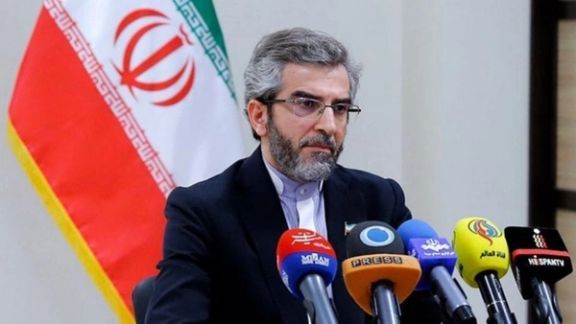
Iran's Chief nuclear negotiator, Ali Bagheri-Kani. FILE PHOTO
With Iran’s nuclear issue “resolved by the 2015 agreement” only lifting US sanctions needs to be agreed when talks resume in Vienna, Iran’s top negotiator says.
“We do not have nuclear talks, because the nuclear issue was resolved in 2015 in the form of an agreement reached between Iran and the P5+1,” Ali Bagheri-Kani, negotiator and a deputy foreign minister, told Iranian state television in an interview from Paris.
The statement is another sign of Iran’s hardening posture. On Monday Iran’s foreign ministry insisted that the US must meet three conditions for the talks to proceed and success. Spokesman Saeed Khatibzadeh told reporters that the US should lift the sanctions “at once”, admit culpability and provide guarantees that it will not withdraw from the agreement again. If these are real negotiating demands and not public posturing, the future of the talk look bleak, commentators in Iranand abroad said.
The Vienna talks aim at reviving the 2015 JCPOA (Joint Comprehensive Plan of Action), which limited the Iranian nuclear program and was signed by Iran with the five permanent members of the United Nations Security Council (China, France, Russia, the United Kingdom and the United States).
The Iranian lead negotiator's reaction was made one day after French Foreign Minister Jean-Yves Le Drian said the talks with Iran must resume where they left off on 20 June by Iran after six rounds of talks with the administration of former President Hassan Rouhani.
Problems had risen, Bagheri-Kani explained, when the US left the JCPOA in 2018 and imposed ‘maximum pressure’ sanctions, which sent the Iranian economy into recession.
"The main issue we are facing now is the consequences of the US withdrawal from the JCPOA, which are limited to the illegal sanctions imposed against the Islamic Republic of Iran,” Bagheri-Kani said.
Bagheri-Kani spoke Tuesday evening after a meeting with Philippe Errera, the French foreign ministry political director and lead negotiator. Bagheri-Kani is on a tour of European capitals, which began in Moscow. His remarks came a day after French Foreign Minister Jean-Yves Le Drian said the Vienna talks, in which Washington participates indirectly, should resume where they left off on June 20.
Bagheri-Kani described his talk with Errera as “detailed, frank, serious, constructive and forward-looking,” and noted there was a "very good opportunity” to improve relations with France as it prepares for a six-month stint as president of the European Union's Council beginning in January.
In a tweet Tuesday, Mikhail Ulyanov, Russia's envoy to the International Atomic Energy Agency (IAEA), said the upcoming Vienna talks would be "a remarkable event after a long (almost 5,5 months) break." Ulyanov said the talks "must be a successful exercise” as there was “no acceptable alternative” to the JCPOA.
China said Monday that the US should rectify its actions in unliterally leaving the JCPOA and so lay the basis for Iran to again accept the JCPOA limits in its nuclear program, which it began exceeding in 2019 in response to US sanction. The official Xinhua news agency cited a Saturday phone call between Foreign Minister Wang Yi and his Iranian counterpart Hossein Amir-Abdollahian.
In Iran, officials have been playing down the importance of restoring the JCPOA. "The JCPOA isn't a priority for our country, and we will not waste all our capacities waiting for the outcome of the [Vienna] talks," said Fada-Hossein Maleki, a member of the parliamentary National Security and Foreign Policy Committee, Wednesday.
Maleki said that Iran needed guarantees that all parties would abide by the agreement in future: "The talks must bear practical and tangible results for us. The Islamic Republic will no longer put all its eggs in the JCPOA basket as it was done during the Rouhani administration [which left office in August]…We will not allow the talks to become attritional.”
Iran's uranium enrichment facility at Natanz. FILE PHOTO
The Iranian Reformist Front's call for an immediate return to the nuclear deal to solve Iran's economic problems has faced tough reactions from conservatives.
The Reformist Front, an umbrella organization that coordinates ploicies among a range of reformist political parties and organizations warned in a statement released on November 7 that "Any delay in returning to the JCPOA will be damaging for the nation's interests."
The statement added that "While expressing serious concern about the way Iran's foreign policy and its nuclear diplomacy is being furthered, we hope that the government would prevent missing the opportunity to end sanctions against Iran and to prevent Iran from lagging behind the quick pace of development in Asia and Iran's neighboring countries."
The statement was issued after Iran's chief nuclear negotiator Ali Bagheri-Kani said that talks with the JCPOA partners are going to be resumed by November 29, but the foreign ministry spokesman on Monday issued three conditions the US must meet, including lifting all sanctions in one step and providing a guarantee that future US governments will not withdraw from the deal.
The Reformist Front's statement charged that 15 years ago, Iran's nuclear case was sent to the UN Security Council while Iranian officials chanted revolutionary slogans rather than negotiating with the world. The statement added that the reformists expected the new government and Iran's new political structure, consolidated under conservatives, to pave the way for lifting the sanctions and solving back-breaking economic problems, but unfortunately, one cannot see such an approach being taken.
The reformists further blamed Iranian "radicals" for playing into the hands of the enemies that do not want the sanctions against Iran to be lifted.
Fars further charged that Iran's reformists supported a foreign minister for 8 years who has confessed that he did not know that the word "suspension" was used in the JCPOA rather than "lifting", for sanctions. The website also charged that it was President Hassan Rouhani who accepted the voluntary implementation of the Non-Proliferation Treaty (NPT) and the Additional Protocol fearing that the United States was about to start a war against Iran. "That was a miscalculation by Iran's reformists," said Fars.
Meanwhile, hardline daily newspaper Kayhan, which is funded by Supreme Leader Ali Khamenei's office, attacked reformists in a fron-tpage article on November 9 and claimed that the reformists suggest the United States can return to the JCPOA without lifting the sanctions it has imposed on Iran.
Kayhan accused the reformists of distorting the reality and serving the interests of those who have imposed sanctions on Iran. The daily called the JCPOA "nothing but sheer damage."
The daily also accused Iran's reformists of beatifying the United States' hostile acts against Iran and trying to conceal their own footprints in the series of actions that have led to the current situation. Kayhan reminded that reformists told Iranians immediately after signing the JCPOA that sanctions are now part of history. But sanctions were redoubled while the reformists were still in power in Iran. Kayhan also claimed that decisions made by reformists led to the shutting down of Iran's nuclear industry and pouring concrete in the heart of the nuclear reactor in Arak.
"The reformists are to be blamed if the JCPOA has no achievement. But they keep accusing their critics," Kayhan wrote, adding that the reformists criticize lack of development in Iran as a result of attaching priority to the country's military power, but they forget that they have been in power holding key government positions during the past 43 years, including holding the executive body during the past 8 years.
Kayhan expectedly, did not mention that nuclear sanctions have impeded Iran’s economic development and major policies are decided by Khamenei.
Kayhan wrote that the same reformists who are now saying demanding guarantees from the US is impractical, used to say in 2015 when the JCPOA was signed that "The US Secretary of State's signature guarantees that the agreement will work."
Ali Bagheri-Kani, Iran's chief nuclear negotiator. FILE PHOTO
Ali Bagheri-Kani, Iran's leading nuclear envoy, confirmed Monday he will be meeting European diplomats in preparation for resumed talks in Vienna November 29.
"Exchanges on bilateral & regional issues AWA future talks are on the agenda," Bagheri-Kani tweeted. “We shall spare no effort in advancing our national interests incl removal of illegal sanctions.”
France's foreign minister told his Iranian counterpart on Tuesday that when talks with world powers on reviving the JCPOA resume at the end of November, they must continue where they left off in June.
The comments suggest growing concern over Iran's public rhetoric before indirect talks between Iran and the United States resume in Vienna on Nov. 29.
Foreign journalists including the diplomatic editor of Britain's Guardian newspaper had reported earlier that Bagheri-Kani would meet with French, British, and German diplomats, including Philippe Errera, the French foreign ministry political director and lead negotiator, Tuesday and Liz Truss, the United Kingdom’s foreign minister, Thursday.
Saeed Khatibzadeh, Iran’s foreign ministry spokesman, told his weekly press conference Monday that Bagheri-Kani would visit Paris, Berlin, London, and possibly Madrid.
Tehran had already expressed intention to liaise with remaining parties to the 2015 nuclear agreement, Joint Comprehensive Plan of Action (JCPOA) – China, France, Germany, Russia and the United Kingdom – before resuming Vienna talks aimed at reviving the JCPOA, which former United States president Donald Trump unilaterally left in 2018, imposing draconian sanctions on Iran.
Bagheri-Kani began is diplomatic tour in Moscow October 29, meeting with the Russian Deputy Foreign Minister Sergei Ryabkov. Soon afterwards, Bagheri-Kani confirmed the date, November 29, for restarting talks in Vienna.
The administration of President Joe Biden, which has continued Trump’s ‘maximum pressure’ sanctions on Iran, has meanwhile continued to stress its coordination with Europe, the Sunni-led Arab states, and Israel.
Secretary of State Antony Blinken said Monday during a visit to Egypt that the US had serious concerns regarding Iran's “destabilizing influence in the region,” a reference to Israeli and Saudi unease over Iran’s alliances.
Blinken, however, linked this to Biden’s stated commitment to return to the JCPOA, which Israel and Saudi Arabia have opposed. "An Iran with a nuclear weapon would be an even more destabilizing force in the region and beyond,” Blinken said, “which is why President Biden met recently in Rome with his German, French, and British counterparts to discuss how we can work together to get Iran back into compliance with the JCPOA...”
Many US Republicans oppose a US return to the JCPOA and lifting ‘maximum pressure’ sanctions. Congresswomen Claudia Tenney has demanded that Biden “clarify” whether Iran played any role in a recent assassination attempt on Iraqi Prime Minister Mustafa Al-Kadhimi. "We shouldn’t be negotiating with a regime that’s actively working to assassinate foreign leaders," Tenney tweeted Monday.
Iran in June interrupted the Vienna talks that had started in April with the indirect participation of the United States.
With US ‘maximum pressure’ sanctions continuing, Iran has accelerated its nuclear program, which began to exceed JCPOA limits in 2019, the year after Trump imposed the sanctions. Iran has also trimmed back monitoring by the International Atomic Energy Agency (IAEA) to that required under the Nuclear Non-Proliferation Treaty.
Having survived the US sanctions, many in Iran argue its position has strengthened. Javan newspaper, which is affiliated to the Revolutionary Guards, recentlysaid Iran would be returning to talks with a “full briefcase”, as it had accumulated 210kg of uranium enriched to 20 percent and 25kg enriched to 60 percent. Under the JCPOA Iran enriched to only 3.67 percent.
Ali Bagheri-Kani, Iran's chief nuclear negotiator. FILE PHOTO
France's foreign minister told his Iranian counterpart on Tuesday that when talks with world powers on reviving the JCPOA resume at the end of November, they must continue where they left off in June.
The comments suggest growing concern over Iran's public rhetoric before indirect talks between Iran and the United States resume in Vienna on Nov. 29.
On Monday, Tehran repeated demands that the United States lift all the sanctions it has imposed since then-president Donald Trump abandoned a 2015 deal between Iran and major powers, and guarantee that it would not quit the deal again.
In a call with Iranian Foreign Minister Hossein Amirabdollahian, France's Jean-Yves Le Drian "stressed the importance and the urgency of resuming the negotiations interrupted on June 20 by Iran, on the basis negotiated up to that date, with the objective of a rapid return (to the accord)", a ministry spokesperson said.
Since Trump withdrew from the accord in 2018, Iran has responded to the imposition of US sanctions by breaching the prescribed limits on uranium enrichment, which can be used to make the fuel for nuclear weapons. Iran says its program is entirely peaceful.
Iran's top nuclear negotiator, Ali Bagheri Kani, was in Paris on Tuesday as part of a tour to the capitals of France, Britain and Germany, the three European parties to the pact.
Former Iranian foreign minister Zarif and US Secretary of State Kerry in 2014
A well-known commentator in Iran says that Tehran’s demand for a US guarantee that it will stay in the 2015 nuclear deal beyond the Biden era is not realistic.
Reformist journalist, activist and former political prisoner Ahmad Zeidabadiin a sharp article published in Etemad newspaper has reacted to remarks by the spokesman of Iran’s foreign ministry on Monday that one of the three conditions for the United States to return to the nuclear agreement is a guarantee that no future US president will withdraw from the deal.
Iran has been making this demand for a while, but the Biden Administration’s position is that it cannot make decisions for a future president.
Zeidabadi askes Iran’s leaders if they really want the United States to provide such a guarantee. That would mean changing the Joint Comprehensive Plan of Action (JCPOA) into a treaty, which would need approval by the US Senate, where many lawmakers would demand guarantees from Iran on other issues.
This would make the nuclear agreement, a treaty about US-Iran relations in fact, Zeidabadi wrote and expressed doubt if this is what Tehran really wants.
Ahmad Zeidabadi, Iran commentator and former political prisoner.
Not only almost every Republican Senator but a sufficient number of Democrats think the Islamic Republic is a threat to the United States, its neighbors and Israel and they would not approve a treaty unless Iran permanently dismantles its nuclear program in its current form and dramatically changes it foreign policy.
“Is Iran ready to take the needed steps to attract the minimum number of votes in the US Congress?” asks Zeidabadi. President Joe Biden cannot provide a solid guarantee that a future US president will stay in the JCPOA. The most he can deliver “is a verbal” pledge.
The issue of resolving the four-decade old tensions between the Islamic Republic and Iran has always simmered in the background. US presidents have made overtures to Tehran to enter talks to reduce tensions and normalize ties. But Iran’s Supreme Leader Ali Khamenei and his hardcore supporters, especially among the Revolutionary Guards have opposed direct talks and improvement of relations. Khamenei only agreed to nuclear negotiations in 2013 after UN nuclear sanctions brought the economy to the brink of crisis.
Zeidabadi further argued that agreements between states last as long as both sides see their interests served. This is the strongest motivation for keeping commitments.
“If the Islamic Republic wants guarantees for the survival of JCPOA after the Biden presidency, it should try to discover shared interests with America and pursue them both within and outside the JCPOA. Such an approach not only would strengthen the nuclear agreement, but it would also make it impossible for a future US president to abandon it,” Zeidabadi wrote.
Quoting British statesman Palmerston, that his country never has permanent friends or enemies but just permanent interests, Zeidabadi argued that if shared interests are not the foundation of agreements, they are not worth the paper there are written on. If deals are made just to put fires out, they will soon break down, he said.
Saeed Khatibzadeh, spokesman of Iran's foreign ministry. FILE PHOTO
Iran reiterated its demands Monday that the United States should lift all sanction at once and guarantee that it will never leave the nuclear agreement again.
Foreign ministry spokesman Saeed Khatibzadeh in his weekly briefing on Monday, said that US officials commenting on Iran’s actions or words should know that the US is not a member of the Joint Comprehensive Plan of Action (JCPOA).
He was responding to the latest statement by US National Security Advisor Jake Sullivan who told the CNN on Sunday that Iran has not shown a willingness to return to the nuclear agreement.
“The United States should know that it is not a member of the JCPOA and cannot…have demands from JCPOA members. It should first prove its brotherhood,” he said. “We are glad that Americans constantly repeat their intention and will. Perhaps they want to remove all the illegal and extra-territorial sanctions that were imposed by the former US government. But what is important is action,” Khatibzadeh retorted.
Iran accepted indirect negotiations with the US in Vienna within the overall framework of the JCPOA. The talks lasted from April to June, when Iran suspended its participation after the election of its hardline president Ebrahim Raisi (Raeesi). Iran delayed the resumption of the talks for almost five months and only last week agreed to resume negotiations at the end of November.
Khatibzadeh revealed Iran’s new and tougher negotiating posture by claiming that in the first six round of talks “no agreement was reached”, therefore there was never an understanding about a “step-by- step” return to the JCPOA. This argument seems aimed at boosting Iran's demand for a one-step removal of US sanctions.
What Iran has seen from the Biden Administration’s actions has contradicted their declared intentions, Khatibazadeh said and added, “The path for the United States to return to JCPOA is clear. As the party guilty of the current situation, it should retrace its steps from the path it has followed.”
The official news agency IRNA, mentioned the US acceptance of guilt and responsibility as the third condition for its return to the JCPOA.
The foreign ministry spokesman then insisted that sanctions imposed after former president Donald Trump withdrew from the JCPOA in 2018 should be lifted at once, in one step and “what is more important it should provide a guarantee that no future US government” will repeat what was dome in 2018.
Khatibzadeh also announced that Iran's chief nuclear negotiator, Ali Bagheri-Kani will travel to Europe at the end of the week to hold talks with members of the JCPOA.
Iran’s posture seems to have hardened recently, demanding that the US should first lift all the sanctions imposed since 2018 before Iran would be willing to negotiate with it. While until June the two sides were discussing a gradual restoration of the JCPOA, Tehran is now signaling “a simple solution”, calling on Washington to just lift all sanctions and provide a guarantee that no future US government would leave the agreement. The Biden Administration cannot provide such a guarantee if JCPOA is not a treaty, approved by the US Senate.
Washington has said its return to the 2015 nuclear deal should be negotiated alongside agreement as to how Iran reduces its nuclear program, which it has expanded and refined since 2019. But Iran seems to be more determined now to get concessions from Washington before a final agreement is reached.
Foreign Minister Hossein Amir-Abdollahian has directly demanded that the Biden Administration should unfreeze $10 billion of Iran’s blocked funds as a “goodwill gesture”.
Tehran is also trying to isolate the United States arguing that it cannot make demands because it is not a member of the JCPOA any longer. It appears that Tehran wants to negotiate with the three European members of the agreement – the United Kingdom, France and Germany - hoping to extract concessions as a means of pressure on Washington.