• العربية
  • فارسی
Brand
  • Iran Insight
  • Politics
  • Economy
  • Analysis
  • Special Report
  • Opinion
  • Podcast
  • Iran Insight
  • Politics
  • Economy
  • Analysis
  • Special Report
  • Opinion
  • Podcast
  • Theme
  • Language
    • العربية
    • فارسی
  • Iran Insight
  • Politics
  • Economy
  • Analysis
  • Special Report
  • Opinion
  • Podcast
All rights reserved for Volant Media UK Limited
volant media logo

Opinion - The Iranian People Are Not The Iranian Regime
Nov 7, 2021, 16:42 GMT+0Updated: 10:30 GMT+0
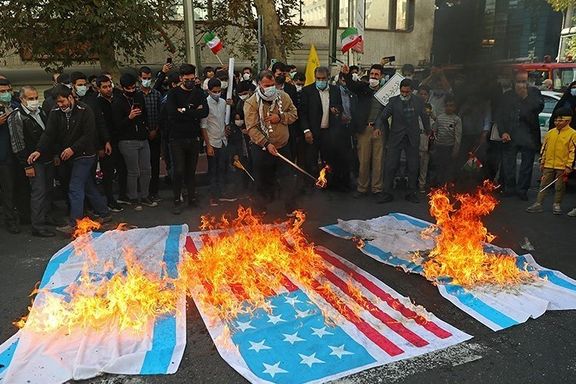
Government supporters in Iran burning American and Israeli flags, November 4, 2021

Opinion by Bryan E Leib and Dr. Daniel Jafari - "We, the American people...must always draw a line in the sand separating the Iranian people from the Iranian Regime."

-------------------------------------------------------------------------------------------------------

On Thursday, November 4th, thousands of Iranians with ties to the Iranian Regime gathered on streets of Tehran for the anniversary of the 1979 seizure of the US Embassy, chanting “Death to America” and “Death to Israel,” and burning American and Israeli flags. The US Embassy takeover triggered a 444-day hostage crisis and break in diplomatic relations that continues to this day.

Ever since the Iranian Regime took power in 1979, they have been on a mission to spread their version of Islam around the world to serve their anti-Western agenda, while also radically changing the lifestyle of the Iranian people.

The Regime has tried to achieve this through their terrorist and militant proxies such as Hamas and Palestinian Jihad in Israel, Hezbollah in Lebanon and the Houthis in Yemen. The Regime spends billions of dollars every year financing these terrorist groups with cold hard cash, missiles, weapons and training.

In addition to the funding of terrorism around the world, which by the way, the Iranian people have been protesting for years - the Regime will do whatever is needed to deny the Iranian people the benefits of basic political and social freedoms, equality and tolerance.

University students in Tehran refusing to walk on the American and Israeli flags. January 2020
100%
University students in Tehran refusing to walk on the American and Israeli flags. January 2020

While many in the Iranian Regime and the 1% of Iran enjoy luxuries like unfettered access to the internet, access to social media, business and educational opportunities and much more - the vast majority of the Iranian people are suffering because of the corruption and misrule of the Islamic Republic, and have been for decades.

This Regime has proven time and time again that they will do whatever is necessary to maintain their grip on power. Some examples of this are:

Arresting and executing high profile citizens like Navid Afkari on trumped up charges;

Allowing honor killings that permits close relatives to execute their own family members for being gay or lesbian, or for extramarital relationships;

Turning off the internet inside Iran when the Iranian people take to the streets to protest, to ensure that the outside world can’t see what’s happening;

And when turning off the internet doesn't work, Supreme Leader Ali Khamenei gives the order to use lethal force.

Once such example was in November 2019.

The Iranian people started taking to the streets to protest against the Islamic Republic. First, the Regime turned off the internet so the people couldn't broadcast their message to the world. When that didn't work, Khamenani issued a directive to the IRGC to use lethal force on his citizens.

When the dust settled, Reuters reported that over 1,500 innocent Iranians were murdered on streets all throughout Iran.

Which brings me to the topic of this piece. We, the American people and our representatives in the Federal Government must always draw a line in the sand separating the Iranian people from the Iranian Regime.

In my (Bryan) latest op-ed in the Wall Street Journal, I discussed how the Iranian people and Iranian diaspora around the world support the Abraham Accords and they want peace with Israel and their Arab neighbors. The Iranian Regime has coordinated a smear campaign against the Abraham Accords with all Regime officials and their allies in America pouring cold water on the historic agreements at every opportunity.

The Iranian people love America, our values and our culture. The Iranian Regime has been chanting “Death to America”, burning American flags and sanctioning terrorist attacks against American forces and our allies for decades.

From our perspective, it’s very clear that most Iranians love America. We will never stop standing with the Iranian people in their fight for freedom and we hope you will stand with the Iranian people as well because they need our support now more than ever before. Stand for liberty!

Bryan E. Leib is the Executive Director of Iranian Americans for Liberty and he is a former GOP Congressional Candidate and Dr. Daniel Jafari is the President of Iranian Americans for Liberty

Opinions expressed by the authors do not necessarily reflect the views of Iran International

Most Viewed

100 days after carnage: Iran economy reels from war, inflation, unemployment
1
INSIGHT

100 days after carnage: Iran economy reels from war, inflation, unemployment

2
INSIGHT

Ghalibaf defends Iran-US talks amid hardline backlash

3
INSIGHT

A nation in limbo: 100 days after the massacre, has the world moved on?

4
ANALYSIS

From instability to influence: Pakistan’s pivotal role in US-Iran diplomacy

5
ANALYSIS

100 days on: why Iran’s January protests spread across social classes

Banner
Banner

Spotlight

  • War-hit homeowners feel abandoned as Iran’s reconstruction aid fades

    War-hit homeowners feel abandoned as Iran’s reconstruction aid fades

  • 100 days on: the anatomy of Iran’s January crackdown
    INSIGHT

    100 days on: the anatomy of Iran’s January crackdown

  • Ghalibaf defends Iran-US talks amid hardline backlash
    INSIGHT

    Ghalibaf defends Iran-US talks amid hardline backlash

  • 100 days on: why Iran’s January protests spread across social classes
    ANALYSIS

    100 days on: why Iran’s January protests spread across social classes

  • From instability to influence: Pakistan’s pivotal role in US-Iran diplomacy
    ANALYSIS

    From instability to influence: Pakistan’s pivotal role in US-Iran diplomacy

  • A nation in limbo: 100 days after the massacre, has the world moved on?
    INSIGHT

    A nation in limbo: 100 days after the massacre, has the world moved on?

•
•
•

More Stories

Former Supporter Says Khamenei 'Massacring' Defenseless Iranians

Nov 7, 2021, 15:25 GMT+0

A former supporter of the Islamic Republic in a statement has accused Iran’s Supreme Leader Ali Khamenei of continuously “massacring defenseless Iranians”.

Abolfazl Ghadiani (Qadiani), who has been indicted and imprisoned in the past for criticizing Khamenei and the political system in Iran issued a statement for the second anniversary of nationwide protests in which hundreds were killed by security forces in November 2019.

Ghadiani said that the bloody response to those protests added a new page to the “dark and long record of killings” by Iran’s rulers. He added that the majority of people want to get rid of the president and put an end to “Supreme Leader’s monarchy”.

Ghadiani belonged to a leftist, revolutionary group that was supporting Khamenei until the disputed presidential election of 2009, when the Supreme Leader backed the questionable reelection of Mahmoud Ahmadinejad. Ghadiani with many others protested the results became an opposition figure.

Since 2018, Ghadiani has issued several statements calling Khamenei a despot and demanding his resignation. In June, he signed a statement with 100 other activists calling for a boycott of the presidential election, in which all important rivals to Ebrahim Raisi were barred from running.

Iran Tries To Distance Itself From Assassination Attempt On Iraq's President

Nov 7, 2021, 13:41 GMT+0
•
Iran International Newsroom

Iranian official reactions to the drone attack on the residence of Iraq’s prime minister were meant to deflect any blame and pointing fingers at unknown forces.

Social media users in Iran generally described government reactions to the incident as a way of distancing the Islamic Republic from the attempt.

Al-Kadhimi escaped the attempt and subsequently praised "the steadfastness and determination of Iraq's heroic security forces,” adding that he was "fine and among my people."

While usually the Foreign Ministry is the first to react to such incidents, the spokesman for the ministry was not that quick on Sunday and his reaction came hours past mid-day in Tehran. Saeed Khatibzadeh categorically condemned the attack and repeated Iran's formulaic statement about "Tehran's support for continued peace and stability in Iraq."

Iran's national security chief Ali Shamkhani who was quick to respond to the news, in an early morning tweet accused "foreign think tanks" of being behind the attack. Shamkhani condemned the attack, calling it "a new sedition".

Most of more than 140 Twitter users who commented on Shamkhani's tweet said, in one way or another, that the tweet was an effort to distance Iran from the attempt while many in Iran and Iraq saw the Islamic Republic's hand somewhere in the story.

Iraqi PM Mustafa Al-Kadhimi meets with Iraq's President Barham Salih after a drone attack on PM's residence in Baghdad, Iraq, November 7, 2021
100%
Iraqi PM Mustafa Al-Kadhimi meets with Iraq's President Barham Salih after a drone attack on PM's residence in Baghdad, Iraq, November 7, 2021

Iranian dissident scholar in France Mohammad Javad Akbarin, for instance, charged: "You wrote this tweet because you probably know that everyone knows who was behind the attack.” Akbarin also mentioned some characteristic indications in the tweet that pointed fingers at Tehran.

Iranian blogger Hamid Moeeni wrote: "When you define your strategic depth based on religion and have a special IRGC unit for it with a lot of mercenaries and take pride in your pictures being on billboards in another country, then you have to wait for such allegations. At least think of the probability of your own think tanks also being infiltrated by foreign think tanks!"

Meanwhile, Noor News, a website close to Shamkhani and Iran's Supreme Council of National Security characterized the assassination attempt as "suspicious," and an attempt to overshadow the work of the fact-finding committee that is looking into a clash between security forces and pro-Iran demonstrators on Friday.

Iran's proxy groups in Iraq who rejected the outcome of the latest parliamentary elections had threatened to take revenge. Abu Ali Al-Askari one of the figureheads of pro-Iran Kataib Hizballah said following the assassination attempt that Al-Kadhimi was pretending to be a victim in a bid to win more popularity.

Muqtada Al-Sadr, whose group won the elections called for security forces to take full control of Iraq – a thinly-veiled jab at pro-Iran militias. He reiterated his call for ending foreign influence in Iraq, also a reference to Iran. Another Iraqi figurehead Ammar Hakim also condemned the attack. Most current and former Iraqi officials including President Barham Salih and Al-Nasr Coalition Leader Hayder al-Ibadi also denounced the assassination attempt.

Noor News said that "the quick reaction of some pro-Western groups following the attack makes the event look even more suspicious," but did not explain why and did not name those groups.

In Iran, IRGC-linked news agencies Fars and Tasnim carried factual reports of the Sunday morning attack and summed up the reactions in Iran without mentioning the backdrop of hostilities of which Iran and the IRGC are known to be a part of.

The administration-owned news agency ISNA reported that Foreign Minister Hossein Amir-Abdollahian has called his Iraqi counterpart Fuad Hussain to ask about the prime minister's good health. ISNA quoted Amir-Abdollahian as saying that the attack was carried out by "sinister elements."

Official news agency IRNA featured an extensive report about the drone attack on Al-Kadhimi's residence asking whether the United States was behind the attack, but stopped short of explaining why the US would want to harm a leader who has good relations with Washington. IRNA attributed the conspiracy question to un-named Iraqi groups.

Meanwhile, it quoted a controversial Iraqi commentator as charging that US forces did not activate the anti-aircraft system over Baghdad’s green zone to stop the attack. Generally, IRNA blamed many groups and regional media outlets for being behind the attack, without mentioning pro-Iran groups. Instead, the agency quoted several pro-Iran militia leaders pointing fingers at foreign countries and media outlets.

Iran's Currency Loses Value Despite Nuclear Talks Scheduled To Resume

Nov 7, 2021, 11:41 GMT+0

The value of Iran’s currency, rial, has dropped this week despite an announcement setting the date for the resumption of nuclear talks with world powers.

The rial on Sunday was trading close to 280,000 against the US dollar. There were hopes among Iranians that the national currency can rebound once positive news emerges regarding talks to revive the 2015 nuclear agreement, JCPOA. If the nuclear talks succeed, US oil and banking sanctions will be lifted, giving Iran a financial lifeline.

Earlier in the week the rial was slightly stronger at 260,000 to the dollar.

But despite these hopes, the rial has actually dropped further since the announcement to restart the JCPOA Vienna negotiation in the end of this month. The market reaction in Iran can show a lack of optimism about the outcome of the multilateral talks.

The Iranian rial has lost value ninefold against major currencies since the former US president Donald Trump indicated that he would withdraw from the nuclear deal and impose sanctions. Once he implemented his threat, rial’s fall accelerated in 2018.

Oil exports provide at least half the revenue the Iranian government needs to operate. In the absence of sufficient oil exports, the Central Bank of Iran has been printing money, with liquidity rising rapidly since 2017 and fueling inflation.

Iraq's Kadhimi Holds National Security Meeting After He Escapes Drone Attack

Nov 7, 2021, 11:03 GMT+0

Iraqi Prime Minister Mustafa al-Kadhimi who escaped unharmed in an assassination attempt by armed drones in Baghdad on Sunday, held a security council meeting.

The incident dramatically raises tension in the country weeks after a general election disputed by Iran-backed militia groups.

Kadhimi appeared in a video footage published by his office on Sunday chairing a meeting with top security commanders to discuss the drone attack.

"The cowardly terrorist attack that targeted the home of the prime minister last night with the aim of assassinating him, is a serious targeting of the Iraqi state by criminal armed groups," the premier’s office said in a statement issued following the meeting.

Six members of Kadhimi's personal protection force stationed outside his residence in the Green Zone were wounded, security sources told Reuters.

Three drones were used in the attack, including two that were intercepted and downed by security forces while a third drone hit the residence, state news agency INA quoted an interior ministry spokesman as saying.

A spokesman for the armed forces commander in chief said the security situation was stable inside the fortified Green Zone - which houses the residence, government buildings and foreign embassies - following the attack.

Iranian Army Launches Drills In Sea Of Oman Region As Tensions Rise

Nov 7, 2021, 10:46 GMT+0
•
Iran International Newsroom

The traditional Iranian Army (Artesh) has begun exercises in the Sea of Oman area deploying ground, air and navy units, state-controlled media reported Sunday.

Iranian armed forces are divided into the traditional army and the Islamic Revolution Guard Corps (IRGC), each with many parallel units, such as armor, artillery and navies.

The army’s drills cover an area of one million sq kilometers or 386,000 sq miles, well over half the territory of Iran. Navy vessels and submarines, as well as air force planes and drones are taking part.

Tasnim news agency reported that American-made F4 Phantom interceptors and fighter bombers fired “air-to-ship optimized missiles”. Some Phantoms acquired in the early 1970s during the monarchy are still in operation.

Iran does not have a fully equipped modern air force due to decades of sanctions but it maintains some American and Russian-made warplanes. It relies heavily on a ballistic missile force to intimidate regional adversaries.

The exercises come after Israeli officials have recently said their armed forces are preparing for a possible war with Iran, given the fast progress its nuclear program is making. Israel has repeatedly vowed it will never allow Iran to acquire nuclear weapons.

An Israeli official told Iran International on October 25 that attacking Iran was now the Israeli air force’s top priority.

Iranian state television said that the aim of the drills is “to boost preparedness for confronting foreign threats and any kind of invasion.”

Iran has been enriching uranium to 60 percent and has accumulated 25 kilograms of the highly purified fissile material, which has no civilian use.

Tensions are high in the region as nuclear talks between Iran and world powers are set to restart on November 29. The United States has warned that if Iran does not come to an agreement to limit its nuclear program, “other options” exist.